


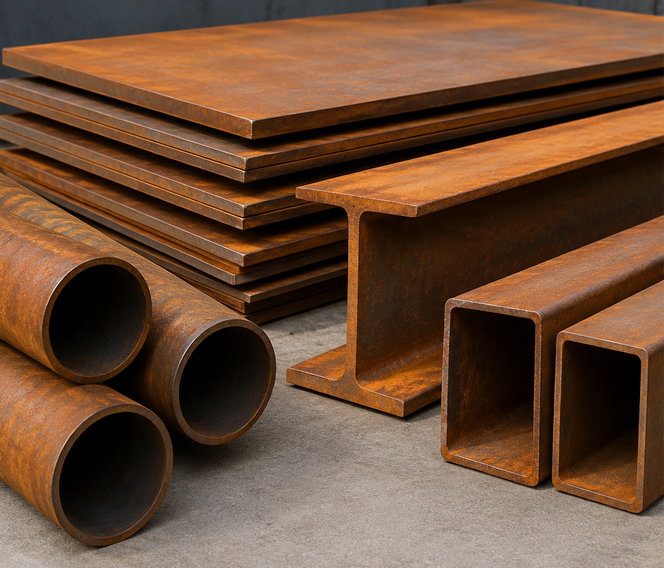
Corten Steel
Corten steel is a high-strength low-alloy structural steel that contains small additions of copper, chromium, nickel, and phosphorus. These elements let the surface form a tight, rust-colored oxide layer called a patina, which slows further corrosion and removes the need for paint in most outdoor settings. Engineers specify it for bridges, building envelopes, towers, and exposed plant structures. Procurement teams buy it as plate, sheet, coil, pipe, tube, and structural sections under ASTM, EN, JIS, and IS standards.
Products made from Corten Steel
Mills roll Corten steel products in flat, tubular, and structural forms, and fabricators cut and weld them into finished parts.
- Plates form bridge girders, building frames, and storage vessels.
- Hot-rolled and cold-rolled sheets, coils, and strips feed cladding panels, screens, and formed components.
- Pipes and tubes, including cold-formed, welded, and seamless structural tubing to ASTM A847, serve columns, frames, and architectural supports.
- Angles, channels, and beams make up transmission towers, bridge members, and platform steelwork.
- Bars and flats produce brackets, base plates, and fabricated connections.
- Structural bolts to ASTM A325 Type 3, with matching nuts and washers, join members without creating a corrosion mismatch.
Corten Steel Grades
The Corten steel grades fall under ASTM, EN, and JIS standards, each with a defined strength level and product form.
- COR-TEN A: ASTM A242 Type 1
- COR-TEN B: ASTM A588 Grade A, Grade B, Grade C, Grade K
- Sheet and strip: ASTM A606 Type 4 (hot rolled and cold rolled)
- Structural tubing: ASTM A847
- Bridge steel: ASTM A709 Grade 50W
- EN 10025-5: S235J0W, S235J2W, S355J0WP, S355J2WP, S355J0W, S355J2W, S355K2W
- JIS G3114: SMA400AW, SMA400BW, SMA400CW, SMA400AP, SMA400BP, SMA400CP, SMA490AW, SMA490BW, SMA490CW, SMA490AP, SMA490BP, SMA490CP, SMA570W, SMA570P
Corten Steel Equivalent Grades and Standards
The table below maps the two COR-TEN grades to their closest ASTM, EN 10025-5, and JIS G3114 counterparts for cross-referencing.
|
Grade |
ASTM |
EN 10025-5 |
JIS G3114 |
|
COR-TEN A |
A242 Type 1 |
S355J0WP |
SMA400AP |
|
COR-TEN B |
A588 Grade A |
S355J2W |
SMA490BW |
These pairings are approximate. Chemistry limits, thickness ranges, and impact test requirements differ between standards, so buyers should confirm the exact designation against the mill test certificate before substituting one grade for another.
Corten Steel Specifications
The table below lists governing standards, product forms, and delivery conditions to cite when specifying these steels on a purchase order.
|
Parameter |
Details |
|
Commercial grades |
COR-TEN A, COR-TEN B |
|
ASTM standards |
A242, A588, A606 Type 4, A709 Grade 50W, A847 |
|
Product forms |
Plates, sheets, coils, strips, pipes, tubes, angles, channels, beams, bars |
|
Delivery condition |
Hot rolled, cold rolled, normalized (as ordered) |
|
Surface finish |
Mill finish, pickled, pre-weathered |
Properties of Corten Steel
This alloy combines structural strength with a chemistry that builds its own protective surface layer. The sections below cover corrosion behavior, mechanical values, chemical composition, welding, density, and service limits.
- Atmospheric Corrosion Resistance
- Patina Formation
- Yield and Tensile Strength
- Strength Under EN 10025-5
- Ductility and Elongation
- Weldability
- Density and Weight Calculation
- Service Limits
Applications of Corten Steel
Architects, bridge engineers, and plant designers specify Corten weathering steel where low maintenance and an exposed, unpainted finish both matter.
- ASTM A709 Grade 50W girders on road and rail bridges remove repainting cycles from the maintenance schedule.
- Facade cladding, screens, and sculptural panels use sheet in a natural or pre-weathered finish.
- Transmission towers and telecom masts use angles and structural tubing.
- Railway freight wagons, shipping containers, and bulk hoppers use plate and sheet.
- Chimneys, flues, and silos in industrial plants use plates in thicker gauges.
- Exposed pipe racks and pipe supports use structural tubing and sections.
- Planters, retaining walls, and landscape edging use cut and bent sheet.
Corten Steel Selection Guide
Match the grade, thickness, finish, and site conditions to the service requirement before placing an order, using the points below.
- Assess the exposure first, because the patina needs alternating wet and dry cycles and fails in permanently damp or buried conditions.
- Keep the structure clear of marine splash zones and heavy de-icing salt spray, or add a protective coating system.
- Choose COR-TEN A or ASTM A606 Type 4 for sheet, cladding, and thin-gauge work, and A588 or A709 Grade 50W for structural plate and bridge members.
- Align the standard with the project code, whether ASTM, EN 10025-5, JIS G3114, or IS 11587.
- Check the thickness limits, since yield strength drops as plate thickness increases under both ASTM A242 and A588.
- Decide between natural, pickled, and pre-weathered finishes, and plan drainage for rust runoff that can stain adjacent concrete or stone.
- Specify matching filler metal and ASTM A325 Type 3 fasteners so welds and joints weather at the same rate as the base steel.
- Request a mill test certificate and verify the copper and chromium content, because these elements control patina quality.