Monel alloys have been reliable in demanding industrial environments for over a century. They survive conditions that cause most metals to fail, such as heavy corrosion, elevated temperatures, and sustained mechanical stress. If you’re evaluating materials for a challenging application, Monel is worth understanding properly.
What are Monel Alloys?
Monel is a group of nickel-copper alloys known for their corrosion resistance and strength at elevated temperatures. The alloy was developed in the early 1900s and named after Ambrose Monell, then president of the International Nickel Company. It’s remained commercially relevant ever since, that is not because of marketing, but because it performs.
Nickel is the dominant element, making up well over half the composition. Copper follows as the second major component. Together, they produce an alloy that handles acidic environments, seawater, and chloride-rich conditions far better than standard stainless steels.
Composition of Monel Alloys
The core monel alloy composition is primarily nickel and copper, with nickel content typically above 63%. Small amounts of iron, manganese, carbon, and silicon are also present. Aluminium and titanium additions drive the precipitation hardening process. This strengthens the alloy significantly, though the chemistry must still align with ASTM and UNS specifications.
Properties of Monel Alloys
Monel alloy properties include strong resistance to a wide range of corrosive media, including acids, alkalis, seawater, and hydrofluoric acid environments. These properties hold steady even under thermal stress that ranges from cryogenic lows to standard high-heat operations.
Beyond corrosion resistance, Monel offers low magnetic permeability, making it suitable where magnetic interference is a concern. It welds reliably and fabricates complex forms without significant loss of properties.
Physical Properties of Monel Alloys
Monel has a higher density than aluminium or titanium, but it’s lighter than many copper-based alloys. Its thermal conductivity is moderate, and it maintains dimensional stability under thermal cycling, which matters in heat exchanger and pressure vessel service where repeated expansion and contraction occur.
The melting point sits above 1300°C, depending on the grade. That range supports reliable performance in elevated-temperature environments where lower-melting alloys would begin to soften or lose structural integrity.
Mechanical Properties of Monel Alloys
Monel alloys outperform pure nickel or copper in both tensile and yield strength. Because of this, components handle heavy mechanical loads and industrial stress over the years of service. For extreme applications, precipitation-hardened grades like Monel K-500 provide a massive strength boost to all without sacrificing the signature corrosion resistance of the alloy family. Fatigue resistance is also notable; Monel parts used in rotating or reciprocating equipment last considerably longer than equivalents made from lesser alloys.
What Are the Different Grades of Monel Alloys?
Refer to the table below for a comparison of common Monel grades and their primary industrial uses:
| Grade | Key Characteristics | Primary Applications |
| Monel 400 | Standard grade; high corrosion resistance and moderate strength. | Marine, chemical processing, oil & gas. |
| Monel 401 | Low-carbon variant; precise control over electrical resistivity. | Specialized electronic applications. |
| Monel 404 | Low magnetic permeability; magnetically neutral. | Aerospace and electronic assemblies. |
| Monel R-405 | Free-machining (added Sulphur); high-speed production. | High-volume screw machine parts, fasteners. |
| Monel K-500 | High-strength; precipitation-hardened (Al + Ti). | Pump shafts, propeller shafts, valve stems. |
Applications of Monel Alloys
- Marine Engineering: Propeller shafts and seawater piping benefit from its exceptional saltwater corrosion resistance.
- Chemical Processing: Reactors and valves use Monel to handle aggressive acids and chloride-rich media.
- Oil and Gas: Downhole tools and offshore equipment rely on Monel for sour gas protection.
- Aerospace & Electronics: Flight and electronic systems are protected from external disturbance by low magnetic fields.
- Food Processing: Resists organic acids and meets strict hygiene requirements for industrial food equipment.
Limitations of Monel Alloys
Monel is expensive. The high nickel content is the primary driver, and pricing tracks nickel market movements closely. Where a less costly alloy can meet the performance requirement, Monel shouldn’t be the default.
It’s also susceptible to stress corrosion cracking in specific conditions, such as particularly hydrofluoric acid vapour at elevated temperatures and moist chlorine gas. Proper grade selection and design controls are needed in those service environments. Machining Monel (except R-405) is a high-stakes process. The material hardens near the tip of the tool, so you need to use the right feeds and speeds to keep the tool from breaking too soon.
Conclusion
Monel alloys are a proven solution for corrosive, high-stress, and thermally demanding environments. The family covers a range of needs, from general-purpose Monel 400 to the high-strength K-500. The cost is real, and so is the performance. For the right application, Monel justifies the investment.
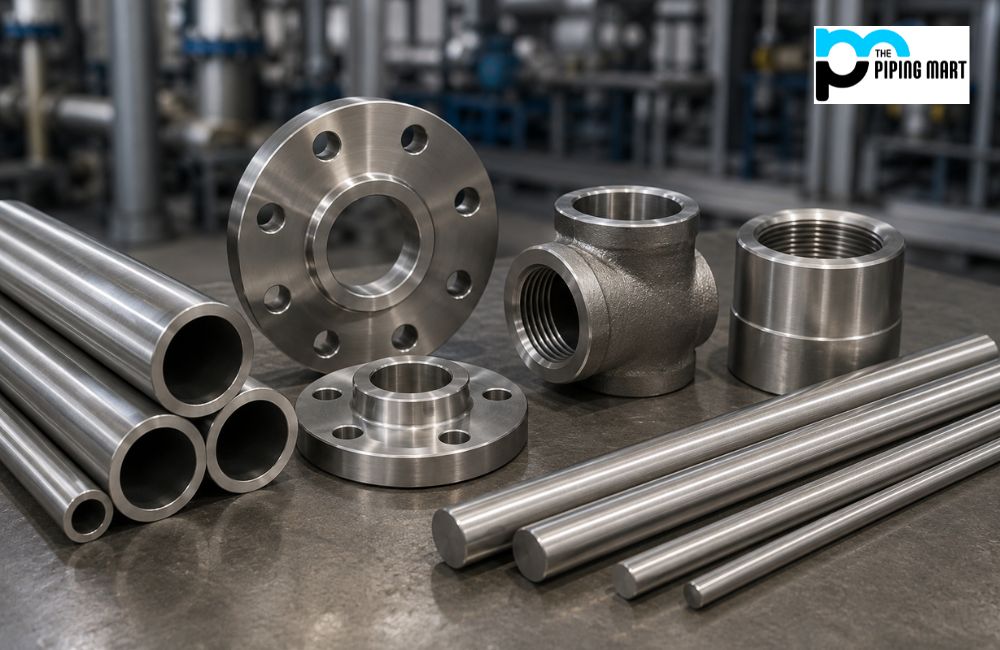
We supply Monel in multiple grades and product forms that are bar, pipe, fittings, flanges, and sheet, through The Piping Mart’s verified supplier network. Connect with our listed suppliers for specifications, availability, and current pricing.
FAQs
What is the Melting Point of Monel Alloy?
Monel alloys have the potential to melt at temperatures ranging from 1300 to 1350, depending on the purity of the aluminium. Due to the fact that they have a high melting range, they are suited for industrial applications that involve high temperatures.
Are Monel Alloys Magnetic?
Monel grades that are considered standard, such as Monel 400, are effectively non-magnetic when ordinary circumstances are present. It is possible for heavy cold work to create a small magnetic field. Monel 404 is utilised in situations where there is a requirement for complete magnetic neutrality, as it has been specifically designed to have an extremely low magnetic permeability.
Is Monel Alloy stronger than steel?
Standard Monel 400 has comparable strength to mild steel. Monel K-500 in the precipitation-hardened condition surpasses many standard steel grades in both tensile and yield strength. The real advantage over steel in most applications is the combination of strength and corrosion resistance, as steel cannot reliably offer both in aggressive environments.
Why is Monel Alloy so expensive?
Nickel is the primary cost driver. Monel’s nickel content exceeds 63%, and nickel is significantly more expensive than iron or copper. Alloying and refining add further cost. Monel K-500 costs more still, due to aluminium and titanium additions and the precipitation hardening treatment it requires.
What is the chemical composition of Monel Alloys?
Nickel (over 63%) and copper form the core alloy. Small additions of iron or silicon are common, but K-500 adds aluminium for precipitation hardening. ASTM and UNS standards set grade-specific percentages.