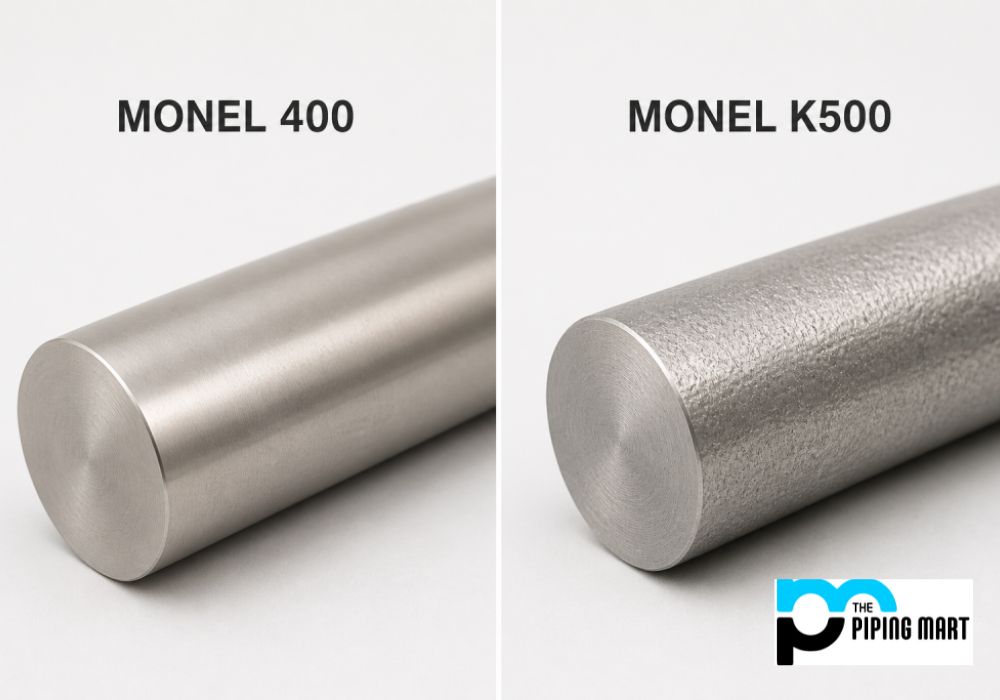
An engineer specifying materials for a marine pump shaft has to decide between two nickel-copper alloys that look similar on paper but behave quite differently under load. That is a common situation, and the Monel 400 vs K500 question comes up regularly in marine, oil and gas, and chemical processing projects. Both alloys offer strong corrosion resistance; the difference is in strength, heat treatment, and what that means for cost and fabrication. This guide covers composition, mechanical properties, cost, and where each alloy makes sense so you can make a straightforward decision based on your actual requirements.
Difference Between Monel 400 & Monel K500
Both are nickel-copper alloys, but K500 has aluminium and titanium added, which allow it to be precipitation-hardened for significantly higher strength. Monel 400 is a general-purpose grade; K500 is used when mechanical demands are higher.
Monel 400 vs Monel K500 Composition Comparison
The composition difference between these two alloys is minimal based on the element composition, but the addition of aluminium and titanium in K500 differentiates what the alloy can do mechanically.
Monel 400 Composition
Monel 400 is essentially a binary nickel-copper alloy with small amounts of iron and manganese. Nickel sits at a minimum of 63%; copper ranges from 28 to 34%; and the remaining elements, such as iron, manganese, carbon, silicon, and sulphur, are present in minor quantities. There are no additions designed to increase strength through heat treatment. The alloy is used in the annealed condition and derives its properties purely from its base composition.
| Element | Content (%) |
| Nickel | 63.0 min |
| Copper | 28.0–34.0 |
| Iron | 2.5 max |
| Manganese | 2.0 max |
| Carbon | 0.3 max |
| Silicon | 0.5 max |
Monel K500 Composition
K500 starts with a similar nickel-copper base but adds aluminium (2.30–3.15%) and titanium (0.35–0.85%). These two elements form fine precipitates within the grain structure during the ageing heat treatment, which is what drives the strength increase. Without those additions, the alloy would behave similarly to Monel 400. The nickel content is slightly higher on average, and copper is in a similar range.
| Element | Content (%) |
| Nickel | 63.0 min |
| Copper | 27.0–33.0 |
| Aluminium | 2.30–3.15 |
| Titanium | 0.35–0.85 |
| Iron | 2.0 max |
| Manganese | 1.5 max |
Monel 400 vs Monel K500: Properties Comparison
The difference between the two grades is significant, particularly in tensile and yield strength. Corrosion resistance is broadly similar; the main separation is mechanical.
Monel 400 Properties
Monel 400 in the annealed condition has a tensile strength of around 70–80 ksi and a yield strength of roughly 28–35 ksi. Elongation is good — typically 35–45% — which means it is reasonably ductile and easy to form. Hardness runs around 110–150 HB. It handles seawater, hydrofluoric acid, alkalis, and a wide range of chemicals without significant corrosion. It performs well at both sub-zero and moderately elevated temperatures.
| Property | Value |
| Tensile strength | 70–80 ksi (482–551 MPa) |
| Yield strength | 28–35 ksi (193–241 MPa) |
| Elongation | 35–45% |
| Hardness | 110–150 HB |
| Max service temp | ~480°C |
Monel K500 Properties
After age hardening, K500 reaches tensile strengths of 140 ksi and above, with yield strength around 100–115 ksi. Hardness increases to around 250–300 HB. Elongation drops to roughly 20%, which is still acceptable for most structural applications. Corrosion resistance is comparable to Monel 400; the heat treatment affects strength, not corrosion behaviour. K500 also retains better strength at elevated temperatures than 400 under load.
| Property | Value |
| Tensile strength | 140+ ksi (965+ MPa) |
| Yield strength | 100–115 ksi (690–793 MPa) |
| Elongation | ~20% |
| Hardness | 250–300 HB |
| Max service temp | ~538°C under load |
Cost Considerations Between the Two
Monel K500 typically costs 15–25% more than Monel 400, with the difference coming from two places: the additional alloying elements (aluminium and titanium) and the precipitation hardening heat treatment, which adds processing time and energy. Availability is also a factor: Monel 400 is stocked in a wider range of standard sizes by most suppliers, while K500 may need to be ordered or has a longer lead time. On the total cost of ownership, the calculation is not always straightforward. If using K500 allows a smaller cross-section for the same load, material costs may partially offset the price premium. And if the higher strength prevents in-service failure, the cost difference becomes less relevant. For low-stress applications, paying the K500 premium does not give you anything useful. For high-stress or safety-critical components, the 400 may simply not meet the load requirement regardless of cost.
Choosing the Right Monel for Your Application
The decision usually comes down to one question: Does the application require high mechanical strength alongside corrosion resistance, or is corrosion resistance the main requirement with moderate loads? The table below gives a straightforward starting point.
| Requirement | Recommended Grade |
| Corrosion resistance, moderate loads | Monel 400 |
| High mechanical stress | Monel K500 |
| Seawater piping, valves, and heat exchangers | Monel 400 |
| Propeller shafts, fasteners, springs | Monel K500 |
| Downhole oil and gas tools | Monel K500 |
| Chemical processing equipment | Monel 400 (in most cases) |
| Aerospace structural fasteners | Monel K500 |
| Budget-constrained projects with moderate loads | Monel 400 |
Marine and Chemical Processing Uses
Monel 400 covers the bulk of marine and chemical processing applications. Pump casings, valve bodies, seawater piping, and heat exchanger tubes are standard uses. The alloy’s corrosion resistance in seawater and a wide range of chemicals is well established, and it is available in the forms and sizes needed for most process equipment without special ordering. For components that are not under high sustained mechanical load, the additional strength of K500 adds cost without benefit.
High-Stress and Aerospace Applications
K500 is the right grade when the component carries a significant mechanical load in addition to operating in a corrosive environment. Propeller shafts, pump shafts, downhole drilling tools, aerospace fasteners, and springs are common examples. The age-hardened strength of 140+ ksi allows smaller cross-sections in some designs, and the alloy holds its properties better at elevated temperatures under load than Monel 400 does. In aerospace specifically, K500 is frequently specified for structural fasteners where both weight and environment are concerns.
Conclusion
The Monel 400 vs K500 decision is not complicated once the requirements are clear. Monel 400 is the practical choice when corrosion resistance is the primary need and mechanical loads are moderate; it is widely available, easier to machine and fabricate, and costs less. K500 is the right option when strength matters as much as corrosion resistance, particularly in components under sustained load or where high pressure and corrosive conditions occur together. Both alloys offer similar corrosion performance; the strength gap is the real differentiator. If you are unsure which grade suits your operating conditions, a conversation with a materials engineer or specialist metals supplier will help you confirm the right specification before committing to the material.
Frequently Asked Questions
Can I substitute Monel 400 for K500?
Only if the component’s mechanical load requirements are within the 400s’ strength range. Monel 400 has roughly half the tensile strength of aged K500, so substituting it in high-stress applications carries a real risk of component failure. Always check the load requirements against the material’s specified mechanical properties before making the switch.
Is Monel K500 harder to machine than 400?
Yes, noticeably so. The higher hardness in the aged condition, around 250–300 HB, compared to 110–150 HB for 400, wears cutting tools faster and requires slower speeds. Carbide tooling is generally needed, along with consistent coolant application. Some manufacturers machine K500 in the annealed condition and then age-harden the finished part to avoid this.
Which Monel alloy lasts longer in seawater?
Both perform well in seawater, and the corrosion performance is broadly comparable. The service life difference in practice usually comes down to mechanical failure rather than corrosion. A K500 component under high load will outlast a 400 component in the same condition because it is less likely to yield or fatigue.
Does K500 require special welding procedures?
It uses similar welding methods to Monel 400 TIG or MIG with Monel-compatible filler metal, but post-weld ageing is required to restore full strength in the weld zone. Skipping that step leaves the weld area significantly weaker than the parent material. The ageing cycle needs to be factored into the fabrication process from the start.
Why is Monel K500 more expensive?
Two main reasons: the aluminium and titanium additions increase raw material cost, and the precipitation hardening heat treatment adds processing time and energy that Monel 400 does not require. Lead times can also be longer because it is not stocked as widely as the 400.
Can both alloys handle high temperatures?
Both can, but K500 retains better strength at elevated temperatures under load, up to around 538°C, compared to approximately 480°C for 400 before significant strength loss occurs. For applications that combine high temperature with mechanical load, K500 is the more suitable option.