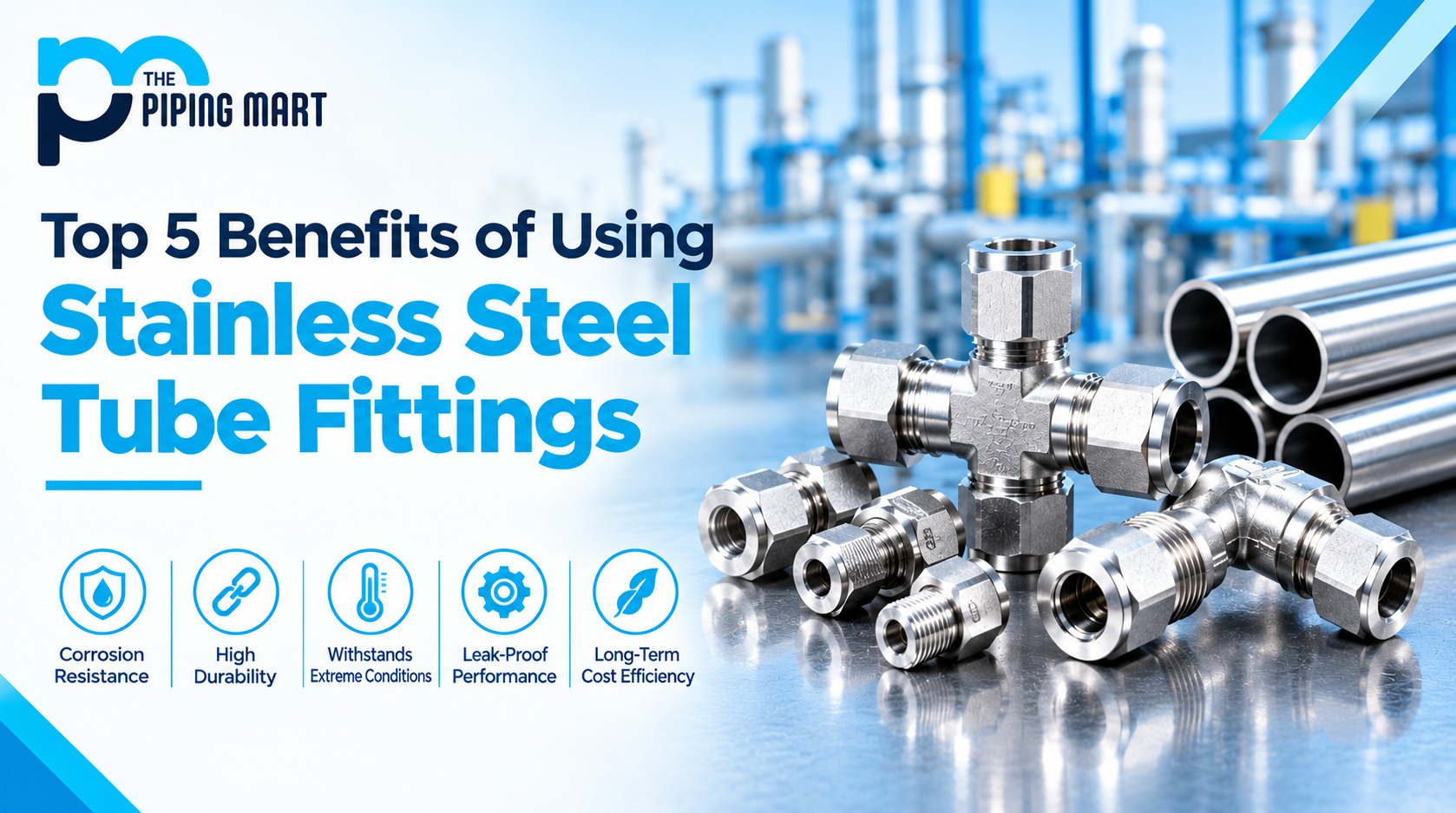
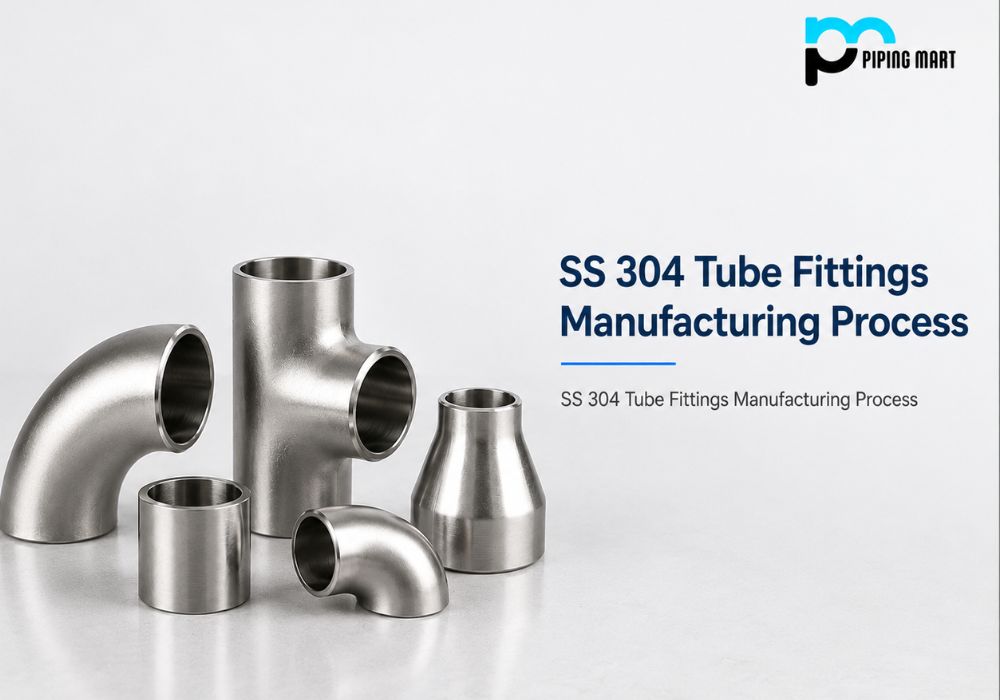
SS 304 tube fittings are one of the most used fittings in process and instrumentation systems. They are used in applications where corrosion resistance, pressure integrity, and dimensional accuracy are important. These fittings are made of 304 stainless steel, a material with 18% chromium and 8% nickel, providing it with good general corrosion resistance. However, a fitting is not a reliable indicator on its own. Mechanical properties, dimensional tolerances, and surface condition of the final product are determined by the manufacturing process of the SS 304 tube fittings. This process can fail to produce good results, resulting in either leaks, stress cracking, or failure to be usable in service. This article explains the production process of SS 304 tube fittings step by step.
Introduction to SS 304 Tube Fittings
The SS 304 tube fittings are precision-manufactured tube fittings for connecting, redirecting, or terminating the tube runs in fluid and gas handling systems. These tube fittings are made from AISI 304 austenitic stainless steel, including its variants 304, 304L, and 304H, which mainly differ in carbon content to suit different uses. These fittings are available in several common types, such as elbows, tees, unions, reducers, and caps, and are typically available in outer diameters ranging from 1/8 inch to 2 inches. SS 304 tube fittings are used in chemical processing, oil and gas, pharmaceuticals, food and beverage, and instrumentation systems. The quality of the fitting’s ability to hold pressure and resist corrosion over time depends on the manufacturing method.
Step-by-Step SS 304 Tube Fittings Manufacturing Process
The SS 304 tube fittings are made in five main steps, each having its own requirements, and they must be done in the correct order for proper manufacturing.
Forging Process
The SS 304 tube fittings forging process starts by cutting round bar stock or billets of 304 stainless steel to weight. These blanks are then heated to the forging temperature, usually between 1150°C and 1260°C, and shaped using hydraulic or mechanical forging presses. Forging aligns the grain structure of the material and makes it stronger than castings. The forged shape is slightly oversized to allow for subsequent machining. Die design is critical here since incorrect flash or material flow can cause incomplete fill or lap defects in the blank.
Forming Process
For certain fitting types, the SS 304 tube fittings forming process is used instead of or alongside forging. Forming involves bending, deep drawing, or cold pressing pre-cut tube or sheet stock into the required shape. Elbow fittings are often produced by tube bending or mandrel forming. The cold working involved in forming increases surface hardness slightly. Spring-back is a factor with stainless steel due to its work-hardening tendency, so tooling is designed to compensate. Formed fittings generally require less material removal in later stages.
Machining Process
The SS 304 tube fittings machining process includes turning, boring, threading, and drilling on CNC lathes and machining centres. Here, the forged or formed blank size is specified by the drawing. This is the stage when threads like NPT, BSPT, and BSPP are cut. The surface of bores is finished to produce the desired surface roughness and roundness. Stainless 304 is an adhesive material that work hardens rapidly, and the selection of tools and cutting speeds must be carefully considered. Poor surface finish or out-of-tolerance bores are a sign of chatter or tool deflection.
Heat Treatment Process
The SS 304 tube fittings’ heat treatment process often involves solution annealing. The parts are heated to about 1040°C to 1120°C and then quickly cooled in water. This process is used to dissolve any carbide precipitation that may have formed in forging or machining, and to bring the corrosion resistance of the material back to normal. If the fitting is not annealed properly, sensitisation may be present in the HAZ and cause the fitting to be susceptible to intergranular corrosion. In the 304L grade, the lower carbon content lowers this risk; the production process still includes heat treatment in most production flows.
Finishing Process
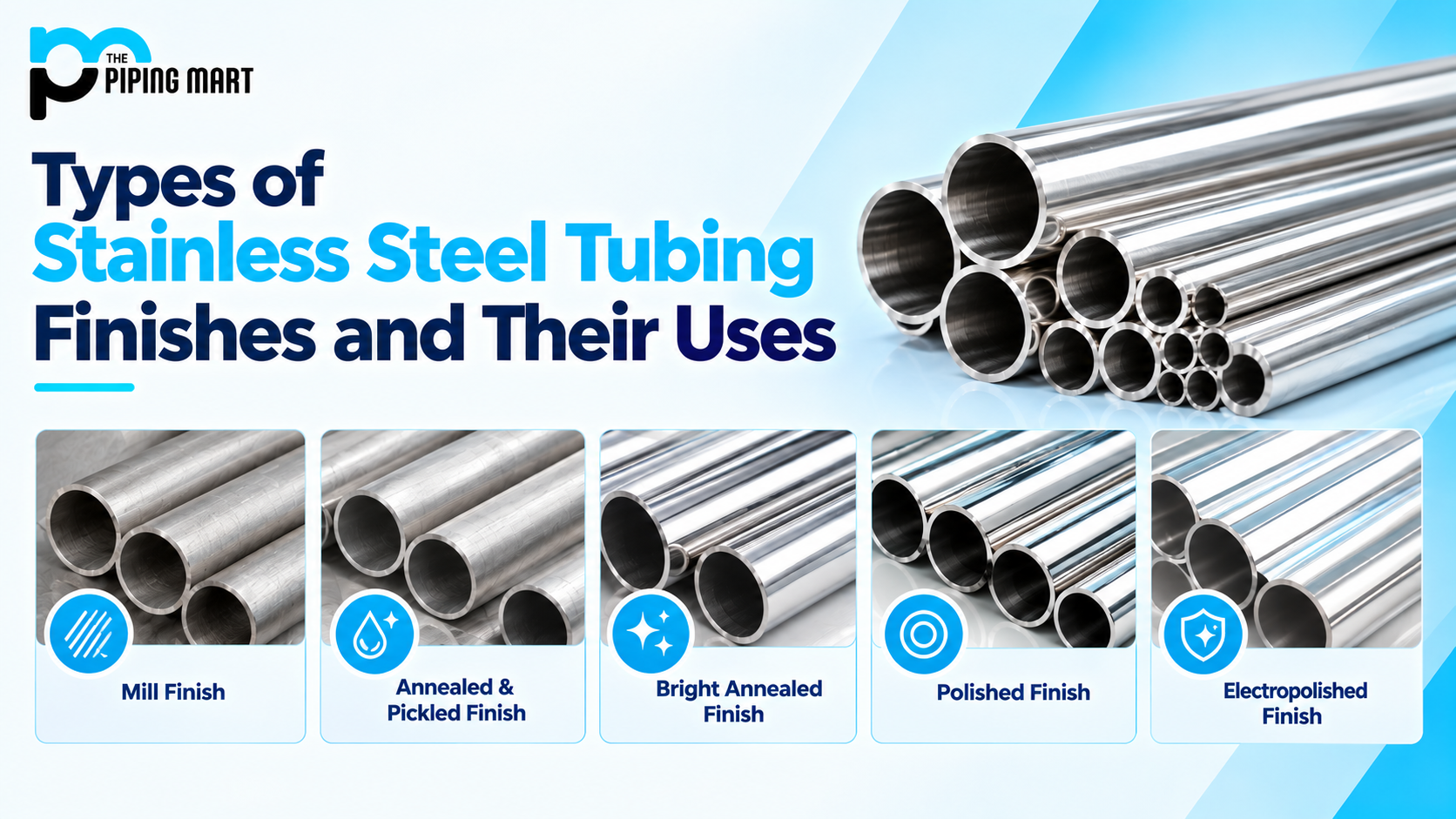
The SS 304 tube fittings finishing process covers several operations. Pickling and passivation remove the heat tint and oxide scale from forging and heat treatment. This is done using nitric and hydrofluoric acid solutions. After pickling, a passive chromium oxide layer reforms on the surface. For fittings requiring a smoother surface, mechanical polishing or electropolishing is done. Electropolishing removes a thin layer of material and gives a bright finish with Ra values of 0.4 micrometres or lower. The parts are then cleaned, dried, and visually inspected before moving to dimensional checking.
Fabrication Techniques for SS 304 Tube Fittings
The SS 304 tube fittings fabrication process is not limited to one method. Depending on the fitting type, size, and pressure class, manufacturers use a combination of closed-die forging, open-die forging, CNC turning, pressing, and tube bending. Smaller fittings under 1/2″ OD are often produced from bar stock by pure machining with no forging step. Larger fittings or those with complex geometry go through forging first. Welded fabrication is used for some larger body fittings or stub-end types. Prototype or low-volume fittings can be produced directly from bar by machining, though this is more material-intensive. The choice of fabrication method affects lead times, tooling costs, and the mechanical properties of the final part.
Quality Control and Inspection Process
The quality control of SS 304 tube fittings begins at the raw material stage and extends to the production process. The raw materials are verified by mill test reports, and chemical verification may be carried out by PMI testing. Sample parts are sized during manufacture, so that dimensions are correct before production. Standard measuring tools and gauges are used to size, test threads, and measure the surface quality of finished fittings. These SS 304 tube fittings are also hydrostatic pressure-tested and hardness-tested to ensure their performance and heat treatment. Records of all inspections are kept for complete traceability.
Standards and Specifications for SS 304 Tube Fittings
ASTM standards for SS 304 tube fittings cover raw material, dimensional requirements, and testing. The table below summarises the main parameters and specifications applicable to these fittings.
| Parameter | Specification |
| Product Name | Stainless Steel 304 Tube Fittings / Compression Fittings / Ferrule Fittings |
| Grade | 304, 304L, 304H |
| UNS Number | S30400 (304), S30403 (304L), S30409 (304H) |
| WNR (EN) | 1.4301 (304), 1.4306 (304L), 1.4948 (304H) |
| Material Standards | ASTM A276 Type 304 (Stainless Steel Bars)ASME SA-479 Type 304-SSASTM A182 F304 (Forged fittings)ASTM A403 WP304 (Buttweld fittings)ASTM A269 TP304 (Seamless tubes)ASTM A240 (Plate/Sheet)ASTM A312 (Seamless & Welded Pipe)ASTM A213 (Seamless Boiler/Heat Exchanger)ASTM A789/A790 (Duplex)ASTM A270 (Sanitary) |
| International Standards | BS 970 304S11, 304S31, 304S51DIN 4401, DIN 17440, EN 10088, EN 10025JIS G4303, JIS G4311 SUS 304 SS 2332, SS 2352AFNOR Z7CN18-09 |
| Size Range | 1/8″ to 2″ (3mm to 50mm) OD1/8″ OD to 2″ OD (seamless tubes)3 mm OD to 38 mm ODDN15 to DN50 |
| Pipe Schedule | Schedule 5S, 10S, 40S, 80S |
| Wall Thickness | 0.020″ to 0.188″ (0.5 mm to 4.8 mm) |
| Ends | Threaded, Welding, JIC (Joint Industry Council) |
| Threads | NPT (National Pipe Tapered)BSPT (British Standard Pipe Tapered)BSPP (British Standard Pipe Parallel) |
| Fitting Types | Tube to Union, Tube to Male, Tube to Female, Elbows, Tees, Crosses, Reducers, Caps, Unions, Instrument Pipe Fittings, Street Elbows, Adapters, Push-to-Connect |
| Pressure Rating | 1000 Psi, 3000 Psi, 6000 Psi, 10000 Psi |
| Working Pressure (psig) | 1/8″: 8,000 (thin wall), 10,500 (medium), 14,700 (thick)1/16″: 12,000 (thin), 9,500 (medium)3/16″: 3,997–12,965 (varies by wall) |
| Surface Finish | Annealed & Pickled, Bright/Polished (Ra ≤ 0.4 μm), Electropolished |
| HS Code | 73072900 |
Common Manufacturing Defects and How They Are Avoided
Several defects can occur during the SS 304 tube fittings manufacturing steps if the process is not controlled properly. Porosity and laps in forgings come from incorrect billet temperature or die design. These are caught by visual inspection and, in critical applications, dye penetrant testing. Dimensional variation in machined threads is addressed by regular gauge calibration and in-process checking. Sensitisation from improper heat treatment leads to corrosion in service. Using the right annealing process and cooling it quickly helps prevent this. Iron particles or machining debris left on the surface can cause small pits and corrosion, so it is important to clean the parts thoroughly after machining and heat treatment. This means the parts are cleaned, pickled, and passivated to remove any contaminants. For clean, high‑purity uses, electropolishing gives an even cleaner and more stable surface.
Conclusion
The SS 304 tube fittings manufacturing process includes several key steps, such as forging, forming, machining, heat treatment, finishing, etc. Each step needs to be performed carefully to ensure that the fittings meet the required quality and performance. Any production errors or shortcuts can result in leaks, poor fit, or failure during pressure testing. A better understanding of the manufacturing process enables the buyer and engineer to make decisions and choose products that are reliable. Suppliers should also be able to explain the production process and offer good material traceability and quality documentation.
FAQs
How Manufacturing Affects the Performance of SS 304 Tube Fittings
The manufacturing process directly controls the mechanical properties and corrosion resistance of the fitting are directly controlled by the manufacturing process. When cast, grains are less dense than when forged, giving it less strength. Corrosion resistance is regained by the proper solution annealing. Surface conditions resulting from poor machining or poor finishing are initiation sites for corrosion or fatigue cracking during service. A fitting that appears to be visually acceptable could be internally flawed due to an uncontrolled production process.
What processes are used in the production of SS 304 fittings?
The SS 304 tube fittings are manufactured through four steps, i.e, forging or forming to create the rough shape, CNC machining to get the final size and threads, solution annealing to restore corrosion resistance, and pickling or electropolishing to clean and smooth the surface. The exact steps depend on the fitting’s type and size. Smaller fittings can be made directly from bar stock by machining only, while bigger or more complex fittings are usually forged first and then machined.
What standards apply to SS 304 tube fittings?
Several ASTM standards apply depending on the product form. ASTM A182 F304 covers forged fittings. ASTM A403 WP304 covers buttweld fittings. ASTM A269 TP304 covers seamless tubes used as feedstock. ASTM A276 covers bar stock. The international standards include BS 970, DIN 17440, JIS G4303, and EN 10088, among others. The applicable standard depends on the end-use specification and the market to which the product is being supplied.
How are raw materials selected for SS 304 Tube Fittings?
The manufacturing process begins by selecting the right raw material. The mill test certificate is verified to confirm that the chemical composition meets the requirements of 304, 304L, or 304H stainless steel. For 304L, the carbon content must be below 0.03%. Physical dimensions of bar or tube stock are checked against the required starting size for the forging or machining operation. Some manufacturers also carry out incoming PMI checks using XRF analysers to confirm the grade independently of the paperwork.