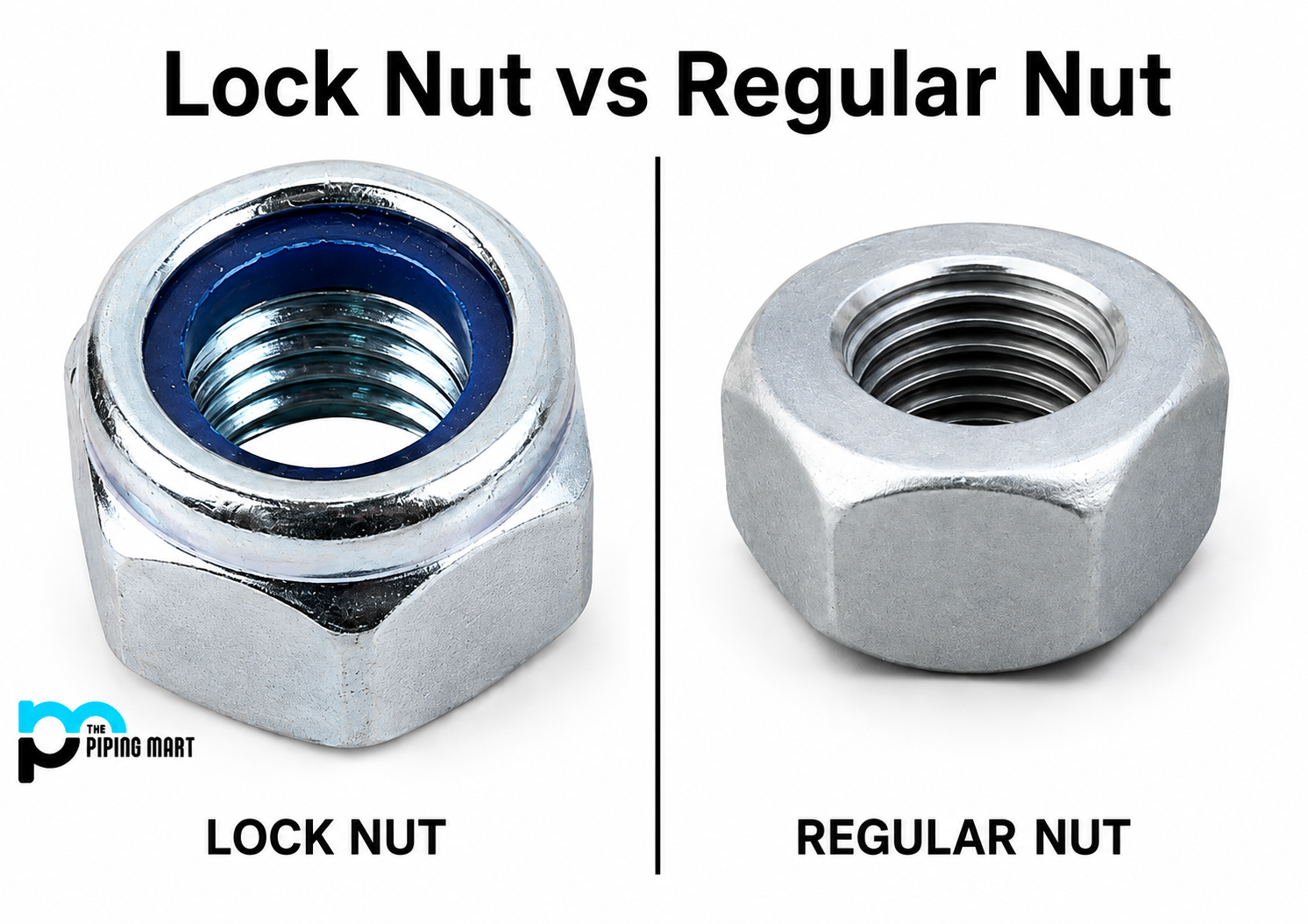
A lock nut and a regular nut may look similar, but their performance differs significantly once a bolted joint is subjected to vibration and cyclic loading. A regular nut clamps a bolted connection and holds it through friction and preload alone. A lock nut adds a built-in feature, a nylon insert, a deformed thread, or a serrated face that resists backing off under vibration and repeated load. For engineers and procurement teams specifying fasteners for rotating equipment or structural steelwork, the choice isn’t a minor line item; it affects joint reliability, maintenance intervals, and safety margins. This page covers what a lock nut is, how the lock nut vs regular nut comparison plays out in practice, and where each type belongs.
What is Lock Nut?
A lock nut, also called a locking nut or a prevailing torque nut, carries an added mechanism built to resist loosening once torqued down. Some designs use a nylon insert pressed into the top of the nut body. Others rely on a deformed thread section, a serrated flange face, or a wedge-shaped ramp that bites into the mating surface. The common thread across every variant is prevailing torque, meaning the nut resists rotation even before the joint is fully seated, which is why it suits vibration, shock, and cyclic loading, conditions where a plain nut works itself loose over time. Browse the DIN 985 nylon insert lock nut range for standard metric sizes.
What is Regular Nut?
A regular nut, sometimes called a plain or standard hex nut, threads onto a bolt with no built-in resistance beyond ordinary thread friction. It runs freely down the shank until it contacts the bearing surface, then depends entirely on clamping force from bolt preload to stay put. There’s no insert, deformation, or serration in the design. Regular nuts cover the largest share of general fastening work because they cost less, install faster, and come in dimensions covering nearly every bolt size in use, holding up well in static joints where vibration stays minimal. Check the hex nut range for common ISO and ASME sizes.
Difference Between Regular Nut and Lock Nut
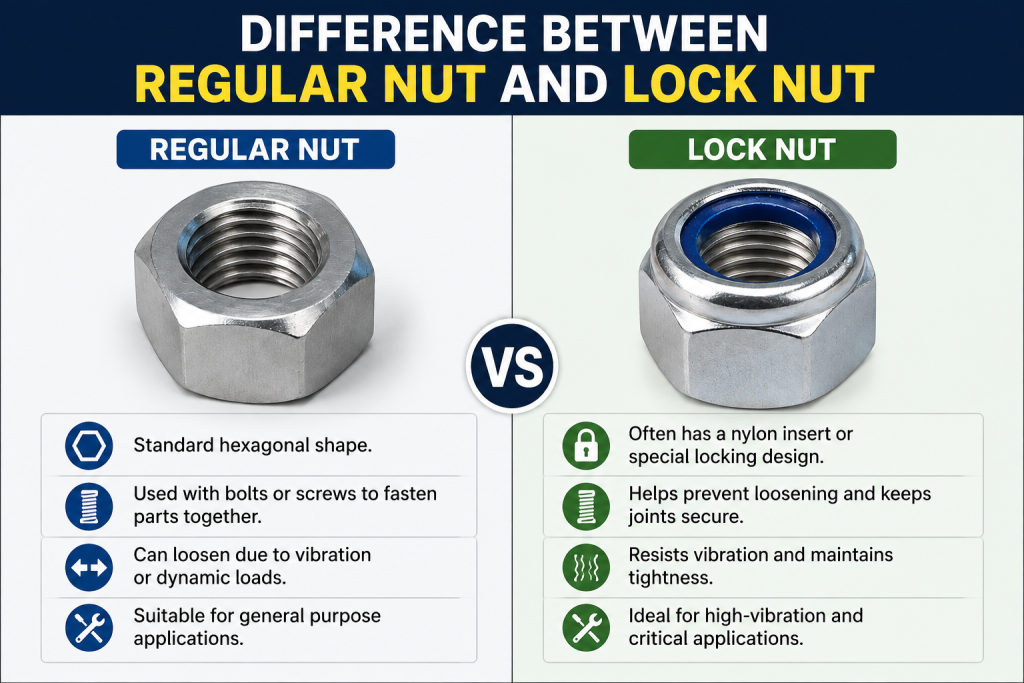
The table below lines up both nut types across the factors that matter most when specifying fasteners for a bolted joint.
| Comparison point | Regular nut | Lock nut |
| Basic function | Clamps components to a bolt or threaded stud | Clamps components and resists unintended loosening |
| Thread behavior | Free-running on the mating bolt thread before clamping | Requires additional torque because of its self-locking feature |
| Locking mechanism | None built into the nut | Nylon insert, deformed thread, metal insert, serrations, wedge feature, or other locking element |
| Resistance to vibration | Relatively low when used alone | Higher than a regular nut because it creates prevailing torque or additional friction |
| Dependence on clamping load | Relies mainly on bolt preload and joint friction | Provides resistance to rotation independently of clamping load once the locking feature is engaged |
| Installation torque | Torque needed to overcome thread and bearing friction, then tightening torque | Normal tightening torque plus prevailing torque from the locking element |
| Removal torque | Usually low once the joint is unloaded | Higher removal torque, particularly while the locking feature stays effective |
| Reusability | Generally reusable if threads and bearing surfaces remain undamaged | Depends on type; nylon and prevailing-torque lock nuts lose effectiveness after repeated use and need inspection or replacement |
| Typical materials | Carbon steel, stainless steel, brass, aluminium, alloy steel | Carbon steel, stainless steel, alloy steel, combined with nylon or metal inserts |
| Temperature capability | Governed mainly by nut material, coating, lubricant, and joint design | Governed by nut material and locking element, nylon types carry a lower temperature limit than all-metal types |
| Corrosion resistance | Determined by base material and coating | Determined by base material, coating, insert, and exposed locking feature |
| Effect on bolt thread | Normally doesn’t damage or deform the bolt thread | Nylon types normally grip without thread deformation; distorted-thread and serrated types can increase thread wear |
| Installation speed | Fast, runs down by hand or with a tool | Slower, since the locking feature has to be overcome during installation |
| Cost | Usually lower | Usually higher due to the added locking feature |
| Need for an additional washer | May require a plain, spring, or other washer depending on the joint | May or may not require a washer; flange, serrated, or wedge-lock designs can build in a locking function |
| Best suited for | Static, low-vibration joints and general-purpose assembly | Vibration-prone, cyclic, mobile, rotating, or maintenance-sensitive joints |
| Common failure concern | Loosening if preload drops or vibration is present | Reduced locking performance after reuse, overheating, incorrect installation, or a damaged locking element |
| Examples | Hex nut, heavy hex nut, square nut, thin/jam nut | Nyloc nut, all-metal prevailing-torque nut, castellated nut, serrated flange nut, wedge-lock nut |
| Common metric examples | ISO 4032 hexagon nut; ISO 4033 high nuts; ISO 4035 thin nuts | DIN 985 nylon-insert nut, DIN 982 all-metal lock nut, and ISO 10511 thin prevailing-torque nut |
| Common inch examples | ASME B18.2.2 hex nut; ASTM F594 stainless steel hex nut | ASME B18.16.6 nylon-insert locknut; prevailing-torque nuts to applicable ASME/SAE requirements |
| Standard performance testing | Dimensional, material, strength, and hardness requirements | Dimensional, material, strength, hardness, and prevailing-torque performance requirements |
| Suitable joint design | Must maintain adequate preload and friction through service | Useful where joint vibration can cause rotation, but doesn’t replace correct bolt preload and joint design |
Advantages of Lock Nut
Lock nuts earn their place in demanding joints for reasons beyond just holding tighter. Each locking mechanism targets a specific failure mode that plain nuts are prone to.
Superior Vibration Resistance
Prevailing torque keeps the nut engaged with the bolt thread as vibration tries to work it loose. On high-RPM equipment or under constant road shock, this stops the slow rotational creep that strips clamping force from a joint.
Enhanced Safety in Critical Applications
In aerospace brackets, suspension components, and structural connections, a nut backing off mid-service can cause component separation. Lock nuts lower that risk by holding torque through the service life, which matters where inspection access is infrequent.
Elimination of Extra Locking Hardware
A properly rated lock nut removes the need for lock washers, thread adhesive, or wire locking on many joints. Fewer parts mean fewer installation steps and less chance of a technician skipping one during maintenance.
Reliable Performance Under Thermal Cycling
All-metal lock nuts, such as distorted-thread or wedge-lock types, hold their locking force through repeated heating and cooling cycles, suiting exhaust brackets and engine mounts where nylon inserts would soften.
Load Distribution and Protection
Flange-type lock nuts spread clamping load over a wider bearing surface than a standard hex nut. This lowers surface pressure on softer materials and reduces the chance of the nut embedding into the joint face.
Long-Term Maintenance Cost Reduction
Joints that hold torque without loosening need fewer retightening checks during scheduled maintenance, which cuts downtime spent re-torquing bolts that a regular nut would have let back off.
Advantages of Regular Nut
Regular nuts remain the default choice across most fastening work for practical reasons rather than performance limits.
Simple Design and Fast Installation
With no insert or deformed thread to overcome, a regular nut carries down a bolt by hand until it reaches the bearing surface, which matters on projects with high fastener counts and tight schedules.
Wide Standardisation and Easy Sourcing
Hex nuts, heavy hex nuts, and jam nuts are produced to established standards such as ISO 4032 and ASME B18.2.2, which keep stock widely available across sizes and simplify sourcing for procurement teams.
Lower Component Cost
Without an added locking feature, a regular nut costs less to manufacture per piece. On assemblies using hundreds of fasteners, that difference adds up across a bill of materials on static, low-vibration structures.
Compatibility with Standard Tooling
Regular nuts don’t need the higher breakaway torque that prevailing-torque types require, so standard wrenches and sockets handle installation and removal without extra capacity or specialised fittings.
Suitable for Static and Low-Load Joints
In fixed structures and joints that see little movement, bolt preload alone is often enough to keep the joint tight, making a locking feature an unnecessary added cost.
Easy Field Replacement
A damaged or corroded regular nut is simple to source and replace in the field, since common sizes are stocked at most hardware and industrial supply outlets.
Applications of Lock Nut
Lock nuts are used wherever a joint faces vibration, cyclic load, or a safety consequence if it loosens.
Bridge Construction and Civil Infrastructure
Structural connections on bridges and elevated roadways experience traffic-induced vibration and repeated load cycles. Lock nuts can be used on railing supports, equipment mounts, and other connections where resistance to loosening is required.
Automotive Systems and Assemblies
Suspension arms, engine mounts, and wheel assemblies see continuous vibration and shock loading. Lock nuts keep these joints torqued between service intervals, cutting the risk of a fastener working loose in motion.
Railway and Train Systems
Bogie assemblies, suspension components, equipment mounts, and other railway assemblies exposed to repeated vibration and impact loading can use locking nuts to maintain joint security. Lock nuts maintain clamping force despite the constant cyclic stress in the rail structure.
Aerospace and Aviation
Airframe panels, engine mounts, and control linkages require fasteners that maintain joint security under vibration, pressure cycling, and temperature changes. Aerospace assemblies use application-specific prevailing-torque and all-metal locking nuts to resist rotational loosening under these demanding service conditions.
Heavy Machinery and Industrial Equipment
Vibrating screens, crushers, and conveyor systems run continuously and generate high-frequency vibration. Lock nuts resist loosening far better than plain nuts under this repeated mechanical stress.
Naval and Marine Engineering
Deck fittings, engine room equipment, and hull-mounted brackets face constant vibration along with salt spray exposure. Corrosion-resistant lock nuts hold these joints securely where access is limited.
Mining and Underground Operations
Drilling rigs, conveyor structures, and processing equipment in mines operate under heavy shock loading and dust exposure. Lock nuts cut the frequency of retightening on equipment that’s hard to access.
Large Commercial Buildings and Parking Structures
Structural steel connections, curtain wall brackets, and rooftop equipment mounts in large buildings use lock nuts where wind load or vibration could otherwise loosen a standard nut over time.
Applications of Regular Nut
Static assemblies and general fabrication work make up the bulk of where regular nuts get specified.
General Structural Steelwork
Column base plates, purlin connections, and secondary steel members with minimal vibration exposure commonly use regular hex nuts, since bolt preload alone keeps these static joints clamped.
Furniture and Fixture Assembly
Shelving units, racking systems, and workbenches rely on regular nuts, since the loads involved stay static and the joints see little cyclic movement during normal use.
Electrical Panel and Enclosure Assembly
Control panel frames, cable trays, and enclosure mounting brackets use regular nuts for the combination of low cost and fast installation across large quantities of fastening points.
Plumbing and Pipe Support Systems
Pipe hangers, support brackets, and clamp assemblies in low-vibration piping runs use regular nuts, since the joint carries mostly static load once installed and levelled.
General Machinery Assembly
Covers, guards, and non-critical brackets on stationary machinery are typically fastened with regular nuts, reserving lock nuts for joints that carry rotating loads within the same machine.
When to choose Lock Nut vs Regular Nut
Choosing between a lock nut and a regular nut comes down to what the joint experiences in service, not just the load it carries. Where vibration, cyclic stress, or repeated impact acts on a connection, a lock nut protects against the gradual loosening that a plain nut can’t resist alone. Static joints with steady load and easy access for inspection rarely need that feature, and a regular nut does the job at lower cost. Safety-critical joints and anything hard to reach for maintenance generally justify the extra cost of a locking design.
Conclusion
The difference between a lock nut and a regular nut lies in what happens after the joint is torqued down. A regular nut depends fully on bolt preload and friction, which work fine in static, low-vibration joints. A lock nut adds a mechanism that keeps resisting rotation on its own, mattering wherever vibration or safety risk is involved. Specifying the right type per joint, rather than defaulting to one across a project, keeps maintenance shorter and lowers the chance of an unplanned fastener failure.
FAQs
What is the difference between a lock nut and a regular nut?
A regular nut holds a joint through bolt preload and thread friction alone. A lock nut adds a built-in feature, such as a nylon insert or deformed thread, that resists loosening independent of that preload.
Why are lock nuts used instead of regular nuts in vibration applications?
Vibration causes a plain nut to rotate slightly with each cycle until it backs off the bolt thread. A lock nut’s prevailing torque resists that rotation, which is why vibration-prone joints on vehicles and machinery specify them.
Can a regular nut be used instead of a lock nut?
Yes, in static joints with low vibration and easy access for retorquing. In joints exposed to cyclic load or safety consequences, substituting a regular nut raises the risk of loosening over the equipment’s service life.
Which is better, Lock Nut vs Regular Nut?
Neither type is better across the board, since the right choice depends on the joint. A lock nut suits vibration-prone and safety-critical connections, while a regular nut suits static, low-load assemblies where cost and speed matter more.