Surface finish decides how a stainless steel tube looks, how it cleans, and how it behaves once it enters service. Appearance, smoothness, corrosion resistance and fabrication needs all change with the finish, which makes it a core part of tube selection alongside grade and size. Selecting the correct finish depends on the tube grade, the manufacturing process, the application, hygiene requirements, and the service environment. This guide explains the main types of stainless steel tubing finishes, where each one is utilised, and how to choose between them as per your project.
What Is Stainless Steel Tubing Finish?
A stainless steel tubing finish is the surface condition of a tube after manufacturing and any treatment that follows. Finishes range from standard mill surfaces to mechanically polished and electrochemically refined ones, and each carries its own roughness, appearance, and cleanability.
The forming method, heat treatment, and any later grinding, buffing, or chemical treatment set the final surface. A mill surface comes straight from production, while a mechanical finish removes material by abrasion to level the surface. Because two tubes of identical grade and dimensions can differ sharply in roughness, the finish belongs in the specification next to grade and size. It also shapes how the tube looks and how easily process residue is released from the wall.
What Are the Different Types of Stainless Steel Tubing Finishes?
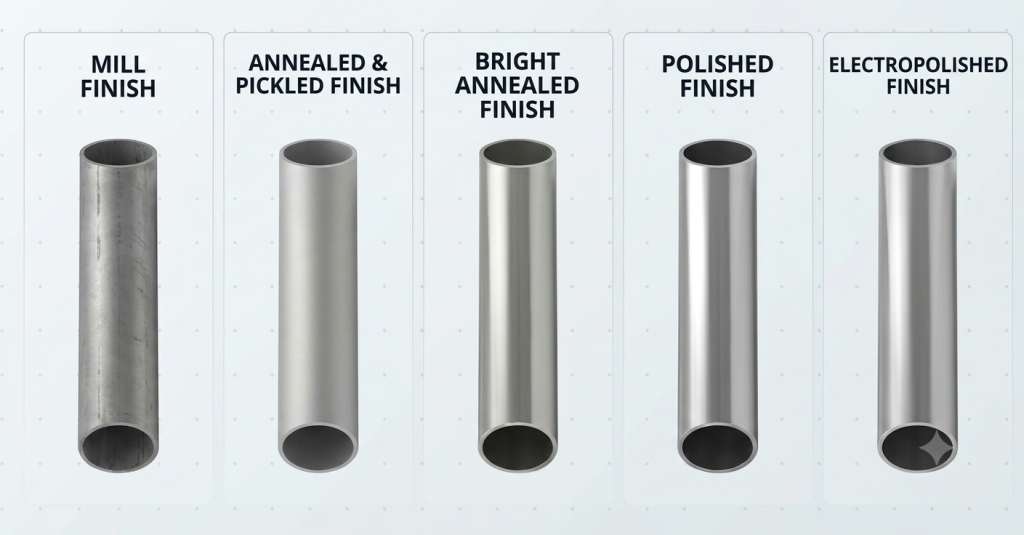
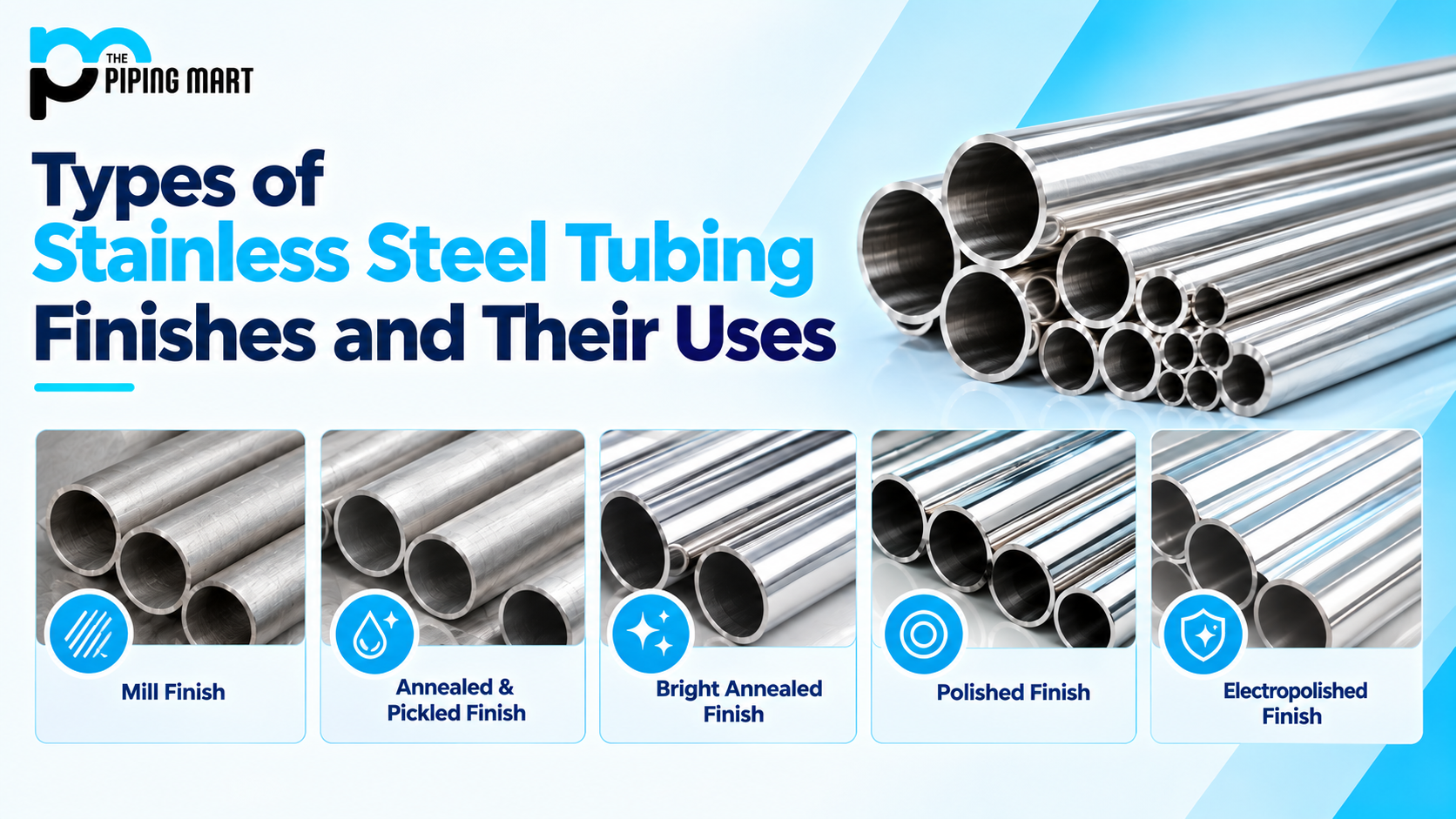
Five finish categories cover most stainless steel tubing requirements, running from the untreated production surface to a refined electrochemical surface used in high-purity service.
Mill Finish
Mill finish is the surface left after rolling, drawing, and standard heat treatment, with a dull grey appearance. General industrial piping and structural uses accept it without further work, such as Stainless Steel 304 Tubing in utility lines.
Annealed and Pickled Finish
Annealed and pickled finish strips the oxide scale formed during heat treatment in an acid bath, which also restores corrosion resistance at the surface. Process piping in Stainless Steel 316L Tubing and Stainless Steel 304L Tubing depends on it.
Bright Annealed Finish
A bright annealed finish comes from heat treatment in a controlled atmosphere, which prevents scaling, avoids pickling, and leaves a bright, smooth surface. Instrumentation and exposed lines in Stainless Steel 316 Tubing and Stainless Steel 316Ti Tubing use it.
Polished Finish
A polished finish comes from abrasive grinding and buffing through grits such as 180, 240, and 320, which lower roughness and give a uniform sheen. Hygienic and decorative applications of Stainless Steel 304L Tubing and Stainless Steel 316L Tubing specify it.
Electropolished Finish
Electropolished finish uses an electrochemical process that dissolves a controlled layer of surface metal, smoothing peaks and improving cleanability. Pharmaceutical, biotechnology, semiconductor, and food processing systems specify it, though availability depends on the product specification for each grade.
How Stainless Steel Tubing Finish Affects Its Uses
Finish links directly to service conditions because surface roughness, scale removal, and cleanability change how a tube performs in each sector. The four groups below show these links in actual practice.
Industrial Processing
Functional finishes such as mill, annealed, and pickled surfaces suit general process equipment, where scale removal and surface soundness count for more than looks. Heat exchangers, furnace parts, and process lines in Stainless Steel 310 Tubing and Stainless Steel 309 Tubing use them.
Food and Beverage
Smooth, cleanable walls leave fewer surface valleys where residue and bacteria can lodge, so dairy, brewing and beverage lines favour polished or bright annealed tube. Stainless Steel 316L Tubing and Stainless Steel 304L Tubing serve these lines, with the finish set by the cleaning regime.
Pharmaceutical and High-Purity Applications
Polished and electropolished surfaces suit pharmaceutical and high-purity systems because a smoother wall cleans faster and sheds fewer particles. Stainless Steel SMO 254 Tubing suits chloride-bearing media, while Stainless Steel 316L Tubing covers standard clean service. Electropolishing applies only where the product specification supports it.
High Temperature Applications
The finish selection in high-temperature service follows grade and operating environment, since scale behaviour and surface condition change with exposure. Stainless Steel 310S Tubing, Stainless Steel 321H Tubing, and Stainless Steel 347H Tubing each need a finish matched to their grade and temperature, since the alloy carries scale resistance.
Stainless Steel Tubing Finish Comparison
The table below sets the five finishes side by side by surface characteristics and typical use, giving a quick reference when matching a finish to an application and its service environment before detailed specification begins.
| Finish | Surface Characteristics | Typical Use |
| Mill Finish | Standard manufactured surface with a dull grey look and visible production marks | General industrial tubing where appearance and roughness are not critical |
| Annealed & Pickled | Cleaned, de-scaled matte surface with restored corrosion resistance | Process and industrial applications after heat treatment |
| Bright Annealed | Smooth, bright surface produced in a controlled atmosphere without scaling | Process, instrumentation and decorative applications |
| Polished | Mechanically smoothed surface with a uniform sheen, graded by grit | Architectural and hygienic applications |
| Electropolished | Highly refined electrochemical surface with improved smoothness and cleanability | Pharmaceutical, biotech and high-purity applications |
Verify final terminology and finish designations against the applicable product specification or manufacturing standard.
How to Choose the Right Stainless Steel Tubing Finish
Treat finish as a structured check against the application, not a stand-alone decision made after grade, tube size, and manufacturing method are already settled.
- Define the application first, since hygienic, decorative, and general process duties each set a different minimum surface condition and cleaning routine.
- Specify the required roughness as an Ra value in micrometres or microinches, because polish grit alone does not guarantee a measured result.
- Match cleanability and hygiene needs to the finish, using polished or electropolished surfaces where residue release and cleaning validation matter.
- Check the corrosion and service environment, because chlorides, acids, cleaning chemicals, and process media react differently with each surface condition.
- Review operating temperature and duty cycle, since heat exposure changes scale behaviour and the surface condition a finish must withstand.
- Decide the appearance requirement early, because architectural and exposed installations need a uniform sheen that mill surfaces cannot give.
- Consider bending, welding, and forming steps, since fabrication can damage a delicate surface or require pickling or repolishing afterwards.
- Confirm the applicable specification or standard, and verify the finish designation with the supplier before ordering.
- Never select a finish independently of grade, tube dimensions, manufacturing method, and service conditions, because all four govern how the surface performs.
Conclusion
Stainless steel tubing is available in surface conditions that run from untreated mill finish to electropolished walls, and each one changes appearance, smoothness, cleanability, and application suitability. Mill, annealed and pickled, bright annealed, polished, and electropolished finishes each serve a different requirement, from general industrial duty to high-purity service. Buyers should choose the finish together with the grade, dimensions, manufacturing method, and service conditions, and confirm the designation against the product specification.
FAQs
What is the finish of stainless steel tubing?
Finish describes the surface condition of a tube after manufacturing, from untreated mill surfaces to pickled, bright annealed, polished, or electropolished conditions that set roughness, appearance, and cleanability.
What are the common types of stainless steel tubing finishes?
Mill, annealed and pickled, bright annealed, polished, and electropolished finishes form the five common categories, ranging from basic mill surfaces to refined electrochemical ones.
What is the difference between polished and electropolished stainless steel tubing?
Polishing abrades the surface mechanically to smooth it, while electropolishing dissolves a thin surface layer electrochemically, giving a smoother, cleaner wall suited to high-purity use.
Which stainless steel tubing finish is suitable for hygienic applications?
Polished and electropolished finishes suit hygienic duties. The Piping Mart lists tube suppliers who can confirm the finish, roughness value, and grade against the product specification.
Does stainless steel tubing finish affect corrosion resistance?
Yes, in part. Pickling restores the corrosion-resistant surface after heat treatment, and smoother polished or electropolished walls hold less contamination, though grade still sets the baseline resistance.
How do I choose the right finish for stainless steel tubing?
Start with the application, required roughness, and hygiene needs, then match the finish to grade, dimensions, temperature, and applicable specification before confirming the designation with the supplier.