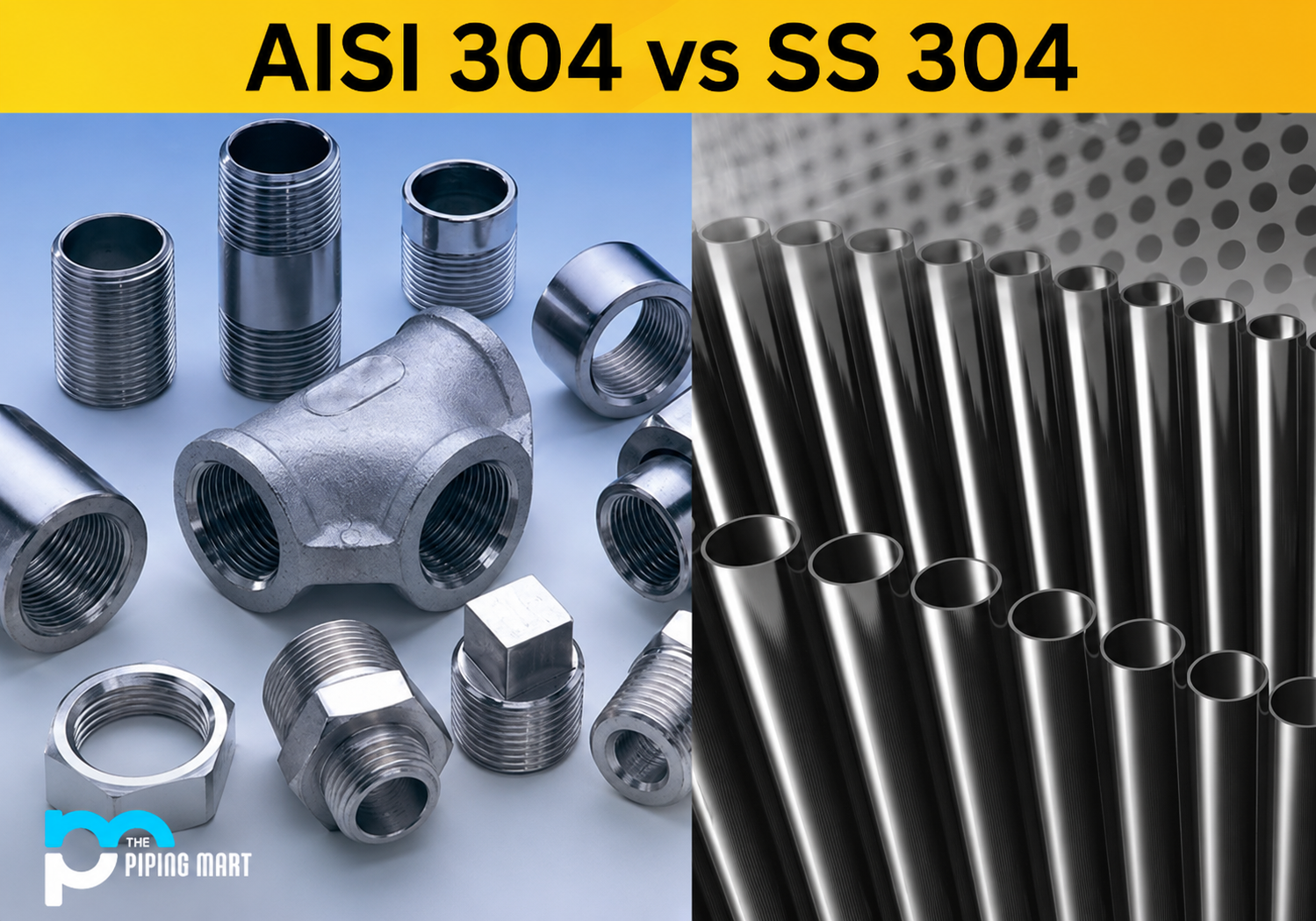
Engineers and procurement teams frequently come across two names for what is technically the same alloy: AISI 304 and SS 304. The confusion isn’t about metallurgy; it’s about naming conventions used across specifications, catalogues, and mill certificates. AISI 304 refers to the designation assigned by the American Iron and Steel Institute, tied closely to ASTM and ASME material specifications. SS 304 is the informal shorthand used across the market, appearing on invoices, supplier catalogues, and in everyday conversations between buyers and vendors. Both terms refer to UNS S30400, an austenitic stainless steel with an 18 percent chromium and 8 percent nickel composition; for anyone drafting a purchase order or checking a mill test certificate, knowing which term applies where matters more than it might at first appear.
What is AISI 304?
AISI 304 is the American Iron and Steel Institute’s designation for the most widely used grade of austenitic stainless steel, carrying UNS number S30400 and matching EN 1.4301 in European standards. The composition sits around 18 percent chromium and 8 percent nickel, giving the alloy solid corrosion resistance in atmospheric and mild chemical environments. Mill certificates, engineering drawings, and procurement specifications list the grade this way because it ties directly back to ASTM A240 for plate and sheet, ASTM A312 for stainless steel pipes, and related standards for bar, tube, and fittings. This precision matters wherever traceability counts.
What is SS 304?
SS 304 is the shorthand term used across the stainless steel trade for the same alloy, without any change in chemistry, mechanical properties, or governing standard. Suppliers, catalogues, and buyers use it because it’s quicker to write and say than the full AISI or ASTM designation. Material sold as SS 304 still carries UNS S30400 and still meets the same specifications as AISI 304, whether it’s supplied as sheet, coil, stainless steel plate, or fittings. The term holds up fine in commercial conversation, though drawings and compliance documents should still reference the formal designation for accuracy.
Comparison Table – AISI 304 vs. SS 304
The difference between these two terms comes down to naming and documentation practice, not the metal itself. The table below lines up with the same technical reference points, useful when cross-checking a 304 stainless steel RFQ or a catalogue listing.
| Designation | AISI 304 | SS 304 |
| Full Form | American Iron and Steel Institute 304 | Stainless Steel 304, a generic market term |
| Material Classification | Austenitic stainless steel | Same alloy family; usually used as a shorthand commercial name |
| Governing Standard | Commonly referenced under ASTM/ASME material specifications for 304 | Same governing standards when sold as 304 stainless steel |
| UNS Number | S30400 | S30400 |
| EN / WNR Equivalent | 1.4301 / X5CrNi18-10 | 1.4301 / X5CrNi18-10 |
| ASTM Specifications | Typically ASTM A240, A276, A312, A182 depending on product form | Same ASTM family, depending on the supplied form |
| Available Product Forms | Sheet, plate, coil, pipe, tube, bar, fittings, fasteners | The same product forms are available in the market |
| MTC Identification | Listed as 304 / AISI 304 / UNS S30400 / 1.4301 on the mill test certificate | Often listed simply as SS 304, but traceability should still show UNS S30400 and the standard |
| Engineering Drawing Reference | Best written as ASTM/UNS/EN designation, e.g., ASTM 304, UNS S30400, 1.4301 | Best written the same way; “SS 304” is less precise for drawings |
| Procurement Terminology | Preferred technical term in specs and RFQs | Common buyer shorthand, but less formal |
| Global Market Usage | Widely recognised in technical and manufacturing documentation | Very common in commercial listings and supplier catalogues |
| Supplier Catalogue Naming | Often shown as AISI 304, ASTM 304, or 304 stainless steel | Often shown as SS 304 or stainless steel 304 |
| Interchangeability | Practically interchangeable with SS 304 when the same grade is intended | Practically interchangeable with AISI 304 |
| Best Used In Documentation | Engineering drawings, MTCs, purchase specs, and compliance documents | ‘Sales brochures’ and ‘informal catalogue references’ are avoided as the sole spec term |
AISI 304 vs SS 304: Are They the Same?
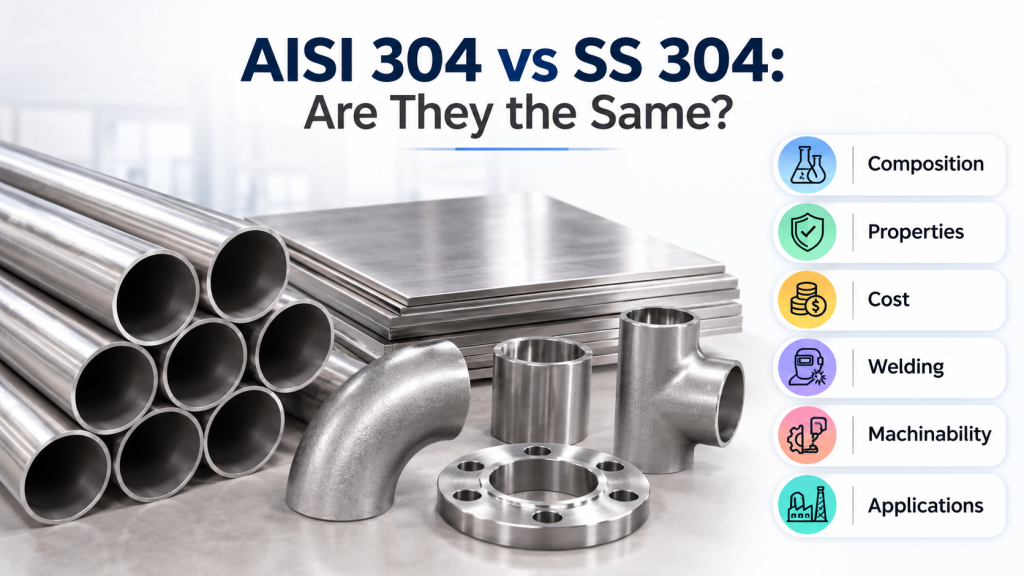
Yes, the two names generally refer to the same 304 stainless steel alloy; the difference is mainly in terminology. Their respective terminology and usage are outlined below.
Composition
- AISI 304 and SS 304 refer to the same alloy, with composition defined by the applicable ASTM/ASME material specification at roughly 18% chromium, 8% nickel, and low carbon content, all traceable through the ASTM A240 requirements on the certificate; the distinction is only in how the product is labelled on a packing list or quote.
Properties
- AISI 304 and SS 304 have the same mechanical properties, including tensile strength near 515 MPa and yield strength around 205 MPa, because both names refer to the same material; a datasheet marked SS 304 should therefore show the same values used for AISI 304 design calculations.
Cost
- AISI 304 and SS 304 cost the same because pricing is driven by raw material markets such as nickel and chromium, not by the label used; SS 304 is simply a shorthand name, and once the UNS number and standard are confirmed, there is no separate lower-grade or cheaper version.
Welding
- AISI 304 and SS 304 have the same welding behaviour and can be joined with TIG, MIG, or stick methods; low-carbon 304L is often chosen when post-weld sensitisation needs to be reduced, and any procedure qualified for AISI 304 applies equally to material sold as SS 304.
Machinability
- AISI 304 and SS 304 have the same machinability, with moderate cutting rates and a tendency to work-harden, so tooling speeds and feeds must still be adjusted; there is no separate machining data for SS 304 because it is the same material.
Applications
- AISI 304 and SS 304 are used for the same applications, including pressure vessels, dairy and brewery equipment, fasteners, and structural components; the difference is mainly in how they are referenced, with AISI 304 appearing in formal ASTM-backed documentation and SS 304 more common in commercial listings and procurement discussions.
Conclusion
AISI 304 and SS 304 describe the same austenitic stainless steel grade, carrying identical chemistry, mechanical properties, and UNS S30400 traceability regardless of which name appears on a document. The distinction lies entirely in documentation practice, with AISI 304 favoured on drawings, mill certificates, and formal specifications, while SS 304 remains the everyday term used across catalogues and purchase conversations. For procurement and engineering teams, the safest approach is confirming the UNS number and governing ASTM standard on paperwork, rather than relying on either name alone to define the material.
FAQs
Is AISI 304 the same as Stainless Steel 304?
Yes. Both terms refer to the identical alloy carrying UNS S30400, with AISI 304 being the formal designation and SS 304 the commercial shorthand used in the market.
Which is better, AISI 304 or SS 304?
Neither is better, as they describe the same material. AISI 304 is the preferred wording for technical documents, while SS 304 works fine for general trade communication.
Can AISI 304 and SS 304 be welded?
Yes. Both names refer to the same base metal, so any welding procedure qualified for one applies directly to material sold under the other name.
Is there any cost difference between AISI 304 and SS 304?
No. Pricing depends on raw material costs and market conditions, not on which name appears on the invoice or quote.
Do AISI 304 and SS 304 have the same mechanical properties?
Yes. Tensile strength, yield strength, and hardness values remain identical, as all three terms point to the same UNS S30400 material specification.