What are Stainless Steel Pipes?
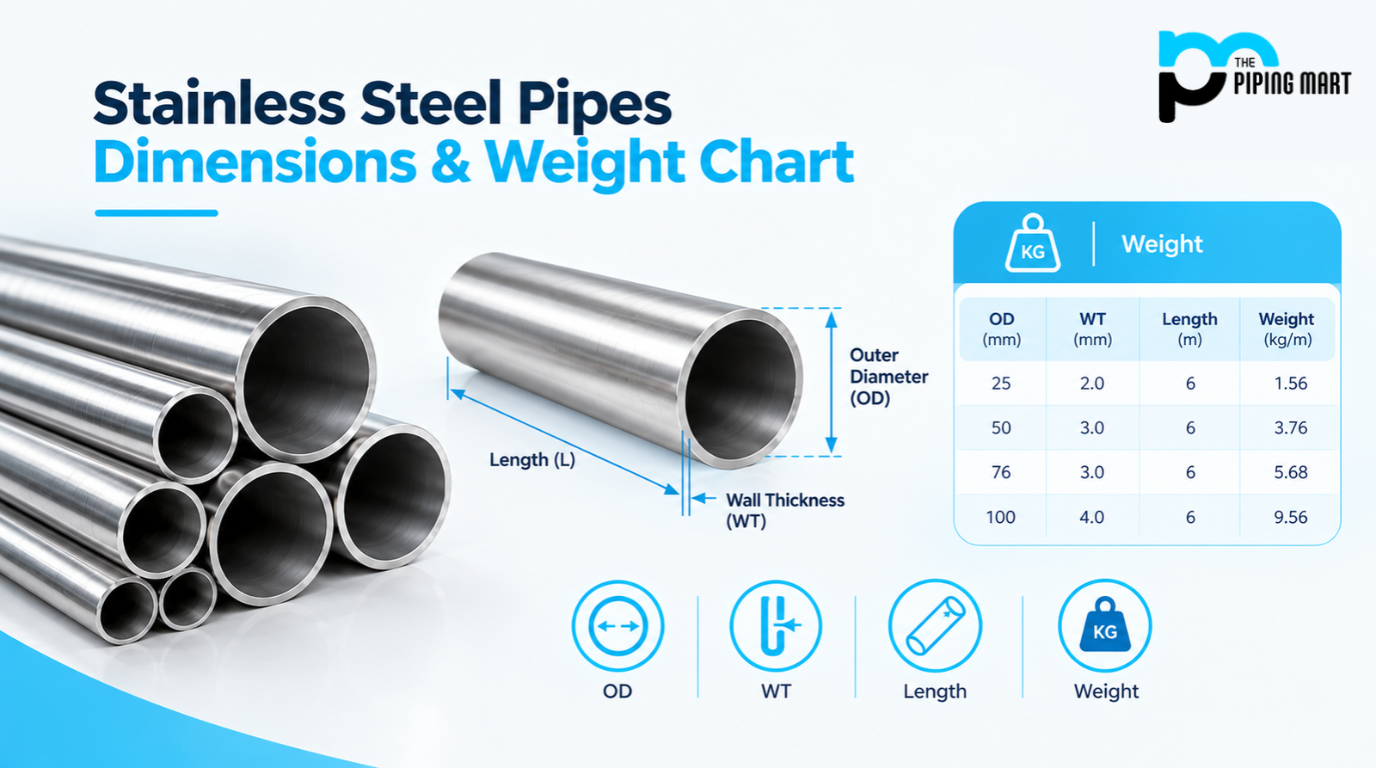
Stainless steel pipes are hollow structural tubes engineered to transport industrial fluids and gases safely. A few measurements drive everything else: nominal pipe size, outside diameter, wall thickness, schedule, and pipe length. These numbers aren’t just paperwork. Dimensions decide how much fluid a pipe can carry, how well it handles pressure, how easily it installs alongside other components, and ultimately how much it weighs, which matters for transport and handling. Buyers comparing stainless steel pipes across sizes and schedules need these fundamentals before anything else makes sense.
Stainless Steel Pipe Dimensions Chart
The following dimensional chart lists nominal pipe sizes, schedules, outside diameters, and wall thicknesses as specified in ASME B36.19M-2018.
| NPS (DN) | Schedule | Outside Diameter, in. (mm) | Wall Thickness, in. (mm) |
| 1/8 (6) | 5S | 0.405 (10.3) | — |
| 1/8 (6) | 10S | 0.405 (10.3) | 0.049 (1.24) |
| 1/8 (6) | 40S | 0.405 (10.3) | 0.068 (1.73) |
| 1/8 (6) | 80S | 0.405 (10.3) | 0.095 (2.41) |
| 1/4 (8) | 5S | 0.540 (13.7) | — |
| 1/4 (8) | 10S | 0.540 (13.7) | 0.065 (1.65) |
| 1/4 (8) | 40S | 0.540 (13.7) | 0.088 (2.24) |
| 1/4 (8) | 80S | 0.540 (13.7) | 0.119 (3.02) |
| 3/8 (10) | 5S | 0.675 (17.1) | — |
| 3/8 (10) | 10S | 0.675 (17.1) | 0.065 (1.65) |
| 3/8 (10) | 40S | 0.675 (17.1) | 0.091 (2.31) |
| 3/8 (10) | 80S | 0.675 (17.1) | 0.126 (3.20) |
| 1/2 (15) | 5S | 0.840 (21.3) | 0.065 (1.65) |
| 1/2 (15) | 10S | 0.840 (21.3) | 0.083 (2.11) |
| 1/2 (15) | 40S | 0.840 (21.3) | 0.109 (2.77) |
| 1/2 (15) | 80S | 0.840 (21.3) | 0.147 (3.73) |
| 3/4 (20) | 5S | 1.050 (26.7) | 0.065 (1.65) |
| 3/4 (20) | 10S | 1.050 (26.7) | 0.083 (2.11) |
| 3/4 (20) | 40S | 1.050 (26.7) | 0.113 (2.87) |
| 3/4 (20) | 80S | 1.050 (26.7) | 0.154 (3.91) |
| 1 (25) | 5S | 1.315 (33.4) | 0.065 (1.65) |
| 1 (25) | 10S | 1.315 (33.4) | 0.109 (2.77) |
| 1 (25) | 40S | 1.315 (33.4) | 0.133 (3.38) |
| 1 (25) | 80S | 1.315 (33.4) | 0.179 (4.55) |
| 1 1/4 (32) | 5S | 1.660 (42.2) | 0.065 (1.65) |
| 1 1/4 (32) | 10S | 1.660 (42.2) | 0.109 (2.77) |
| 1 1/4 (32) | 40S | 1.660 (42.2) | 0.140 (3.56) |
| 1 1/4 (32) | 80S | 1.660 (42.2) | 0.191 (4.85) |
| 1 1/2 (40) | 5S | 1.900 (48.3) | 0.065 (1.65) |
| 1 1/2 (40) | 10S | 1.900 (48.3) | 0.109 (2.77) |
| 1 1/2 (40) | 40S | 1.900 (48.3) | 0.145 (3.68) |
| 1 1/2 (40) | 80S | 1.900 (48.3) | 0.200 (5.08) |
| 2 (50) | 5S | 2.375 (60.3) | 0.065 (1.65) |
| 2 (50) | 10S | 2.375 (60.3) | 0.109 (2.77) |
| 2 (50) | 40S | 2.375 (60.3) | 0.154 (3.91) |
| 2 (50) | 80S | 2.375 (60.3) | 0.218 (5.54) |
| 2 1/2 (65) | 5S | 2.875 (73.0) | 0.083 (2.11) |
| 2 1/2 (65) | 10S | 2.875 (73.0) | 0.120 (3.05) |
| 2 1/2 (65) | 40S | 2.875 (73.0) | 0.203 (5.16) |
| 2 1/2 (65) | 80S | 2.875 (73.0) | 0.276 (7.01) |
| 3 (80) | 5S | 3.500 (88.9) | 0.083 (2.11) |
| 3 (80) | 10S | 3.500 (88.9) | 0.120 (3.05) |
| 3 (80) | 40S | 3.500 (88.9) | 0.216 (5.49) |
| 3 (80) | 80S | 3.500 (88.9) | 0.300 (7.62) |
| 3 1/2 (90) | 5S | 4.000 (101.6) | 0.083 (2.11) |
| 3 1/2 (90) | 10S | 4.000 (101.6) | 0.120 (3.05) |
| 3 1/2 (90) | 40S | 4.000 (101.6) | 0.226 (5.74) |
| 3 1/2 (90) | 80S | 4.000 (101.6) | 0.318 (8.08) |
| 4 (100) | 5S | 4.500 (114.3) | 0.083 (2.11) |
| 4 (100) | 10S | 4.500 (114.3) | 0.120 (3.05) |
| 4 (100) | 40S | 4.500 (114.3) | 0.237 (6.02) |
| 4 (100) | 80S | 4.500 (114.3) | 0.337 (8.56) |
| 5 (125) | 5S | 5.563 (141.3) | 0.109 (2.77) |
| 5 (125) | 10S | 5.563 (141.3) | 0.134 (3.40) |
| 5 (125) | 40S | 5.563 (141.3) | 0.258 (6.55) |
| 5 (125) | 80S | 5.563 (141.3) | 0.375 (9.53) |
| 6 (150) | 5S | 6.625 (168.3) | 0.109 (2.77) |
| 6 (150) | 10S | 6.625 (168.3) | 0.134 (3.40) |
| 6 (150) | 40S | 6.625 (168.3) | 0.280 (7.11) |
| 6 (150) | 80S | 6.625 (168.3) | 0.432 (10.97) |
| 8 (200) | 5S | 8.625 (219.1) | 0.109 (2.77) |
| 8 (200) | 10S | 8.625 (219.1) | 0.148 (3.76) |
| 8 (200) | 40S | 8.625 (219.1) | 0.322 (8.18) |
| 8 (200) | 80S | 8.625 (219.1) | 0.500 (12.70) |
| 10 (250) | 5S | 10.750 (273.0) | 0.134 (3.40) |
| 10 (250) | 10S | 10.750 (273.0) | 0.165 (4.19) |
| 10 (250) | 40S | 10.750 (273.0) | 0.365 (9.27) |
| 10 (250) | 80S | 10.750 (273.0) | 0.500 (12.70) |
| 12 (300) | 5S | 12.750 (323.8) | 0.156 (3.96) |
| 12 (300) | 10S | 12.750 (323.8) | 0.180 (4.57) |
| 12 (300) | 40S | 12.750 (323.8) | 0.375 (9.53) |
| 12 (300) | 80S | 12.750 (323.8) | 0.500 (12.70) |
| 14 (350) | 5S | 14.000 (355.6) | 0.156 (3.96) |
| 14 (350) | 10S | 14.000 (355.6) | 0.188 (4.78) |
| 14 (350) | 40S | 14.000 (355.6) | 0.375 (9.53) |
| 14 (350) | 80S | 14.000 (355.6) | 0.500 (12.70) |
| 16 (400) | 5S | 16.000 (406.4) | 0.165 (4.19) |
| 16 (400) | 10S | 16.000 (406.4) | 0.188 (4.78) |
| 16 (400) | 40S | 16.000 (406.4) | 0.375 (9.53) |
| 16 (400) | 80S | 16.000 (406.4) | 0.500 (12.70) |
| 18 (450) | 5S | 18.000 (457.0) | 0.165 (4.19) |
| 18 (450) | 10S | 18.000 (457.0) | 0.188 (4.78) |
| 18 (450) | 40S | 18.000 (457.0) | 0.375 (9.53) |
| 18 (450) | 80S | 18.000 (457.0) | 0.500 (12.70) |
| 20 (500) | 5S | 20.000 (508.0) | 0.188 (4.78) |
| 20 (500) | 10S | 20.000 (508.0) | 0.218 (5.54) |
| 20 (500) | 40S | 20.000 (508.0) | 0.375 (9.53) |
| 20 (500) | 80S | 20.000 (508.0) | 0.500 (12.70) |
| 22 (550) | 5S | 22.000 (559.0) | 0.188 (4.78) |
| 22 (550) | 10S | 22.000 (559.0) | 0.218 (5.54) |
| 22 (550) | 40S | 22.000 (559.0) | — |
| 22 (550) | 80S | 22.000 (559.0) | — |
| 24 (600) | 5S | 24.000 (610.0) | 0.218 (5.54) |
| 24 (600) | 10S | 24.000 (610.0) | 0.250 (6.35) |
| 24 (600) | 40S | 24.000 (610.0) | 0.375 (9.53) |
| 24 (600) | 80S | 24.000 (610.0) | 0.500 (12.70) |
| 30 (750) | 5S | 30.000 (762.0) | 0.250 (6.35) |
| 30 (750) | 10S | 30.000 (762.0) | 0.312 (7.92) |
| 30 (750) | 40S | 30.000 (762.0) | — |
| 30 (750) | 80S | 30.000 (762.0) | — |
Actual dimensions vary according to the applicable pipe standard and schedule, so this chart focuses on the sizes most commonly required in industrial piping rather than every dimension available.
What Dimensions Are Used for Stainless Steel Pipes?
Four measurements come up in almost every specification sheet.
Nominal Pipe Size (NPS)
NPS is the standard designation used to identify pipe size, but it’s a naming convention rather than a direct measurement. A pipe labelled NPS 2 doesn’t necessarily have a 2-inch outside diameter; the actual dimension is fixed by standard and schedule. Industrial piping commonly runs from NPS 1/8 through NPS 30 and beyond, depending on the system.
Outside Diameter (OD)
OD is the actual measured external diameter, and it’s what matters when fitting elbows, flanges, clamps, and supports around the pipe. Unlike NPS, which is nominal, OD stays fixed for a given size regardless of schedule, which is why fittings are selected against OD rather than the nominal label.
Wall Thickness
Wall thickness governs pressure resistance, durability, internal diameter, and pipe weight all at once. A thicker wall handles higher pressure but reduces the internal bore and adds weight. Schedules such as SCH 10, SCH 40, and SCH 80 are the shorthand the industry uses to specify this thickness consistently across sizes.
Pipe Length
Pipes come in standard lengths, with custom lengths available for specific projects. Length affects transportation logistics, on-site installation, how much cutting and jointing a job needs, and the total material quantity a project has to order.
Also read: What Are the Different Pipe Size Notations?
How Is Stainless Steel Pipe Weight Calculated?
Pipe weight comes down mainly to outside diameter, wall thickness, material density, and length. Suppliers typically express this as weight per metre or per foot, calculated from the pipe’s cross-sectional steel area multiplied by the material’s density. It’s worth separating two figures here: theoretical weight, calculated from nominal dimensions, and actual supplied weight, which can vary slightly due to manufacturing tolerances. Grade matters too, since stainless steel grades carry slightly different densities, so the specific grade should factor into any weight calculation rather than assuming one figure fits every alloy.
Stainless Steel Pipe Weight Chart
The following weight chart lists nominal plain-end pipe weights in lb/ft and kg/m based on ASME B36.19M-2018.
| NPS (DN) | Schedule | Weight, lb/ft (kg/m) |
| 1/8 (6) | 5S | — |
| 1/8 (6) | 10S | 0.19 (0.28) |
| 1/8 (6) | 40S | 0.24 (0.37) |
| 1/8 (6) | 80S | 0.31 (0.47) |
| 1/4 (8) | 5S | — |
| 1/4 (8) | 10S | 0.33 (0.49) |
| 1/4 (8) | 40S | 0.43 (0.63) |
| 1/4 (8) | 80S | 0.54 (0.80) |
| 3/8 (10) | 5S | — |
| 3/8 (10) | 10S | 0.42 (0.63) |
| 3/8 (10) | 40S | 0.57 (0.84) |
| 3/8 (10) | 80S | 0.74 (1.10) |
| 1/2 (15) | 5S | 0.54 (0.80) |
| 1/2 (15) | 10S | 0.67 (1.00) |
| 1/2 (15) | 40S | 0.85 (1.27) |
| 1/2 (15) | 80S | 1.09 (1.62) |
| 3/4 (20) | 5S | 0.68 (1.02) |
| 3/4 (20) | 10S | 0.86 (1.28) |
| 3/4 (20) | 40S | 1.13 (1.69) |
| 3/4 (20) | 80S | 1.48 (2.20) |
| 1 (25) | 5S | 0.87 (1.29) |
| 1 (25) | 10S | 1.41 (2.09) |
| 1 (25) | 40S | 1.68 (2.50) |
| 1 (25) | 80S | 2.17 (3.24) |
| 1 1/4 (32) | 5S | 1.11 (1.65) |
| 1 1/4 (32) | 10S | 1.81 (2.69) |
| 1 1/4 (32) | 40S | 2.27 (3.39) |
| 1 1/4 (32) | 80S | 3.00 (4.47) |
| 1 1/2 (40) | 5S | 1.28 (1.90) |
| 1 1/2 (40) | 10S | 2.09 (3.11) |
| 1 1/2 (40) | 40S | 2.72 (4.05) |
| 1 1/2 (40) | 80S | 3.63 (5.41) |
| 2 (50) | 5S | 1.61 (2.39) |
| 2 (50) | 10S | 2.64 (3.93) |
| 2 (50) | 40S | 3.66 (5.44) |
| 2 (50) | 80S | 5.03 (7.48) |
| 2 1/2 (65) | 5S | 2.48 (3.69) |
| 2 1/2 (65) | 10S | 3.53 (5.26) |
| 2 1/2 (65) | 40S | 5.80 (8.63) |
| 2 1/2 (65) | 80S | 7.67 (11.41) |
| 3 (80) | 5S | 3.03 (4.52) |
| 3 (80) | 10S | 4.34 (6.46) |
| 3 (80) | 40S | 7.58 (11.29) |
| 3 (80) | 80S | 10.26 (15.27) |
| 3 1/2 (90) | 5S | 3.48 (5.18) |
| 3 1/2 (90) | 10S | 4.98 (7.41) |
| 3 1/2 (90) | 40S | 9.12 (13.57) |
| 3 1/2 (90) | 80S | 12.52 (18.64) |
| 4 (100) | 5S | 3.92 (5.84) |
| 4 (100) | 10S | 5.62 (8.37) |
| 4 (100) | 40S | 10.80 (16.08) |
| 4 (100) | 80S | 15.00 (22.32) |
| 5 (125) | 5S | 6.36 (9.46) |
| 5 (125) | 10S | 7.78 (11.56) |
| 5 (125) | 40S | 14.63 (21.77) |
| 5 (125) | 80S | 20.80 (30.97) |
| 6 (150) | 5S | 7.59 (11.31) |
| 6 (150) | 10S | 9.30 (13.83) |
| 6 (150) | 40S | 18.99 (28.26) |
| 6 (150) | 80S | 28.60 (42.56) |
| 8 (200) | 5S | 9.92 (14.78) |
| 8 (200) | 10S | 13.41 (19.97) |
| 8 (200) | 40S | 28.58 (42.55) |
| 8 (200) | 80S | 43.43 (64.64) |
| 10 (250) | 5S | 15.21 (22.61) |
| 10 (250) | 10S | 18.67 (27.78) |
| 10 (250) | 40S | 40.52 (60.29) |
| 10 (250) | 80S | 54.79 (81.53) |
| 12 (300) | 5S | 21.00 (31.24) |
| 12 (300) | 10S | 24.19 (35.98) |
| 12 (300) | 40S | 49.61 (73.86) |
| 12 (300) | 80S | 65.48 (97.44) |
| 14 (350) | 5S | 23.09 (34.34) |
| 14 (350) | 10S | 27.76 (41.36) |
| 14 (350) | 40S | 54.62 (81.33) |
| 14 (350) | 80S | 72.16 (107.40) |
| 16 (400) | 5S | 27.93 (41.56) |
| 16 (400) | 10S | 31.78 (47.34) |
| 16 (400) | 40S | 62.64 (93.27) |
| 16 (400) | 80S | 82.85 (123.31) |
| 18 (450) | 5S | 31.46 (46.79) |
| 18 (450) | 10S | 35.80 (53.31) |
| 18 (450) | 40S | 70.65 (—) |
| 18 (450) | 80S | 93.54 (—) |
| 20 (500) | 5S | 39.82 (59.32) |
| 20 (500) | 10S | 46.10 (68.65) |
| 20 (500) | 40S | 78.67 (117.15) |
| 20 (500) | 80S | 104.23 (155.13) |
| 22 (550) | 5S | 43.84 (65.33) |
| 22 (550) | 10S | 50.76 (75.62) |
| 22 (550) | 40S | — |
| 22 (550) | 80S | — |
| 24 (600) | 5S | 55.42 (82.58) |
| 24 (600) | 10S | 63.47 (94.53) |
| 24 (600) | 40S | 94.71 (141.12) |
| 24 (600) | 80S | 125.61 (187.07) |
| 30 (750) | 5S | 79.51 (118.34) |
| 30 (750) | 10S | 99.02 (147.29) |
| 30 (750) | 40S | — |
| 30 (750) | 80S | — |
Treat these figures as a planning reference rather than a certified value. The final numbers for any order should come from the applicable dimensional/weight standard or the supplier’s own specification sheet, not an estimate presented as a certified weight.
How Do Pipe Schedule and Wall Thickness Affect Weight?
Standard Wall Pipes
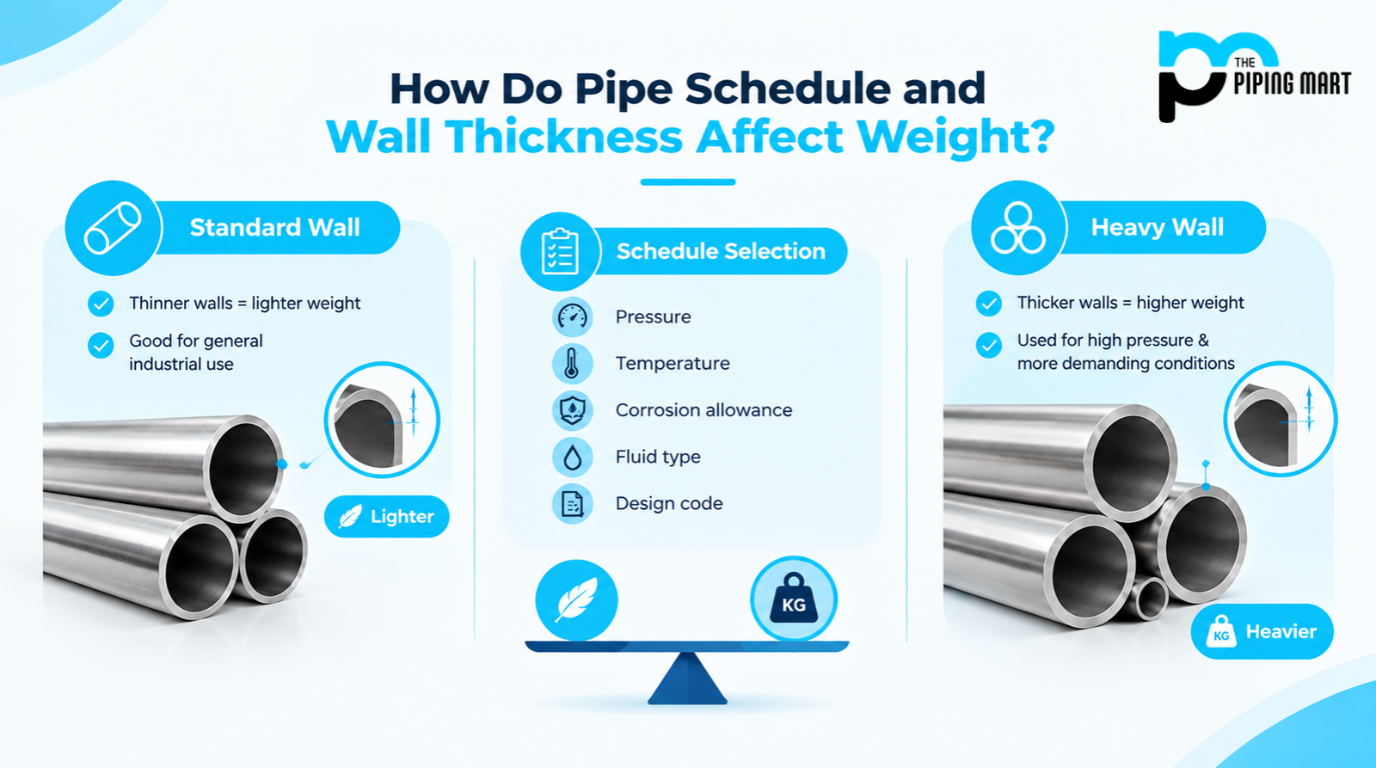
Thinner walls generally mean lower weight. Standard wall thickness suits many general industrial applications where operating pressure and mechanical demands stay moderate, without the extra material cost and weight of a heavier schedule.
Heavy Wall Pipes
Increasing wall thickness increases both material usage and weight. Heavier schedules typically come into play where higher pressure or more demanding mechanical conditions call for the extra margin that added wall thickness provides.
Schedule Selection
Schedule shouldn’t be chosen based on weight alone. Pressure, temperature, corrosion allowance, fluid characteristics, and the applicable piping design code all factor into the right schedule for a given system, and weight is simply a consequence of that decision rather than the starting point.
Factors to Consider When Selecting Stainless Steel Pipe Dimensions
Operating Pressure and Temperature
Wall thickness needs to match the design pressure and temperature the system will actually see in service, not just a general sense of “heavy duty.”
Flow Requirements
Internal diameter determines flow capacity, so choosing a pipe that’s too large or too small for the required flow rate affects both pressure drop and flow velocity.
Connection and Fitting Compatibility
Outside diameter, wall thickness, and end dimensions all need to match elbows, tees, flanges, valves, and other components the pipe will connect to.
Material Grade
Grade selection depends on corrosion exposure and service conditions, separate from dimensions entirely. The right dimensions on the wrong grade still won’t suit the application.
Applicable Standards
Dimensions should be verified against the required ASTM, ASME, or other applicable specification, alongside grade, size, schedule, manufacturing method, testing, and certification requirements.
Conclusion
Pipe size, outside diameter, wall thickness, schedule, length, and weight all tie together, and getting one wrong usually throws off the rest. A stainless steel pipe dimensions and weight chart is a useful starting point for initial selection, estimation, transportation planning, and material budgeting, but it’s exactly that: a starting point. Final dimensions and weight should always be verified against the applicable standard and the project’s own specification before an order is placed. For buyers working through that verification step, The Piping Mart operates as a reliable B2B platform connecting buyers with manufacturers and suppliers who can confirm the exact dimensions, schedules, and certified weights a project actually needs.
Frequently Asked Questions
What Are the Standard Dimensions of Stainless Steel Pipes?
The main dimensional parameters are nominal pipe size, outside diameter, wall thickness, schedule, and length, each contributing to how a pipe performs and connects within a system.
How Is Stainless Steel Pipe Weight Calculated?
Weight is calculated from outside diameter, wall thickness, material density, and pipe length, typically expressed as a weight per unit length such as kg/m or lb/ft.
Does Pipe Schedule Affect Stainless Steel Pipe Weight?
Yes, increasing the schedule generally increases wall thickness, which directly increases the weight per metre of the pipe for a given outside diameter.
What Is the Difference Between NPS and Outside Diameter of Stainless Steel Pipes?
NPS is a nominal designation used for identification, while outside diameter is the actual measured external diameter the pipe carries for a given size.
How Do I Choose the Right Stainless Steel Pipe Size?
Size should be selected based on flow requirements, operating pressure and temperature, connection compatibility, material grade, and the applicable standards governing the project.