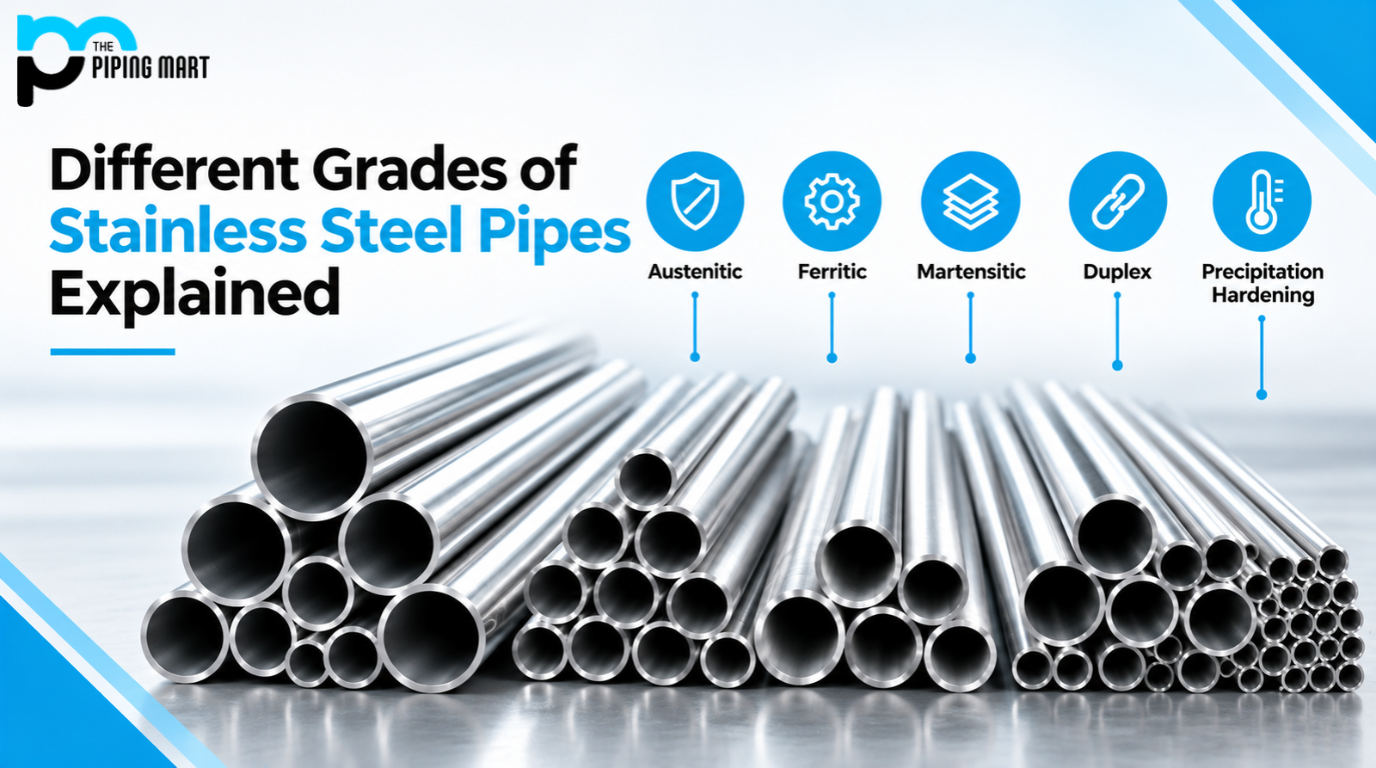
Stainless steel pipes come in a wide range of grades, each defined by chemical composition, microstructure, mechanical properties, corrosion resistance, and temperature performance. These differences separate five major families: Austenitic, Ferritic, Martensitic, Duplex, and Precipitation Hardening. Buyers evaluating stainless steel pipes need to understand which family and grade actually fits their application.
What Are Stainless Steel Pipe Grades?
A grade identifies the chemical composition of a pipe and the attributes that come from that. Chromium is the main ingredient for corrosion resistance of stainless steel, although nickel and other alloying elements affect the microstructure and properties of various grades. The addition of molybdenum and nitrogen improves the resistance to certain types of corrosion, and the carbon content influences the strength, the sensitization behavior, and the weldability.
Stainless Steel Pipe Families and Their Grades
The five major families classify grades in terms of microstructure. Austenitic grades like 304 and 316 are very commonly used for industrial applications because of their superior corrosion resistance, formability, and weldability. Ferritic grades such as 409 and 430 are magnetic stainless steels with chromium as their principal alloying element. Martensitic grades, like 410 and 420, are strengthened by heat treatment. Duplex grades are a mix of austenite and ferrite. Precipitation hardening grades like 17-4 PH are high-strength grades with regulated heat treatment.
Austenitic Stainless Steel Pipes
Austenitic grades are the most widely used stainless steel family, valued for good corrosion resistance, formability, and weldability across a broad range of industries.
SS 304 / 304L Stainless Steel Pipes
SS 304 Pipe: Offers good corrosion resistance, formability, and weldability for general-purpose applications.
SS 304L Pipe: Features a lower carbon content, reducing the risk of sensitization after welding.
Common Applications: Suitable for food processing, water systems, architectural structures, and general industrial applications.
SS 316 / 316L Stainless Steel Pipes
SS 316 Pipe: Contains molybdenum, which improves resistance to pitting and crevice corrosion in chloride-containing environments compared with SS 304.
SS 316L Pipe: Features a lower carbon content, helping reduce the risk of sensitization after welding.
Common Applications: Suitable for marine, chemical, pharmaceutical, and food processing industries.
SS 310 / 310S Stainless Steel Pipes
310/310S delivers strong high-temperature performance and oxidation resistance and is used in furnaces, heat-treatment equipment, and other elevated-temperature applications.
Stainless Steel 321 Pipes
Stainless Steel 321 Pipe is a titanium-stabilized grade pipe suited to elevated temperatures, valued where resistance to sensitization matters. 321 is a titanium-stabilized austenitic grade used for elevated-temperature service in applications such as process equipment, heat-transfer equipment, and aerospace components.
Ferritic Stainless Steel Pipes
Ferritic grades carry chromium as their main alloying element, are magnetic, and offer solid corrosion resistance for selected industrial environments at generally lower cost than austenitic grades.
Stainless Steel 409 Pipes
Stainless Steel 409 Pipe is made up of a chromium-based ferritic grade offering oxidation and corrosion resistance, commonly used in automotive exhaust applications.
Stainless Steel 430 Pipes
SS 430 pipes offer good corrosion resistance in many mild environments, is magnetic in nature, and are suited to general industrial, architectural, and equipment use.
Stainless Steel 446 Pipes
SS 446 pipe carries high chromium content for strong resistance to oxidation at elevated temperatures and is used in furnace components and high-temperature industrial applications.
Martensitic Stainless Steel Pipes
Martensitic grades are defined by their ability to reach higher strength and hardness through heat treatment, trading some corrosion resistance for mechanical performance.
Stainless Steel 410 Pipe
The strength, hardness, and corrosion resistance of SS 410 pipes help in valves, pumps, and industrial mechanical equipment.
Stainless Steel 420 Pipe
Stainless Steel 420 Pipe has higher carbon than 410, may obtain higher hardness with heat treatment, and is good for wear-resistant mechanical parts.
Stainless Steel 440 Pipes
A high-carbon martensitic grade that can attain high hardness and wear resistance following appropriate heat treatment, for use in specific mechanical applications.
Duplex Stainless Steel Pipe
Duplex grades have a two-phase microstructure of austenitic and ferritic properties that give a good mix of strength and corrosion resistance.
Duplex 2205 Stainless Steel Pipes
A commonly used duplex type is Duplex 2205 Stainless Steel Pipe, having high strength and good resistance to chloride-related corrosion and stress corrosion cracking. Used in oil and gas, chemical processing, maritime, and desalination pipes.
Super Duplex 2507 Stainless Steel Pipes
Improved alloy levels over normal duplex grades for offshore, seawater handling, chemical processing, and desalination applications with improved corrosion resistance.
Precipitation Hardening Stainless Steel Pipes
Precipitation-hardening grades reach high strength through controlled heat treatment that develops fine precipitates within the microstructure.
17-4 PH Stainless Steel Pipes
Also known as UNS S17400, this grade combines high strength with useful corrosion resistance, and its properties can be tuned through different heat-treatment conditions. It suits aerospace, power generation, chemical processing, pumps, and valves wherever high mechanical strength is the priority.
Stainless Steel Pipe Grades Comparison
This comparison table outlines the primary stainless steel pipe families, key grades, core mechanical properties, and common industrial applications.
| Family | Common Grades | Key Characteristics | Typical Applications |
| Austenitic | 304, 304L, 316, 316L, 310, 321 | Corrosion resistance, weldability, formability | Food, chemical, pharmaceutical, industrial |
| Ferritic | 409, 430, 446 | Magnetic, chromium-based, oxidation resistance | Automotive, architectural, high-temperature |
| Martensitic | 410, 420, 440 | Strength, hardness, wear resistance | Pumps, valves, mechanical components |
| Duplex | 2205, 2507 | High strength and corrosion resistance | Oil & gas, marine, chemical, desalination |
| Precipitation Hardening | 17-4 PH | High strength and useful corrosion resistance | Aerospace, power, engineering |
How to Choose the Right Stainless Steel Pipe Grade?
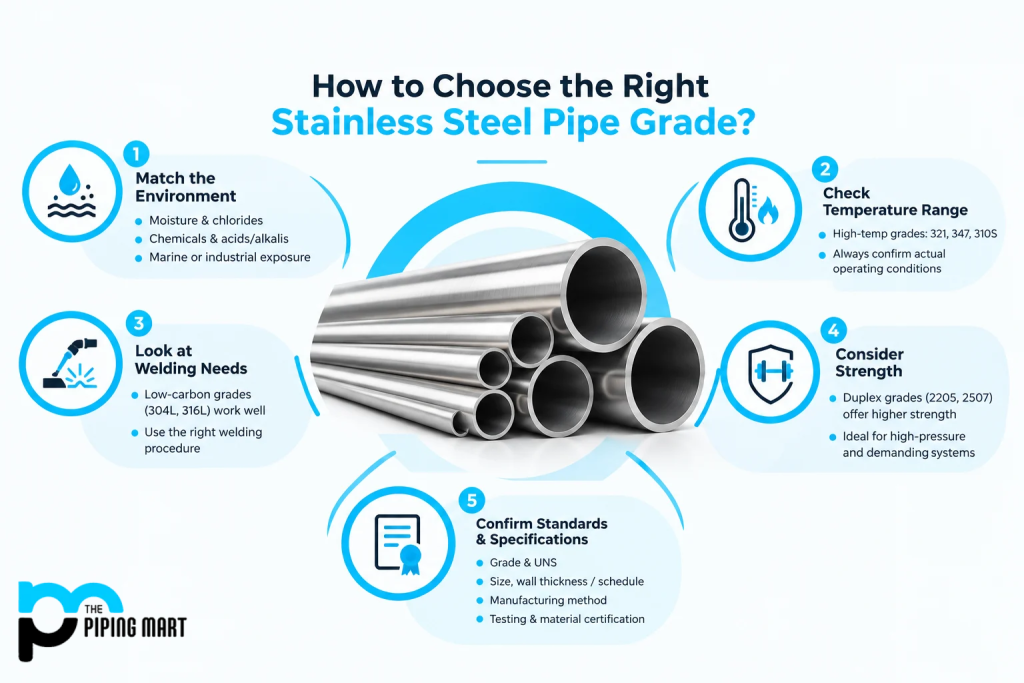
Selecting SS pipe grades comes down to a handful of factors evaluated together rather than any single property.
Consider the Corrosive Environment
Identify exposure to moisture, chlorides, seawater, acids, alkalis, and process chemicals. 304 may suit general environments, while 316, duplex, or 904L suit more demanding conditions.
Check Operating Temperature
321, 347, and 310S suit elevated-temperature applications, though actual operating temperature and exposure duration should always be evaluated directly.
Consider Welding Requirements
Low-carbon grades like 304L and 316L suit welded piping, provided the welding procedure is compatible with the chosen grade.
Evaluate Strength Requirements
Duplex grades like 2205 and 2507 offer higher strength than many conventional austenitic grades, relevant in high-pressure, mechanically demanding systems.
Verify Standards and Specifications
Confirm the grade and UNS designation, pipe size, wall thickness or schedule, manufacturing method, surface condition, testing requirements, and material certification before ordering.
Conclusion
At The Piping Mart, we connect buyers, suppliers, manufacturers, and exporters of stainless steel pipes and other industrial items. By knowing the differences between 304, 316, 321, 310, duplex, ferritic, martensitic, and precipitation-hardening grades, buyers may specify their needs before contacting the vendors concerned.
Before sourcing, buyers should confirm with the selected supplier the grade, appropriate pipe standard, dimensions, manufacturing technique, testing requirements, certification, and service conditions necessary.
FAQs About Stainless Steel Pipe Grades
What are the most common stainless steel pipe grades?
Commonly used grades include SS 304, 304L, 316, 316L, 321, 310, and Duplex 2205, with the right choice depending on the application.
What is the difference between SS 304 and SS 316 pipes?
304 does not contain molybdenum that 316 adds; hence, it has better resistance in chloride conditions than normal 304.
Which stainless steel pipe grade is suitable for high-temperature applications?
SS 310/310S and SS 321 are often used for environments that have an elevated temperature duty, although the final decision should be based on the actual conditions of operation.
Are ferritic stainless steel pipes magnetic?
Yes, ferritic stainless steels are magnetic in general due to their ferritic crystal structure.
How should I select the right stainless steel pipe grade?
The selection shall be based on corrosion exposure, temperature, pressure, mechanical requirements, welding and fabrication requirements, dimensions, and applicable standards.