Stainless steel bars carry loads in shafts, fasteners, pins, machined components, and structural supports across fabrication and engineering work. Size and weight decide what you order, what you pay for, and how you move it, since mills and suppliers price bars by the kilogram rather than by the piece. Weight shifts with cross-sectional shape, dimensions, cut length, and the density of the grade supplied. A reliable stainless steel bars size and weight chart ensures accuracy at the estimation stage.
What Are Stainless Steel Bars?
Stainless steel bars are solid long products rolled, forged, or drawn to a fixed cross-section and supplied in straight lengths for machining and fabrication. Four cross-sections dominate industrial supply: round, square, hexagonal and flat.
Round sections go into shafts, pins, studs and turned components. Square and hexagonal stock feeds fastener and tool manufacturing, in which the flats provide a gripping surface. Flat bar suits brackets, base plates and support frames.
Grade choice determines corrosion performance and, to a smaller degree, weight. SS 304 holds roughly 18% chromium and 8% nickel, covering general fabrication and architectural work. SS 316 adds 2 to 3% molybdenum for chloride resistance. Density separates the two only slightly: 7.93 against 7.98 g/cm³.
Stainless Steel Bar Size Chart
The stainless steel bar size chart below groups commercial sizes by shape. Weight per metre is calculated at 7.93 g/cm³, with standard mill lengths running 3 to 6 metres.
| Shape | Dimension Range | Standard Length | Common Sizes | Approx. Weight per Metre |
| Round bar | 3 to 300 mm diameter | 3 to 6 m | 10 / 20 / 25 / 50 mm | 0.62 / 2.49 / 3.89 / 15.57 kg |
| Square bar | 6 to 150 mm side | 3 to 6 m | 10 / 20 / 25 / 50 mm | 0.79 / 3.17 / 4.96 / 19.83 kg |
| Hexagonal bar | 6 to 75 mm across flats | 3 to 6 m | 12 / 17 / 19 / 25 mm | 0.99 / 1.99 / 2.48 / 4.29 kg |
| Flat bar | 10 to 400 mm wide, 3 to 60 mm thick | 3 to 6 m | 25×6 / 50×6 / 50×10 / 100×10 mm | 1.19 / 2.38 / 3.97 / 7.93 kg |
Hexagonal stock is measured across flats, never across the corner, and flat bar size states width before the thickness. Quote stainless steel round bars by diameter and cut length together, as stockists cut from 6 metre bars and bill the offcut.
Stainless Steel Round Bar Weight Chart
Round bar weight rises with the square of the diameter, not in direct proportion to it. A 50 mm bar weighs four times a 25 mm bar of equal length. The stainless steel bar weight chart below shows the weight per metre and the total for 6 metres.
| Diameter | Length | Approx. Weight per Metre | Total Weight (6 m) |
| 6 mm | 6 m | 0.22 kg | 1.35 kg |
| 8 mm | 6 m | 0.40 kg | 2.39 kg |
| 10 mm | 6 m | 0.62 kg | 3.74 kg |
| 12 mm | 6 m | 0.90 kg | 5.38 kg |
| 16 mm | 6 m | 1.59 kg | 9.57 kg |
| 20 mm | 6 m | 2.49 kg | 14.95 kg |
| 25 mm | 6 m | 3.89 kg | 23.36 kg |
| 30 mm | 6 m | 5.61 kg | 33.63 kg |
| 40 mm | 6 m | 9.97 kg | 59.79 kg |
| 50 mm | 6 m | 15.57 kg | 93.42 kg |
Figures apply to SS 304. For SS 316 round bars, add about 0.6% for the higher density.
How to Calculate Stainless Steel Bar Weight
Weight follows from cross-sectional area, length, and density:
Weight per metre (kg) = Cross-sectional area (mm²) × Density (g/cm³) ÷ 1,000
Area is what changes with shape:
- Round bar: 0.7854 × D²
- Square bar: S²
- Hexagonal bar: 0.866 × (A/F)²
- Flat bar: Width × Thickness
A 25 mm SS 304 round bar gives 0.7854 × 625 = 490.9 mm². Multiply by 7.93, divide by 1,000: 3.89 kg per metre, or 23.36 kg over 6 metres. The same arithmetic covers stainless steel flat bars.
Factors Affecting Stainless Steel Bar Weight
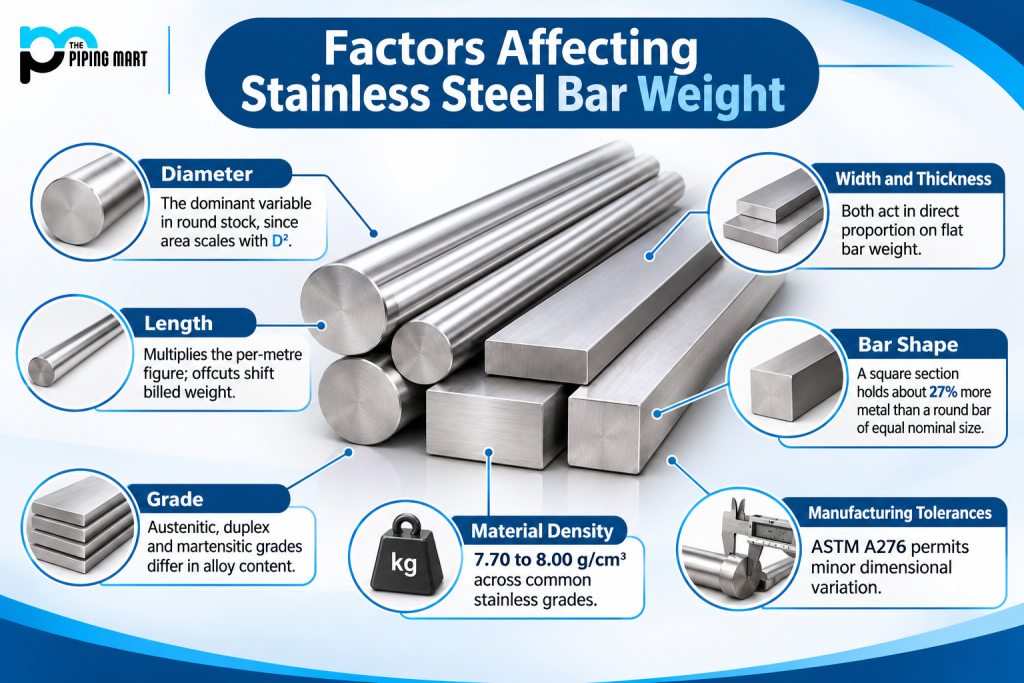
- Diameter: the dominant variable in round stock, since area scales with D².
- Width and thickness: both act in direct proportion on flat bar weight.
- Length: multiplies the per-metre figure; offcuts shift billed weight.
- Bar shape: a square section holds about 27% more metal than a round bar of equal nominal size.
- Grade: austenitic, duplex and martensitic grades differ in alloy content.
- Material density: 7.70 to 8.00 g/cm³ across common stainless grades.
- Manufacturing tolerances: ASTM A276 permits minor dimensional variation.
Stainless Steel Bar Size vs Weight
Larger cross-sections raise weight per metre, though the relationship is rarely linear. Shape sets the gap, as a comparison at one nominal size shows.
| Shape at 25 mm | Cross-Sectional Area | Approx. Weight per Metre | Weight vs Round Bar |
| Round bar | 490.9 mm² | 3.89 kg | Baseline |
| SS 304 hex bar | 541.3 mm² | 4.29 kg | +10.3% |
| Square bar | 625.0 mm² | 4.96 kg | +27.5% |
Equal lengths can therefore differ by more than 25% in billed weight purely on cross-section
Supplied weight also drifts from chart values. Tolerance bands and straightening introduce small variation, so treat theoretical weight as a costing estimate and the mill test certificate as the delivered record.
Conclusion
Confirm cross-section, dimensions, cut length, weight per metre, grade and applicable specification before releasing a purchase order. Theoretical charts cover estimation, costing and freight planning with enough accuracy for most procurement decisions. Final billing should rely upon verified mill documentation and the tolerance class stated on the order.
Frequently Asked Questions
1. What are the standard sizes of stainless steel bars?
Round bars run 3 to 300 mm in diameter, square sections 6 to 150 mm, hexagonal stock 6 to 75 mm across flats, and flats 10 to 400 mm wide, with thicknesses of 3 to 60 mm. Standard lengths are 3 to 6 metres.
2. How is the weight of a stainless steel bar calculated?
Multiply the cross-sectional area in mm² by density in g/cm³, then divide by 1,000 for weight per metre. For a round bar, area equals 0.7854 × D². A 25 mm SS 304 bar gives 3.89 kg per metre.
3. What factors affect the weight of stainless steel bars?
Cross-sectional dimensions, cut length, bar shape, grade, and density all change the result. Tolerances under ASTM A276 add small variation, so delivered weight can sit marginally above or below the calculated figure.
4. What is the difference between stainless steel bar size and weight?
Size states physical dimensions in millimetres, such as diameter, side or width, and thickness. Weight is the derived mass in kilograms, obtained from those dimensions, the length supplied, and the density of the grade.
5. Why is a stainless steel bar size and weight chart useful?
It converts dimensions into billed kilograms without manual calculation, supporting costing, freight planning, handling load limits, and accurate material take-offs before an enquiry reaches the stockist.