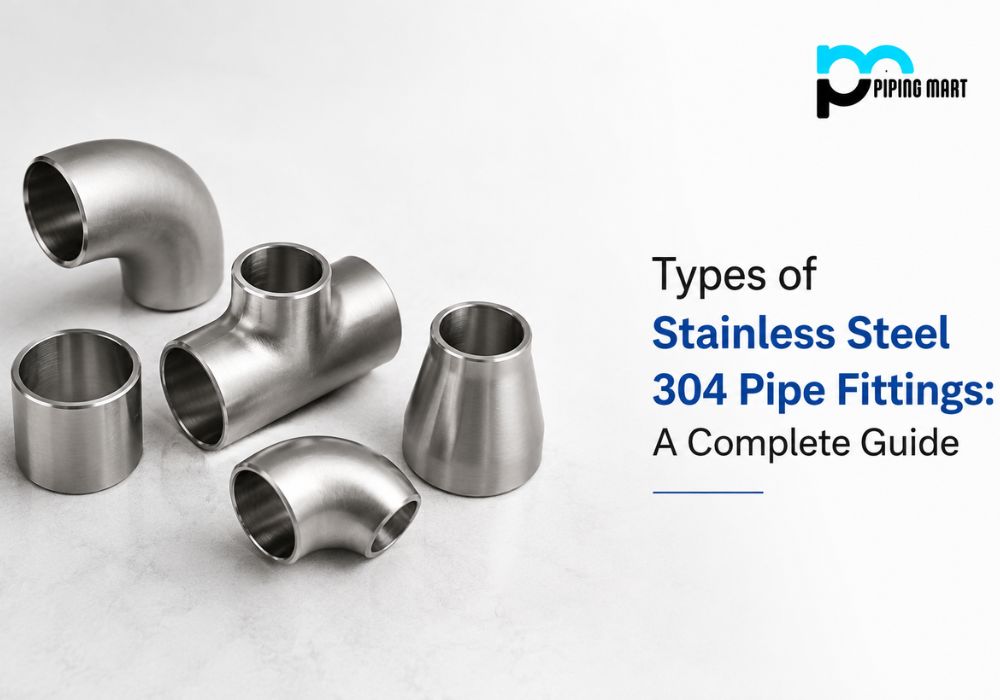
Stainless steel 304 pipe fittings are used in chemical, food processing, pharmaceutical, and general industrial pipelines. They connect pipes, change flow direction, split or combine flow lines, and close off pipe ends. SS 304 is a widely used grade because it handles corrosion reasonably well, stays within a practical cost range, and meets most standard piping specifications. Before selecting any fitting, it helps to know what types are available, how each is installed, and where each type is typically applied. This guide covers all major categories of stainless steel 304 pipe fittings directly and practically.
What Are Stainless Steel 304 Pipe Fittings?
Pipe fittings are parts that join, redirect, branch, or end sections of a pipe system and are made of stainless steel 304. They are made of SS 304, which is an austenitic grade with approximately 18% of chromium and 8% of nickel. This composition provides a good degree of corrosion resistance, particularly in moist and mild acid and oxidizing environments. Fittings come in various pressure ratings, end types, and dimensions, including ASME B16.9, B16.11, and MSS SP-83. They are manufactured either by forging or by the fabrication of plates and pipes. They come in a variety of sizes, from small (half-inch) to large-diameter industrial parts. The majority are accompanied by mill test reports and are supplied to ASTM A403 or A182 specifications.
Types of SS 304 Pipe Fittings
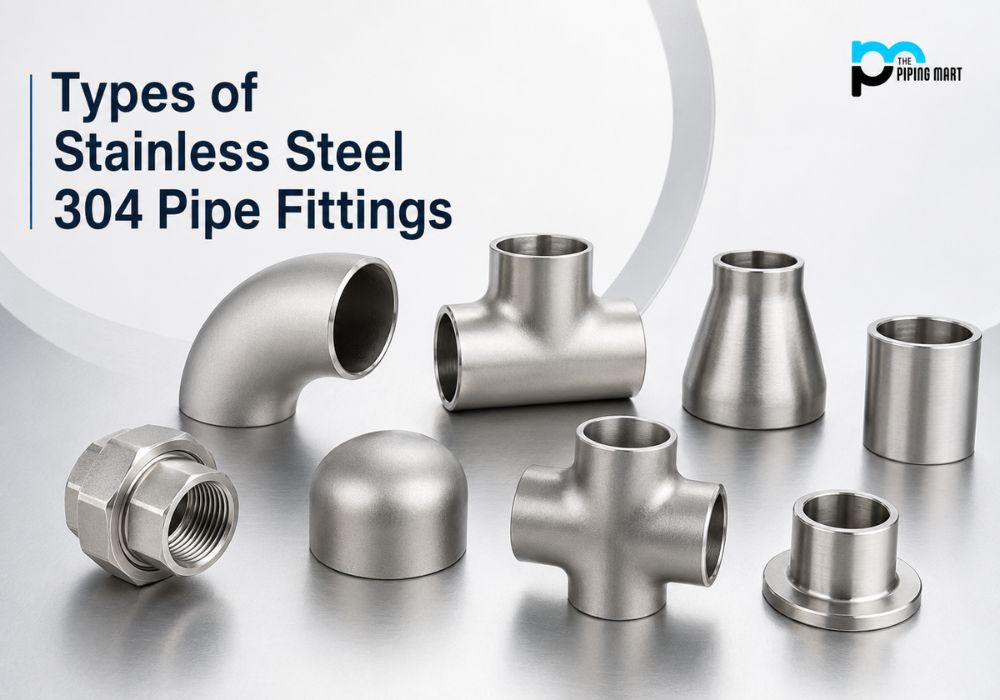
SS 304 pipe fittings are broadly divided based on their manufacturing method and connection type. The two main categories are butt weld fittings and forged fittings. Within each category, there are several sub-types suited to different piping configurations and pressure requirements.
Butt Weld Pipe Fittings (Permanent and High Strength)
Butt-weld SS 304 fittings are joined to pipes by welding the fitting end directly to the pipe end. These are permanent connections and are generally preferred in high-pressure or high-temperature systems where leak-free joints are critical. They are manufactured to ASME B16.9 and are available in seamless or welded construction. Because the joint becomes part of the pipeline itself after welding, butt weld fittings are structurally strong and are commonly used in oil, gas, petrochemical, and power generation pipelines.
SS304 Elbow
The SS304 elbow changes the direction of flow in a pipeline. It is available in 45-degree and 90-degree configurations and also in long-radius and short-radius types. Long-radius elbows (1.5D) are the standard choice in most industrial systems because they reduce pressure drop. Short-radius elbows (1D) are used where space is limited. Both are welded directly to the pipe.
Tees (Equal and Reducing)
A tee fitting splits or combines flow at a branch point. Equal tees have the same diameter on all three ends. Reducing tees have a smaller branch diameter than the main run. Both types are used when a pipeline needs to branch off in a perpendicular direction. They are welded at all three ends and supplied to ASME B16.9.
Reducers (Concentric vs Eccentric)
Reducers connect pipes of different diameters. Concentric reducers are symmetrical and used in vertical pipelines. Eccentric reducers are offset on one side and are used in horizontal lines to maintain a flat bottom, which prevents air pockets or liquid accumulation, depending on the service. Choosing the wrong type can cause operational issues, so the application matters here.
Stub Ends and Caps
Stub ends are used with lap joint flanges, mostly in systems that need frequent dismantling. The stub end is welded to the pipe, and the flange rotates freely around it. Caps are used to close off the open end of a pipe. Both are straightforward fittings, but they are important where pipeline terminations or flanged joints are involved.
Forged Stainless Steel Fittings
Forged stainless steel fittings are manufactured through a forging process that produces a dense, grain-refined structure. They are stronger than cast fittings of similar dimensions and are typically used in smaller pipe sizes, up to 4 inches, though some go higher. These fittings comply with ASME B16.11 and are rated for higher pressure classes such as Class 3000, 6000, and 9000. They are common in instrumentation lines, hydraulic systems, and any place where compact, high-strength connections are required.
Socket Weld Fittings
Socket weld fittings have a socket or recessed area at the end into which the pipe is inserted before welding. The weld is applied on the outside, at the socket shoulder. These are used in smaller pipe sizes where full penetration butt welding is not practical. They provide a reasonably strong joint and are used in high-pressure, low-flow lines.
Threaded Fittings
Threaded forged fittings connect to pipes through NPT or BSP threads, without any welding. Installation is straightforward. They are mostly used in low-pressure, non-critical lines or in temporary connections where the line may need to be disassembled. In corrosive environments, thread sealants are used to prevent leaks at the joint.
Threaded and Screwed Fittings
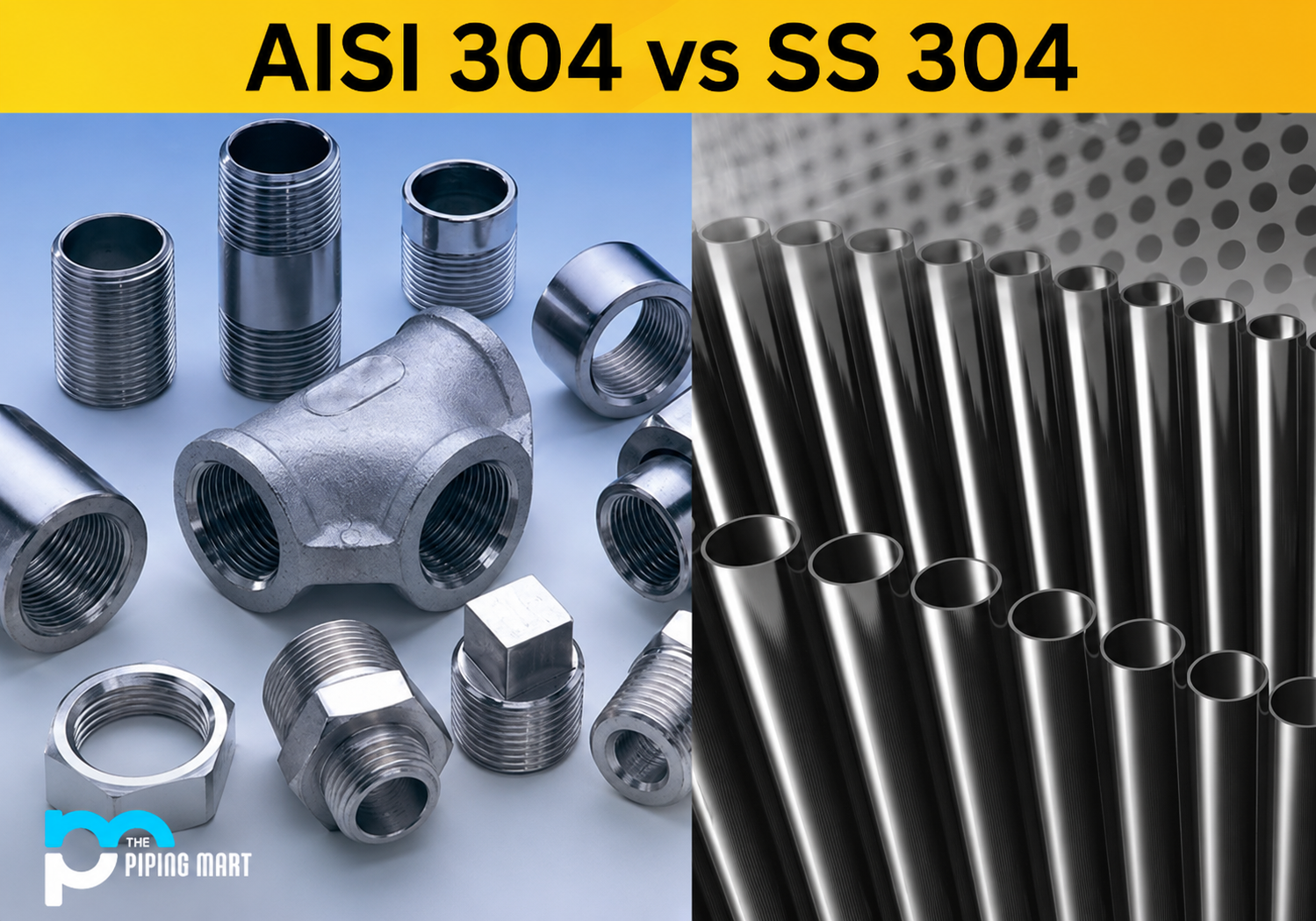
Forged type is not the only type of threaded fittings. A larger class of threaded and screwed 304 fittings comprises couplings, unions, bushings, nipples, and hex plugs. These are primarily used in instrument lines, utilities, and maintenance pipelines. They can be installed and removed with ease without the need for welding equipment. They are not, however, recommended for high-temperature or high-pressure systems and are typically specified for lower-rated service conditions.
Special and Custom SS 304 Fittings
In addition to the regular types, special or fabricated fittings may be needed for some projects. This includes swaged nipples, laterals, crosses, weld-o-lets, sock-o-lets, and custom-shaped transition pieces. Fabricated fittings are manufactured according to a drawing or specifications. Weld-o-lets and sock-o-lets are branch connection fittings that are used when a tee fitting cannot be fitted, for example, if there is a size difference or layout constraints. Applicable in larger-sized industrial pipelines or special process applications.
How to Choose the Right Type of SS 304 Pipe Fittings
The choice depends on several factors. First, check the pressure and temperature rating of the system. High-pressure lines generally need butt welds or forged socket weld fittings, not threaded types. Next, look at pipe size. Forged fittings are standard for smaller sizes; butt weld fittings are more practical above 2 inches. The connection method also matters, whether welding is available on-site or not. For systems that need periodic disassembly, unions or flanged stub-end connections are more practical than permanent welds. Also consider the medium flowing through the pipe. SS 304 is not suitable for chloride-heavy environments; in those cases, SS 316 would be more appropriate. Always cross-check the applicable standard before placing an order.
Common Mistakes When Selecting Pipe Fitting Types
One common mistake is using threaded fittings in high-pressure steam or process lines where butt weld connections are the correct choice. Another is specifying concentric reducers on horizontal lines where eccentric reducers are needed. Mixing pressure classes is also a problem; for example, connecting a Class 3000 fitting to a Class 150 system creates a weak point. Some buyers also overlook dimensional standards and order fittings that are not compatible with the pipe schedule they are using. Getting the end preparation wrong, such as ordering plain-end fittings when bevel ends are needed for welding, adds delays. Always review the complete piping specification before finalizing a fitting type.
Conclusion
The stainless steel 304 pipe fittings are available in different sizes, each with its own unique features and capabilities. For systems where the fitter will need to stay in the system and pressure is high, butt-welded fittings are the go-to fitting. Forged fittings are suitable for high-pressure, small-bore lines where space is limited. In utility or instrument applications using low pressures, threaded and screwed fittings can be used. It is important to take proper care in choosing the right type, which is not difficult if the operating conditions and installation requirements are specified in advance. Avoid the return of the material, rework, and on-site delays by getting the specifications correct up front. When in doubt, always ask the project piping class or contact the supplier before ordering.
FAQs
What is the difference between buttweld and forged fittings?
Welded fittings are made from pipe or plate and are installed in the pipeline by joining end-to-end. They are used in larger pipes and higher-pressure systems. Forged fittings are fabricated by forging techniques, and they are normally applied in smaller sizes that connect by socket weld or thread. Forged fittings typically have more grain in their structure and higher working pressures per size.
What standards apply to SS 304 pipe fittings?
Butt weld fittings are normally furnished to ASME B16.9 with the material grade of ASTM A403 WP304. Forged socket weld and threaded fittings are made to ASME B16.11, and the material is to ASTM A182 F304. Other applicable standards are MSS SP-43 (Lightweight Fittings) and MSS SP-83 (Unions).
Where are forged stainless steel fittings used?
In a hydraulic system, instrumentation line, chemical injection system, and high-pressure small-bore pipelines, forged stainless steel fittings are often employed. They are also commonly used in offshore and subsea applications where small, strong connections are needed. Forged fittings are found in sanitary grade piping systems in pharmaceutical and food processing facilities, where the inside of the pipes is a shiny surface.