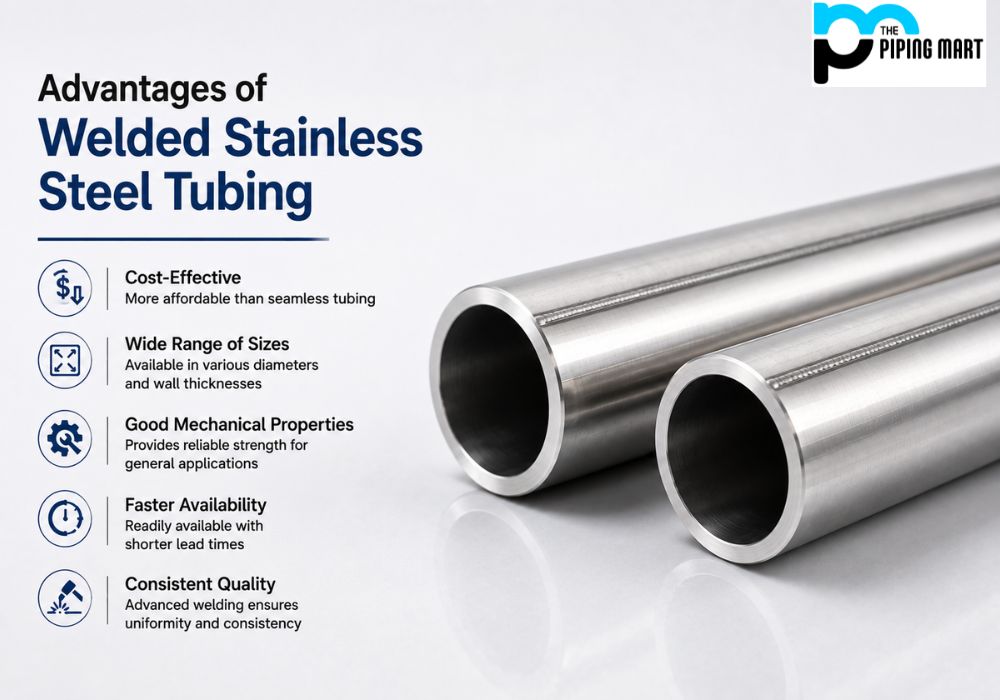
Engineers and procurement teams keep coming back to welded stainless steel tubing for a simple reason: it does the job without pushing the budget up. Whether you are speccing a process line or sourcing material for a structural project, the choice between welded and seamless tubing shapes affects cost, lead time, and final performance. Welded steel tubing has come a long way from being seen as the “cost-effective option.” Modern welding methods, tighter quality control, and better inspection have made welded tubing a genuine first choice in many applications, not just a fallback. This page looks at what welded stainless steel tubing actually is, where it performs well, and why so many buyers now list it as their default rather than an alternative.
What Is Welded Stainless Steel Tubing?
Welded stainless steel tubing is made by rolling a flat strip of stainless steel into a round or shaped profile and then joining the seam using a welding process, usually TIG or laser welding, for tighter tolerances. Once welded, the seam is often smoothed, and, depending on the application, the tube may go through further finishing, such as annealing or polishing. This method allows manufacturers to produce long, consistent lengths of tubing at a lower cost compared to seamless production. Stainless steel welded tubes are used across a wide set of industries because the process gives good control over wall thickness and diameter, which matters when you are ordering in bulk.
Key Advantages of Welded Stainless Steel Tubing
There are a few reasons buyers keep choosing welded tubing over seamless. Some of it comes down to cost, some to how the material performs once installed.
Lower Manufacturing Cost
Welded tubing costs less to produce because the process uses flat strip stock rather than a solid billet that has to be pierced and drawn. Less raw material waste and fewer production steps bring the price down. For large orders, this difference adds up quickly and shows up directly on the quote.
Wider Availability and Faster Lead Times
The welding process is quicker and more uniform than seamless production, and most steel tubing suppliers do welding and have larger stocks of steel tubing and can fill orders faster. Welded tubing may be the preferred option if the tubing is required in a hurry.
Excellent Dimensional Accuracy
The wall thickness and outer diameter can be controlled well in the rolling and welding process. Such consistency is important for applications where the tubing is to be fitted into a fixed fitting or connected to an existing system without further machining.
Availability in Larger Diameters
The larger the diameter, the harder and more costly it will be to produce seamless tubing. Welded tubing is not subject to this limitation and is more readily available in large sizes at little extra cost.
Consistent Surface Finish
Welded tubes go through finishing steps that give a smooth, even surface both inside and out. This matters in food, beverage, and pharmaceutical lines where a rough or inconsistent finish can trap residue.
Reliable Performance for Most Industrial Applications
For pressures and temperatures found in most standard industrial systems, welded tubing performs just as well as seamless. Seamless tubing still has its place in extreme pressure or safety-critical applications, but for general use, welded tubing holds up fine.
Industrial Applications of Welded Stainless Steel Tubing
Welded stainless steel tubing shows up in more places than people expect once you start looking. Below are the sectors where it gets used most.
Food and Beverage Processing
Welded tubing is suitable for pipes that carry liquids, dairy, or beverages because of its smooth interior surfaces and corrosion resistance. A tube with no pits or rough spots inside makes cleaning and sanitation easier.
Pharmaceutical Systems
The pharmaceutical industry requires tubing that is contamination-resistant and can withstand multiple cycles of sterilisation for manufacturing. Welded stainless steel tubes are well-suited for this purpose, particularly when the tubes are finished to sanitary standards.
Architectural and Structural Projects
The welded tubing is often used for handrails, balustrades, and structural framing because of its consistent length, diameter, and surface finish for visible installations.
Automotive Manufacturing
Welded steel tubing is the preferred material choice for vehicles’ exhaust systems and structural parts because of its strength-to-weight ratio. It also has good weldability and bendability in production, which is important.
Water Treatment Systems
Corrosion resistance is the key cause here. Welded tubing handles exposure to water and chemical treatment processes without breaking down, which keeps maintenance costs down over the life of the system.
Conclusion
Welded stainless steel tubing offers very good cost and performance characteristics. It is lower in cost, easier to buy in bulk, and performs well in industrial applications such as food processing lines and structural fittings. Seamless tubing still has a place where extreme pressure ratings are non-negotiable, but for the majority of applications, welded tubing does the job without the added expense. If you are working with welded steel tubing suppliers, it is worth checking their finishing process and quality checks, since these affect how the tubing performs once it is installed.
FAQs
Is welded stainless steel tubing strong enough for industrial use?
Yes. For most standard industrial pressures and loads, welded tubing performs reliably. Modern welding techniques close the gap that used to exist between welded and seamless strength ratings, so unless you are dealing with extreme pressure, welded tubing works fine.
Why is welded tubing less expensive than seamless tubing?
Welded tubing is manufactured from a flat strip, rolled and welded together, which uses less raw material and fewer production processes than seamless tubing drawn from a solid billet. This cost saving is reflected in the price.
How Welded Stainless Steel Tubing Is Manufactured
A flat stainless steel strip is rolled up to form a tube, and the seam is welded with TIG welding or laser welding. The weld is then smoothed, and the tube can be annealed or polished for a uniform finish, depending on the use.
Can welded tubing resist corrosion effectively?
Yes. The stainless steel used in welded tubing carries the same corrosion resistance as the base material. As long as the weld is done properly and finished well, there is no weak point that corrodes faster than the rest of the tube.
How do I choose between welded and seamless tubing?
It depends on your application. For standard pressures, if you need faster lead times at a lower cost, welded tubing is generally the better choice. The seamless tubing is the better option for extreme pressure or safety-critical systems.