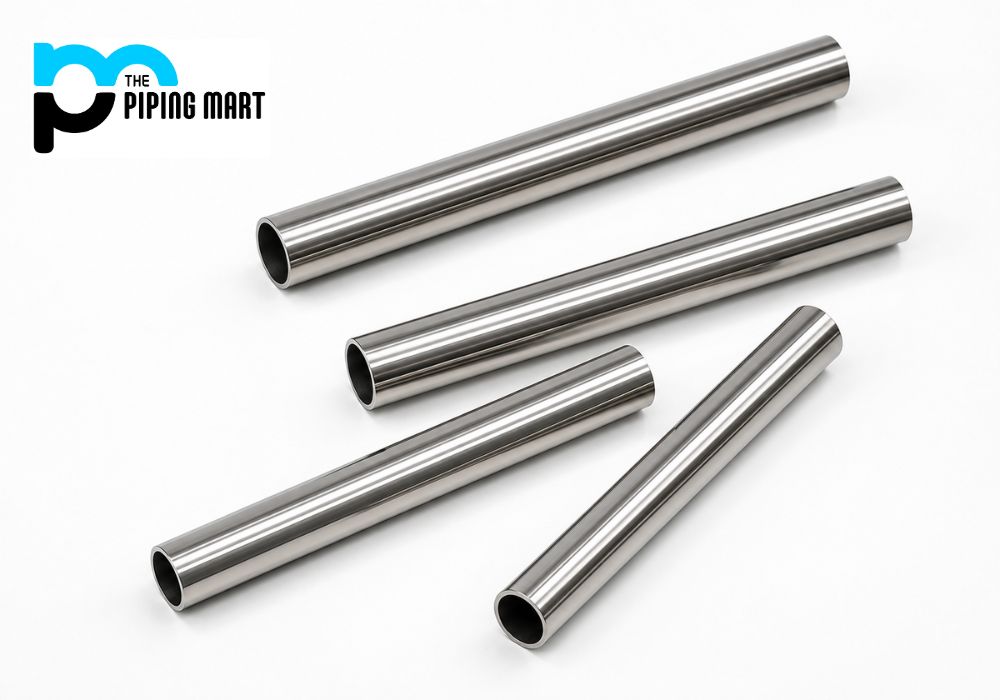
Stainless steel 304 tubes are widely used in various industries and commercial applications like food processing, chemical handling, construction, HVAC systems, and general fabrication work, as they provide a consistent combination of corrosion resistance, strength, and formability. Understanding these properties of SS 304 tubes is useful when choosing materials based on various working conditions. This blog covers the mechanical, physical, and chemical properties of stainless steel 304 tubing in simple and useful terms, without depending too heavily on technical data sheets.
What is Stainless Steel 304 Tubing?
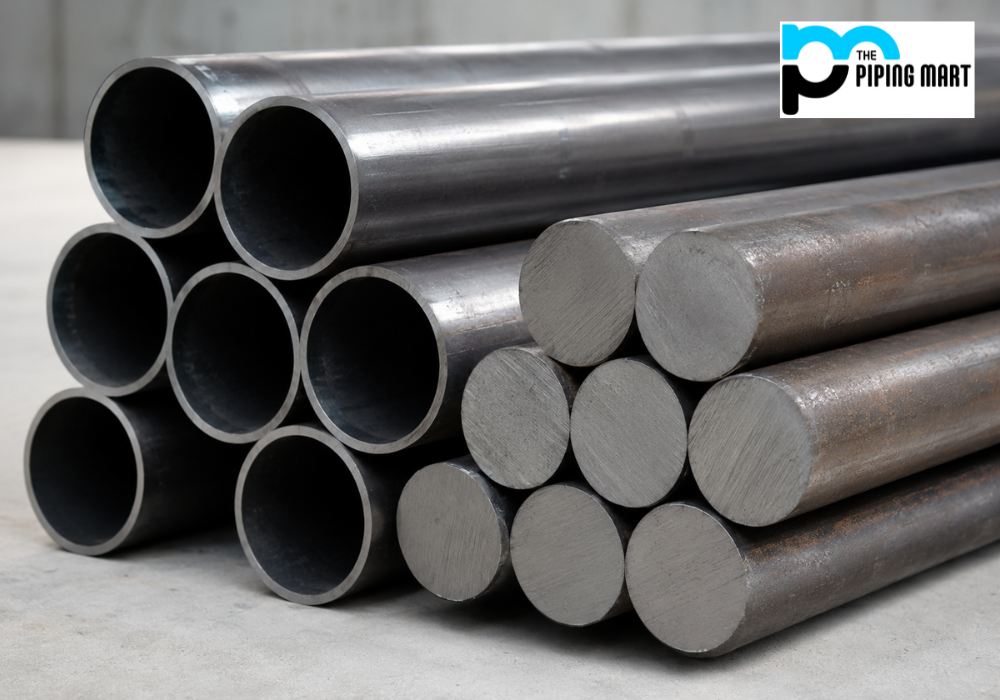
SS 304 tubes are the hollow cylindrical components manufactured from grade 304 stainless steel, an austenitic alloy based on 18% chromium and 8% nickel. The tubes are manufactured in both seamless and welded types and are available in various outer diameters and wall thicknesses. Grade 304 is highly resistant to atmospheric corrosion without surface treatment; it can also withstand moderate heat and can be easily welded.
Mechanical Properties of Stainless Steel 304 Tubing
The mechanical properties of stainless steel 304 tubes are impacted based on their pressure rating, loads, stress, and repetitive use.
Tensile strength and yield strength.
The minimum tensile strength of SS 304 tubing is 515 MPa, and the yield strength is approximately 205 MPa. The numbers represent the degree of stress the material will withstand before it starts to permanently deform or fail. These values will provide sufficient results for most general industrial and structural applications.
Elongation and Ductility
The minimum elongation of grade 304 is 40% in a 50 mm gauge length. The ductility is such that the tubing can be bent, formed and drawn into all kinds of shapes without cracking. It is a cooperative grade for making shapes when compared with higher-carbon or ferritic grades.
Hardness and Impact Resistance
The Brinell hardness value of SS 304 tubing is normally 201 HB, and the Rockwell B hardness is about 92. Austenitic stainless steels have a high impact resistance. Grade 304 has good toughness at low temperatures, which in turn makes it useful in refrigeration and cryogenic applications.
Fatigue Strength in Tubing Applications
Under reversed bending conditions, the fatigue strength of the 304 stainless steel tubes is about 210 MPa. This value is relevant for applications where pressure cycling or vibration occurs repeatedly, such as for hydraulic lines or heat exchangers. Not a high-fatigue-duty material as per the specialist criteria; however, it will cope with typical cycling loads in most commercial applications.
Physical Properties of SS 304 Tubing
These properties cover how the material behaves in terms of weight, heat, and electrical response. They are separate from how it handles mechanical load and are particularly useful when designing systems that involve thermal cycling, heat transfer, or weight restrictions.
Density and Weight Advantages
The density of SS 304 tubing is approximately 8.0 g/cm³. It is slightly heavier than carbon steel, but the difference rarely causes problems in practice. What tips the balance is that grade 304 does not need protective coatings or linings in most environments. Carbon steel pipe in the same service might need epoxy lining, galvanising, or paint, all of which add weight, cost, and maintenance. On a lifecycle basis, the density difference becomes less significant.
Thermal Conductivity
The thermal conductivity is around 16.2 W/m·K at 100°C. That is considerably lower than carbon steel and much lower than copper. In heat exchanger design, this has real consequences. Slower heat transfer means you generally need more surface area to achieve the same duty. Engineers factor this in at the design stage by adjusting tube length, bundle size, or flow configuration. It is not a problem unique to 304; it applies to stainless steels in general.
Electrical Resistivity
Grade 304 has an electrical resistivity of roughly 72 µΩ·cm at room temperature. Stainless steel is not a conductor in any useful sense, and this grade is no exception. In most installations, that is simply not relevant. Where it does matter is in systems where stray electrical currents could drive galvanic corrosion. The tubing’s increased resistivity limits current flow and reduces risk when compared to more conductive metals.
Melting Point and Thermal Expansion
The melting range for stainless steel 304 tubing runs from about 1400°C to 1450°C. For most service environments, this is more than sufficient. The thermal expansion coefficient is around 17.2 µm/m·°C between 0°C and 100°C, which is higher than that of carbon steel. In long pipe runs or systems that cycle between hot and cold, that expansion adds up. Expansion loops, flexible connections, and proper support spacing are the standard ways to manage it. This is standard engineering practice, not a limitation specific to grade 304.
Chemical Properties of Stainless Steel 304
The composition of grade 304 is what drives everything else about it. As each element in the alloy plays a specific role, understanding what they do helps explain both the strengths and the limitations of the material.
- Carbon (Maximum 0.08%): The carbon content is maintained low. As high carbon content in stainless steel can cause chromium carbide to develop at grain boundaries during welding, pushing chromium away from those places and reducing local corrosion resistance. Keeping carbon at or below 0.08% reduces the risk in most standard welding situations.
- Chromium (18.0 to 20.0%): Stainless steel resists corrosion as it contains chromium. Chromium forms a thin protective oxide layer on the surface that prevents rust and corrosion. If the surface gets scratched or cut, the layer quickly repairs itself when exposed to oxygen. Without enough chromium, this protective layer cannot form properly.
- Nickel (8.0 to 10.5%): Nickel stabilises the austenitic microstructure at ambient temperature and contributes to ductility. It also improves resistance to certain reducing environments. Without enough nickel, grade 304 would shift toward a ferritic or martensitic structure with very different properties.
- Manganese (Maximum 2.0%): Manganese helps in deoxidation throughout the steelmaking process and stabilises the austenite phase. It is a supporting element, rather than a primary one.
- Silicon (Maximum 1.0%): Also acts as a deoxidant. At higher levels within this range, silicon can marginally improve oxidation resistance at elevated temperatures, though this is not a primary reason for its inclusion.
- Phosphorus (Maximum 0.045%) and Sulphur (maximum 0.030%): Both are controlled as impurities. Excess phosphorus reduces toughness, and high sulphur causes problems during hot working. Sulphur is intentionally raised in free-machining variants of 304, but that is a separate grade designation.
When it is considered together, these chemical properties of stainless steel 304 provide it with solid resistance to atmospheric corrosion, most organic acids, weak inorganic acids, and food-contact environments. Where it falls short is in chloride-heavy conditions. Seawater, marine spray, and road de-icing salts can cause pitting and crevice corrosion. Grade 316, with its molybdenum addition, is the standard step up for those situations.
How These Properties Impact Real-World Applications
Food & Beverage Industry
Most dairy lines, brewery pipework, and food processing equipment you will come across use SS 304 tubes. The surface can be finished to very low roughness values, which limits bacterial adhesion and makes cleaning easier. The material is compatible with most food acids, cleaning agents, and sanitising solutions used in these environments. It meets the hygiene requirements set by food safety standards without needing any additional coatings or treatments.
Chemical Processing
Grade 304 handles a reasonable range of chemicals, including dilute acids, alkalis, and many organic solvents. The limitation is chlorides. Any application involving chlorinated compounds, hydrochloric acid, or chloride-containing process streams should be evaluated carefully. In those cases, 316 is usually the safer specification. For the broader range of non-chloride chemical service conditions, 304 is used routinely and without issue.
Construction & Architecture
Handrails, balustrades, cladding frames, column covers, and curtain wall support systems are all common uses of SS 304 tubes in construction. In areas with moderate pollution, grade 304 maintains its surface in good condition. The one area to watch is coastal construction. Salt-laden air can cause surface staining and pitting over time. In those locations, either 316 or a surface treatment programme would be needed.
Heat Exchangers & Piping Systems
The mechanical properties of stainless steel 304 tubing are adequate for heat exchanger tube bundles operating at moderate temperatures and pressures. The lower thermal conductivity compared to copper is a design consideration, not a disqualifier. Water treatment plants, HVAC systems, and general process piping regularly use grade 304 for these duties. Where temperatures are high or fluid chemistry is aggressive, the grade selection would need to be reviewed against those specific service conditions.
Conclusion
The Stainless steel 304 tubing provides better strength, stability, and corrosion resistance, which makes it suitable for various industrial and commercial applications. The key properties of SS 304, including tensile strength, ductility, corrosion resistance, and thermal performance, help engineers choose it effectively for most applications. However, in environments with high chloride levels (like marine or de-icing salt exposure), a higher-grade alloy such as 316 is usually a better choice. For most other conditions, SS 304 remains a reliable and cost-effective option.
FAQs
What are the main properties of stainless steel 304 tubing?
The SS 304 has better corrosion resistance, solid tensile strength, high ductility, and reasonable performance at elevated temperatures. The 18% chromium content forms a self-repairing passive layer that resists rust in most environments. The 8% nickel keeps the microstructure austenitic, which contributes directly to the ductility and non-magnetic behaviour of the material in its annealed condition.
What are the mechanical properties of stainless steel 304 tubing?
The material offers a minimum tensile strength of 515 MPa, yield strength of 205 MPa, and elongation of 40%, providing good strength, formability, and impact resistance for pressure and load-bearing applications.
Is SS 304 tubing corrosion-resistant?
Yes. In most standard environments, it is. The chromium in the alloy forms a passive oxide film that prevents ongoing corrosion in atmospheric and many chemical service conditions. The material performs well against water, food acids, cleaning chemicals, and weak industrial acids. It does not perform well in environments with significant chloride content. Seawater and de-icing salt exposure can cause localised pitting. Grade 316 should be specified for those conditions.
What are the physical properties of SS 304 tubing?
Density is approximately 8.0 g/cm³. The melting range runs from 1400°C to 1450°C. The thermal conductivity is around 16.2 W/m·K at 100°C, and the thermal expansion coefficient is approximately 17.2 µm/m·°C.