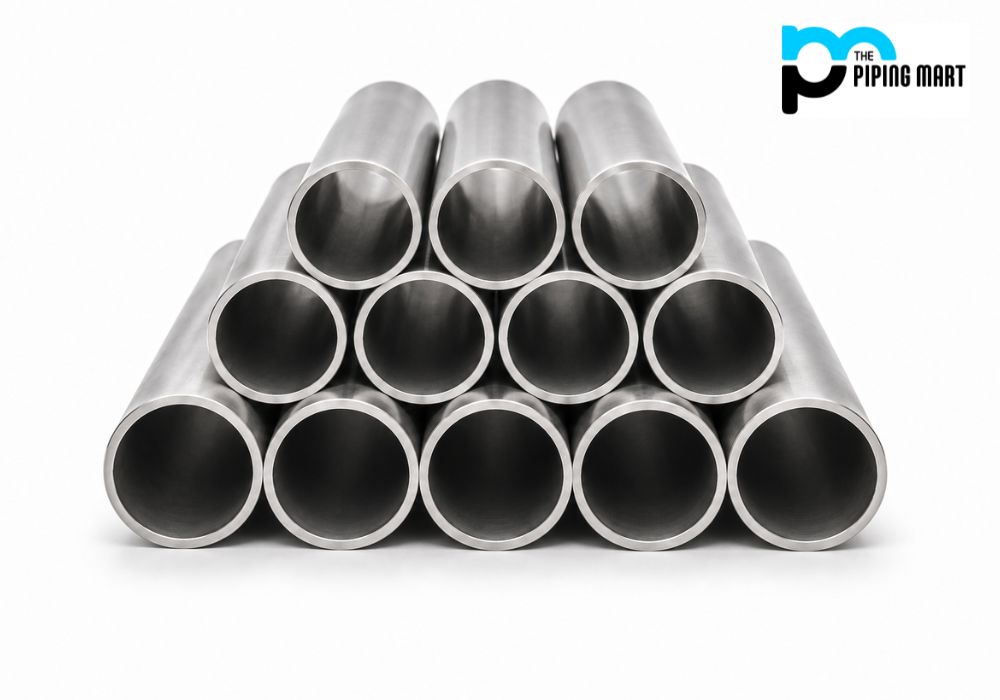
The selection of the right tube for a project depends on precise dimensional and weight information. Stainless steel 304 tubes are extensively used in industries such as food processing, chemical handling, oil and gas, and construction. The grade provides a reliable combination of corrosion resistance and mechanical strength. For engineers, procurement teams, and fabricators, understanding the appropriate 304 stainless steel tube dimensions, wall thicknesses, and weight per metre is essential to avoid ordering mistakes, support load calculations, and ensure compliance with project specifications. This guide covers the specifications of size charts, weight charts, and schedule data in one place, allowing you to quickly and easily cross-check sources without needing to refer to multiple sources.
Understanding Stainless Steel Tube Dimensions
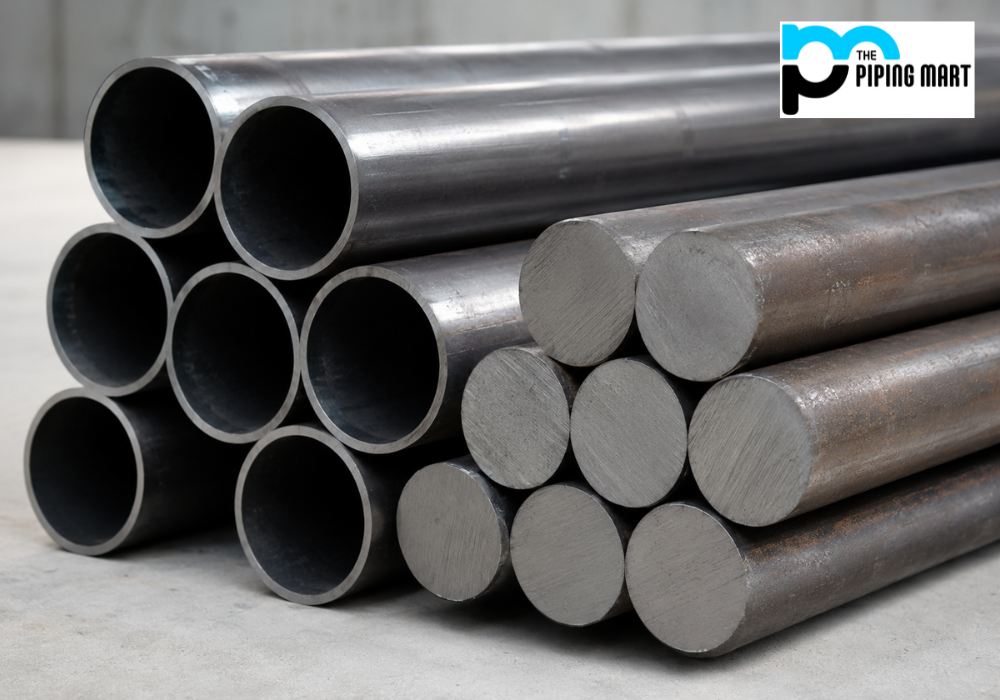
The dimensions of stainless steel tubes are defined by three fundamental parameters, i.e., outer diameter (OD), wall thickness (WT), and length. The OD is the measurement across the outside of the tube, whereas the wall thickness is the amount of material between the outside and inner surfaces. The inner diameter (ID) is simply the outside diameter minus twice the wall thickness. Unlike pipes, which are sized according to nominal pipe size (NPS) and schedule, SS 304 tubes are often defined by actual OD and wall thickness. The difference matters when ordering, as the same NPS can correlate to different actual ODs depending on the standard being used. Always confirm whether you require tube or pipe sizing before placing an order.
Stainless Steel 304 Tubes Size Chart
Below is a reference chart covering common OD sizes, wall thickness options, available lengths, and dimensional tolerances for stainless steel 304 tubes.
| OD (inch) | OD (mm) | Common Wall Thicknesses | Standard Lengths | Tolerance |
| 1/8″ | 10.3 | 0.035″, 0.049″ | 6 m, 12 m, or cut length | OD ±0.005″ to ±0.010″, wall ±10% to ±15% |
| 1/4″ | 13.7 | 0.049″, 0.065″ | 6 m, 12 m, or cut length | OD ±0.005″ to ±0.010″, wall ±10% to ±15% |
| 3/8″ | 17.1 | 0.049″, 0.065″ | 6 m, 12 m, or cut length | OD ±0.005″ to ±0.010″, wall ±10% to ±15% |
| 1/2″ | 21.34 | 0.065″, 0.083″, 0.109″ | 6 m, 12 m, or cut length | OD ±0.005″ to ±0.010″, wall ±10% |
| 3/4″ | 26.67 | 0.065″, 0.083″, 0.113″ | 6 m, 12 m, or cut length | OD ±0.010″, wall ±10% |
| 1″ | 33.40 | 0.065″, 0.109″, 0.133″ | 6 m, 12 m, or cut length | OD ±0.010″, wall ±10% |
| 1 1/4″ | 42.16 | 0.065″, 0.109″, 0.140″ | 6 m, 12 m, or cut length | OD ±0.010″ to ±0.015″, wall ±10% |
| 1 1/2″ | 48.26 | 0.065″, 0.109″, 0.145″, 0.154″ | 6 m, 12 m, or cut length | OD ±0.010″ to ±0.015″, wall ±10% |
| 2″ | 60.33 | 0.065″, 0.109″, 0.154″ | 6 m, 12 m, or cut length | OD ±0.010″ to ±0.015″, wall ±10% |
| 3″ | 88.90 | 0.120″, 0.216″, 0.300″ | 6 m, 12 m, or cut length | OD ±0.015″, wall ±10% |
| 4″ | 114.30 | 0.120″, 0.237″, 0.337″ | 6 m, 12 m, or cut length | OD ±0.015″, wall ±10% |
| 6″ | 168.28 | 0.134″, 0.280″, 0.432″ | 6 m, 12 m, or cut length | OD ±0.030″; wall ±10% |
| 8″ | 219.08 | 0.148″, 0.322″, 0.500″ | 6 m, 12 m, or cut length | OD ±0.030″; wall ±10% |
Note: Wall thickness availability may vary by manufacturer and stock. Tolerances are indicative and should be confirmed against the applicable ASTM or EN standard for the specific tube product. Custom lengths are available on request from most suppliers.
Stainless Steel 304 Tubes Weight Chart
The table below gives approximate weights per metre for SS 304 tubes at commonly used wall thicknesses. These figures are based on a stainless steel density of approximately 7,930 kg/m³.
| OD (in) | OD (mm) | Wall Thickness | Approx. Weight (kg/m) |
| 1/8″ | 10.3 | 0.8 mm | 0.15 |
| 1/4″ | 13.7 | 0.8 mm | 0.21 |
| 3/8″ | 17.1 | 0.8 mm | 0.27 |
| 1/2″ | 21.3 | 1.2 mm | 0.59 |
| 3/4″ | 26.7 | 1.2 mm | 0.77 |
| 1″ | 33.4 | 1.6 mm | 1.28 |
| 1 1/4″ | 42.2 | 1.6 mm | 1.65 |
| 1 1/2″ | 48.3 | 1.6 mm | 1.88 |
| 2″ | 60.3 | 1.6 mm | 2.45 |
| 2 1/2″ | 73.0 | 2.0 mm | 3.79 |
| 3″ | 88.9 | 2.0 mm | 4.66 |
| 4″ | 114.3 | 2.0 mm | 6.06 |
| 6″ | 168.3 | 2.0 mm | 9.00 |
| 8″ | 219.1 | 2.0 mm | 11.85 |
Note: Weight values are approximate and calculated for the wall thickness listed. If your application uses a different wall thickness, recalculate using the formula in the next section. Actual weights may vary slightly depending on manufacturing tolerances and surface finish.
Standard Formula for Stainless Steel Tube Weight Calculation
Pipe and tube weight calculation is straightforward once you have the outer diameter, wall thickness, and length. There are two commonly used methods, depending on the level of precision required and the unit system being used.
The Fundamental Geometric Formula
The accurate method uses the cross-sectional area of the tube wall multiplied by length and material density. Where OD is the outer diameter, t is the wall thickness, L is the length, and rho is the density of stainless steel, the weight (W) is expressed as follows:
W = (pi/4) x (OD² – ID²) x L x rho
Since ID = OD – 2t, this simplifies to:
W = pi x (OD – t) x t x L x rho
In industrial practice, a simplified version is used for quick estimation. For metric units where OD and t are in millimetres and the result is in kg/m:
Weight (kg/m) = (OD – t) x t x 0.02466
The constant 0.02466 accounts for material density and unit conversion. For imperial units where OD and t are in inches and the result is in lb/ft:
Weight (lb/ft) = 10.69 x (OD – t) x t
Tools and Methods to Simplify Weight Calculation
Online tube weight calculators are the quickest option for one-off checks. You enter the OD, wall thickness, and length, and the tool gives you the weight instantly. Most supplier websites and engineering portals offer these free of charge.
Spreadsheet templates with the metric or imperial formula pre-built are useful if you are calculating weights for multiple sizes at once. They reduce manual errors and let you compare different wall thickness options side by side.
For procurement or fabrication settings, referencing a pre-calculated weight chart (like the one above) is often faster than recalculating each time. These charts work well when you are working with standard sizes and thicknesses that do not change often.
Factors Affecting Tube Weight
Outer diameter is the primary driver of tube weight. A larger OD means more material per unit length, even before factoring in wall thickness. Two tubes with the same OD but different wall thicknesses can have meaningfully different weights.
Wall thickness directly determines how much material is present in the cross-section. Thicker walls add weight per metre proportionally. Choosing a heavier schedule purely for pressure resistance when a lighter one would suffice increases material cost and structural load.
Material density varies slightly between stainless steel grades. SS 304 has a density of around 7,930 kg/m³. If you are comparing tubes across different alloy grades, the density difference should be factored into weight calculations.
Surface finish and coating, if applicable, add negligible weight in most cases but can be relevant for very long tube runs or large-diameter tubes with thick coatings.
Stainless Steel Tube Schedule Chart
The stainless steel tube schedule chart below covers Schedule 10S, 40S, and 80S for NPS 1/2″ through 12″, showing OD, internal diameter, and wall thickness for each schedule.
| NPS | OD (mm) | SCH 10S ID (mm) | SCH 10S WT (mm) | SCH 40S ID (mm) | SCH 40S WT (mm) | SCH 80S ID (mm) | SCH 80S WT (mm) |
| 1/2″ | 21.3 | 17.1 | 2.11 | 15.7 | 2.77 | 13.7 | 3.73 |
| 3/4″ | 26.7 | 22.5 | 2.11 | 20.9 | 2.87 | 19.1 | 3.81 |
| 1″ | 33.4 | 28.0 | 2.77 | 26.6 | 3.38 | 24.2 | 4.57 |
| 1 1/4″ | 42.2 | 36.4 | 2.77 | 35.1 | 3.56 | 32.5 | 4.83 |
| 1 1/2″ | 48.3 | 42.8 | 2.77 | 40.9 | 3.69 | 38.2 | 5.08 |
| 2″ | 60.3 | 54.5 | 2.77 | 52.4 | 3.92 | 49.3 | 5.54 |
| 2 1/2″ | 73.0 | 66.0 | 3.05 | 62.8 | 5.16 | 58.9 | 7.01 |
| 3″ | 88.9 | 82.8 | 3.05 | 77.8 | 5.49 | 73.7 | 7.62 |
| 4″ | 114.3 | 107.2 | 3.05 | 102.3 | 6.02 | 97.1 | 8.56 |
| 6″ | 168.3 | 162.7 | 2.77 | 154.1 | 7.11 | 146.3 | 10.98 |
| 8″ | 219.1 | 213.3 | 2.77 | 207.0 | 8.18 | 200.3 | 12.70 |
| 10″ | 273.1 | 267.2 | 3.05 | 259.7 | 9.28 | 248.5 | 12.70 |
| 12″ | 323.9 | 317.9 | 3.05 | 310.5 | 9.53 | 298.5 | 12.70 |
Note: SCH 10S is a light-wall option suited for lower-pressure applications. SCH 40S is the standard schedule used in general-purpose piping systems. SCH 80S has a thicker wall and is used where higher pressure ratings or additional mechanical strength are required. All values are in millimetres unless stated otherwise. Verify against ASME B36.19M for exact specifications.
How to Select the Right Tube Size and Weight
Start with your application requirements, specifically the pressure rating, fluid or gas type, and temperature range. These will determine the minimum wall thickness and, by extension, the appropriate schedule. For structural applications, the load-bearing requirement will guide the OD and wall selection. Cross-check the selected dimensions against the weight per metre to ensure compatibility with your support structure or transport logistics. Always confirm whether the project specifies tube by OD and wall thickness or by NPS and schedule, as mixing these up is a common source of ordering mistakes. If weight is a constraint on a project, a lighter schedule with a larger OD can sometimes achieve the same flow capacity at a lower total weight.
Common Mistakes in Tube Size and Weight Selection
One of the more frequent errors is confusing tube and pipe sizing. The pipes follow NPS, where the nominal size does not directly match the actual OD, while tubes are specified by actual OD. Another common mistake in weight calculations is using the incorrect density constant, especially when converting between metric and imperial values. Using an improper formula constant can lead to considerable errors in weight calculations. Relying on catalogue weights without accounting for tolerance bands is also problematic, as actual weights can deviate by several percent from the nominal figure depending on manufacturing variation.
Conclusion
The right size and weight information for stainless steel 304 tubes is crucial, especially from the design and procurement phases to the installation. The charts and formulas contained in this guide range in values for a majority of industries. Verify dimensions are available via the size chart, check material loads via the weight chart and correlate wall thickness with pressure requirements through the schedule chart. If a size or weight is not covered, it can be calculated directly by the standard formula. Suppliers listed on the Piping Mart supply a wide selection of product types and specifications to help you meet project demands for sourcing SS 304 Tubes in a variety of sizes and schedules.
FAQs
How do you calculate the weight of stainless steel 304 tubes accurately?
To accurately calculate the weight of stainless steel 304 tubes, you can use this simple metric formula: Weight (kg/m) = (OD – t) x t x 0.02466, where OD and t are in millimetres. This formula includes the density of SS 304 (8,000 kg/m³ is used because it is approximately 7,930 kg/m³). This formula is often built into a spreadsheet so you can enter OD and wall thickness and get the tube weight automatically, without doing the calculation by hand every time.
How does wall thickness affect stainless steel tube performance?
The thicker the wall, the higher the pressure rating and the stronger the tube will be. It also increases the load per metre and decreases the inner bore, thereby reducing the flow capacity. To choose the right wall thickness, it is necessary to consider weight, flow and pressure requirements. The thicker the wall, the more material it requires to be produced, but no real value is gained.
Are SS 304 tubes available in custom lengths?
Yes, most of the manufacturers and stockists provide standard lengths of 6 m and 12 m of SS 304 tubes and further offer cut-to-length tubes as well. Standard lengths are available, but custom lengths are generally available and may require a minimum quantity. When ordering customised lengths, the lead time should be confirmed, as these are normally manufactured separately from stock items.
Why Do Size and Weight Matter in SS 304 Tube Selection?
The size of the tube determines its fit to the connection points, flow rate capabilities and pressure requirements. Weight is an issue with structural support design, transportation and installation, particularly for larger projects with long tube runs. If either of these is performed incorrectly at the procurement stage, it causes issues further down the line, which will lead to increased manufacturing costs and be time-consuming.
Why is it important to refer to a stainless steel tube weight chart before purchasing?
The weight chart can be used to check the required weight or meter before ordering. This is specifically for large amounts, where even a slight change between the estimated and actual weight can have a major impact on freight charges or structure loading calculations. It also can determine if a lighter schedule or reduced OD would perform as well, while being lighter and less expensive to manufacture.