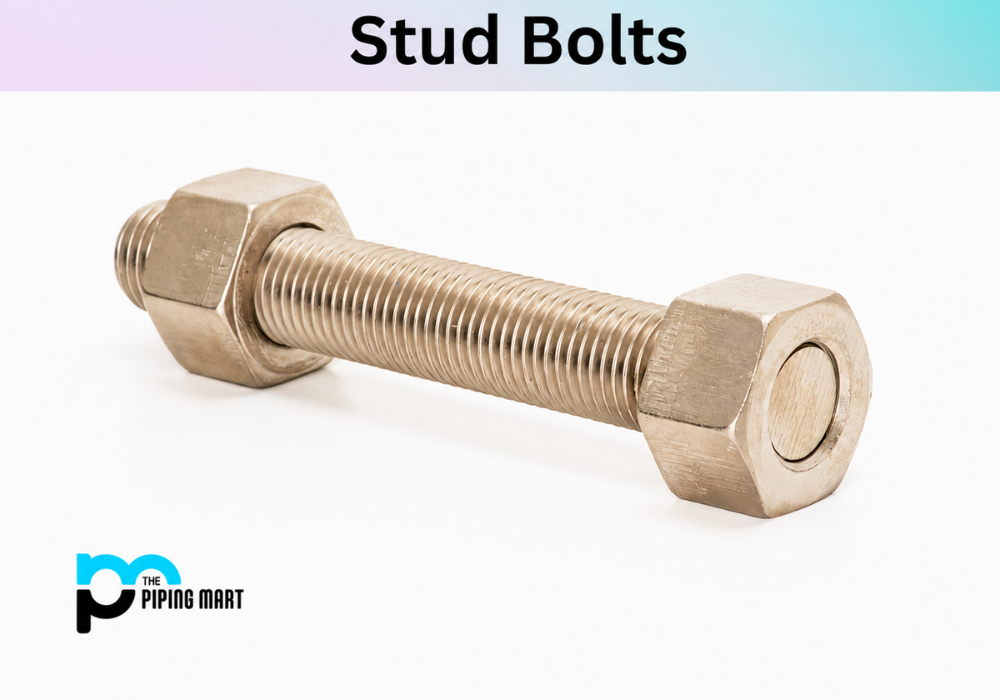
What is a Stud Bolt?
A stud bolt is a headless, externally threaded fastener that connects two or more components under high-load situations. Unlike normal bolts, it lacks a head; instead, both ends are threaded, and nuts are used at one or both ends to secure the assembly. Stud bolts are commonly used in pipes, flanges, pressure vessels, and industrial equipment where a strong, dependable connection is required. They are available in different materials, thread types, and sizes, and must follow standards like ASTM A193 and ASME B16.5, depending on how they are used. Their design helps spread the load evenly across the joint, which is very crucial in high-pressure and high-temperature conditions.
Stud Bolt Standards & Specifications
The stud bolts are produced and shipped in accordance with international standards that define their dimensions, material grades, mechanical properties, and thread specifications. The commonly used standards are ASME B16.5 for flange bolting dimensions, ASME B18.2.1 for inch-series fastener dimensions, ASTM A193 for alloy steel and stainless steel bolting materials intended for high-temperature or high-pressure operation, and ASTM A320 for low-temperature applications. Thread types are usually based on ASME B1.1 for unified inch threads (UNC, UNF, and 8UN), and ISO 261 for metric threads. The material and strength requirements of stud bolts can change depending on how and where they are used. Stud bolts are usually supplied with matching nuts that meet the ASTM A194 standard.
Stud Bolt Sizes and Dimensions
Stud bolts are used in pipes, flanges, and pressure vessels to provide strong, high-tension connections. They adhere to standards such as ASME B16.5, ASME B18.2.1, ASTM A193, and ASTM A320 to ensure correct fit and performance. Sizes usually range from 1/4″ to 8″ (M6 to M152), with the most common sizes between 1/2″ and 4″. The length is chosen based on flange thickness, gasket, nuts, and how much thread must be engaged. Thread types include UNC, UNF, 8UN, and metric. Smaller sizes are used in low-pressure systems, while larger sizes are used in high-pressure systems.
| Pipe Size (NPS) | of Studs | Diameter | Length (mm) |
| 1/2 | 4 | 1/2″ | 55 |
| 1 | 4 | 1/2″ | 65 |
| 2 | 8 | 5/8″ | 75 |
| 4 | 8 | 3/4″ | 95 |
| 6 | 12 | 3/4″ | 110 |
| 12 | 20 | 1″ | 150 |
| 24 | 40 | 1-1/2″ | 240 |
Types of stud bolts
Stud bolts depend on the application, load requirements, and type of joint being built, as they are available in various configurations. The primary types of stud bolts used in engineering and industrial applications are listed below.
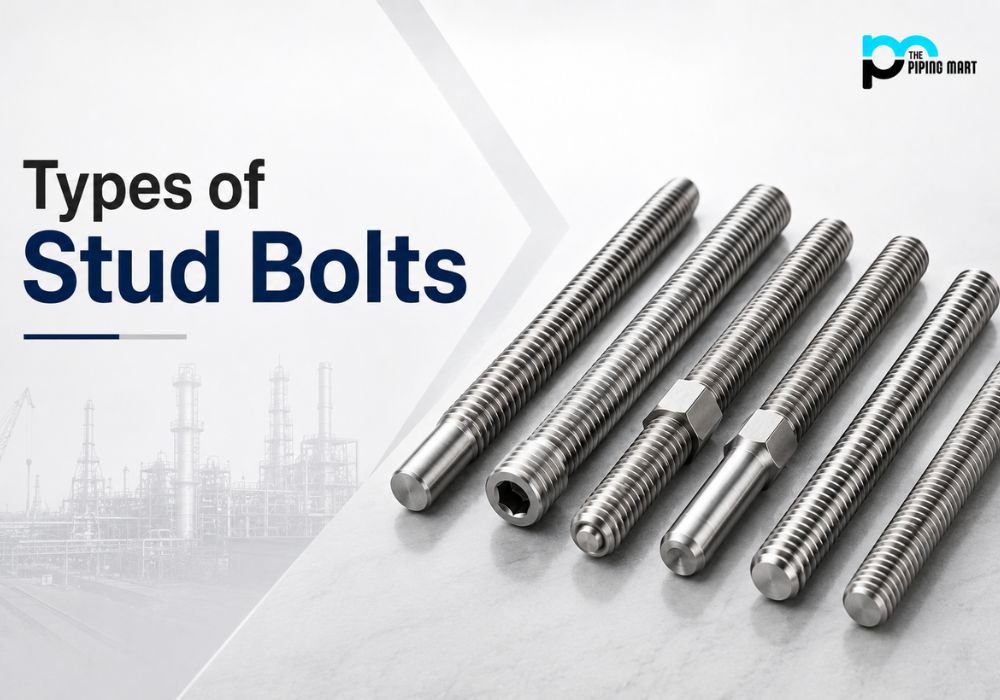
- Fully Threaded Stud Bolts
These are threaded across the full length, with no plain section in between. They are mostly used where both ends need nuts, and full engagement is required through the joint. You will see them in standard flange connections and general assemblies. They pass through the hole and are tightened from both sides.
- Partially Threaded Stud Bolts
Threads are only at the ends, and the centre portion is plain. That middle section takes some of the load and avoids high stress at the threads. These are used in flanges where a better fit inside the hole is needed. The plain shank also helps with alignment.
- Double-Ended Stud Bolts
Both ends are threaded, but one side is usually shorter. The shorter end goes into a tapped hole, and the longer side is left for a nut. These are common in valves, pumps, and pressure parts where one side stays fixed. You don’t remove the full stud during maintenance, just the nut side.
- Seamless Stud Bolts
Made from a single piece of bar, no joints or welds. The material stays consistent along the full length. These are used in high-pressure or high-temperature service where failure is not acceptable. Oil and gas setups often specify this type.
- Welded Stud Bolts
One end is welded directly to the base material using stud welding. The other end remains threaded for a nut. This is used in structural work, shipbuilding, and some automotive parts. It saves time during assembly since the stud stays fixed in place.
- Hexagon-Headed Stud Bolts
These have a hex head on one side. It helps during installation since you can use a spanner to tighten it into a threaded hole. Useful when access is limited and gripping a plain stud is difficult.
- Stud Bolts with Nuts
These are supplied as a set. The stud and nuts match in grade and fit. For example, B7 studs are often supplied with A194 2H nuts. This prevents errors during installation and ensures proper load while tightening.
- Shoulder Stud Bolts
A machined flat portion between the threads is referred to as the shoulder. This part mainly acts as a guide and can sometimes carry sideways (shear) forces. It is used in equipment where accurate alignment is very important, such as fixtures, dies, or rotating parts. The shoulder holds the components in position instead of depending on the threads.
Stud Bolt Material Grades
The choice of stud bolt material depends directly on the operating conditions, such as temperature range, pressure, corrosion exposure, and the media involved. Material grades are largely defined under ASTM standards, particularly ASTM A193 for elevated-temperature service and ASTM A320 for low-temperature applications.
Carbon Steel Stud Bolts
- B7: The most commonly used grade in industrial pipes. It is a chromium-molybdenum alloy steel (usually 4140 or 4142, quenched and tempered) with a minimum tensile strength of 125 ksi and a service temperature of up to 1,100°F. Combined with A194 2H heavy hex nuts.
- B7M: B7M is close to B7 in terms of composition, but the hardness is kept lower. That change is mainly to reduce the risk of stress corrosion cracking. This matters in sour service. If hydrogen sulphide (H₂S) is present, B7M is usually preferred over standard B7. It is commonly used in oil and gas systems where H₂S exposure cannot be avoided.
- ASTM A354 (BC, BD): ASTM A354 covers higher-strength alloy steel bolts. Grades BC and BD fall under this. Both are quenched and tempered. Grade BD goes up to a minimum tensile strength of 150 ksi. Because of that, it is used where the load is high, but there is limited space for larger bolt diameters. BC is lower in strength compared to BD but still stronger than many standard bolting grades.
- ASTM A540 (B21–B24): ASTM A540 includes grades B21 to B24. These are not general-purpose fasteners. They are used in specific cases, mainly power plants and pressure vessels. The material is alloy steel with very high strength. Mechanical properties are tightly controlled. These are usually selected only when standard grades are not enough.
Stainless Steel Stud Bolts
- B8 Class 1: B8 Class 1 is basic 304 stainless steel in the solution annealed condition. It gives good corrosion resistance. Yield strength is around 30 ksi, so it is not used where high strength is required. It is used more for moderate temperature service, and where corrosion matters more than load.
- B8 Class 2: B8 Class 2 is also 304, but it is strain hardened after annealing. That increases the yield strength to about 95 ksi. Identification is simple. There is an underline mark on the head or end. It is used when both strength and corrosion resistance are needed, but without moving to alloy steel.
- B8M Class 1: B8M Class 1 is 316 stainless, again in the solution annealed condition. The added molybdenum improves resistance to pitting and crevice corrosion, especially in chloride environments. This is common in marine service, offshore equipment, and chemical plants.
- B8M Class 2: B8M Class 2 is the strain-hardened version of 316. Strength is higher than Class 1. It is used in similar environments, but where the load is also higher. Corrosion resistance remains similar, just with better mechanical performance.
Alloy Steel Stud Bolts
- B16: A chromium-molybdenum-vanadium alloy steel used in high-temperature bolting, typically for service in the 751–1,100°F range. It shows less stress relaxation at elevated temperatures compared to B7, making it preferable in critical flange joints at high service temperatures.
- ASTM A320 L7: It is similar in composition to B7 but tested and certified for low-temperature service down to -150°F. Used in cryogenic pipelines, LNG equipment, and cold climate installations. Paired with A194 grade 4 or 7 nuts.
- ASTM A320 L7M: Low-temperature grade with restricted hardness, similar to the relationship between B7 and B7M. Used where both low-temperature performance and stress corrosion resistance are required simultaneously.
Stud Bolt Thread Types
The thread type on a stud bolt determines how it engages with nuts and tapped holes and must be matched correctly for the application, pressure class, and applicable standard. Below are the main thread forms used on stud bolts.
- ISO Metric Thread: This is the standard thread used in metric systems. It follows ISO 261 and ISO 965. Sizes are written with diameter and pitch, like M20 x 2.5. It is seen across most European and international equipment. It is common in general piping and process setups where metric dimensions are followed.
- ACME Thread: This has a trapezoidal shape with a 29-degree angle. It is not typical for regular stud bolts in piping. It is used where the load is high and movement is involved. For example, jacking screws, presses, and valve stems. The design handles force well and allows smooth movement under load.
- UNC Thread (Unified National Coarse): This is the most common inch-based thread used in stud bolts. It follows ASME B1.1. The thread spacing is wider, so there are fewer threads per inch. That helps during assembly. It goes in faster and reduces the chance of cross-threading. Widely used in flange connections, especially in North American systems.
- UNF Thread (Unified National Fine): This has more threads per inch compared to UNC. Because of that, it gives better strength over a shorter length. It is used where space is limited or where tighter adjustment is needed during tightening. Not as common as UNC for standard stud bolts, but still used in specific cases.
- 8UN Thread (Unified National 8-Thread Series): This is a fixed thread series with 8 threads per inch, no matter the diameter. It follows ASME B16.5. For stud bolts of 1 inch and above in flanged piping, this is usually the required thread. It gives a good balance between strength and ease of assembly. You will see it often in larger flange bolting.
- Whitworth Thread (BSW/BSF): This is an older British standard with a 55-degree angle. It follows BS 84. Not common in new systems. Still found in older plants, legacy equipment, and some British-standard fittings. Mostly comes up during maintenance or replacement work where the original thread form needs to be matched.
Stud Bolt Length (OAL vs FTF)
Stud bolts are fully threaded fasteners used in high‑pressure piping and flange joints. Their length is important for proper fit and even load. Two main measurements, OAL and FTF, are used to specify the correct length during manufacturing and installation.
- OAL Definition: Overall Length (OAL) measures the total end-to-end distance of the stud bolt, including all threads, any unthreaded shank, and end chamfers or points. It represents the physical dimension for complete assembly checks.
- FTF Definition: First-to-First (FTF) length measures from the first full thread on one end to the first full thread on the other end, excluding end-chamfers. This is the industry standard for flange bolting to guarantee thread engagement.
Key Differences
OAL includes end chamfers/points; FTF excludes them (typically OAL exceeds FTF by 1/4 to 1/2 inch). OAL suits manufacturing and total span verification; FTF is used for procurement and ASME B16.5 flange tables. FTF ensures consistent nut seating; OAL accounts for fabrication tolerances.
Stud Bolt Length Measurements: OAL vs. FTF
- Overall Length (OAL): Total length from one end to the other, including chamfers. Used to check dimensions during manufacturing.
- First to First Thread (FTF): Distance from the first full thread at one end to the first full thread at the other end. This is used when ordering bolts and is specified in ASME B16.5 tables.
Industry Standards (ASME B16.5)
- Piping Standard: ASME B16.5 specifies FTF lengths for stud bolts used in pipe flanges from Class 150 through Class 2500, based on flange rating and nominal pipe size.
- Length Calculation Formula: FTF is calculated by multiplying flange thickness, gasket thickness, nut height, and thread engagement allowance by two. This ensures full nut contact on both ends without excess protrusion.
Stud Bolt Coating Materials
Surface coatings on stud bolts are applied to improve corrosion resistance, reduce galling, or meet specific environmental and service requirements. The correct coating must be selected based on service temperature, chemical exposure, and installation conditions.
- Electrozinc Plating: A thin zinc layer applied by electroplating. Offers basic corrosion protection for indoor or low-moisture environments.
- Electro-Cadmium Plating: Provides strong corrosion resistance, especially in marine conditions, along with good lubricity. Now limited mainly to aerospace and defence due to environmental concerns.
- Hot-Dip Galvanising: Stud bolts are coated in molten zinc, forming a thick, durable layer. Ideal for outdoor use. Threads may need adjustment due to coating thickness.
- PTFE Coatings: A low-friction, chemical-resistant coating that improves bolt tightening and prevents corrosion.
- Phosphate Coating: Provides minor corrosion resistance and enhances lubricant or paint adherence. Common in automotive and general engineering.
- Electroless nickel plating: Ensures consistent coating, even on complex shapes. Provides good hardness, wear, and corrosion resistance.
- Zinc and Nickel Coating: Stronger than ordinary zinc plating, it provides improved corrosion resistance in severe conditions.
- Aluminium Coatings: It is suitable for high-temperature applications. Offers oxidation and corrosion protection.
- Silver Coating: Prevents galling at high-temperature and high-pressure circumstances. Also increases electrical conductivity.
- Zinc-Nickel Electrodeposited: Offers a uniform alloy coating with reliable corrosion protection.
- Dacromet: Zinc-aluminium coating has excellent corrosion resistance and no risk of hydrogen embrittlement.
- Geomet: A chromium-free variant of Dacromet with comparable protection and improved environmental compliance.
- XYLAN 1070: A fluoropolymer coating that decreases friction while resisting corrosion and chemicals.
- XYLAN 1024: It is similar to XYLAN 1070, which is often used for anti-galling in offshore applications.
- Xylar 1: High-performance coating with excellent corrosion and chemical resistance in harsh environmental conditions.
Stud Bolt Uses and Applications
Stud bolts are used in various industries where high-strength, reliable fastening is required in harsh operating conditions. The following are the primary application areas.
- Piping and Flanges (Oil & Gas / Petrochemical):
The most common use of stud bolts is to join pipe flanges so they form a tight, leak-free seal. These bolts (i.e, ASTM A193 B7 with A194 2H nuts) are commonly used in process piping, wellheads, and refineries, and meet ASME B16.5 standards for flange classes 150 to 2500.
- Heavy Machinery and Equipment:
Gearboxes, compressors, and other large machines use stud bolts to hold covers, housings, and pressure parts in place. Stud bolts provide an even clamping force, which is especially important when the equipment faces vibration or changing loads.
- Automotive Engines:
Used in cylinder head assemblies, exhaust manifolds, and turbocharger flanges. Stud bolts allow cylinder heads to be removed and reinstalled without disturbing the studs threaded into the engine block, improving repeatability and reducing thread wear.
- Construction and Infrastructure:
It is used in structural steel connections, anchor bolts for machinery bases, bridge components, and precast concrete assemblies. Hot-dip galvanised or heavy-duty coated stud bolts are used for outdoor and exposed structures.
- Power Plants and Turbines:
Used in steam turbine casings, heat exchangers, boiler flange connections, and pressure vessel covers. High-temperature grades such as B16 or A193 B7 are used where service temperatures exceed what standard carbon steel fasteners can handle.
- Marine and Shipbuilding:
Used in hull assemblies, bulkhead fittings, engine foundations, and seawater piping. Stainless steel or specially coated stud bolts are selected to handle the highly corrosive marine environment, where long-term resistance to salt water and humidity is essential.
Difference Between Stud Bolt, Bolt, and Threaded Rod
Stud bolts, bolts, and threaded rods all have external threads, but they are designed differently, work differently, and are used for different types of joints. The table below outlines the key differences across practical and engineering criteria.
| Feature | Bolt | Stud Bolt | Threaded Rod |
| Design | Head (hex, square, etc.) on one end; partial threading on the opposite end (fully threaded variants exist). | A fully or double-ended threaded rod, often headless with a central unthreaded shank for uniform stress. | Long rod fully threaded end-to-end; no head, uniform diameter. |
| Installation | Insert through aligned holes; nut/washer on threaded end; head bears against the surface. | One end tapped/screwed into substrate (e.g., flange); nut on free end; often pre-installed. | Nuts/couplings threaded anywhere along length; cuttable for custom spans. |
| Applications | General assembly, machinery, construction; high shear/tension loads. | Flange/pipeline bolting in petrochemicals and oil/gas; high-pressure sealing. | Structural framing, hangers, suspension, seismic bracing, and long-distance tension. |
| Length | Fixed standard lengths (e.g., 1-12 inches); not easily extended. | Shorter, precise (e.g., 2-20 inches); shank length matches assembly needs. | Very long/custom (feet to metres); sold in continuous lengths. |
| Materials | Carbon/low-alloy steel, stainless (304/316), and nickel alloys for corrosion. | High-strength alloys (e.g., B7 studs with 2H nuts) and stainless/nickel for harsh environments. | Mild steel, stainless, galvanised; corrosion-resistant coatings are common. |
| Standards | ASTM A307/A325, SAE J429, and DIN 931/933; grades 2-8/10.9. | ASTM A193 B7/B8, ASME B18.2.1; often supplied as sets with nuts. | ASTM A307/A193, ISO 898; right-hand/left-hand threading options. |
| Strength/Loading | Excellent shear (head resists rotation); tension via nut torque. | Uniform clamping pressure; ideal for axial tension in flanges. | Pure tension; adjustable positioning for load distribution. |
| Advantages | Easy to handle/install; reusable head prevents loss. | Compact, high preload accuracy; no head interference in tight spaces. | Versatile, economical for bulk/long runs; easy adjustments. |
| Disadvantages | Head requires clearance; partial thread limits adjustability. | Needs precise tapping; harder to remove if seized. | Exposed threads are prone to damage; requires multiple nuts. |
| Cost | Moderate; economies of scale. | Higher due to precision machining/sets. | Lowest per length; bulk savings. |
Conclusion
Stud bolts are the key component used in high-pressure and high-temperature industrial assemblies. When selecting the right stud bolt, consider the material grade, dimensions, thread type, coating, and the applicable standard for the service conditions. Whether it’s a petrochemical flange, a power plant pressure tank, or a marine fitting, each of these variables influences how the joint performs over time. Also, ensure that the specification is accurate from the start, as it reduces maintenance problems and increases the assembly’s overall reliability.