Abrasion-resistant (AR) steel is a high-carbon, low-alloy steel designed to withstand surface wear from friction, impact, and abrasive contact. Its Brinell hardness is much higher than that of conventional structural steel, with values ranging from 200 HBW to over 600 HBW depending on grade. This improved hardness is accomplished through controlled alloying and heat treatment during the manufacturing process. AR steel is often used in industries such as mining, construction, cement manufacturing, and material handling, where equipment surfaces are constantly subjected to abrasive conditions. Choosing the appropriate grade is determined by the specific wear environment, the level of impact, and the application’s manufacturing requirements.
How is Abrasion-Resistant Steel Made?
Abrasion-resistant steel is manufactured through a controlled process to achieve high hardness and wear resistance. Each step is planned to control the steel’s structure and mechanical properties. The aim is to find the right balance between hardness and toughness for each grade. The process includes melting and alloying, rolling, heat treatment, and final inspection.
Alloy Selection and Melting
The process begins by melting raw materials in an electric arc furnace or basic oxygen furnace. Carbon is added in a controlled amount, typically between 0.10% and 0.50%, depending on how hard the steel needs to be. Other elements such as manganese, chromium, boron, and molybdenum are also added to improve its properties. These help adjust strength, wear resistance, and internal structure.
Controlled Rolling
After casting, the steel goes through hot rolling. The temperature and rolling pressure are controlled carefully. This step helps to maintain a consistent grain structure across the plate. It also supports uniform mechanical properties.
Quenching
The steel is reheated to around 800°C to 900°C and then cooled very quickly using water. This quick cooling converts the structure to martensite. Martensite is hard but also highly fragile. The quenching stage primarily focuses on increasing hardness.
Tempering
The quenched steel is reheated, but at a lower temperature. This reduces internal stress and increases toughness. Some hardness is reduced, but the material becomes more stable. The balance between hardness and toughness is adjusted here.
Surface Finishing and Inspection
The plates are then aligned and trimmed to the appropriate sizes. Their hardness is then checked, often using the Brinell test. This makes sure the plates meet required grades, such as AR400, AR450, or AR500. The final inspection confirms everything is uniform before the plates are shipped.
Types of Abrasion-Resistant Coatings for Steel
Steel surfaces often require additional protection because friction and contact with abrasive materials wear them down over time. These coatings form a strong layer that prevents the steel from thinning or scratching in high-wear conditions.
Thermal Spray Coatings
These involve the deposition of molten or semi-molten materials (such as ceramics or cermets like tungsten carbide-cobalt) onto the steel surface. These coatings provide outstanding toughness and are commonly used in mining and heavy manufacturing.
Epoxy Coatings
Epoxy coatings create a protective layer that resists abrasion and corrosion. These are mostly used in pipelines, tanks, and structural parts. They are easy to apply but may wear faster under heavy mechanical impact. They work better in moderate conditions.
Polyurethane Coatings
Polyurethane coatings provide good flexibility along with abrasion resistance. They handle surface movement and minor impacts better than epoxy. Often used in conveyor systems and material handling equipment. They also give a smoother finish.
Ceramic Coatings
Ceramic coatings are very hard and handle high abrasion well. These are used where there is constant friction or sliding wear. Common in mining and processing equipment. The coating is brittle, so it may crack under heavy impact.
Hard Chrome Plating
This coating deposits a thin layer of chromium on the steel surface. It improves hardness and reduces wear from sliding contact. Used in hydraulic rods, rollers, and machine parts. It also gives some corrosion resistance, but the thickness is limited.
Hardfacing (Weld Overlays)
Hardfacing adds a layer of wear-resistant material by welding. It is used on surfaces that face heavy abrasion, like crusher parts or excavator buckets. The layer is thick and durable. However, it may need machining after application.
Chemical Vapour Deposition (CVD) and Physical Vapour Deposition (PVD)
These are thin coating processes that are carried out in controlled conditions. They deposit extremely hard compounds such as nitrides or carbides on the surface. Used for cutting tools and precision components. The coating is thin yet extremely strong, which makes it effective under controlled wear conditions.
Electroless Nickel Plating
This is a chemical coating process that gives a uniform nickel layer. It improves wear resistance and also protects against corrosion. Used in components with complex shapes where an even coating is needed. Hardness can be increased further with heat treatment.
Advantages of Using Wear-Resistant Steel
Wear-resistant steel is designed to withstand conditions in which normal steel would degrade too quickly. Industries such as mining, construction, and material handling rely on the working conditions, as they require more from the material.
Extended Equipment Lifespan
Wear-resistant steel lasts considerably longer than mild steel in abrasive environments. The higher hardness means the surface doesn’t wear down as fast, so components like buckets, liners, and chutes hold their shape and thickness over time. Replacing parts less frequently has a direct impact on operational costs. In most cases, switching to wear-resistant grades noticeably extends the service intervals of equipment.
Reduced Maintenance Costs & Downtime
Fewer replacements mean less time taken out of production for repairs. In heavy industries, unplanned downtime is expensive, not just for the parts, but for the labour and lost output. Wear-resistant steel reduces how often maintenance teams need to intervene. Over a full equipment lifecycle, the savings are usually significant compared to using standard steel.
High Impact and Abrasion Resistance
This steel is built to handle both sliding abrasion and repeated impact without failing quickly. That combination matters in applications like crusher liners, dump truck bodies, and conveyor components where material is constantly striking and scraping the surface. Standard steel tends to deform or wear through relatively fast under those conditions. Wear-resistant grades hold up better simply because the material properties are suited for it.
Work Hardening Ability
Specific wear-resistant steels, particularly austenitic manganese steel, exhibit further hardening when impacted during operation. The surface hardens during operation, enhancing wear resistance over time instead of deteriorating. This is useful in high-impact applications where the surface takes repeated blows. Not all wear-resistant grades behave this way, but where applicable, it adds real practical value.
Good Fabricability
Despite the higher hardness, most wear-resistant steels can still be cut, welded, and formed without major difficulty. Proper procedures are needed; preheat requirements and suitable consumables matter, but fabrication is very much achievable. This means components can be manufactured or repaired on-site or in a workshop without specialised equipment beyond what most fabricators already have.
Abrasion-resistant Steel Grades
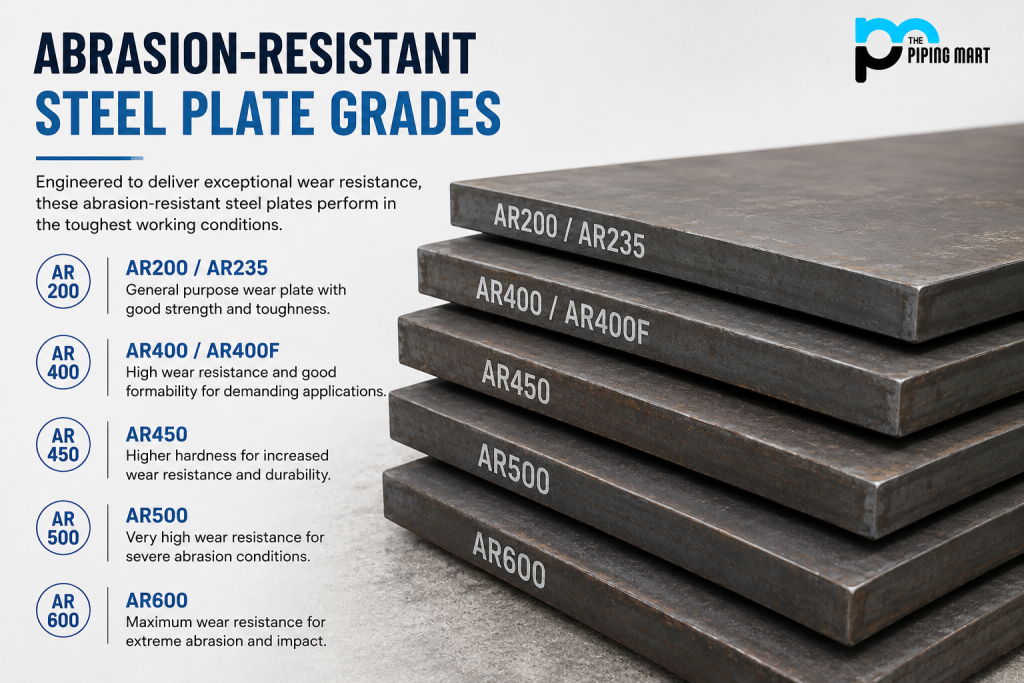
AR steels are graded by their Brinell hardness number, which directly indicates how resistant the material is to surface wear. Higher numbers mean harder steel, but also less formability, so the right grade depends on what the application actually demands.
AR200 / AR235
These are the softer end of the AR range, with hardness sitting between 180 – 235 HBW. They offer only moderate abrasion resistance and are closer to structural steel in terms of how they behave during fabrication. Bending, welding, and forming are straightforward. Used where light wear resistance is needed and where extensive fabrication is part of the job, things like agricultural equipment, light chutes, or general structural applications with some abrasive exposure.
AR400 / AR400F
AR400 is probably the most commonly used grade across industries. It has a hardness of around 360–440 HBW, which gives a reasonable balance between wear resistance and workability. It can be welded and cut without excessive difficulty, provided basic precautions are followed. The “F” variant has slightly better formability, making it easier to cold-bend without cracking. Used in truck bodies, hoppers, bucket liners, and similar applications.
AR450
Sits between AR400 and AR500 in terms of hardness, typically 430–480 HBW. The wear resistance is noticeably better than AR400, but it’s still manageable to fabricate. Some industries prefer this grade when AR400 is wearing out faster than expected, but moving to AR500 feels excessive. Not as widely stocked as AR400, so availability can be a factor depending on the supplier.
AR500
Hardness is around 470–540 HBW. At this level, wear resistance is considerably higher, and the steel holds up well under both abrasion and moderate impact. Fabrication becomes more involved — preheating before welding is generally required, and cold bending has tighter limitations. Used in mining equipment, crusher components, and ballistic-rated applications. The hardness also makes it a common choice for targets and armour plates.
AR600
This is the hardest grade in the standard AR range, with hardness reaching 570–640 HBW. Wear life is significantly longer than in lower grades, but fabrication is genuinely difficult. Welding requires careful heat management, and cold forming is very limited. Mostly used in extreme abrasion conditions, high-wear liner applications and certain mining and quarrying equipment where extending service life justifies the added complexity during manufacture.
Common Applications of Abrasion-Resistant Steel
Abrasion-resistant steel is used wherever surfaces are exposed to constant wear, impact, or friction during normal operation. The industries below represent some of the more demanding environments where standard steel simply doesn’t last long enough to be practical.
Mining and Construction Equipment
This is probably where AR steel sees the heaviest use. Excavator buckets, dozer blades, dragline buckets, crusher liners, and chute liners all take continuous punishment from rock, ore, and abrasive material. Standard steel wears through relatively quickly in these conditions. AR grades typically AR400 and above are used because they hold up longer and reduce how often components need to be replaced or rebuilt.
Cement and Concrete Industry
Cement production involves handling highly abrasive raw materials like limestone, clinker, and slag. Equipment such as mixing drums, conveyor liners, hoppers, and chutes wears down fast in this environment. AR steel is used to line these surfaces and extend their working life. The material also handles the combination of abrasion and moderate impact that’s common throughout the production process.
Transportation and Automotive Industry
Dump truck bodies and trailer floors are the most common applications here. These surfaces take constant loading and unloading of rock, gravel, and demolition material. AR steel keeps the floor and side panels from wearing thin prematurely. Some specialist vehicle components, particularly in off-highway and heavy transport, also use AR grades where wear is a regular operational factor.
Recycling and Waste Management
Shredders, balers, and sorting equipment deal with abrasive and often unpredictable material – scrap metal, demolition waste, and general refuse. The internal surfaces of this equipment wear quickly. AR steel liners and wear plates are used to protect these areas. Replacement is still necessary over time, but the intervals are much longer compared to mild steel.
Agriculture and Forestry
Ploughshares, tillage equipment, harvester components, and forestry mulcher blades all operate in abrasive conditions: soil, stones, roots, and woody material. Wear is a constant issue, and parts made from or lined with AR steel last considerably longer. In forestry, particularly, the combination of impact and abrasion from debris makes harder grades worthwhile.
Material Handling
Conveyor systems, hoppers, chutes, and transfer points handling bulk materials, such as coal, sand, gravel, and ore, are subject to ongoing surface wear. AR steel is used to line these areas and protect the underlying structure. In facilities that operate constantly, minimising the frequency of liner replacement has a direct impact on uptime and maintenance scheduling.
Conclusion
Abrasion-resistant steel is a practical material choice for any application where surface wear is a recurring operational problem. The range of available grades from AR200 through to AR600 means there is usually a suitable option regardless of whether the priority is easier fabrication or maximum wear life. Industries dealing with rock, ore, bulk materials, or abrasive soils have relied on AR steel for decades because it demonstrably reduces replacement frequency and maintenance costs. Selecting the right grade, applying appropriate fabrication procedures, and using protective coatings where needed will ensure the material performs as expected throughout its service life.
FAQs
What is abrasion-resistant steel used for?
AR steel is used in equipment and structures that experience constant surface wear from abrasive materials. Common uses include mining buckets, crusher liners, dump truck bodies, conveyor chutes, agricultural tillage components, and recycling equipment. The material was specifically chosen to extend the service life of parts used in high-wear settings.
What is the highest level of abrasion resistance (AR)?
AR600 is the highest standard grade in the AR range, with a Brinell hardness of approximately 570–640 HBW. Some specialist or proprietary grades may exceed this, but AR600 represents the upper end of what is commercially available as a rolled plate product. At this hardness level, wear resistance is very high, though fabrication becomes considerably more demanding.
What is the ASTM standard for abrasion resistance?
The most widely referenced ASTM standard for abrasion testing is ASTM G65, which covers dry sand and rubber wheel abrasion testing. ASTM A514 covers high-yield-strength quenched and tempered alloy steel plate, and some AR products are also manufactured as per the ASTM A wear-plate requirements. The appropriate standard varies according to the grade and supplier.
What are the properties of wear resistance?
Wear-resistant steel has high hardness, which is the primary factor in resisting surface abrasion. Beyond hardness, it also has good toughness to handle impact without cracking, sufficient tensile strength for structural use, and, in many grades, reasonable weldability with correct procedures. Some grades also exhibit work-hardening behaviour, where the surface becomes harder under repeated impact during service.