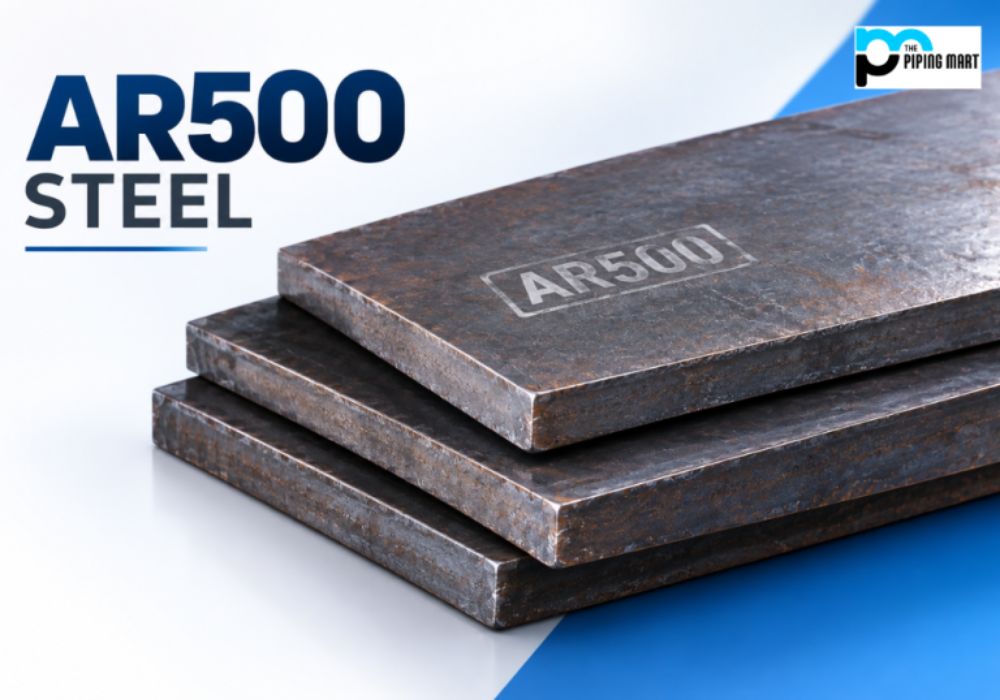
AR500 is a high-hardness, abrasion-resistant steel designed for environments requiring regular wear, impact, or ballistic exposure. The ‘AR’ stands for Abrasion Resistance, while the ‘500’ indicates an approximate Brinell hardness of 500 HBW. It is not a general-purpose structural steel; it is selected precisely when conventional steel would wear out too quickly. Common applications include mining equipment, material handling systems, military armour, and shooting targets. This article covers its composition, properties, benefits, and key applications.
What Is AR500 Steel?
AR500 steel is a high-carbon, abrasion-resistant steel with hardness through the full thickness. It is made using a quench and temper process, which gives it a consistent hardness of about 477 to 534 HBW, not just on the surface. To achieve these mechanical properties, the steel is mixed with alloying elements such as carbon, chromium, molybdenum, and manganese. Compared to softer steels, AR500 resists surface wear and deformation under load much better. It comes in different thicknesses and is used to make parts that must last a long time in harsh working conditions. The steel meets various international standards and is manufactured by major mills globally.
AR500 Steel Composition
AR500 steel contains a carefully balanced mix of alloying elements that together produce its hardness and wear resistance. Below are the common chemical composition ranges:
| Element | Percentage / Value |
| Carbon (C) | 0.46 – 0.54% |
| Manganese (Mn) | 0.60 – 1.00% |
| Silicon (Si) | 0.15 – 0.50% |
| Phosphorus (P) | 0.035% max |
| Sulphur (S) | 0.035% max |
| Chromium (Cr) | 0.40 – 1.20% |
| Molybdenum (Mo) | 0.15 – 0.50% |
| Nickel (Ni) | Up to 1.00% |
| Boron (B) | Trace amounts |
| Hardness (Brinell) | 477 – 534 HBW |
Key Properties of AR500 Steel
A distinct set of properties differentiates AR500 steel from general-purpose structural steels. These characteristics fall into four categories: mechanical, wear, processing, and performance.
Mechanical Properties
The mechanical properties of AR500 determine how it responds to stress, impact, and deformation under load.
- Hardness: R500 steel is very hard, with a Brinell hardness between about 477 and 534 HBW. This hardness results from a thermal process known as ‘quench and temper’. The plate is equally hard all the way through, not just on the outside. In contrast, mild steel is much softer, usually around 120–180 HBW.
- Tensile Strength: AR500 provides a tensile strength of about 1,655 MPa (240 ksi) or higher, depending on its thickness and the manufacturer. It can handle very high forces before it breaks, which is important in heavy-duty, high-wear uses.
- Toughness: Despite its hardness, AR500 retains enough toughness to withstand impact without cracking in normal working conditions. This blend of hardness and toughness makes it a preferred option for high-impact uses like mining and ballistic protection.
Wear Properties
AR500 was designed primarily for wear-critical applications, and its wear-related properties reflect this.
- Wear Resistance: AR500 provides much higher wear resistance than common structural steels like A36 or A572. It does not wear down quickly under sliding or abrasive contact. The hardness runs through the material, not just on the surface. In actual use, parts often last three to five times longer than mild steel in similar conditions.
- Surface Hardness Uniformity: The hardness is consistent from the surface to the core. It is not just a hard outer layer. When the plate is cut, drilled, or machined, the new surfaces still have the same hardness. This helps keep performance steady during use.
Processing Properties
Knowing how the AR500 process works during fabrication helps in planning and reducing waste during manufacturing.
- Fabrication: AR500 can be cut using plasma, laser, or water-jet methods. Flame cutting is also possible; in specific cases, preheating is required to prevent cracking. Welding requires low-hydrogen electrodes and may require preheating, depending on plate thickness and ambient conditions.
- Machinability: Due to its high hardness, AR500 is difficult to machine with standard tools. Carbide-tipped tools and slower cutting speeds are recommended. Drilling and tapping should be done carefully to avoid tool wear.
- Formability: AR500 does not bend easily when cold. It can be bent, but it needs gentler, larger curves than mild steel. Trying to make sharp or tight bends can cause it to crack. Hot forming can improve this, but it may alter the hardness of the material.
Performance Properties
In service, AR500 is expected to perform under demanding conditions. Here is how it handles various types of stress.
- Impact Resistance: AR500 handles repeated impact loads reasonably well for a steel of its hardness level. The quench-and-temper process gives AR500 enough ductility to absorb sudden impacts without shattering. As a result, it’s a common choice for crusher liners, dump buckets, and armour applications.
- Heat Resistance: AR500 is not designed for high-temperature service. Prolonged exposure above 250°C can begin to reduce its hardness. If welding or thermal cutting produces high localised heat, post-weld treatment may be required to restore properties.
- Fatigue Resistance: The steel performs well under cyclic loading conditions, though its performance depends heavily on the finish quality and absence of surface defects. The sharp notches or weld defects can reduce fatigue life.
- Corrosion Resistance (Limited): AR500 steel does not naturally resist rust. It will rust if left exposed to moisture or harsh environments. To protect it, you usually need to use paint, galvanising, or another type of protective coating.
Benefits of AR500 Steel
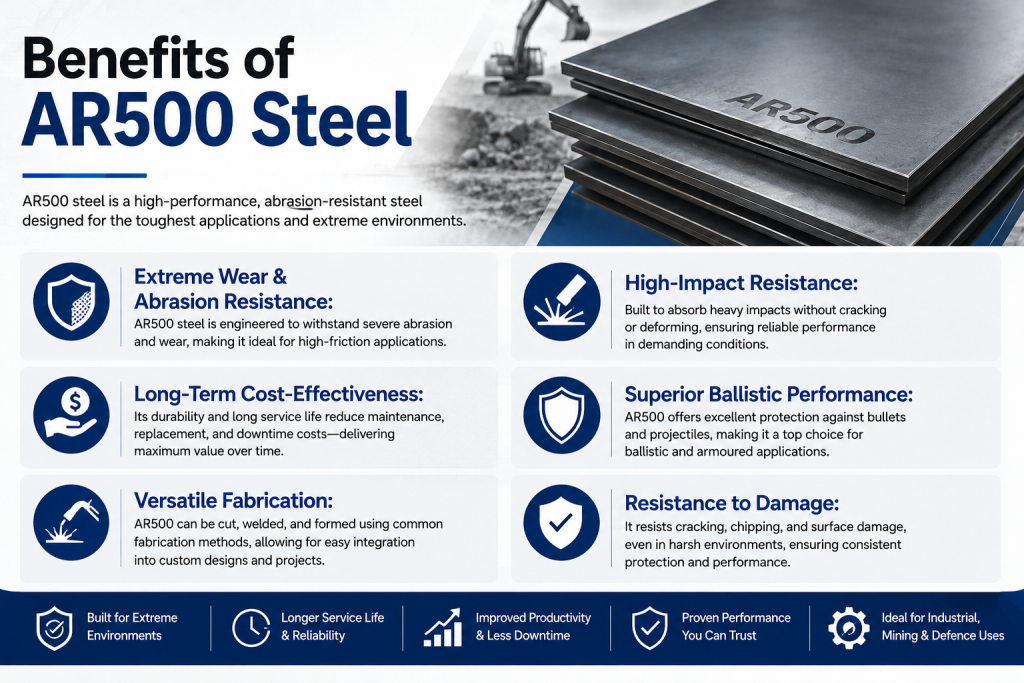
AR500 steel offers several practical advantages in applications where standard steels cannot provide adequate performance.
- Extreme Wear & Abrasion Resistance:
AR500 handles surface wear much better than standard steels. In areas with constant friction or material movement, it does not wear out quickly. Parts stay usable for longer, so replacements are less frequent. This helps keep operations running without frequent stoppages.
- High-Impact Resistance:
The material can take repeated hits without cracking. It is used in equipment where impact is common, such as crushers and dump liners. The hardness is not just on the surface, so performance stays stable even after some wear.
- Long-Term Cost-Effectiveness:
The initial cost is higher than that of mild steel. But over time, the overall cost tends to be reduced. Parts last longer, so there are fewer shutdowns and less work needed to replace them. In many cases, this makes up for the higher initial cost.
- Superior Ballistic Performance:
AR500 is a common choice for armour and protective plates. Its high hardness helps break up or deform projectiles on impact, improving stopping power. Because of this consistent level of protection, it’s widely used in defence and law enforcement applications.
- Versatile Fabrication:
AR500 can be cut, welded, and shaped using standard industrial equipment with the right parameters. This means it can be used for custom wear parts and complex built-up parts, not only flat plates.
- Resistance to Damage:
In field conditions, AR500 resists gouging, scraping, and surface deformation far better than softer steels. It results in less maintenance, lower lifecycle costs, and more consistent performance over time.
AR500 Steel Applications
AR500 is used across industries where wear and impact are primary concerns. Below are the main application categories.
Mining & Construction Equipment
Mining and heavy construction are among the most demanding environments for steel components. Equipment faces constant exposure to rock, soil, and abrasive material.
- Earthmoving and excavation equipment: Bucket teeth, cutting edges, and dozer blades made from AR500 last significantly longer than those made from mild steel. Its higher hardness minimises wear from continuous contact with rock and compacted soil.
- Dump truck liners and buckets: Dump truck bodies and buckets with AR500 liners can better withstand the impact and wear from loading and unloading ore, gravel, and other bulk materials.
- Crushers and screening equipment: Crusher liners and screen decks made from AR500. It can withstand the impact and abrasive wear caused by processing hard rock and aggregate materials.
- Heavy-duty machinery components: Various structural and wear components in heavy equipment, including side plates, chute liners, and conveyor skirts, are made from AR500 to extend service intervals.
Material Handling & Industrial Use
Wherever bulk materials are moved, AR500 finds use in protecting the equipment from rapid wear.
- Chutes, hoppers, and conveyors: Material handling equipment is subject to constant abrasive flow. AR500-lined chutes, hoppers, and conveyor walls reduce wear from sliding materials like coal, ore, and sand.
- Wear plates and liners: Flat AR500 plates are used as replaceable liners on equipment surfaces that see high wear. These can be swapped out when worn, extending the life of the underlying structure.
- Custom wear parts for industrial machinery: Industrial processors, shredders, and mixing equipment often require custom-shaped wear parts. AR500 is fabricated into these components to handle prolonged contact with abrasive materials.
Ballistic & Defence Applications
AR500 meets the hardness and toughness requirements for ballistic protection in defence and security applications.
- Impact-resistant armour plates: AR500 is mostly used for vehicle armour and portable ballistic plates. As a projectile hits it, its hardness causes it to deform, stopping or slowing penetration.
- Ballistic protection components: Beyond vehicle armour, AR500 is used in bunkers, blast barriers, and protective enclosures where resistance to projectile and blast impact is required.
Shooting & Recreational Applications
AR500 is commonly used in civilian shooting ranges because it handles repeated bullet impacts without breaking.
- Shooting targets: AR500 targets are used for both handgun and rifle practice. They can take a large number of rounds with very little shape change. The hardness forces the bullet to break apart on impact and fall downwards, which helps keep the shooting area safer.
- Range equipment: AR500 is also used for backstops, target frames, and dividers. These parts are exposed to constant impact, so using this grade reduces damage and the need for frequent replacement. It lasts longer than mild steel in the same setup.
Agricultural Equipment
The farm equipment works in direct contact with soil, sand, and stones. These materials wear down regular steel quite fast.
- Tillage tools: AR500 is often used to make farm tools like cultivators, subsoilers, and ripper tips. These parts last longer because the steel surface does not wear down as quickly in tough soil.
- Plough blades: The AR500 blades maintain their cutting edge for a longer time. This helps to provide optimum soil cutting without the need for frequent sharpening or replacement.
- Wear liners: Components such as seed tubes, augers, and feed chutes use AR500 liners. These areas see constant movement of grain, fertiliser, or soil. The liner reduces direct wear on the base material and improves service life.
Conclusion
The AR500 steel is an abrasion-resistant grade used where wear is high and regular steel fails quickly. It has hardness through the full thickness, which helps parts last longer in service. It can take some impact, though not like mild steel, but it generally holds up well under normal loads. Fabrication needs care. Cutting is done with plasma or laser, and welding usually needs preheating to avoid cracks. It is used in mining equipment, liners, buckets, chutes, and also in defence and shooting plates. Heat can reduce its hardness, so it is not used at high temperatures. It also needs a coating for corrosion. The cost is higher, but the service life is usually longer.
Frequently Asked Questions (FAQs)
What is the full form of AR500 steel?
The ‘AR’ stands for ‘Abrasion Resistant’, and 500 indicates the steel’s approximate Brinell hardness, which is roughly 500 HBW. So AR500 refers to an abrasion-resistant steel having a Brinell hardness of 500.
What is the HRC of AR500?
AR500 steel has a Rockwell Hardness (HRC) of approximately 50 to 54 HRC. The Brinell equivalent is 477 to 534 HBW, and these two scales correlate closely in this hardness range.
How expensive is AR500 steel?
AR500 steel is more expensive than other standard steels, such as A36 or A572. It is approximately two to four times higher per kilogram, depending on thickness, order quantity, supplier, and market conditions. Even though it is more expensive initially, its longer service life often results in lower long-term costs.
Is AR500 the strongest steel?
AR500 steel is not the strongest steel. It is engineered for abrasion resistance, rather than elevated tensile strength. Certain tool steels and ultra-high-strength steels have greater strength; however, they often experience more rapid wear than AR500. It performs effectively for its specific purpose, but selection should not be based on strength.