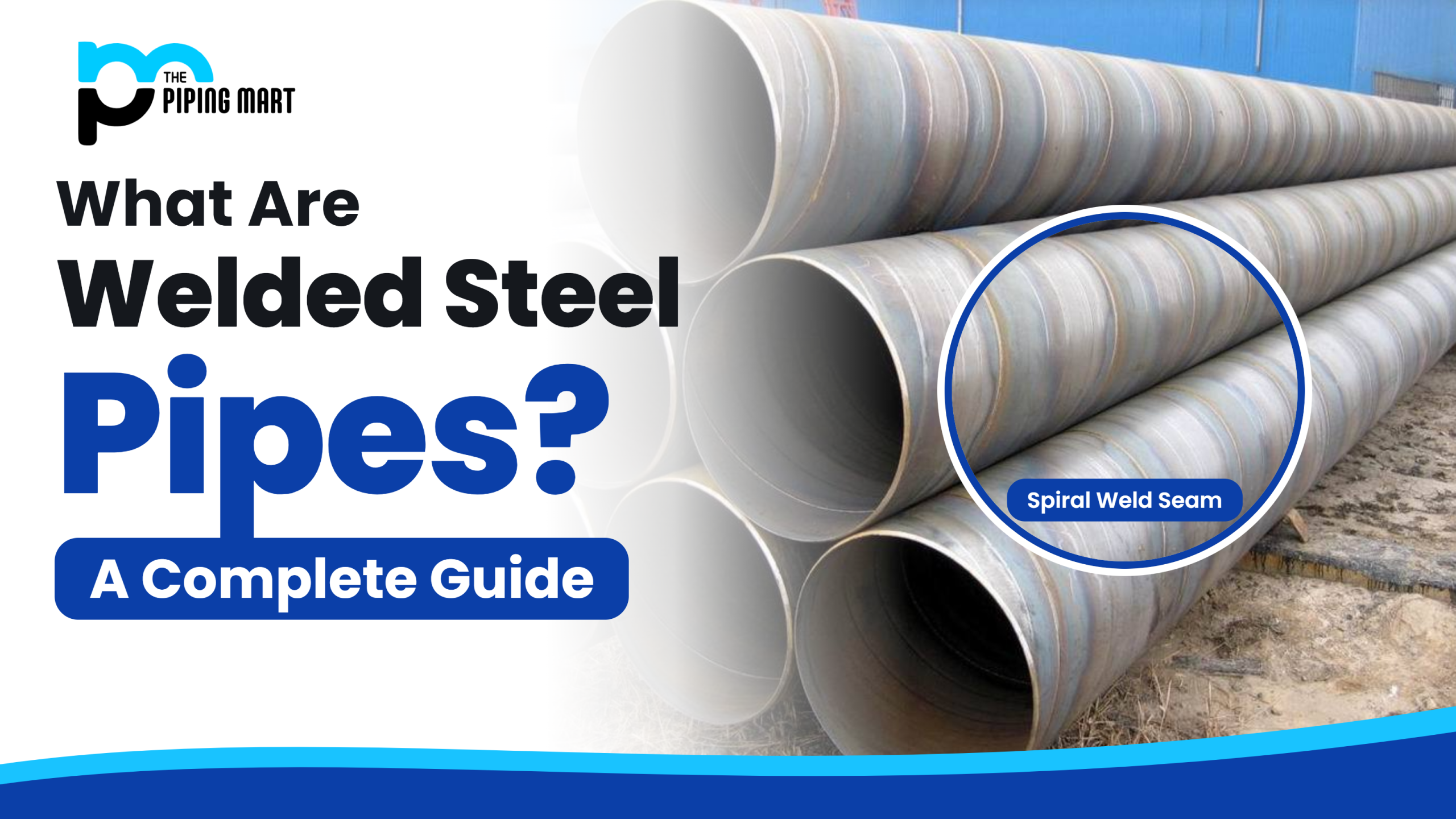
Welded steel pipes are pipes formed from steel strip, sheet, or plate and closed along a seam by welding. Industries use them to transport water, oil, gas, and process fluids, and to carry loads in buildings, bridges, and plant structures. Production routes differ by diameter and wall thickness, and material grades run from carbon steel through to duplex stainless.
What Are Welded Steel Pipes?
A welded steel pipe carries a longitudinal or helical weld seam that joins the edges of the formed steel. Production starts with flat material: coil, strip, sheet, or plate. Rolls or presses bring that material into a cylindrical shape, and a welding process then fuses the meeting edges into a continuous joint. Seamless pipe follows a different route, since it is pierced or extruded from a solid billet and never acquires a seam. Welded products cover a wide dimensional range, with wall thicknesses and tolerances set by the governing standard. A weld seam does not by itself signal lower quality. Manufacturing control, seam inspection, and the service requirements of the system decide suitability.
How Are Welded Steel Pipes Manufactured?
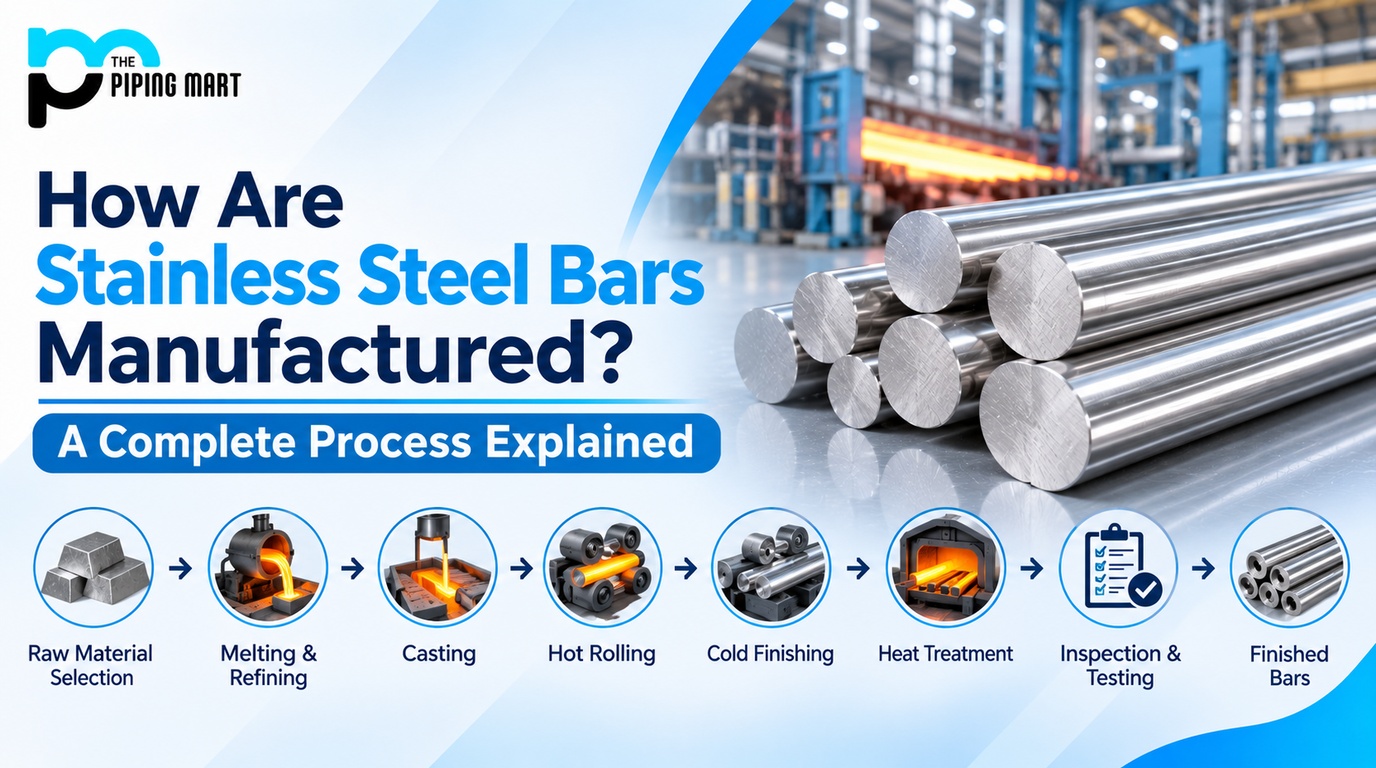
Manufacturing moves through three controlled stages: material preparation, forming and welding, then inspection and finishing. Each stage carries its own acceptance criteria under the product standard.
Raw Material Preparation
Mills select coils, strips, or plates against the grade, thickness, and width required. Incoming material goes through chemical and mechanical verification. Operators then clean the surface, trim the edges, and remove scale or oil that would compromise weld integrity.
Forming and Welding
Roll sets or a press bring the flat section into cylindrical form. Edge alignment at this point governs weld quality. Once the edges meet, the selected welding process fuses them, with or without filler metal depending on the method.
Weld Inspection and Finishing
Inspection of the weld seam follows welding directly, using methods such as ultrasonic testing, radiography, or eddy current examination. Finishing covers sizing, straightening, heat treatment where the standard calls for it, cutting to length, and end preparation. Testing scope tracks the product standard and the intended application.
What Are the Different Types of Welded Steel Pipes?
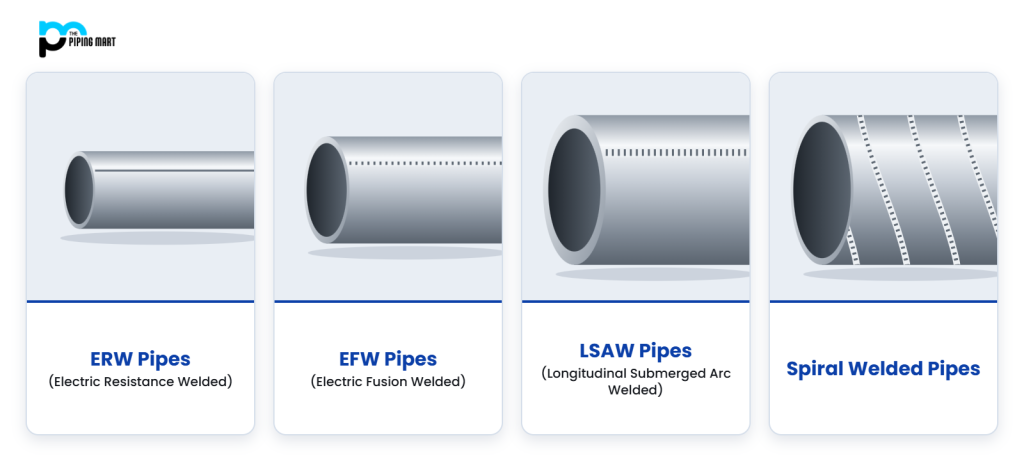
Four welding routes account for most production. Diameter range, wall thickness, and seam geometry separate them, and each serves a distinct application band.
ERW Pipes (Electric Resistance Welded)
Electric resistance welding passes current across the abutting edges of the formed strip, and resistance heat with applied pressure creates the bond without filler metal. Water transportation, structural members, and general industrial piping use ERW pipe in small and medium diameters.
EFW Pipes (Electric Fusion Welded)
Electrical energy drives an arc that melts the joint faces and produces a fusion weld, usually with filler metal. Larger dimensions and heavier walls suit this route. Storage tanks, low-pressure transmission lines and selected process systems draw on it.
LSAW Pipes (Longitudinal Submerged Arc Welded)
Steel plates feed a press or roll-forming line that shapes them into a cylinder, after which submerged arc welding closes the longitudinal seam beneath a protective flux blanket. Large-diameter pipelines and heavy infrastructure projects rely on LSAW pipe.
Spiral Welded Pipes
Spiral welded pipe begins as steel coil fed at an angle into a forming head, which winds the strip helically while submerged arc welding runs along the spiral seam. Large-diameter water transmission mains, piling, and structural sections commonly specify it.
Which Materials Are Used to Manufacture Welded Steel Pipes?
Grade selection answers the operating environment rather than the welding method. Four material families cover the majority of welded pipe requirements.
- Carbon Steel: General industrial piping, structural work, and fluid transportation use it. Strength, weldability, and cost govern the choice.
- Stainless Steel: Chemical plants, food processing lines, and other hygienic environments specify Stainless Steel Pipes where corrosion resistance and surface cleanability matter.
- Alloy Steel: Applications that demand specific mechanical properties or elevated-temperature performance call for chromium-molybdenum and similar alloy grades.
- Duplex Stainless Steel: Duplex Stainless Steel Pipes combine higher strength with resistance to chloride-bearing environments, which suits offshore, desalination, and aggressive process duty.
Welded Steel Pipes vs Seamless Steel Pipes: Key Differences
The two categories differ in origin, not in intent. A short comparison clarifies where each manufacturing route holds an advantage.
| Parameter | Welded Steel Pipes | Seamless Steel Pipes |
| Manufacturing | Formed and welded from strip or plate | Produced from a solid billet without a welded seam |
| Weld Seam | Contains a welded joint | No longitudinal weld seam |
| Size Availability | Offers flexibility in dimensions and diameters | Depends on manufacturing capabilities |
| Cost | Often economical for suitable sizes and specifications | Can have a higher initial cost |
| Applications | General piping, structural and industrial systems | Selected high-pressure and demanding service conditions |
Material grade, wall thickness, manufacturing quality, and the applicable standard determine which one fits a given system, as Seamless vs Welded Stainless Steel Pipes: Key Differences sets out in detail.
Common Applications of Welded Steel Pipes
Welded construction reaches energy, utilities, building work, and manufacturing. Six sectors account for most consumption of welded steel pipes.
- Oil and Gas: Gathering, transportation and processing systems. Project specifications govern grade and seam type.
- Water Supply: Transmission mains and distribution networks, where large diameters favour spiral and LSAW pipe.
- Construction: Structural frameworks, supports, piling and infrastructure elements under static and dynamic load.
- Chemical Processing: Process piping matched to chemical compatibility, with stainless and duplex grades for aggressive media.
- Power Generation: Utility and industrial piping circuits, including cooling water and service lines.
- Automotive and Engineering: Structural components, chassis sections and assemblies produced to tight dimensional tolerance.
Operating pressure, temperature, fluid characteristics, and design requirements decide the pipe type and material.
Important Factors to Consider When Selecting Welded Steel Pipes
Specification work involves six checks. Each one narrows the options before a purchase order goes out.
- Material Grade: Match carbon steel, stainless steel, or alloy steel to the operating environment and the media carried.
- Manufacturing Process: Choose ERW, EFW, LSAW, or spiral welded construction against diameter, wall thickness, and service demands.
- Dimensions: Verify outside diameter, wall thickness, and pipe length, along with the tolerance band the standard allows.
- Standards: Confirm applicable ASTM, ASME, API, or project specifications before release.
- Operating Conditions: Evaluate pressure, temperature, corrosion exposure, and fluid compatibility together, as these factors directly influence one another.
- Inspection: Review weld quality records, non-destructive testing scope, and material documentation such as mill test certificates.
Conclusion
Four welding routes, four principal material families, and a wide dimensional range give welded steel pipes their reach across industrial systems. Dimensions, grade, manufacturing process, and operating conditions determine the right selection. The Piping Mart lists pipe categories across carbon, stainless, alloy, and duplex material options for buyers comparing products.
Frequently Asked Questions About Welded Steel Pipes
What Is the Difference Between Welded and Seamless Steel Pipes?
Welded pipe is formed from strip or plate and joined along a seam. Seamless pipe comes from a solid billet and carries no weld line. Pressure requirements, dimensions, and cost usually decide between them.
What Are the Main Types of Welded Steel Pipes?
Four methods dominate production: ERW, EFW, LSAW, and spiral welding. Each produces a different seam geometry. Diameter range, wall thickness, and the governing standard determine which route a project specifies.
Are Welded Steel Pipes Suitable for High-Pressure Applications?
Yes, where grade, wall thickness, and weld quality satisfy the governing standard. Many high-pressure transmission pipelines use LSAW pipe. Project specifications and test records confirm whether a particular pipe qualifies.
Which Materials Are Used in Welded Steel Pipes?
Carbon steel covers general service. Stainless steel handles corrosive media, alloy steel handles elevated temperatures, and duplex grades deliver higher strength with chloride resistance. The operating environment sets the grade.
How Are Welded Steel Pipes Tested?
Non-destructive methods examine the seam: ultrasonic testing, radiography and eddy current inspection are common. Hydrostatic testing checks pressure integrity. Mechanical and chemical testing verifies the material against the product standard.