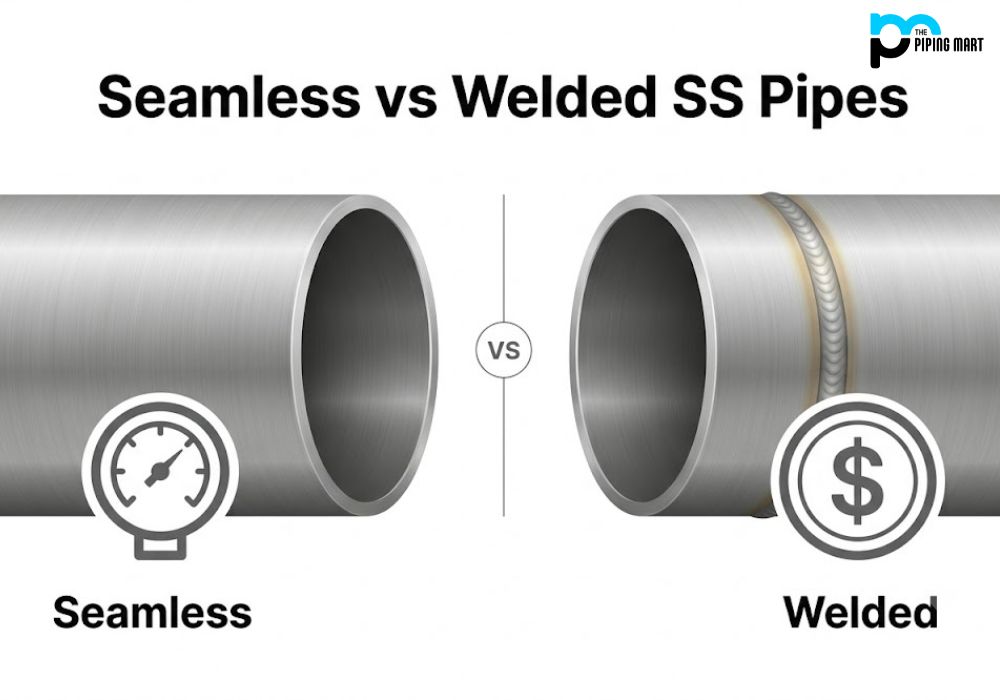
Choosing between a seamless stainless steel pipe and a welded stainless steel pipe is not always easy. Both are made from stainless steel and are used in process and structural applications, but they behave differently under pressure, temperature, and corrosive conditions. The difference between seamless and welded pipe is rooted in how they are manufactured, and that has a direct bearing on their mechanical properties, available sizes, surface condition, and cost. This blog lays out the key technical points so you can assess both types against your actual project requirements and arrive at the right specification.
What Are Seamless Stainless Steel Pipes?
A seamless stainless steel pipe is made from a solid round piece of stainless steel with no welds anywhere along its length. The solid piece is heated and then pierced in the center to create a hollow tube, which is then shaped into the required pipe size. The tube is then rolled, extruded, or drawn into the desired size and wall thickness. The outcome is a pipe that has uniform (or continuous) grain throughout the entire pipe. No seam, no heat-affected zone, and no metallurgical change at each point. It is for this reason that seamless pipes are preferred in areas where structural integrity and high-temperature and high-pressure applications are involved.
What Are Welded Stainless Steel Pipes?
Welded stainless steel pipe, also known as SS welded pipe, is a tube formed by a flat material or plate of stainless steel and then welded together along the longitudinal seam. Generally, the welding is carried out by TIG, laser, or plasma welding, depending on the grade and wall thickness of the pipes. Welded pipes may also be cold drawn or subjected to an annealing heat treatment following the weld to remove any internal stresses and to restore mechanical properties in the weld area. Welded pipes are made in larger diameters and thinner wall thicknesses than seamless pipes and are much less expensive for the most common sizes. These pipe applications are widely used in structural, fluid transport, and general fabrication applications.
Seamless vs Welded Stainless Steel Pipes: Key Differences
The points below cover the main technical differences between the two types. Each factor has a bearing on which pipe suits a given application, so it is worth going through them carefully.
Manufacturing Method
- Seamless Stainless Steel Pipes: The production process of seamless pipe begins with a solid billet, from which it is pierced by heating and then processed by pilgering, rolling, or extrusion to obtain the required seamless pipes.
- Welded Stainless Steel Pipes: The manufacturing process of this type of pipe is based on a flat strip or plate to form a cylindrical pipe, and the seam is welded along the length. After welding, the pipe can be subjected to cold-drawing or heat treatment to enhance the properties.
Strength and Pressure Rating
- Seamless Stainless Steel Pipes: The seamless pipes have no welds, so pressure is spread evenly across the whole pipe wall. This provides them with a more reliable pressure rating and makes them a good choice for hydraulic lines, boiler tubes, and other high‑pressure uses.
- Welded Stainless Steel Pipes: The SS welded pipes are manufactured as per the relevant standard and tested to it, and will meet most general-purpose pressure requirements. However, in high-pressure or cyclic load situations, the weld zone may be an area of concern, but not for moderate-pressure applications.
Corrosion Resistance
- Seamless Stainless Steel Pipes: No weld seam or heat-affected zone (HAZ) and no restriction in corrosion resistance. There are no preferred areas for corrosion to damage the metallic components of the localised area, and no metallurgical differences between the areas.
- Welded Stainless Steel Pipes: In most service conditions, welded stainless steel pipe is satisfactory for corrosion. Chloride environments may make localised damage more likely in the heat-affected area around the seam if post-weld treatment (pickling or passivation) is not performed or executed incorrectly.
Surface Finish
- Seamless Stainless Steel Pipes: The hot-working involved in seamless pipe manufacturing can produce a rougher outer surface compared to welded pipe. Cold-drawing or grinding can improve this, but the starting surface quality is generally not as consistent as that of welded pipe.
- Welded Stainless Steel Pipes: Begin with a relatively smooth and controlled surface of a flat-rolled sheet. The outer finish is more uniform from the beginning, which is suitable for use in applications where the external appearance or cleanliness of the pipe is important.
Dimensional Accuracy
- Seamless Stainless Steel Pipes: Wall thickness in hot-finished seamless pipe can vary slightly due to the nature of the piercing and rolling process. Cold-drawn seamless pipes improve on this, but some degree of wall eccentricity is accepted within standard tolerances.
- Welded Stainless Steel Pipes: The wall thickness of the welded pipe is more uniform, as the original material is a flat-rolled sheet with close tolerances for thickness. This is a key benefit of welded construction in applications where even wall thickness is critical.
Wall Thickness Range
- Seamless Stainless Steel Pipes: The seamless pipes are better suited to heavier wall thicknesses. Schedules 80, 120, and above are more readily available in seamless than in welded, and the structural integrity of a thick-walled seamless pipe is more uniform.
- Welded Stainless Steel Pipes: The welded construction process is easier and more economical for producing thin-walled pipes. For standard schedules or lightweight piping, welded pipe is the more practical and affordable option.
Pipe Sizes Availability
- Seamless Stainless Steel Pipes: Seamless production works well for smaller to medium diameters. As the bore size increases, the process becomes more involved, and the cost rises sharply. Very large bore seamless pipes are manufactured but are not as readily available as welded alternatives.
- Welded Stainless Steel Pipes: Large-diameter pipes are nearly always produced by welding. The plate-forming and seam-welding process scales up without major complications, and most industries rely on welded construction for larger bore sizes.
Cost Comparison
- Seamless Stainless Steel Pipes: Seamless pipes are more expensive. The solid billet starting material costs more than flat-rolled sheet, and the processing steps are more complex and energy-intensive. The price gap is more pronounced in larger diameters and higher-alloy grades.
- Welded Stainless Steel Pipes: Welded pipes are cheaper to produce. The raw material costs less, the process is faster, and the yield from flat-rolled sheet is better. This is why welded pipe is the standard choice for most general and structural applications.
Advantages of Seamless Stainless Steel Pipes
Seamless pipes are specified mainly where the service conditions are demanding and where structural consistency matters more than cost.
- Superior Pressure Capacity
The absence of a weld seam means the pipe handles internal pressure evenly across the full cross-section. This makes seamless pipes the standard choice for hydraulic systems, high-pressure steam lines, and boiler tubing where pressure can be high and variable.
- Uniform Grain Structure
The material properties are consistent from the outer surface to the inner bore and along the full length. There is no localised change in grain structure or hardness at any point, which gives more predictable behaviour under mechanical load.
- Enhanced Corrosion Resistance
No weld seam means no heat-affected zone, and no point where the metallurgy is different from the rest. In chloride environments, acidic media, or other aggressive conditions, this reduces the risk of localised corrosion starting at a structurally weaker point.
- Cleaner Internal Surface
Seamless pipes have no internal weld bead. The bore is smooth and uninterrupted, which matters in hygienic applications such as pharmaceutical production, food processing lines, and medical gas distribution, where contamination must be kept to a minimum.
- Reliability Under Cyclic Loads
Systems that see frequent pressure fluctuations put repetitive stress on the pipe material. The uniform structure of a seamless pipe resists fatigue cracking better than welded pipe over an extended service life, which reduces the risk of failure in cyclic service.
- High Dimensional Accuracy
Cold-drawn seamless pipes, in particular, are produced to tight outer diameter tolerances. This is useful where the pipe needs to fit precisely into a machined component or where fitment tolerances are critical to the system design.
- Long-Term Value
The upfront cost of seamless pipe is higher, but in critical service, the longer maintenance intervals and lower risk of failure generally reduce lifecycle cost. For high-stakes applications, the total cost over the service life often justifies the initial price difference.
Advantages of Welded Stainless Steel Pipes
Welded pipes cover a broader range of applications. For most general-purpose and structural uses, they are the more practical option.
- Cost-Effectiveness
SS welded pipe is cheaper to manufacture. The starting material costs less, the process is less complex, and production rates are higher. For standard sizes in common stainless steel grades, welded construction reduces material cost considerably compared to seamless.
- Size Flexibility
Welded pipes can be produced in a wider range of diameters than seamless pipes. Large-diameter pipes for structural columns, process vessels, and water distribution are almost always welded because seamless production at those sizes is either impractical or too expensive.
- Corrosion Resistance
Welded stainless steel pipes with correct post-weld treatment resist corrosion effectively across a broad range of service environments. In most moderate conditions, the corrosion performance is comparable to seamless, provided the material grade is correctly selected and the weld area is properly treated.
- High Strength and Toughness
With proper welding procedures and post-weld heat treatment, the weld joint can match the base material in tensile strength and toughness. For structural and load-bearing applications, this makes welded pipe a reliable and well-proven option.
- Environmental Sustainability
Flat-rolled sheet is used with less waste than solid billets in seamless production. The overall energy consumption per tonne of finished pipe is also lower for welded construction, which is relevant for projects with environmental reporting requirements.
- Superior Surface Finish
Starting from a flat-rolled sheet gives welded pipe a more consistent and smoother outer surface. This is an advantage in architectural applications, decorative structural use, or anywhere the external appearance of the pipe is visible and important.
- Versatility in Fabrication
Welded pipes are generally easier to work with on-site. They are easier to cut, weld, and modify than seamless pipes, so they are more flexible to use when assembling systems or changing pipe layouts during installation.
Applications of Seamless Stainless Steel Pipes
Seamless pipe applications are concentrated in sectors where operating conditions are severe and where pipe failure would carry serious consequences.
- Oil and Gas Industry
Seamless stainless steel pipes are generally used for downhole, wellhead, and high-pressure gathering lines. In the downhole environment where pressures are high and the space for maintenance is limited, structural consistency is important.
- Chemical and Petrochemical Processing
A standard seamless pipe application is used for transporting corrosive fluids at high temperatures. The risk of failure at a localised weak point is reduced in continuous process environments where the uniform wall and lack of a weld seam are beneficial.
- Power Generation
Steam lines, boiler tubes, superheaters, and reheaters in power stations operate at high temperature and pressure simultaneously. Seamless stainless steel pipes are standard in these circuits because the material performs predictably under those combined conditions.
- Automotive and Aerospace Engineering
Seamless tubes are commonly used in aerospace, automotive, precision tubing, hydraulic circuits, and other applications requiring tight tolerances and consistent mechanical properties, where high-strength grades are required.
- Food, Pharmaceutical, and Medical Sectors
In food plants, pharmaceutical production, and medical gas systems, hygienic pipework is needed, which needs to have a smooth inside diameter and not contaminate the media being transported. Typically, seamless stainless steel pipes, especially in the electropolished condition, are used in these applications.
- Construction and Architecture
Seamless pipes are used when consistent cross-sectional properties are required, such as for structural columns, load-bearing structures, and some fittings in architecture. The equal wall thickness also makes for easier structural calculations.
- Shipbuilding
Fuel systems, hydraulic lines, and exhaust piping on vessels operate in a corrosive marine environment and often at significant pressure. Seamless stainless steel pipes are used here because both corrosion resistance and pressure integrity are required at the same time.
- Cryogenic and Hydrogen Technologies
Austenitic stainless steel grades retain toughness at very low temperatures, making seamless pipes in these grades suitable for cryogenic storage and distribution systems. They are also used in hydrogen pipework where material compatibility and pressure performance are both critical.
- Desalination Plants
The high-pressure feed side of seawater reverse osmosis systems requires pipes that resist both pressure and chloride corrosion. Seamless pipes in duplex or super duplex stainless steel grades are commonly specified for this duty.
Applications of Welded Stainless Steel Pipes
Welded pipes are used across a broad range of industries, particularly where large diameters, thin walls, or volume supply at a reasonable cost are the primary requirements.
- Oil and Gas Infrastructure
Surface pipelines, cross-country transmission lines, and offshore topside piping rely heavily on large-diameter welded pipes. The scale of material needed in these projects makes seamless production impractical, and welded pipes in the appropriate grade perform reliably in these conditions.
- Water Supply and Desalination
The SS welded pipes are used in water distribution networks and the lower-pressure circuits of desalination plants. Stainless steel grades resist chloride attack better than carbon steel, and welded construction makes large-bore pipes available at a reasonable cost.
- Chemical and Petrochemical Processing
Welded stainless steel pipes are often used in lower-pressure process lines, utility connections, and storage tank piping at chemical plants. These pipes operate well under moderate pressure and are less expensive than seamless options.
- Power Generation
Cooling water circuits, condensate return lines, and plant utility piping in power stations are often specified in welded stainless steel pipe. The large bore sizes required in these systems suit welded construction both technically and commercially.
- Construction and Architecture
Handrails, structural hollow sections, facade supports, and decorative elements in buildings regularly use welded stainless steel pipes. The consistent external surface from a flat-rolled sheet is an advantage in visible architectural applications.
- Automotive and Transportation
Exhaust systems, fuel lines, and certain structural components in vehicles and commercial transport use welded stainless steel tubes. The lower cost of welded pipe makes it the practical choice where large quantities are required for high-volume production.
- Sanitary and Food-Grade Applications
Welded stainless steel pipes with proper internal finish are widely used in dairy, beverage, and food processing lines. When the weld is correctly executed and the internal surface is finished to the required standard, these pipes meet the hygienic requirements for food contact applications.
How to Choose Between Seamless and Welded Pipes
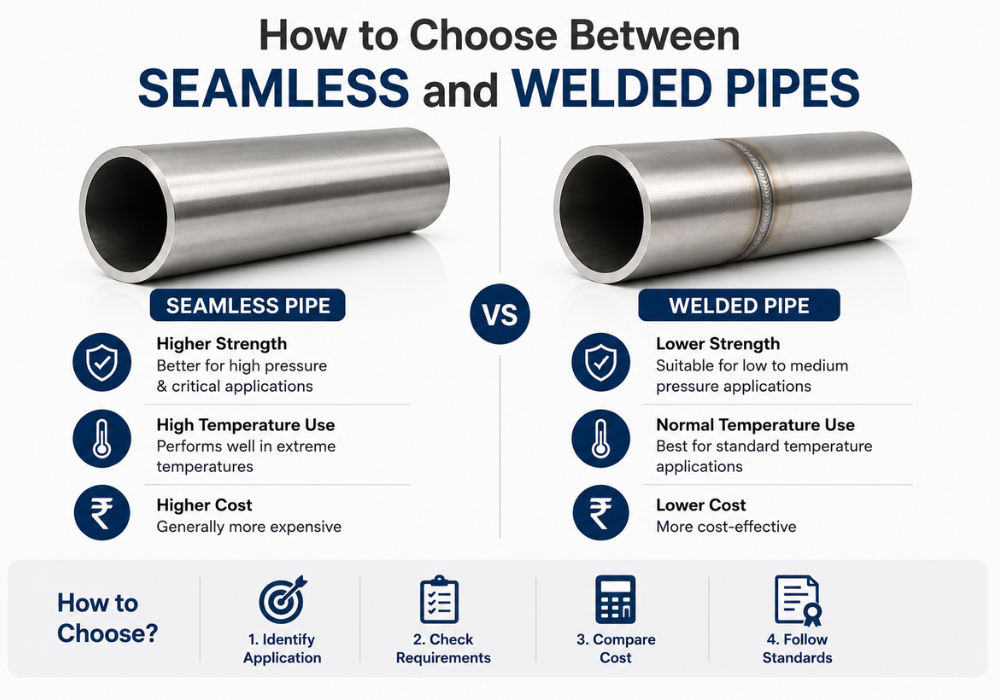
The decision is based on the specific conditions of the application. If the pipe will carry fluid at high pressure, handle extreme temperatures, or be exposed to aggressive media, seamless stainless steel pipe is generally the more appropriate choice. If the application is structural, involves large diameters, operates at moderate pressure, or has cost as a primary constraint, welded pipe is usually sufficient and more economical. Before finalising the specification, check the operating pressure and temperature, confirm what the pipe will carry, review the applicable industry or project standard, and consider the long-term maintenance expectation. In many cases, the standard or engineering specification for the project will already indicate which type is required.
Conclusion
Different specifications are required for seamless and welded stainless steel pipes. Seamless pipes are ideal for demanding circumstances that require outstanding reliability for high-pressure, high-quality material, and high corrosion resistance. The welded pipes are a cost-effective option for general-purpose applications and larger pipe sizes. Instead of preferring one type in general, always pick based on what the specific project and service conditions actually require. Going through the operating conditions, size requirements, applicable standards, and total cost of ownership together will give a more reliable basis for selecting the right pipe for your application.
FAQs
What is the difference between seamless and welded stainless steel pipes?
The seamless pipe and welded pipe are different from each other mainly in the manufacturing methods. Welded pipes are made by forming a flat strip into a tube and welding the seam, while seamless pipes are made from a solid billet with no weld at all. This difference in how they’re made affects their pressure capacity, surface finish, dimensional accuracy, and which service conditions they are best suited for.
Which is stronger: seamless or welded stainless steel pipe?
Seamless pipes generally carry higher pressure ratings and perform better under cyclic loading because there is no weld zone. However, welded pipes produced to the correct standard and with proper post-weld treatment can match the base material strength in most standard applications. The gap in performance becomes more relevant in demanding conditions rather than general use.
Are welded stainless steel pipes reliable?
Yes. SS welded pipes are produced according to standards that are safe and durable in a wide range of applications when they are properly welded and post-weld treated. They don’t cause significant problems when used properly in water supply, construction, oil and gas infrastructure, and food processing.
Which pipe is better for high-pressure applications?
The seamless stainless steel pipe is generally applied to high-pressure services. Without the weld seam, there would be no weak point, and the pressure would be spread equally across the pipe. It is used as the material of choice for high-pressure process lines, boiler tubing, and hydraulic systems.
Why are seamless stainless steel pipes more expensive?
Seamless pipes are more expensive because they start from solid steel billets, which cost more than flat sheets, and their piercing, rolling, and finishing steps use more energy and take longer than making welded pipes. Together, these factors raise the final price per unit compared to similar welded pipes.