Stainless steel flanges join piping components with bolted connections, allowing systems to be assembled, inspected, maintained, and modified without cutting the pipe. Flange type, pressure class, material grade, temperature, and service conditions determine the appropriate design.
What Are Stainless Steel Flanges?
A stainless steel flange is a forged ring that connects piping components at a detachable joint. Flanged joints open on demand, so cleaning and inspection need no pipe cutting.
Three parts make the joint work: the flange pair, a gasket between the faces, and the bolts and nuts that clamp them. SS 304 and SS 316 cover most orders.
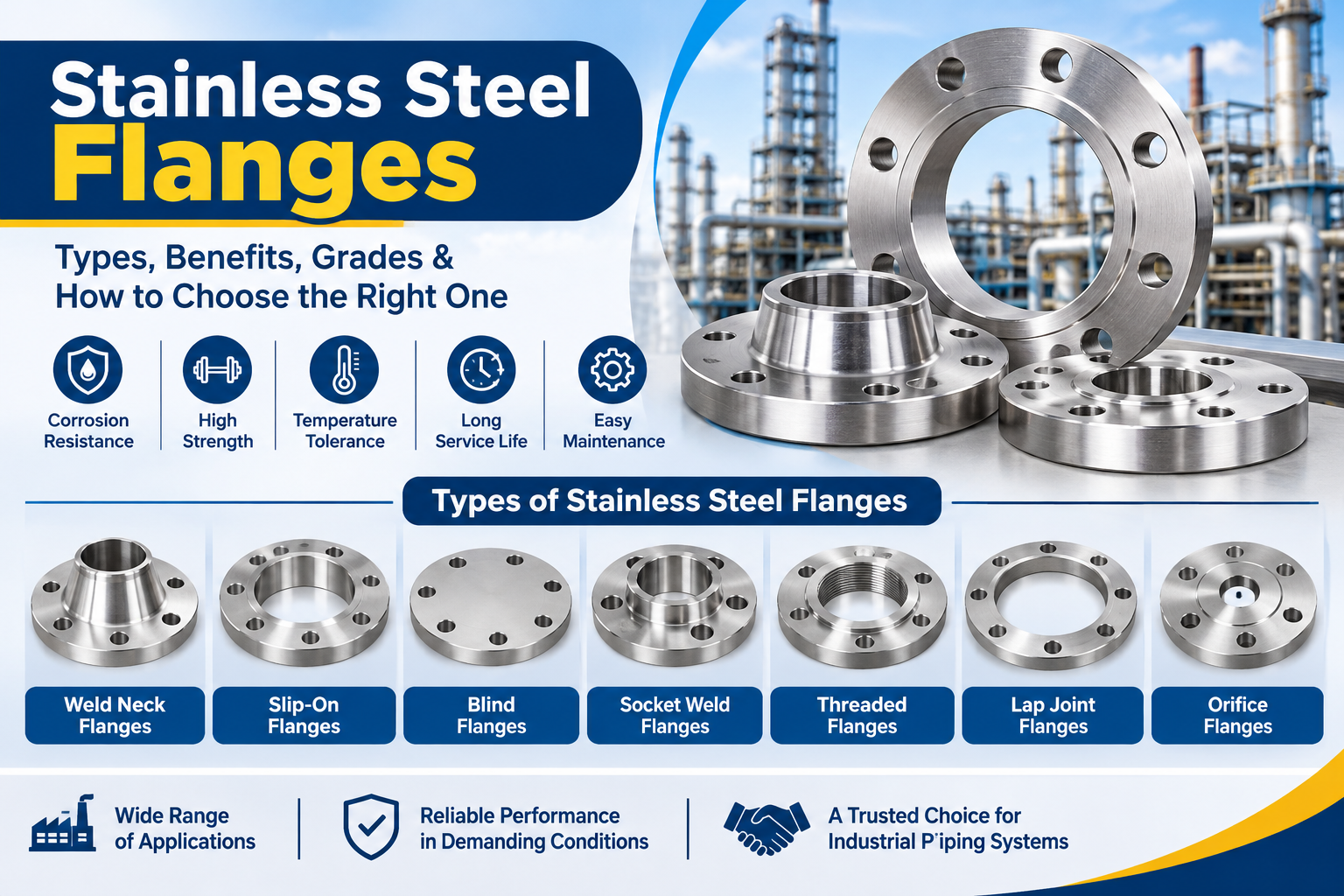
Different Types of Stainless Steel Flanges
Stainless Steel Weld Neck Flanges
A long tapered hub butt-welds to the pipe and that taper moves stress gradually from the flange into the pipe wall. The design copes with high pressure, temperature swings, and repeated loading. Oil and gas, petrochemical, power, and process piping use weld neck flanges on their critical lines.
Stainless Steel Slip-On Flanges
The pipe slides into the flange, and fillet welds go on the inside and outside. Installation takes less time than a butt weld. Water, air, and utility lines at moderate pressure suit slip-on flanges well.
Stainless Steel Blind Flanges
No central bore. A blind flange closes the end of a pipe, valve, or vessel nozzle. Because it bolts on and off, a future tie-in stays simple: remove the flange and the line opens for expansion or inspection.
Stainless Steel Socket Weld Flanges
The pipe fits into the flange socket, and a fillet weld joins the pipe to the flange. They suit small-diameter pressure piping, including instrument and hydraulic lines.
Stainless Steel Threaded Flanges
Internal threads screw onto a threaded pipe end, so no site welding happens. That helps where hot work is restricted. Match the thread standard: NPT flanges need NPT pipe.
Stainless Steel Lap Joint Flanges
A lap joint flange slides freely over a stub end, and the stub end carries the sealing face. The flange rotates, so bolt holes line up fast. Lines that get dismantled often, such as washdown piping, benefit most.
Stainless Steel Orifice Flanges
These flanges hold an orifice plate between them, with tapped holes on the rim for pressure tappings. Engineers use them to measure flow through differential pressure in gas, steam, and liquid process lines.
Stainless Steel Flanges by Pressure Class
ASME B16.5 sorts flanges into Class 150, 300, 600, 900, 1500, and 2500. The class number does not equal a fixed pressure, because ratings shift with material, standard, and service temperature.
Common Stainless Steel Flange Grades
SS 304 flanges serve general corrosion-resistant duties in food, water, and light chemical lines. SS 316 flanges add molybdenum for better resistance to chlorides. SS 321 flanges carry titanium, which suits selected elevated-temperature use. Duplex stainless steel flanges pair high strength with corrosion resistance.
Stainless Steel Flange Standards
ASME B16.5 covers NPS ½ to 24, and ASME B16.47 covers NPS 26 to 60. ASTM A182 specifies the forged material, with grades such as F304, F316, and F321. Flange type, dimensions, material, pressure class, and project requirements decide which applies.
How to Choose the Right Stainless Steel Flange
Follow these sequential step-by-step checks to select the ideal stainless steel flange for your specific system requirements.
1. Pipe size
2. Flange type
3. Stainless steel grade
4. Pressure class
5. Operating temperature
6. Fluid or chemical environment
7. Gasket requirements
8. Connection method
9. Applicable standards
10. Installation and maintenance requirements
Conclusion
Each stainless steel flange type serves a different connection and service requirement. Selection should consider pipe size, flange type, material grade, pressure-temperature rating, fluid conditions, connection method, and applicable standards. At The Piping Mart, being a reliable B2B platform, we connect buyers with manufacturers, suppliers, and exporters of stainless steel flanges, allowing procurement teams to compare specifications and request relevant quotations.
FAQs
What are the different types of stainless steel flanges?
Seven commonly specified types include weld neck, slip-on, blind, socket weld, threaded, lap joint, and orifice flanges.
What is a stainless steel weld neck flange used for?
It connects high-pressure and high-temperature lines in oil and gas, petrochemical, and power plants.
What is the difference between slip-on and weld neck stainless steel flanges?
Slip-on flanges slide over the pipe and install faster. Weld neck flanges butt-weld to the pipe and handle higher pressure.
What is a stainless steel blind flange?
A solid disc with no bore that seals pipe ends, valves, and vessel openings.
How do I choose the right type of stainless steel flange?
Match the connection method, pressure class, grade, temperature, and fluid to the line, then confirm the standard.