Stainless steel pipes are used across some of the most demanding environments in industry, from high-pressure oil and gas systems to sterile pharmaceutical processing lines. The material holds up well against corrosion, heat, and mechanical stress, which is why it remains a preferred choice in so many sectors. But not all stainless steel pipes are the same. Different stainless steel pipe types, grades, and specifications serve different purposes, and selecting the wrong one can cause failures or unnecessary costs. This guide covers the key information you need, including stainless steel pipe grades, sizes, manufacturing methods, standards, and applications, so you can make more informed decisions when sourcing or specifying pipes.
What Are Stainless Steel Pipes?
Stainless steel pipes are hollow, cylindrical sections of stainless steel alloys, primarily iron with a chromium content of at least 10.5%. The chromium is coated in a passive oxide layer that protects against rust and corrosion. This is where SS pipe material differs from carbon steel pipe. SS pipes can withstand high temperatures, chemical damage, and physical wear, depending on the alloy composition. These pipes are available in different types, such as seamless and welded, and are available in a wide range of sizes and wall thicknesses to meet various pressure and flow requirements.
Types of Stainless Steel Pipes
Stainless steel pipes are manufactured in several ways, and each type has specific features that make it more suitable for certain applications than others.
Seamless Pipes
The stainless steel seamless pipes are pipes that are welded without any welding seam. A pipe is created by extruding or piercing a solid piece of steel. This ensures an even structure throughout the length, without weak spots. In hydraulic systems, boilers, and petrochemical lines, where the quality of the weld may be an issue, seamless pipes are often chosen for use in high-pressure applications.
Welded Pipes
The welded stainless steel pipes are manufactured by using a flat steel strip or a plate and rolling it into a cylindrical form, and welding the seam. TIG or plasma arc welding is usually the method used for the weld. These pipes are mostly more affordable than seamless pipes and can be used in applications that do not need strict requirements on weld seam characteristics or for lower pressures in the pipe.
ERW Stainless Steel Pipes
ERW stands for Electric Resistance Welded. This process is done by pressing the steel edges together and applying electrical resistance heating to heat the edges to a molten state and fuse them together without the use of a filler material. ERW pipes have a lesser seam or a cleaner internal seam than some other types of welded pipes. They are also used for the transfer of fluids, construction, and other general industrial uses.
Fabricated Stainless Steel Pipes
Fabricated pipes are made to order, typically for large-diameter applications where standard mill production is not feasible. The pipe is formed by rolling and welding heavy plate material. These are generally used in structural, ducting, or custom engineering projects where specific dimensions are required.
Sanitary Stainless Steel Pipes
The sanitary pipes are produced by adhering to a high standard of hygiene. They have a smooth inside diameter and may be polished, which helps to minimize bacterial growth and make them easy to clean. Sanitary pipes are commonly used in food processing, dairy, beverage, and pharmaceutical manufacturing industries, where contamination cannot be tolerated.
Stainless Steel Pipe Grades
A stainless steel pipe grade is a measure of the alloy that defines the grade. The grade determines the Corrosion resistance, temperature capability, and mechanical properties. The appropriate grade should be chosen depending on the operating environment and the media transmitted.
304 Stainless Steel Pipes
Grade 304 is the most common stainless steel pipe grade. This grade consists of about 18% Chromium and 8% Nickel. It is suitable for moderately corrosive applications, such as food processing plant equipment, architectural fittings, and general industrial pipe, and is not suitable for chloride-rich conditions.
316 Stainless Steel Pipes
Grade 316 includes molybdenum in addition to the chromium-nickel mix. The molybdenum improves resistance to chlorides and acids, making this grade more suitable for marine environments, chemical processing, and pharmaceutical applications. It costs more than 304 but performs better in harsher conditions.
321 Stainless Steel Pipes
Grade 321 is stabilised with titanium. This makes the material resistant to a type of corrosion that can occur when it is exposed to high temperatures for a long time. Because of this, it is used in equipment that deals with high heat, such as heat exchangers, aircraft exhaust systems, and other high‑temperature processing machines.
904L Stainless Steel Pipes
Grade 904L is a high-alloy austenitic stainless steel with very high chromium, nickel, and molybdenum content. It handles highly corrosive acids, including sulphuric acid, at various concentrations. This grade is used in chemical processing plants, fertiliser production, and other severe corrosion environments. It is more expensive than standard grades but justified in demanding conditions.
Properties & Advantages Of Stainless Steel Pipes
Stainless steel pipe properties make it a practical choice for demanding industrial use. The material combines strength, corrosion resistance, and hygiene in a single alloy.
Corrosion Resistance
The passive layer formed by the chromium content of stainless steel protects it from rusting and corrosion when it comes into contact with oxygen. This property is of stainless steel pipe material that can be used in wet, acidic, or chemically aggressive environments without coatings or liners. This is further extended with the higher-grade alloys such as 316 and 904L.
Strength and Temperature Resistance
Stainless steel pipes maintain their mechanical properties across a broad temperature range. Grades like 321 are particularly suitable for elevated temperatures where sensitisation of the material could be an issue. The tensile strength of stainless steel also allows thinner walls to handle comparable pressures versus carbon steel.
Surface Finish and Hygiene Properties
The stainless steel pipes can be produced with various surface finishes, ranging from mill finish to a highly polished interior. Smooth surfaces reduce the minimal bacterial holding or product contamination. This is crucial for food, beverage, and pharmaceutical pipelines where cleanliness and sanitary standards are essential.
Stainless Steel Pipe Sizes and Schedules
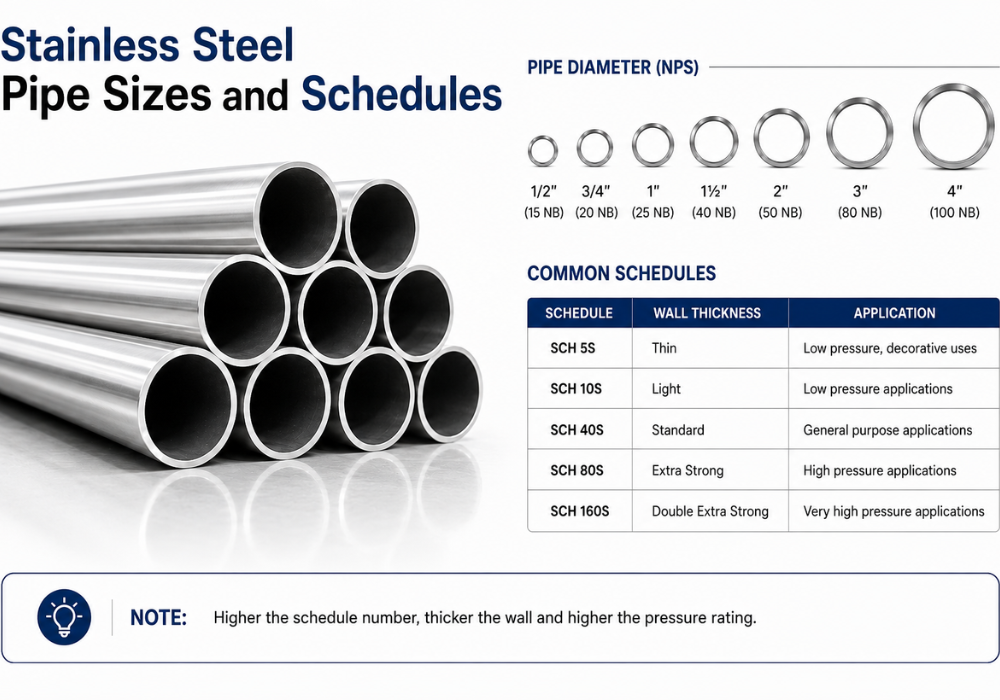
The stainless steel pipe sizes are defined by Nominal Pipe Size (NPS) and pipe schedule, which refers to wall thickness. The stainless steel pipe schedule chart below covers common NPS sizes with corresponding outer diameters and wall thicknesses for Schedules 5S, 10S, 40S, and 80S.
Nominal Pipe Size (NPS)
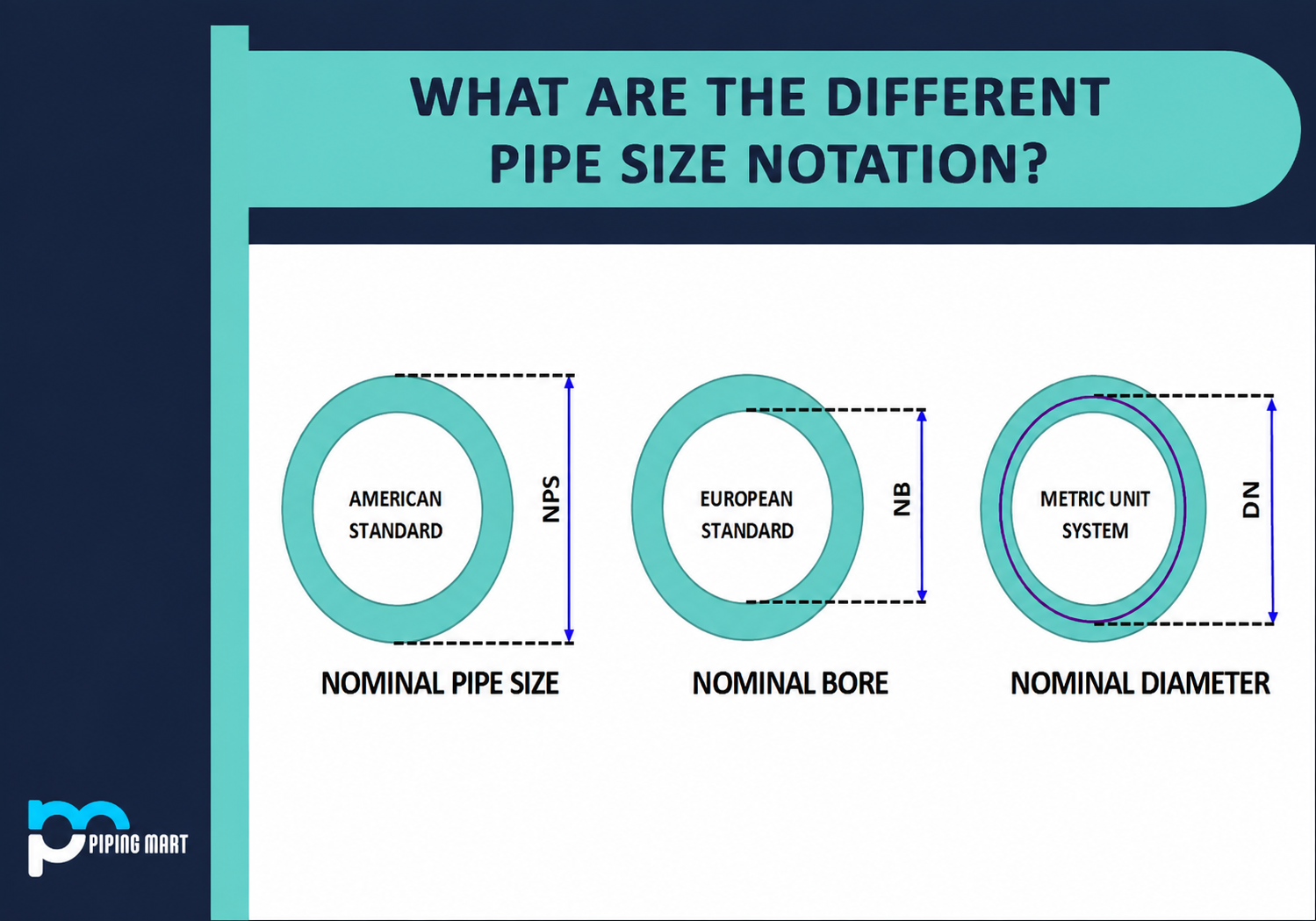
NPS is a North American standard used to designate pipe sizes. It does not directly represent any measured dimension but correlates to the outer diameter. For NPS 1/2 to 12, the OD is fixed regardless of wall thickness, which changes by schedule.
Pipe Schedule Chart Overview
The schedule chart for stainless steel pipe lists the thickness of each pipe in inches by NPS and schedule. Sch 5S with the thinnest wall is used for low-pressure systems. The thick wall and the capacity of higher pressure make Sch 80S the thickest. The proper schedule should be used depending on the operating pressure and temperature of the system, and not only on the size of the material.
Standards and Specifications for Stainless Steel Pipes
Stainless steel pipe standards are the standards that reflect the requirements for composition, dimension, mechanical property, and testing. In regulated industries, the reliability and compatibility of pipes can be ensured with stainless steel pipe that meets recognised pipe specifications.
| NPS | OD (in) | Sch 5S t | Sch 10S t | Sch 40S (STD) | Sch 80S (XS) t |
| 1/2 | 0.84 | 0.065 | 0.083 | 0.109 | 0.147 |
| 3/4 | 1.05 | 0.065 | 0.083 | 0.113 | 0.154 |
| 1 | 1.315 | 0.065 | 0.109 | 0.133 | 0.179 |
| 1¼ | 1.660 | 0.065 | 0.109 | 0.140 | 0.191 |
| 1½ | 1.900 | 0.065 | 0.109 | 0.145 | 0.200 |
| 2 | 2.375 | 0.065 | 0.109 | 0.154 | 0.218 |
| 2½ | 2.875 | 0.083 | 0.120 | 0.203 | 0.276 |
| 3 | 3.500 | 0.083 | 0.120 | 0.216 | 0.300 |
| 3½ | 4.000 | 0.083 | 0.120 | 0.226 | 0.318 |
| 4 | 4.500 | 0.083 | 0.120 | 0.237 | 0.337 |
| 5 | 5.563 | 0.109 | 0.134 | 0.258 | 0.375 |
| 6 | 6.625 | 0.109 | 0.134 | 0.280 | 0.432 |
| 8 | 8.625 | 0.109 | 0.148 | 0.322 | 0.500 |
| 10 | 10.750 | 0.134 | 0.165 | 0.365 | 0.500 |
| 12 | 12.750 | 0.156 | 0.180 | 0.375 | 0.500 |
ASTM Standards
The most widely referenced stainless steel pipe standards are published by ASTM. ASTM A312 covers seamless, straight-seam, and heavily cold-worked welded austenitic stainless steel pipes. ASTM A358 covers electric-fusion-welded pipes for high-temperature service. ASTM A376 applies to seamless austenitic steel pipes for high-temperature central station service.
ASME and ANSI Standards
ASME B36.19 is the main dimensional standard for stainless steel pipes, covering OD and wall thickness by schedule. ASME B31.3 governs process piping design and refers to ASTM material standards for pipe specifications. ANSI standards often overlap with ASME and are used in pressure vessel and piping system design to define dimensional and process requirements.
Applications of Stainless Steel Pipes
Stainless steel pipes are used in a wide range of industries. The material’s combination of corrosion resistance, strength, and hygiene properties makes it suitable for both structural and process applications.
Oil and Gas Industry
In the oil and gas industry, stainless steel pipes are used for transporting crude oil, natural gas, and refined products under high pressures and in corrosive environments. Depending on the grade of chlorine and H₂S in media, duplex and super duplex grades are also employed in addition to the standard grades of austenitic alloys.
Chemical Processing
Chemical plants use stainless steel pipes to handle acids, alkalis, solvents, and other aggressive chemicals. Grade selection depends on the specific chemical being processed. In sulphuric acid service, 904L is commonly specified. For general chemical duty, 316L is often the first choice.
Food and Beverage Industry
Stainless steel pipe applications in food and beverage include transfer lines for milk, juices, beer, and edible oils. The material does not impart taste or contaminate products and can withstand repeated cleaning-in-place (CIP) cycles using hot water and caustic solutions. Grade 304 and 316 are the most common in this sector.
Pharmaceutical Industry
Materials used for pharmaceutical pipelines must be of high purity. Water-for-injection systems, active pharmaceutical ingredient (API) production lines, and sterile fluid transfer systems all use stainless steel pipes, with 316L the preferred stainless steel grade for these applications. Surface finish and electropolishing are crucial in these applications, as they are in the interior of the pipe.
Construction and Infrastructure
Stainless steel pipes are used in building for construction columns, handrails, cladding supports, and plumbing systems. Grade 304 is typical for interior use. When salt air is an issue, 316 is preferred for coastal or marine construction. The surface quality of the material is also appreciated in architecture.
How Are Stainless Steel Pipes Manufactured?
The seamless stainless steel pipes are manufactured with a solid billet, heated to a high temperature, and then perforated to form a hollow pipe. It is then drawn out and rolled or drawn to the desired thickness and diameter. Welded pipes are manufactured from flat-rolled strip or coil of metal that is wound into a tube and welded along the longitudinal seam. Both are heat-treated, surface-finished, dimensionally and mechanically tested, and then dispatched after welding. All pipes are manufactured to industry standards for stainless steel pipes, including ASTM A312/A358, and dimensional standards, including ASME B36.19.
How to Choose the Right Stainless Steel Pipe?
The first step is to determine what material the pipe will transport and what operating conditions exist, such as pressure, temperature, chemical composition, etc. This reduces the number of grades available. In most general corrosive environments, 304 or 316 will serve most applications. Consider 321 for high temperatures. In more critical chemical service, 904L might be required. After fixing the grade, calculate the Sizes and Schedule of the required stainless steel pipe based on flow and pressure requirements. Ensure the pipe complies with the appropriate stainless steel pipe industry or application standards. In addition to the inner diameter finish specification, select the inner surface finish for food, pharmaceutical, or sanitary applications.
Conclusion
Stainless steel pipes are a useful and long-lasting choice for various industrial, commercial, and process applications. The long-term performance will be achieved by the right mix of type, grade, size, and specification. Grade 304 is suitable for general-purpose applications, 316 for more corrosive service, 321 for high-temperature service, and 904L for severe chemical service. The type of pipe (seamless or welded) is also an important factor, depending on the specific application and pressure needs. By matching the properties and specifications of the stainless steel pipe with the actual operating conditions, the stainless steel pipe failure rates will be reduced, and the life cycle cost will be lowered.
FAQs
What is the difference between seamless and welded stainless steel pipes?
Stainless steel seamless pipe is produced without a weld joint, which has a uniform structure and is more suitable for high-pressure applications in general. Welded stainless steel pipes are economical and usually have a seam along the length of the pipe. Welded pipes are used in most normal pressure and temperature applications and are reliable.
Which grade is best for stainless steel pipes?
There is no single best grade. Grade 304 is the most commonly used and covers general-purpose applications. Grade 316 is better where chlorides or acids are present. For high-temperature service, 321 is more appropriate. The right grade depends entirely on the specific operating conditions and media.
What are the common sizes of stainless steel pipes?
The stainless steel pipe sizes are specified as per the different standard industrial sizes from 1/2″ to 12″ or larger and are identified by Nominal Pipe Size (NPS). The outer diameter for each NPS is fixed, and the wall thickness varies based on the schedule. The thickness is given for each size in the stainless steel pipe schedule chart from Sch 5S to Sch 80S
What standards are used for stainless steel pipes?
The most important stainless steel pipe standards are ASTM A312 (seamless and welded austenitic pipes), ASTM A358 (electric-fusion-welded pipes), and ASME B36.19 (dimensional specification). Process piping design is covered by ASME B31.3. To ensure consistent pipe quality and product compliance with regulations, pipes should have these stainless steel pipe specifications.
What is the difference between stainless steel pipes and tubes?
Pipes are mostly defined by NPS and schedule, which are concerned with the flow capacity inside the pipe. The tighter tolerances apply to tubes, which are specified by exact outer diameter and wall thickness. Common tubes are used in precision applications like instrumentation, heat exchangers, and medical equipment, and pipes are employed for the conveyance of fluids and gases in process.