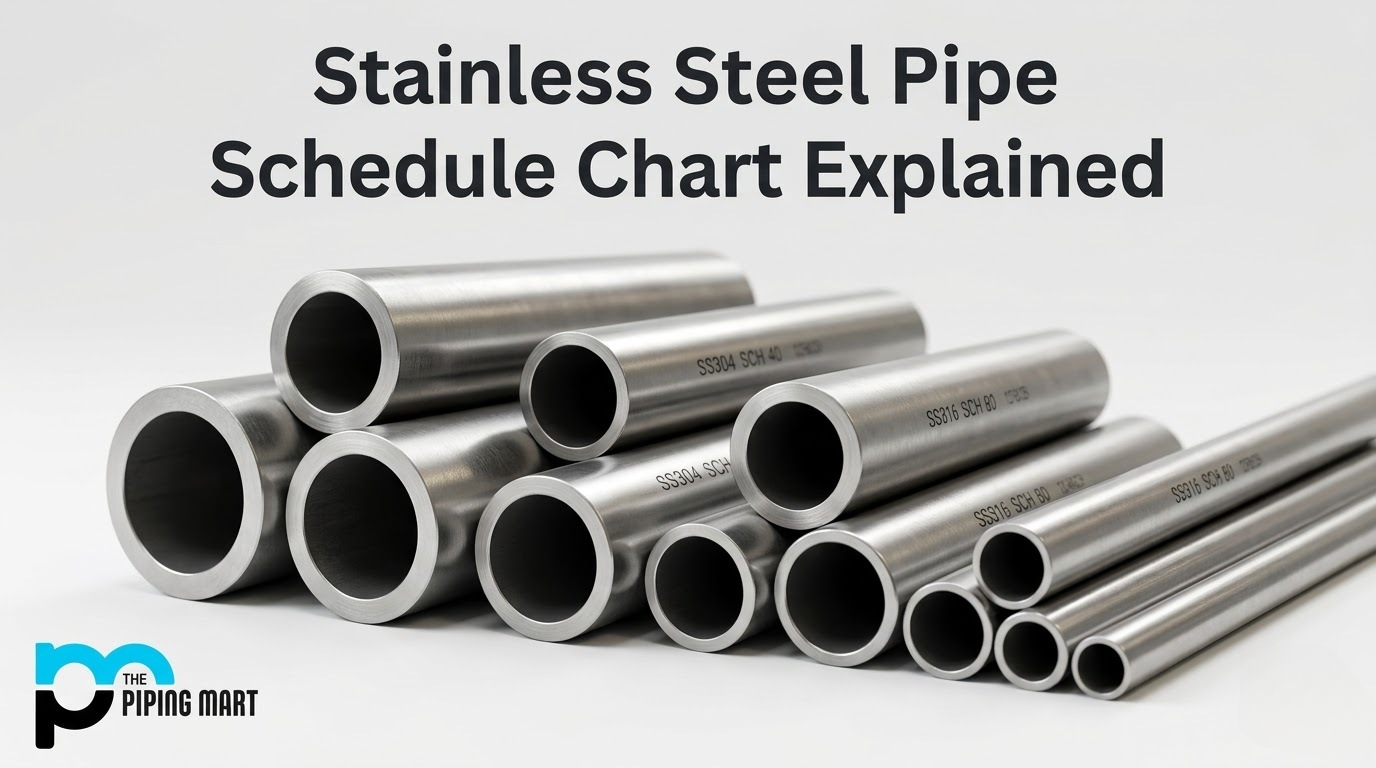
A stainless steel pipe schedule chart converts a schedule designation into a wall thickness for each nominal pipe size. Designations such as 5S, 10S, 40S, and 80S identify stainless steel pipe wall thickness, but one schedule is not one fixed thickness: SCH 10S differs between a 1/2 inch and a 6-inch pipe.
What Is a Stainless Steel Pipe Schedule?
SCH stands for schedule, a dimensionally insensitive designation tied to wall thickness. The S suffix marks the stainless series in ASME B36.19M.
NPS names the pipe size without measuring it. Outside diameter (OD) stays fixed for each NPS, wall thickness changes with the schedule, and inside diameter (ID) equals the OD minus twice the wall thickness.
A higher schedule means a thicker wall for a given NPS. Schedule is not equivalent to a pressure rating, since allowable pressure also depends on material, temperature, design code, and other engineering factors.
Stainless Steel Pipe Schedule Chart
Dimensions below follow ASME B36.19M in millimetres. NPS 1/2 has a 21.3 mm OD, and its wall runs from 1.65 mm in 5S to 3.73 mm in 80S.
| NPS | OD (mm) | SCH 5S (mm) | SCH 10S (mm) | SCH 40S (mm) | SCH 80S (mm) |
| 1/2 | 21.3 | 1.65 | 2.11 | 2.77 | 3.73 |
| 3/4 | 26.7 | 1.65 | 2.11 | 2.87 | 3.91 |
| 1 | 33.4 | 1.65 | 2.77 | 3.38 | 4.55 |
| 1 1/2 | 48.3 | 1.65 | 2.77 | 3.68 | 5.08 |
| 2 | 60.3 | 1.65 | 2.77 | 3.91 | 5.54 |
| 2 1/2 | 73.0 | 2.11 | 3.05 | 5.16 | 7.01 |
| 3 | 88.9 | 2.11 | 3.05 | 5.49 | 7.62 |
| 4 | 114.3 | 2.11 | 3.05 | 6.02 | 8.56 |
| 6 | 168.3 | 2.77 | 3.40 | 7.11 | 10.97 |
| 8 | 219.1 | 2.77 | 3.76 | 8.18 | 12.70 |
| 10 | 273.1 | 3.40 | 4.19 | 9.27 | 12.70 |
| 12 | 323.9 | 3.96 | 4.57 | 9.53 | 12.70 |
Common Stainless Steel Pipe Schedules
- SCH 5S: thin-wall pipe.
- SCH 10S: light wall option for lower pressure services.
- SCH 40S: general purpose wall series.
- SCH 80S: thicker wall where greater mechanical strength or higher pressure requirements may apply.
No schedule is suitable for a pressure service until full design conditions confirm it.
How to Read a Stainless Steel Pipe Schedule Chart
Start with the NPS. NPS 2 has a 60.3 mm OD, not 50.8 mm, since NPS labels the size rather than measuring it. Choose a schedule such as 40S and read its wall thickness, 3.91 mm. Subtracting twice that value from the OD gives an ID of 52.48 mm.
How Pipe Schedule Affects Stainless Steel Pipe Dimensions
Moving up a schedule thickens the wall and shrinks the ID for the same NPS. NPS 4 keeps a 114.3 mm OD, yet its ID falls from 108.20 mm in 10S to 97.18 mm in 80S. That cuts flow area by approximately 19 percent, and the added metal raises pipe weight and alters mechanical characteristics.
How to Select the Right Stainless Steel Pipe Schedule
Selection weighs design pressure, design temperature, material grade, corrosion allowance, piping code or specification, flow area, and mechanical requirements. A schedule chart serves as a dimensional reference only and cannot confirm that a pipe suits a specific pressure service.
Conclusion
A pipe schedule chart links NPS, OD, wall thickness, and ID, and higher schedules thicken the wall and shrink the bore. Reading the chart correctly supports accurate sizing and dimension checks across NPS 1/2 to 12, while pressure suitability still depends on full design conditions.
FAQs
1. What are the different types of pipes available?
Seamless and welded pipes are the two major types, available in many materials and sizes. Application requirements such as pressure, temperature, size, and environment decide which type fits a given job.
2. How do you choose the right pipe material for an application?
Match the material to the service. Corrosion resistance, pressure, temperature, mechanical strength, chemical compatibility, and the surrounding environment guide the choice, and each factor needs checking against the fluid and operating conditions.
3. What is the difference between seamless and welded pipes?
Seamless pipe forms from a solid billet without a weld, while welded pipe forms from rolled plate or strip joined along a seam. Pressure demands, size range, dimensional needs, and cost influence selection.
4. Which industries commonly use industrial pipes?
Oil and gas, chemical processing, construction, power generation, water treatment, and manufacturing all use industrial pipes. Each industry sets its own material, size, and standard requirements for its piping systems.
5. What factors should be considered when selecting pipes?
Pipe size, wall thickness, pressure, temperature, material, corrosion resistance, fluid compatibility, applicable standards, and installation requirements all matter. Engineers weigh these together instead of relying on any single factor.