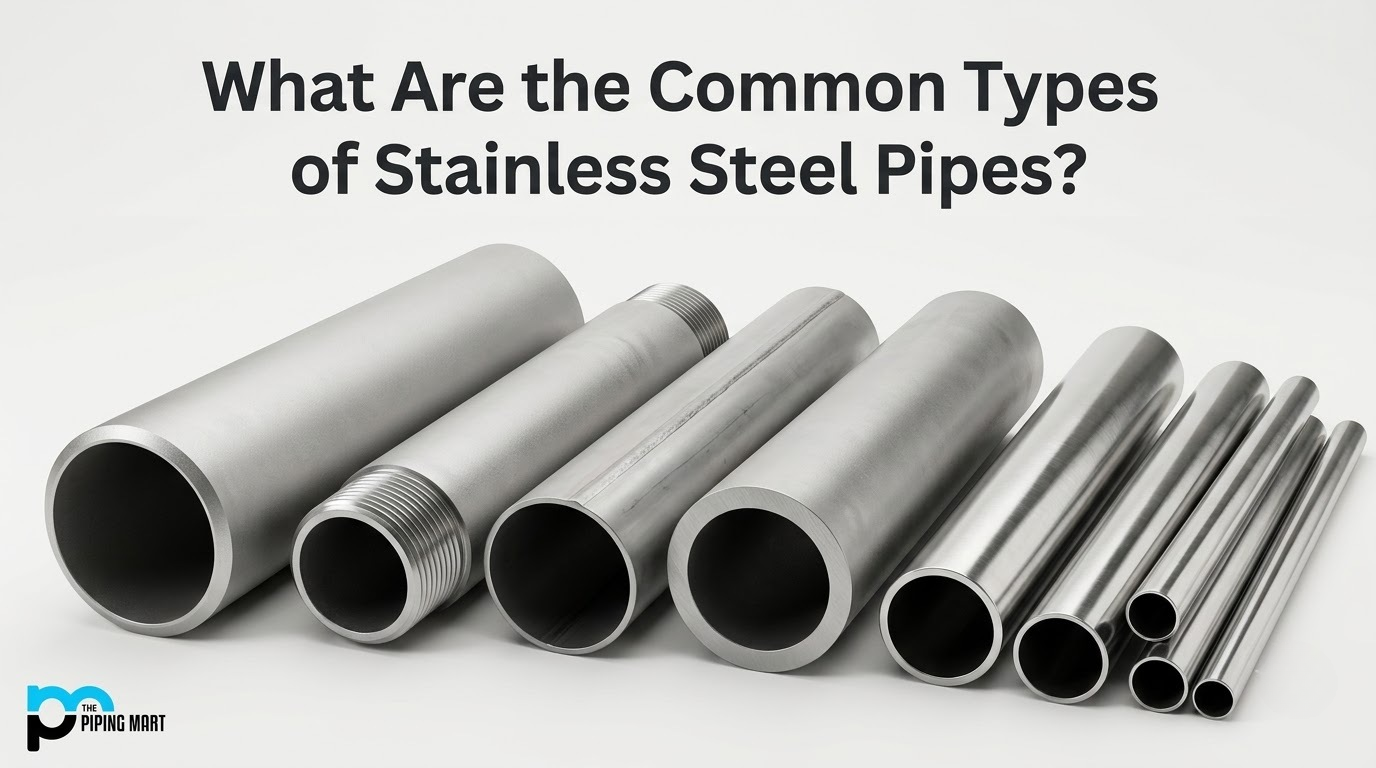
Stainless steel pipes are classified by manufacturing method and alloy grade. Stainless steel pipes are classed by production technique and by alloy grade. Each classification has different dimensional, mechanical, and service characteristics. Understanding both allows customers to select the correct pipe, rather than simply assuming that one type is the default.
Stainless Steel Pipes
Stainless steel pipes are manufactured from chromium-bearing steel alloys that resist corrosion across a wide range of environments, supplied by manufacturers and stockist in forms suited to everything from food processing lines to high-pressure industrial systems.
Common Types of Stainless Steel Pipes
The types of stainless steel pipes below are classified by manufacturing method, which is the first distinction a buyer should understand before looking at the alloy grade.
Seamless Stainless Steel Pipes
Seamless pipes are produced from a solid billet pierced and drawn into a hollow section, with no longitudinal weld seam. That uniform construction is why seamless pipe gets considered for demanding pressure or mechanical performance, though it doesn’t automatically suit every high-pressure duty; grade and wall thickness still have to match the service conditions.
Welded Stainless Steel Pipes
Welded pipes are formed by rolling a stainless steel strip, sheet, or plate into a cylindrical shape and joining the seam. This route offers more dimensional flexibility than seamless production and suits a wide range of industrial and general piping systems. Welded construction isn’t inferior to seamless; it’s simply a different method suited to different needs.
ERW Stainless Steel Pipes
Electric Resistance Welding (ERW) is a specific welding process used to produce welded pipe, where electrical resistance heats and joins the edges of the formed strip. ERW pipe is a category of welded pipe, not a separate alternative to it.
EFW Stainless Steel Pipes
Electric Fusion Welding (EFW) is another welded-pipe process, differing from ERW in how the weld is formed and fused along the seam. The method matters when specifying pipe because it affects weld integrity, available sizes, and inspection requirements.
Stainless Steel Pipes by Grade
Besides the process by which pipes are manufactured, they are also classified according to their metallurgy. The most frequent grades are the austenitic grades, for example 304 and 316 (which has molybdenum for better resistance to chlorine). Ferritic grades like 409 and 430 provide strong general corrosion resistance at a lower cost. The martensitic grades are prized for the higher hardness they can attain following heat treatment. Duplex grades are a mixture of austenitic and ferritic structures, which are more powerful and resistant to corrosion and hence are beneficial in oil and gas and marine piping applications.
How to Choose the Right Type of Stainless Steel Pipe
Selection depends on pressure, temperature, corrosion environment, required strength, pipe size, wall thickness, fabrication requirements, and the applicable specification. Pipe type and pipe grade are separate decisions: a buyer needs to confirm both the manufacturing form and the alloy grade, since the right combination of the two determines performance.
Conclusion
Stainless steel pipes are classified into various types depending on the manufacturing process and grade. Common types are welded pipe and seamless pipe. ERW and EFW are specialized welded-pipe manufacturing methods. Grades such as 304, 316, 409, 430, and duplex 2205 offer varying combinations of corrosion resistance, strength, and temperature performance. At The Piping Mart, we help buyers to analyze sourcing choices based on the type of pipe required, grade, specification, and service requirements by connecting them with manufacturers, suppliers, and exporters.
FAQs
What are the common types of stainless steel pipes?
The common types are seamless and welded pipes, with ERW and EFW as specific welded-pipe manufacturing processes.
What are seamless stainless steel pipes?
Seamless pipes are manufactured without a weld seam, which is why they’re often considered for demanding service conditions.
What are welded stainless steel pipes?
Welded pipes are manufactured from welded strip or plate and are available across a wide range of sizes.
What are common stainless steel pipe grades?
Common grades include 304, 316, 409, and 430, along with duplex 2205 for higher-strength applications.
What are sanitary stainless steel pipes?
Sanitary stainless steel pipes are smooth, highly polished pipes for hygienic uses. They are crevice-free to avoid bacterial development and product contamination in food, beverage, dairy, and pharmaceutical processing systems.
What are pressure stainless steel pipes?
Heavy-duty stainless steel pressure pipes are manufactured for the safe transfer of liquids and gases at high pressures. They are frequently utilized in chemical facilities, electricity generation, oil refineries, and high-pressure steam lines and are tested for structural integrity.
How are stainless steel pipes selected?
Operating pressure and temperature should be considered while choosing stainless steel pipes to determine wall thickness and pipe structure. Also, the alloy grade should be selected to match the environmental exposure to achieve acceptable corrosion resistance, mechanical strength, and weldability.