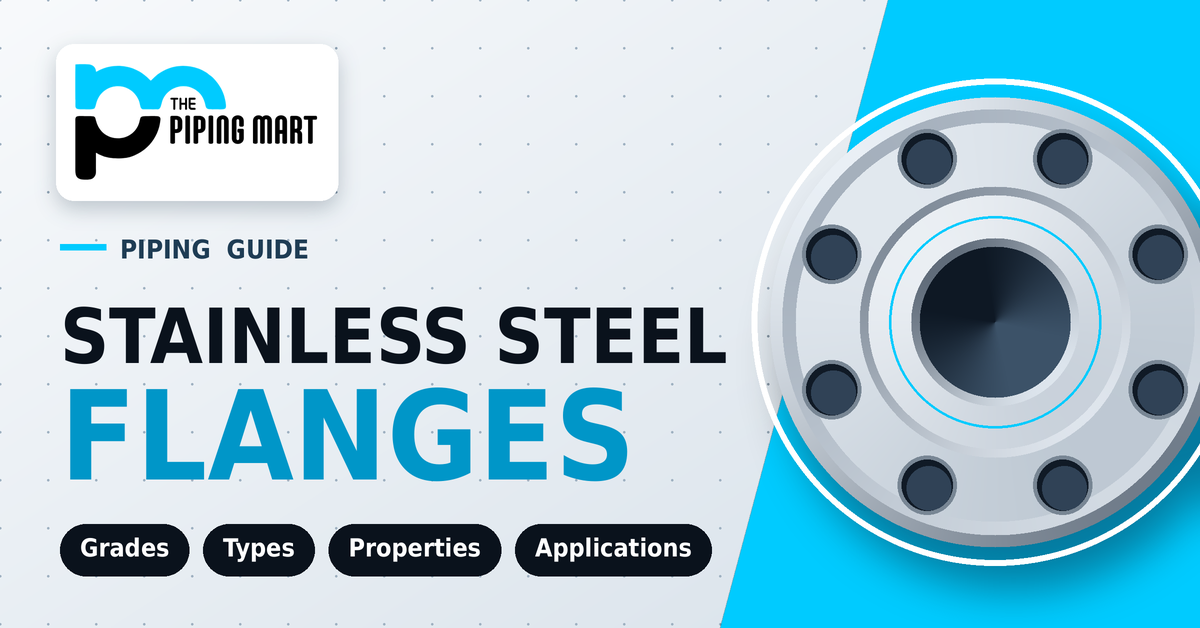
Stainless steel flanges join pipes, valves, pumps, vessels, and other equipment through bolted joints that crews can open for inspection, cleaning, or replacement. Chromium in the alloy forms a self-repairing oxide film that resists corrosion, and the metal carries high-pressure loads, holds strength at elevated temperatures, and performs in chemical, marine, and process plants. This guide covers grades, types, properties, applications, specifications, and selection, so buyers can match a flange to the line it serves.
What Are Stainless Steel Flanges?
Stainless steel flanges are flat or specially shaped components that connect pipes, valves, pumps, and vessels through bolted joints. Flanges span NPS ½ to 60 across the standard dimensional series. Each flange attaches to its pipe by welding, threading, or a stub end, and a mating flange bolts against it.
A gasket is situated between the two faces. Bolts clamp the faces together, which seals the joint and lets crews separate the connection later for maintenance. Stainless steel suits this job because chromium protects the flange body from the corrosion that attacks carbon steel in wet, chemical, and coastal lines.
Stainless Steel Flange Grades
304 Series
The 304 family covers general-purpose austenitic grades with 18–20% chromium and 8–11% nickel. Stainless Steel 304 Flanges handle water, food, and mild chemical lines. Stainless Steel 304L Flanges cap carbon at 0.030%, which protects welded joints from carbide precipitation. Stainless Steel 304H Flanges hold 0.04–0.10% carbon for strength at temperature. Stainless Steel 304N Flanges and Stainless Steel 304LN Flanges add 0.10–0.16% nitrogen to raise yield strength, with 304LN keeping the low carbon.
316 Series
Molybdenum at 2–3% separates the 316 family from 304 and lifts pitting resistance in chloride-bearing media. Stainless Steel 316 Flanges serve as the standard grade for marine and chemical service. Stainless Steel 316L Flanges lower carbon to 0.030% for welded assemblies, while Stainless Steel 316H Flanges raise it to 0.04–0.10% for hot service. Stainless Steel 316N Flanges and Stainless Steel 316LN Flanges add nitrogen for extra strength. Stainless Steel 316Ti Flanges lock carbon with titanium to resist sensitization during heat exposure.
High-Temperature Austenitic Grades
Stabilized and high-chromium grades take over as temperatures climb. Stainless Steel 321 Flanges and Stainless Steel 321H Flanges tie up carbon with titanium; Stainless Steel 347 Flanges and Stainless Steel 347H Flanges do it with niobium. Both routes guard against intergranular attack in the 425–815 °C sensitization range. Stainless Steel 348 and 348H Flanges are stabilized austenitic grades used in applications requiring controlled cobalt content, including certain nuclear-service environments. Stainless Steel 309H Flanges, Stainless Steel 310 Flanges, Stainless Steel 310S Flanges and Stainless Steel 310H Flanges carry 22–26% chromium for oxidation resistance, and Stainless Steel 310 MoLN Flanges add molybdenum and nitrogen.
Higher-Alloy and Specialty Grades
Specialty grades answer narrower demands. Stainless Steel 317 Flanges and Stainless Steel 317L Flanges raise molybdenum to 3–4% for harsher chloride and acid lines. Stainless Steel 904L Flanges pair 4–5% molybdenum with copper for sulfuric acid duty. Stainless Steel SMO 254 Flanges carry about 6% molybdenum for seawater. Stainless Steel 253MA Flanges resist oxidation to roughly 1,100 °C. Stainless Steel 17-4 PH Flanges and Stainless Steel 17-7 PH Flanges gain strength through precipitation hardening, and Stainless Steel 431 Flanges deliver martensitic strength.
Other Austenitic Grades
Stainless Steel 303 Flanges add sulfur for easier machining. Stainless Steel 202 Flanges swap part of the nickel for manganese and nitrogen to cut cost. Both fill narrower roles than the 304 and 316 families.
What Are the Different Types of Stainless Steel Flanges?

Each type joins the pipe in a different way, and that choice sets pressure capability, installation effort, and maintenance access.
1. Weld Neck Flanges
A long tapered hub butt-welds to the pipe and spreads stress away from the joint. Weld neck flanges serve high-pressure, high-temperature process piping.
2. Slip-On Flanges
The pipe slides into the bore, and fillet welds inside and outside secure it. Slip-on flanges align easily and cost less than weld neck designs, though they carry lower fatigue strength on general industrial piping.
3. Blind Flanges
A solid disc closes the end of a pipe or a vessel opening. Crews unbolt it for inspection and maintenance access.
4. Socket Weld Flanges
The pipe seats in a recessed bore, and one outside fillet weld completes the joint. Socket weld flanges suit small-bore lines of NPS 2½ and below, including high-pressure runs.
5. Threaded Flanges
Internal threads screw onto the pipe end, so installers skip welding where heat or sparks create risk.
6. Lap Joint Flanges
A loose flange slides over a stub end that welds to the pipe. The bolt holes rotate freely, which eases alignment on lines that need frequent dismantling.
7. Orifice Flanges
A pair of orifice flanges clamps an orifice plate between them and carries tapped holes for pressure measurement, which lets operators calculate flow.
8. Long Weld Neck Flanges
A long weld neck flange stretches the hub well beyond the standard length. Vessel nozzles and columns use it where a standard hub falls short.
| Flange Type | Connection Method | Typical Use |
| Weld Neck | Butt weld | High-pressure/high-temperature piping |
| Slip-On | Fillet weld | General piping |
| Blind | Bolted closure | Pipe/equipment termination |
| Socket Weld | Socket + fillet weld | Smaller-diameter piping |
| Threaded | Threaded connection | Selected non-welded installations |
| Lap Joint | Used with stub end | Frequent dismantling |
| Orifice | Flange + orifice plate | Flow measurement |
| Long Weld Neck | Butt weld | Specialized piping/equipment |
Properties of Stainless Steel Flanges
Chromium above 10.5% builds the passive film behind stainless corrosion resistance, and molybdenum in 316-type grades extends that protection to chlorides. Forged F304 and F316 flanges reach 515 MPa minimum tensile strength, while the L grades reach 485 MPa. Austenitic grades keep their toughness at sub-zero temperatures, and stabilized and H grades hold strength at high temperatures. Chromium also drives oxidation resistance, which rises from 18% in 304 to 24–26% in the 310 family. Weldability varies by grade: L grades and stabilized grades resist sensitization after welding, while precipitation-hardening and martensitic grades need controlled heat treatment. Smooth surfaces clean easily, which suits hygienic service. Each grade delivers these properties at a different level, so check the grade datasheet before ordering.
| Property | Importance in Flange Applications |
| Corrosion Resistance | Helps withstand corrosive service environments |
| Strength | Supports pressure and mechanical loads |
| Temperature Resistance | Enables use in elevated-temperature systems |
| Toughness | Helps withstand mechanical and service stresses |
| Durability | Supports long-term service |
| Weldability | Important for welded flange connections |
Industrial Applications of Stainless Steel Flanges
Chemical Processing
Plants bolt flanges onto reactors, vessel nozzles, pumps, valves, and process lines that carry acids, solvents, and caustics. Molybdenum-bearing 316 and 317 grades handle the harsher streams.
Oil & Gas and Petrochemical
Refineries and petrochemical units fit flanges to process piping, equipment connections, and pressure systems, from Class 150 utility lines up to Class 1500 service.
Food & Beverage
Stainless Steel 304 Flanges suit hygienic piping and processing lines where grade and surface finish meet plant requirements.
Pharmaceutical and Biotechnology
Drug and biotech process piping needs controlled hygienic conditions, which Stainless Steel 316L Flanges meet with low carbon and molybdenum.
Power Generation
Steam, cooling, process, and auxiliary lines in power plants use flanges, with stabilized 321H and 347H covering the hottest runs.
Water and Wastewater
Treatment plants run flanges on process piping, dosing lines, and corrosion-sensitive installations, where 304L and 316L resist chlorides and disinfection chemicals.
Marine and Offshore
Stainless Steel 316 Flanges withstand salt spray and splash-zone moisture on vessels, platforms and coastal skids. SMO 254 and 904L step in where seawater runs hot or stagnant.
General Industrial and Engineering
Machinery, equipment, process systems and fabrication projects specify grades from 304 to 17-4 PH, depending on the strength and corrosion demand.
Stainless Steel Flange Standards and Specifications
ASME B16.5 governs flanges from NPS ½ to 24 in Classes 150, 300, 400, 600, 900, 1500 and 2500. ASME B16.47 takes over from NPS 26 to 60 in Series A and Series B. ASTM A182 sets material requirements for forged stainless flanges, and ASTM A240 covers plate.
Grade changes the pressure rating. A Class 150 flange in F304 or F316 holds 19.0 bar at 38 °C, while F304L and F316L drop to 15.9 bar. Confirm nominal pipe size, flange dimensions, facing, bore, grade, and heat treatment on every order, since austenitic grades ship solution annealed. Request testing and inspection records with each lot, plus a Material Test Certificate (MTC) listing chemical and mechanical results under EN 10204 3.1. The applicable standard depends on flange type, size, class, material, and service.
Stainless Steel Flange Facing Types
Raised Face (RF) concentrates gasket load on a narrow ring and serves most standard joints. Flat Face (FF) suits low-pressure joints against flat-faced equipment. Ring Type Joint (RTJ) uses a machined groove and metal ring for high-pressure, high-temperature service. Match the facing to the mating flange, gasket, pressure class and service.
How to Select the Right Stainless Steel Flange
1. Identify the piping or equipment connection.
2. Measure pipe size and match flange dimensions.
3. Choose the flange type.
4. Record operating pressure and temperature.
5. Pick the stainless steel grade for the medium and temperature.
6. Select the pressure class against that grade’s rating.
7. Confirm facing and gasket compatibility.
8. Check the governing standards.
9. Confirm testing, certification, and dimensional requirements.
Weigh grade, type, size, pressure rating, facing and service conditions together, because a change in one shifts the others. Put grade, size, class and facing in a single purchase specification, so suppliers quote like for like.
Conclusion
Stainless steel flanges combine corrosion resistance, strength, and durability with connection options from small-bore threaded joints to large-diameter weld neck assemblies. A sound order weighs grade, type, dimensions, pressure class, temperature, facing, applicable standards, and operating environment together. At The Piping Mart, we connect buyers with suppliers, manufacturers, and exporters of stainless steel flanges, helping them evaluate available sources against their technical requirements.
FAQs
What are stainless steel flanges?
They form bolted connections between pipes, valves, pumps, and vessels, with a gasket sealing the mating faces. Chromium in the alloy protects them from corrosion.
What are the different types of stainless steel flanges?
Eight types serve the field: weld neck, slip-on, blind, socket weld, threaded, lap joint, orifice, and long weld neck. Weld neck suits high-pressure lines, and slip-on suits general piping.
Which stainless steel grades are commonly used for flanges?
The 304 and 316 families lead the list. Stabilized 321 and 347, heat-resistant 310, and specialty 904L or SMO 254 serve narrower needs.
What are stainless steel flanges used for?
Chemical plants, refineries, food and drug processing, power stations, water treatment, and offshore platforms use them to join piping and equipment.
How do I select the right stainless steel flange?
Match type, size, pressure class, grade, facing, and standard to the service. Confirm all six against the MTC before ordering.
What standards are used for stainless steel flanges?
ASME B16.5 covers NPS ½ to 24, ASME B16.47 covers NPS 26 to 60, and ASTM A182 sets the forged material requirements.