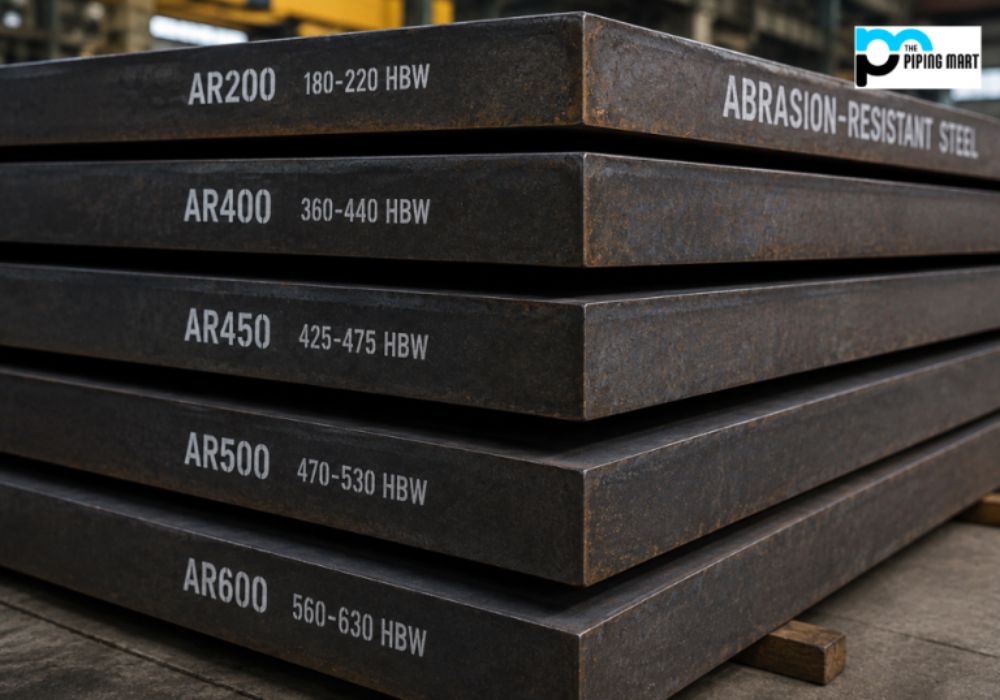
Abrasion-resistant steel is a very hard, heat-treated steel that is manufactured to resist surface wear, friction, and impact in tough industrial environments. It is produced using a quench-and-temper process that creates a martensitic microstructure, which is the key reason for its high hardness and toughness. Hardness is measured in Brinell Hardness (HBW), with different abrasion-resistant steel grades ranging from 400 HBW to 600 HBW. Industries such as mining, construction, agriculture, and bulk material handling rely on it because component wear is a direct operational cost, and frequent part replacement means downtime and higher expenses. The properties of abrasion-resistant steel, particularly hardness, toughness, and tensile strength, make it a practical material choice for equipment handling rock, ore, soil, and other abrasive materials daily.
Properties of Abrasion-Resistant Steel
Abrasion-resistant steel is a high-hardness structural steel that can survive surface wear, impact, and high loads. Abrasion-resistant steel’s properties make it ideal for industries where conventional steel wears out quickly. Here’s a breakdown of its essential qualities.
Superior Toughness
Toughness here refers to the steel’s ability to absorb impact without cracking or fracturing. In real working conditions, think of crushers, excavator buckets, or dump truck liners; the material takes repeated hits. Abrasion-resistant steel holds up under that kind of stress without becoming brittle. It doesn’t just resist surface wear; it handles the shock that comes with it.
Wear Resistance
This is the defining property. The steel resists wearing down when it’s exposed to friction, scraping, or sliding contact. When the steel is harder, measured using Brinell Hardness (HBW), it wears out more slowly. In different abrasion‑resistant steel grades, hardness usually ranges from about 400 HBW to 600 HBW, depending on what the steel is being used for.
Quenched & Tempered Microstructure
The steel’s performance mainly comes from how it is made. First, the steel is heated, then quickly cooled (quenched), and then heated again at a lower temperature (tempered). This process creates a fine martensitic structure that gives the steel both hardness and toughness. Achieving the same combination of properties using alloying alone would be difficult and inefficient.
Formability and Weldability
Even though it is very hard, most abrasion-resistant steel grades can still be cut, bent, and welded on-site if the correct procedures are followed. Preheating is often needed before welding to prevent cracking in the heat-affected zone. Its formability is lower than that of mild steel, so very tight bends must be considered carefully in the design. Still, it is workable enough for most industrial uses of abrasion-resistant steel.
High Yield Strength
Yield strength is the stress level at which steel starts to deform permanently. Abrasion-resistant steel usually has a high yield strength, often above 1,000 MPa, depending on the grade. This means parts made from it can carry very large loads without bending or losing their shape, which is critical in mining and earthmoving equipment.
Tensile Strength
Tensile strength is the most significant stress that steel can withstand before breaking under tension. Abrasion-resistant steel typically has a range of 1,250 MPa to 1,600 MPa across common grades. The material’s exceptional tensile strength, along with its hardness, keeps it intact under surface wear and mechanical pressure.
Elongation (or Ductility)
The elongation indicates how much the steel can stretch before breaking; it is a basic indicator of ductility. Abrasion-resistant steel has lower elongation than mild steel, usually in the range of 8–15%. That’s expected given the hardness level. It still has enough ductility to avoid sudden brittle failure, but it’s not a material you’d choose where significant deformation is required.
Key Applications of Abrasion-Resistant Steel
Abrasion-resistant steel is used across industries where standard steel simply wears out too fast. The applications of abrasion-resistant steel are mostly in environments involving heavy friction, impact, or direct contact with abrasive materials.
Construction Equipment
Bulldozer blades, excavator buckets, loader components, and chute liners all take continuous punishment from rock, soil, and debris. Abrasion-resistant steel is used in these parts because the wear rate on standard structural steel would make replacement too frequent. Higher hardness grades, typically 400 to 500 HBW, are common here, ensuring downtime and longer component life.
Mining & Quarrying
This is one of the most demanding sectors. Equipment like crushers, conveyor liners, haul truck beds, and screening panels deal with sharp, heavy rock material constantly. The combination of impact and abrasion in these environments is severe. Abrasion-resistant steel grades with higher hardness, sometimes up to 600 HBW, are used in the most critical wear zones. The properties of abrasion-resistant steel, particularly toughness and hardness, directly affect how long these components last before needing replacement.
Agriculture and Farming Equipment
Plough shares, tillage components, and cultivator blades work through soil that often contains stones, sand, and other abrasive particles. The wear is gradual but consistent. Abrasion-resistant steel extends the service life of these parts, which is straightforward cost-saving for operators. Not always the highest hardness grades; often mid-range is sufficient, depending on soil conditions.
Industrial and Manufacturing Systems
Hoppers, silos, chutes, and conveyor systems in cement, steel, and bulk material handling all deal with continuous sliding wear from raw materials. Lining these surfaces with abrasion-resistant steel reduces replacement frequency. In some cases, it’s also used in shredder components and mixing equipment where both wear and impact are factors.
Defense and Ballistic Applications
Certain grades of abrasion-resistant steel are used in armoured vehicles and protective structures. The same hardness that resists surface wear also helps resist ballistic impact to a degree. Specific ballistic-grade steel is a separate category, but there is overlap in some armour-plate applications. Usage here is more specialised and depends on the required protection level and thickness.
Transportation and Heavy Vehicle Linings
Dump trucks, tipper bodies, and rail wagons carrying ore, coal, or aggregates need lining materials that hold up over many load cycles. Abrasion-resistant steel is used to line the floors and sides of these vehicles. It keeps the structural body underneath protected and reduces how often the lining needs replacing. In most cases, 400 or 450 HBW grades are used, depending on the material being transported.
Conclusion
Abrasion-resistant steel is a practical solution for industries where wear and impact reduce component life and increase operational costs. The properties of abrasion-resistant steel, such as hardness, toughness, yield strength, and tensile strength, are directly suited to heavy-duty environments. Different abrasion-resistant steel grades allow engineers and procurement teams to match the material to the specific wear conditions rather than using a single specification across all applications. The applications of abrasion-resistant steel cover a wide range, from mining and construction to agriculture and transport. Selecting the right grade for the right use case is what determines how much value the material actually delivers in service.
FAQs
What is the highest level of abrasion resistance (AR)?
The highest commercially available abrasion-resistant steel grade is typically AR600, with a Brinell hardness of around 570–640 HBW. It provides maximum wear resistance but has less toughness and ductility than lower grades; it is used in high-abrasion applications where impact loads are not a major concern.
Is AR400 abrasion-resistant?
Yes. AR400 is a common abrasion‑resistant steel. It has a Brinell hardness of about 360–440 HBW, which provides a good mix of hardness, toughness, and weldability. Because of this balance, it’s widely used in mining, construction, and material handling equipment.
What is the most abrasion-resistant steel?
AR600 is among the hardest and most abrasion-resistant grades available in standard commercial supply. In highly specialised applications, tungsten carbide overlays or chromium carbide hard-facing materials can exceed this, but those are surface treatments rather than through-hardened steel grades.
What is a good abrasion-resistant steel?
AR400 and AR450 are considered reliable, all-around choices for most industrial applications. They offer good wear resistance alongside acceptable toughness and weldability. The right grade depends on the specific operating conditions, particularly whether the application involves pure abrasion, impact, or a combination of both.
Can abrasion-resistant steel be welded without losing hardness?
Welding does affect the hardness in the heat-affected zone, and some loss is unavoidable. Using low-hydrogen electrodes, following correct pre-heat procedures, and controlling inter-pass temperature can minimise hardness loss. In most practical fabrication scenarios, the reduction in the weld area is acceptable, provided the welding procedure is followed correctly.