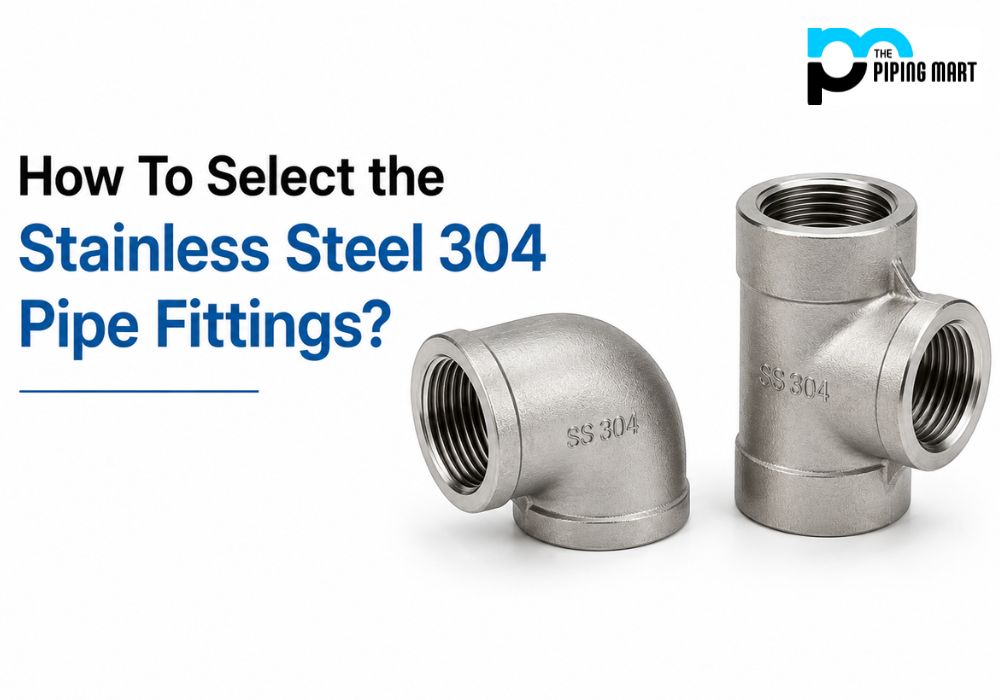
Choosing the right SS 304 pipe fitting is not a simple box-ticking exercise. The grade is widely used in food processing, pharmaceuticals, water treatment, and chemical handling, but that familiarity can make buyers careless. A fitting that looks correct on a datasheet can still fail if the pressure rating, corrosion environment, or connection standard has not been properly checked. This guide is written for engineers, procurement teams, and project managers who need to get the selection right the first time. It covers application requirements, fitting types, pressure ratings, standards compliance, and supplier checks, each step building on the last.
What Are Stainless Steel 304 Pipe Fittings?
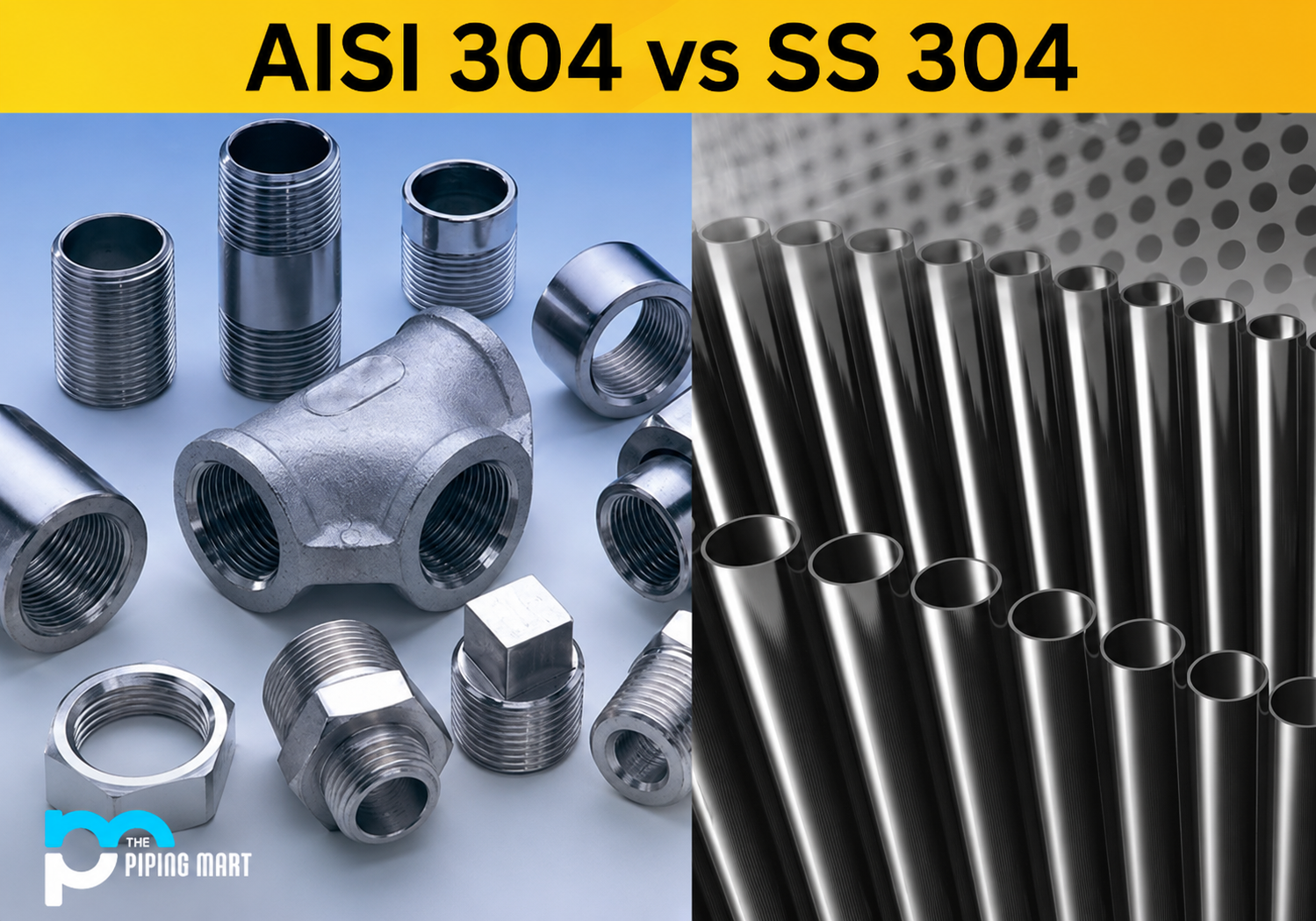
SS 304 pipe fittings are components that connect, redirect, branch, or close off sections of a stainless steel piping system. The 304 designation refers to a specific austenitic grade 18% chromium and 8% nickel, which gives it solid corrosion resistance, good weldability, and reliable mechanical strength across a broad temperature range. Available in forms ranging from elbows and tees to flanges, reducers, and end caps, these fittings are manufactured to meet strict dimensional and chemical standards. They are not a premium exotic material. They are a practical, well-proven choice for most non-chloride industrial and hygienic applications.
Step-by-Step SS 304 Pipe Fittings Selection Guide
Work through the steps below in sequence. Each one narrows the field and prevents the kind of specification errors that cause problems during installation or inspection.
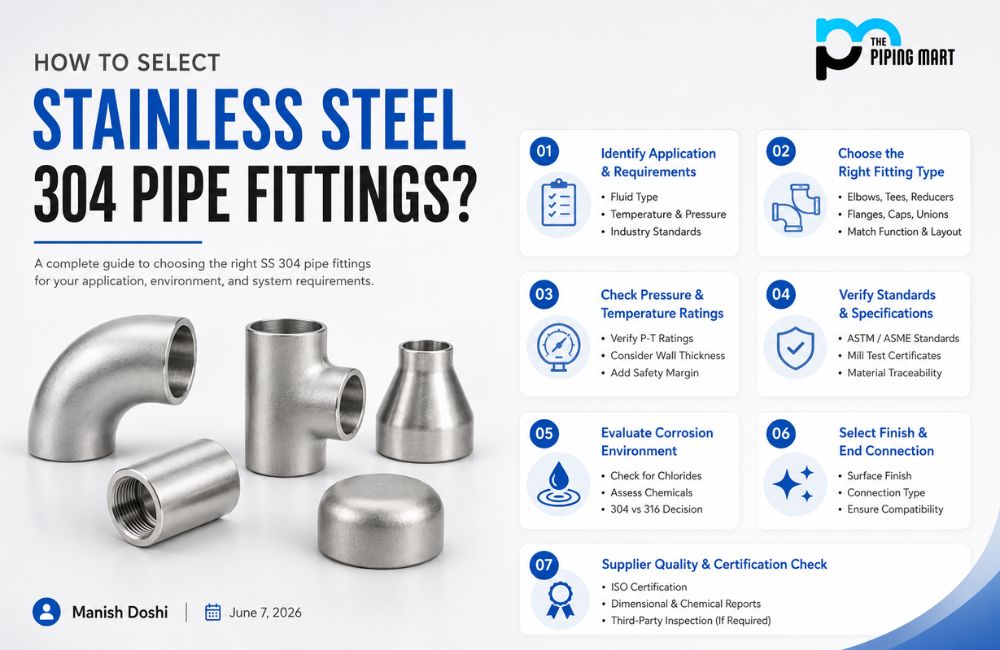
Step 1: Identify the Application and Industry Requirements
Before looking at any fitting catalog, define what the fitting is actually doing. What fluid is passing through? At what temperature and pressure? Is the system handling food-grade products, corrosive chemicals, or potable water? Industries like pharmaceuticals and food processing care regulatory requirements, surface finish standards, material traceability, and documentation that shape every downstream decision. A water treatment line and a dairy processing line may both use SS 304, but the fitting specifications can differ considerably. Start here, and the rest of the process becomes faster.
Step 2: Choose the Right Type of Fitting
Fitting type follows function. Elbows change direction. Tees create branch connections. Reducers join pipes of different diameters. Flanges allow the line to be opened without cutting. Each type also comes in sub-variants, long radius versus short radius elbows, concentric versus eccentric reducers, and those differences matter in practice. Buttweld fittings are the go-to for high-pressure welded systems. Threaded and socket-weld fittings suit smaller bore, lower-pressure applications where quick assembly is a priority. Match the type to the system layout and the connection method already in use.
Step 3: Check Pressure and Temperature Ratings
SS 304 is not a single performance band. Ratings vary by schedule, wall thickness, connection type, and fitting geometry. A fitting that handles 150 bar at ambient temperature may not hold that rating at 300°C. Always pull the pressure-temperature tables from the manufacturer’s documentation and check them against actual operating conditions, not just nominal values. Build in a safety margin. For systems that cycle through temperature or pressure changes, fatigue factors as well. This is where under-specification tends to happen and where failures tend to originate.
Step 4: Verify SS 304 Fittings’ Specifications and Standards
Material grade alone is not enough. The fitting must be manufactured to a recognised standard. Buttweld fittings follow ASTM A403 and ASME B16.9. Forged fittings fall under ASME B16.11. Flanges are covered by ASME B16.5. Threaded connections reference ASME B1.20.1. These standards define chemical composition, dimensions, tolerances, and mechanical properties. Request mill test certificates from the supplier and verify that the heat numbers match the documentation. If the certificates are missing or vague, that is a red flag worth taking seriously.
Step 5: Evaluate the Corrosion Environment
SS 304 handles most environments well mild acids, alkaline solutions, fresh water, and food contact. It struggles in two specific conditions: high chloride concentrations and sustained elevated temperatures in the presence of chlorides. Seawater, brine, and certain cleaning agents used in food plants can trigger pitting or stress corrosion cracking over time. If the service environment includes any of these, 316 grade with its added molybdenum content is worth the price difference. Get the environment wrong, and the grade choice is wrong regardless of everything else.
Step 6: Select Surface Finish and End Connection
Surface finish is often treated as cosmetic. In hygienic applications, it is structural. A rough surface finish creates sites where bacteria can harbor, and cleaning becomes unreliable. Mill finish (2B) works for general industrial use. No. 4 brushed finish is common in food and pharmaceutical environments. Electropolished surfaces are required in the most demanding hygienic applications. End connection types like butt-weld, socket weld, threaded, and flanged must also match the existing piping and the installation method. Mismatched connections cause installation delays and, in some cases, compliance failures.
Step 7: Supplier Quality and Certification Check
The same grade from two different suppliers can be very different in practice. Check for ISO 9001 certification, but do not stop there. Ask for material traceability, the ability to track a fitting back to its original heat of steel. Review dimensional inspection reports. For critical service applications, consider third-party inspection at the supplier’s facility before shipment. A good supplier will produce documentation without hesitation. Pressure on this point often reveals where corners have been cut.
Types of SS 304 Pipe Fittings You Should Know For Selecting
The table below covers the main SS 304 fitting categories, their common sub-types, primary applications, and the key factors that should guide selection. Knowing what each type is designed to do prevents the wrong fitting from ending up in the wrong place.
| Fitting Type | Common Sub-Types | Main Use | Selection Point |
| Buttweld fittings | Elbow, tee, reducer, cap, cross, stub end | Welded piping systems, especially pressure lines | Best when a strong, permanent, leak-resistant joint is required |
| Forged fittings | Socket weld, threaded, couplings, unions, bushings, plugs | Small-bore piping and high-pressure connections | Choose compact fittings and easier installation |
| Flanges | Weld neck, slip-on, blind, threaded, lap joint, socket weld | Connecting pipes to valves, pumps, and equipment | Useful when the line needs to be opened for maintenance |
| Nipples | Barrel nipple, reducing nipple, swage nipple | Short pipe extensions and size transitions | Select when only a short connection piece is needed |
| End caps | Pipe caps, end caps | Closing pipe ends permanently or temporarily | Use to seal the end of a piping line |
| Bends and elbows | 45°, 90°, short radius, long radius, 3D, 5D elbows | Changing flow direction | A long radius reduces pressure drop; short radius saves space |
| Reducers | Concentric reducer, eccentric reducer | Connecting pipes of different sizes | Concentric for vertical lines; eccentric for horizontal to avoid air pockets |
| Crosses | Equal cross, reducing cross | Splitting the flow into four directions | Use only when the layout genuinely requires a four-way branch |
| Unions and connectors | Union, connector | Quick assembly and disassembly | Better suited for systems that need regular maintenance access |
Common Mistakes to Avoid While Selecting SS 304 Pipe Fittings
Selecting based on price without checking certifications is the most common error and the most expensive one to fix after the fact. Assuming all SS 304 fittings are equivalent regardless of supplier is another mistake. Chemical composition can vary, especially with lower-cost imports that are not independently verified. Ignoring the corrosion environment and defaulting to 304 in chloride-heavy service is a failure waiting to happen. Mismatched end connections, skipped pressure-temperature checks, and missing mill test certificates are recurring problems on site. Each of these mistakes is avoidable. The selection process exists precisely to catch them before anything goes into the ground.
Conclusion
SS 304 pipe fittings are reliable, well-documented, and suitable for a broad range of industrial applications. But reliable does not mean foolproof. The grade performs as expected when the selection process is followed, the application is assessed properly, the fitting type is matched, the standards are verified, and the corrosion environment is understood. Skip steps, and problems surface later at considerably higher cost. For most non-chloride, non-marine applications, SS 304 remains a sound and practical choice. The goal of this guide is to make sure that the choice is made with the right information, not just habit or precedent.
FAQs
What standards apply to SS 304 pipe fittings?
The applicable standard depends on the fitting type. Buttweld fittings are covered by ASTM A403 for material and ASME B16.9 for dimensions. Forged fittings follow ASME B16.11. Flanges reference ASME B16.5, and threaded connections must meet ASME B1.20.1 for thread form. Project specifications or industry regulations may also call for additional testing or documentation on top of these baseline standards.
When should I not use stainless steel 304 pipe fittings?
Avoid SS 304 in high-chloride environments, such as seawater, brine, salt spray, and some industrial cleaning agents used in food plants. These conditions can cause pitting and stress corrosion cracking, particularly at elevated temperatures. Strongly reducing acids is also problematic. In these cases, SS 316 with its added molybdenum content provides meaningfully better resistance and is the correct grade to specify.
What is the difference between buttweld and threaded fittings?
Buttweld fittings are welded directly to the pipe, producing a continuous, seamless joint suited to high-pressure and high-temperature service. They require welding equipment and qualified personnel. Threaded fittings screw onto the pipe end using machined threads; they are faster to install, and no welding is required, but they are limited to smaller pipe sizes and lower-pressure applications. Once a threaded joint is in service, it can be disassembled without cutting, which is useful in maintenance-heavy systems.
Are SS 304 fittings suitable for high-pressure applications?
Yes, provided the correct schedule and wall thickness are specified. Schedule 40 and Schedule 80 buttweld fittings in SS 304 are routinely used in pressure pipelines. The fitting’s pressure rating must always be cross-referenced against operating temperature; the two are linked, and a fitting rated for high pressure at ambient may derate significantly at elevated temperatures. Check the manufacturer’s pressure-temperature tables before confirming any high-pressure selection.
How do I verify the quality of SS 304 pipe fittings?
Start with the mill test certificate, which should confirm the chemical composition against the 304 grade specification. Check that the heat numbers on the certificate match the markings on the fittings. For critical applications, positive material identification (PMI) testing provides independent, on-site verification of the material grade. Dimensional inspection reports and third-party test results add another layer of assurance for high-specification or safety-critical service.