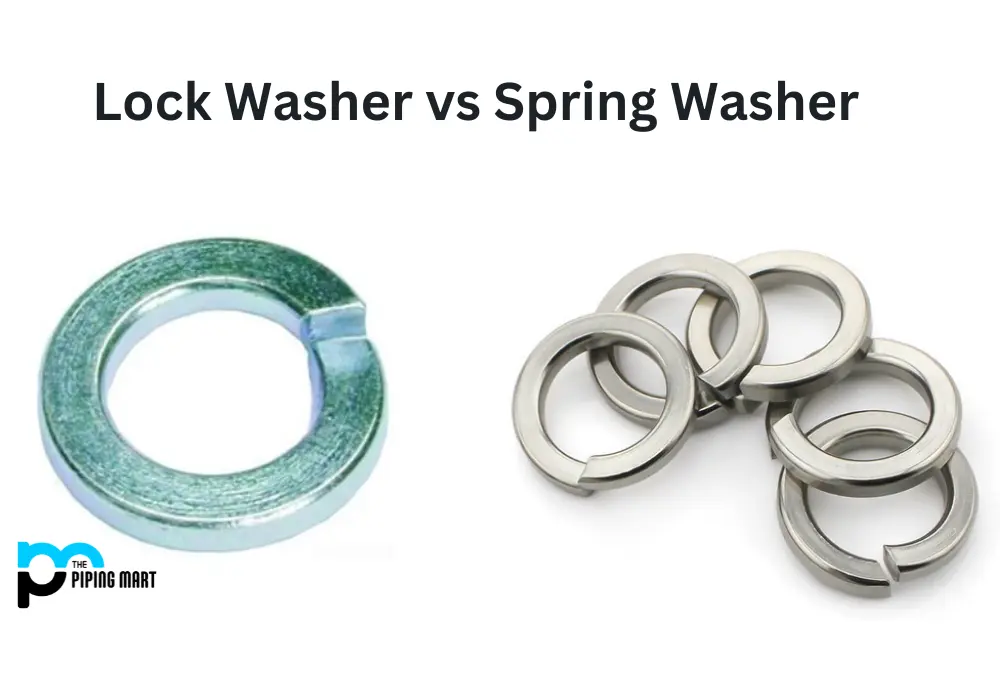
Bolted joints can loosen for several reasons, but fastener rotation and loss of clamp load are two common concerns. Either the fastener rotates loose under vibration, or the clamp load drops off as the joint settles. Two small components are picked to fight these separate problems, and they get mixed up constantly. A lock washer vs spring washer comparison sounds like splitting hairs until a joint backs off on a vibrating frame or preload drops on a gasketed flange. The difference between a lock washer and a spring washer comes down to what each part resists: mechanical rotation on one side and load loss on the other. Engineers who pick wrong usually find out during a shutdown, not before it.
What is a Lock Washer?
A lock washer sits under the fastener head or nut and works through mechanical interference. Split ring types, tooth types, and wedge-lock designs all do the same basic job in different ways. Teeth bite into the bearing surface. A split ring flexes and digs its cut edge into both faces. Wedge-lock washers use two mating cam faces that ratchet against rotation but release cleanly under axial pull. These designs primarily address fastener rotation and resistance to loosening, although their effectiveness depends on the washer design and joint conditions. Most are stamped from spring steel or stainless steel and sized to match standard bolt diameters, and selection depends heavily on the surface finish they will sit against.
What is a Spring Washer?
A spring washer is built to store and release energy, not to grip a surface. The washer deflects when the fastener is torqued down, and that stored elastic force keeps pushing against the joint as it settles, heats up, or cools. Helical spring washers work like a compressed coil under the nut. Belleville washers, shaped like a shallow cone, do the same thing over a much smaller stack height and can be arranged in series or parallel for tuned load ranges. Wave washers spread the same principle across a wider, thinner footprint. Their primary function is to generate spring force through elastic deflection rather than to rely on intentional surface biting.
Difference Between Lock Washer and Spring Washer
Both parts sit under a fastener, and both are called spring washers informally on a shop floor, which is where most of the confusion starts. The table below separates them by what actually matters during selection.
| Aspect | Lock Washer | Spring Washer |
| Primary function | Stops fastener rotation through mechanical interference or friction | Maintains axial preload and compensates for settlement, embedding, or thermal change |
| Typical types | Split (helical) lock, internal/external tooth, wedge-lock, tab, serrated flange | Helical spring, Belleville (disc), wave, conical spring |
| Locking mechanism | Teeth or edges bite into the bearing surface, or cam faces ratchet against rotation | Elastic deflection produces axial force, no intentional surface biting |
| Vibration resistance | Moderate to high, depending on tooth or wedge design | Moderate, better for preload retention than anti-rotation |
| Surface damage risk | Higher, teeth and edges can mark soft or coated surfaces | Lower, generally smooth bearing faces |
| Load distribution | Limited, built for locking rather than spreading load | Better, especially Belleville and wave types under compression |
| Common standards | ASME B18.21.1, DIN 127, DIN 7980, DIN 6797 | DIN 127, DIN 137, DIN 2093, ASME B18.21.1 spring-lock types |
| Typical applications | Vibrating machinery, automotive assemblies, grounding on electrical panels | Thermal cycling joints, gasketed flanges, bearings, dynamic load equipment |
| Used with a flat washer | Often paired with one to protect the surface | Frequently paired with one, Belleville stacks sometimes run alone |
Advantages of Lock Washer
A lock washer earns its place mainly through friction and interference, not elasticity. The points below cover why it stays a default choice for anti-rotation work.
Maintenance of Bolt Preload and Tension
The split or tooth profile keeps constant contact against the nut and the bearing face, resisting micro-movement during normal operation.
Enhanced Resistance to Vibration and Dynamic Loads
Tooth and wedge-lock geometries interrupt the rotational path a nut would otherwise take under repeated shock loading.
Frictional Interlock and Prevention of Rotation
The washer’s edge digs into the surface once torque is applied. Rotation gets physically obstructed rather than just resisted by clamp pressure.
Load Distribution Across Mating Surfaces
Flat and serrated flange types spread bearing pressure over a wider area than the nut face alone, reducing point loading on thin material.
Cost-Effective and Simple Installation
Standard lock washers are installed with the same tools and sequence as a plain washer, with no added torque procedure.
Electrical Grounding Support
Tooth washers cut through paint or light corrosion to establish metal-to-metal contact, common on panel and enclosure grounding points.
Advantages of Spring Washer
Spring washers solve a different problem, keeping preload alive after a joint has already settled once. The points below cover where that elastic behaviour helps.
Secure Fastening and Anti-Loosening
Stored spring force pushes back against small losses of clamp load, keeping the joint from going slack without a mechanical bite.
Vibration and Shock Resistance
Elastic deflection can accommodate small changes in joint compression and help maintain contact force during mechanical or thermal cycling.
Load Distribution and Stress Reduction
Belleville and wave designs spread compressive force over a broader area, reducing peak stress at a single point on the joint face.
Enhanced Longevity and Durability
Spring steel variants resist fatigue across repeated load cycles, holding deflection characteristics longer than a rigid washer would.
Compensation for Thermal Expansion and Contraction
As materials heat and expand or cool and contract, the deflection range absorbs the change without fully releasing preload.
Space Efficiency
Belleville washers deliver a usable spring rate in a stack height far smaller than a coil spring would need for the same force.
Electrical Conductivity
Metal-to-metal contact under sustained spring pressure keeps a stable path, useful for grounding or bonding joints.
Cost-Effectiveness
A single stamped spring washer often replaces a more complex disc-spring stack on lower-load joints, cutting part count.
Applications of Lock Washer
Lock washers show up wherever rotation, not preload loss, is the main risk.
Automotive and Transportation Industry
Engine mounts resist loosening from constant engine vibration. Suspension and Chassis Assemblies need mechanical anti-rotation against road shock. Marine vessels use them on hull fittings exposed to constant motion.
Industrial Machinery and Heavy Equipment
Construction equipment running on rough terrain needs anti-rotation on structural bolts. Manufacturing production lines with repetitive motion loosen standard nuts without a lock washer.
Infrastructure and Structural Engineering
Bridges and rail systems need tooth or wedge-lock hardware against traffic-induced vibration. Agricultural machinery uses them on implement fasteners exposed to field vibration.
Electrical and Electronics Systems
Grounding applications rely on tooth washers cutting through coatings for a low-resistance path. Control panels use them on doors and mounting rails to maintain continuity.
HVAC and Appliance Manufacturing
Rooftop units and air handlers need anti-rotation hardware against fan and compressor vibration. Household appliances like washing machines use them on motor mounts.
Applications of Spring Washer
Spring washers turn up wherever a joint needs to hold its clamp load through heat, settling, or repeated cycling rather than just resist a nut turning.
Automotive Industry
Engine and transmission bolts undergo repeated heating and cooling cycles. Belleville and helical washers under those fasteners keep the clamp load from fading as the joint expands and contracts.
Aerospace and Aviation
Weight matters more here than almost anywhere else, so Belleville washers get stacked to tune preload in a stack height far shorter than a coil spring would need.
Heavy Machinery and Industrial Equipment
Hydraulic cylinders and structural frames on excavators take constant dynamic loading. Spring washers on these joints absorb the small settling that happens as connections bed in.
Power Generation and Energy Sector
Turbine housings run hot for long stretches and cool during shutdowns. Spring washers on flange bolts keep preload steady through that thermal swing without a retorque each cycle.
Electrical and Electronics Industry
Busbar connections depend on steady contact pressure to carry current reliably. Spring washers under these fasteners keep pressure from dropping as connectors heat and cool.
Marine and Offshore Engineering
Flange joints on ships and offshore platforms deal with salt exposure and temperature swings. Spring washers hold seal pressure on these joints better than a rigid washer alone.
Railways and Transport Systems
Rail fastening systems clamp the rail to the sleeper under repeated axle loading. Disc springs maintain a clamping force across millions of cycles without frequent adjustment.
Construction and Structural Engineering
Bolted steel connections on buildings sit through seasonal swings that shrink and expand the structure slightly. Spring washers keep the connection tight through that movement.
Oil, Gas, and Chemical Processing
Gasketed flanges on pipework run under internal pressure and thermal cycling. Spring washers on the flange bolts help stop the seal from loosening into a leak path.
Defense and Military Hardware
Equipment exposed to shock loading needs fasteners that hold preload after an impact. Spring washers are chosen here when retaining clamp load outweighs shaving off weight.
How to Choose a Lock Washer vs a Spring Washer?
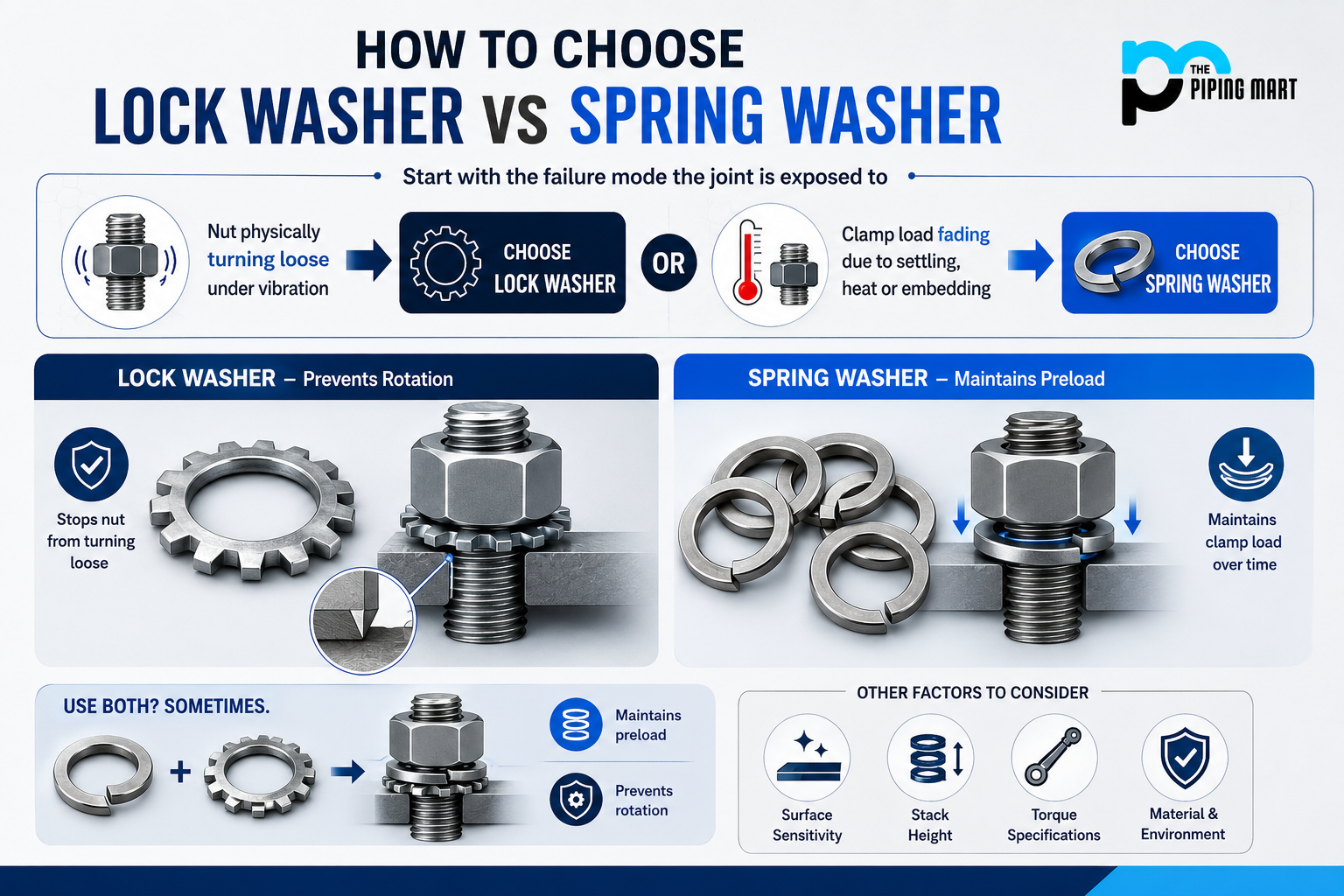
Start with the failure mode the joint is actually exposed to. If the concern is a nut physically turning loose under vibration, a lock washer with a tooth or wedge profile addresses that directly. If the concern is clamp load fading as the joint settles, heats up, or embeds over time, a spring washer, particularly a Belleville type on gasketed or thermally cycled joints, holds preload better. Surface sensitivity matters too; coated or soft materials often rule out toothed lock washers because of the risk of marking. Some assemblies use both a spring washer for preload and a lock washer for rotation, though the choice depends on stack height limits and torque specifications for that specific joint.
Conclusion
Lock washers and spring washers solve different failure modes on the same type of joint. Lock washers use mechanisms such as tooth engagement, mechanical interference, friction, or wedge/cam action, depending on the design. Picking between them, or combining both, depends on vibration exposure, thermal cycling, surface material, and how critical preload retention is to the application. Getting this choice wrong doesn’t usually show up immediately; it shows up months later as a loose fastener or a leaking flange.
FAQs
What is the difference between a lock washer and a spring washer?
A lock washer resists rotation through teeth or edge interference. A spring washer maintains axial preload through elastic deflection.
When should you use a lock washer instead of a spring washer?
Use one when the main risk is the nut backing off under vibration, such as on machinery frames or grounding connections.
How does a spring washer prevent loosening?
It doesn’t stop rotation directly. It stays compressed under the fastener and keeps pushing against the joint as clamp load fades.
Are lock washers effective for vibration resistance?
Yes, tooth and wedge-lock types resist vibration-induced rotation well, though effectiveness varies with tooth design and surface hardness.
Which is better: lock washer or spring washer for bolted joints?
Neither wins outright. Lock washers suit anti-rotation needs, spring washers suit preload retention, and the choice depends on the joint’s actual failure risk.