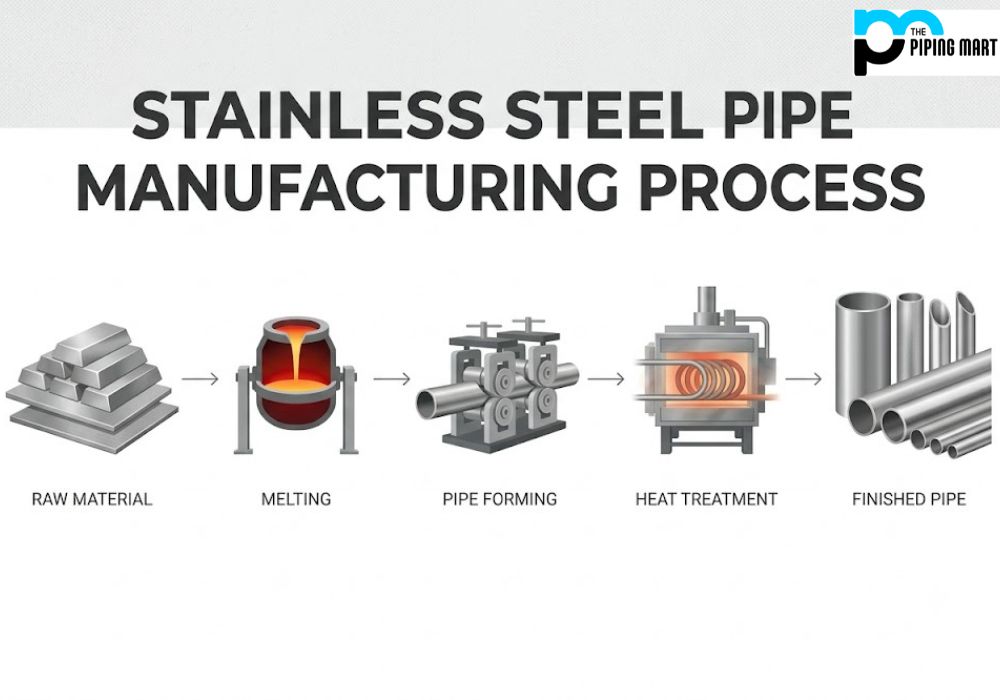
Stainless steel pipes are essential parts in many industrial fields where they should be able to resist corrosion, resist high pressure, or keep the environment clean. The SS pipes are widely used in different fields, including petrochemical plants, pharmaceutical industries, food processing industries, marine installations, and so on. The production of stainless steel pipes is not just a one-step process but a process of controlled steps from the preparation of raw materials to the final inspection. Each stage defines the mechanical integrity, dimensional accuracy and surface condition of the finished product. This blog provides a useful introduction to all the stages of the SS pipe manufacturing process, including seamless pipe and welded pipe production, to help buyers, engineers, and project teams understand the complexities of each pipe they specify.
What is Stainless Steel Pipe Manufacturing?
Stainless steel pipe manufacturing is the conversion and processing of stainless steel material into a tube or hollow product used for fluid or gas transportation or structural support. The exact manufacturing process varies depending on the type of pipe being produced. Seamless pipes are manufactured by piercing and rolling a solid billet, and thus have no weld join. Welded pipes are manufactured by rolling flat strip material into a pipe shape and welding the edges together to form the pipe. Both types of pipe require heat treatment, surface finishing, and testing before they are ready to be installed.
Raw Materials Used in Stainless Steel Pipe Production
The quality of the raw material determines the foundation for all pipes that are produced on the line. Stainless steel is an alloy that is based on iron, and the elements added to it to create specific grades determine the corrosion resistance as well as the suitability for different environments.
Chromium and Nickel Composition
Chromium is the key alloying element in stainless steel. The minimum amount of chromium that must be present in the material for it to be classified as stainless steel is 10.5%. Chromium forms a thin protective oxide layer on the surface when it comes into contact with oxygen. This layer helps to protect against corrosion. Nickel is used to increase the ductility, to maintain the austenitic structure, and to enhance the high-temperature properties of the steel. Also, the ratio of chromium to nickel affects the characteristics of the steel during its forming, welding, and heat-treatment processes in the manufacture of the stainless steel pipe.
Common Stainless Steel Grades Used
304 stainless steel is the most widely used grade for making pipes because it works well in general industrial use and offers decent corrosion resistance. 316 stainless steel contains molybdenum, which gives it better protection against chloride corrosion, so it is commonly used in marine, chemical, and offshore environments. Duplex grades like 2205 are chosen when both high strength and strong corrosion resistance are needed. Grades such as 310S and 321 are used for high-temperature applications where resistance to oxidation is important.
How Seamless Stainless Steel Pipes Are Manufactured
Billet Preparation and Heating
The seamless pipes are made from a solid billet of stainless steel. The billets are cut to the correct length and checked before they are fed into the furnace. It is then subjected to high temperatures of 1200 to 1280 °C in a rotary hearth furnace. It is important to have uniform heating throughout the billet cross-section. If the temperature varies, the material will not be uniformly formed during piercing, and the finished pipe will have variations in wall thickness.
Piercing and Extrusion
When the billet is brought to the proper temperature, it is transferred to the piercing mill. The mandrel or piercing plug is rotated and forced through the center of the billet, converting it into a thick-walled hollow shell. This is one of the fundamental steps in the seamless process. The precision of the piercing operation has a direct bearing on the concentricity of the wall and uniformity of wall thickness. The hollow shell is then fed into an extrusion or rotary elongation mill, where the process continues to reduce the wall thickness and extend the pipe.
Pipe Elongation and Sizing
Pipe Elongation and Sizing. The rough shell is passed through a series of rolling mills where the wall thickness is gradually decreased, and the pipe is lengthened. Following the rolling operation, the pipe is sent to a sizing mill that determines the final outside diameter. Several passes may be necessary to meet the dimensions required within the tolerance. Wall thickness is checked at this point against the applicable specification. For most applications, this is ASTM A312 or a similar standard.
How Welded Stainless Steel Pipes Are Manufactured
The welded pipes are made from flat stainless steel strips or coils. This method is usually faster and cheaper than making seamless pipes, especially for large or thin pipes.
Coil Slitting and Forming
The first step is to slit the stainless steel coil to the correct width based on the desired pipe circumference (wall thickness). The slit strip is then fed through a series of progressive forming rolls that progressively form the slit strip into a tubular shape. The forming has to be done at a controlled rate to avoid cracking or surface damage, particularly with work-hardened grades. The strip ends are cut straight at the forming section and are ready for welding.
TIG and ERW Welding Process
In many cases, the filler metal is not used, and TIG welding, also called Gas Tungsten Arc Welding (GTAW), uses a tungsten electrode. It yields a clean and accurate weld of excellent surface quality and is the preferred technique for pharmaceutical, food, and instrumentation-grade pipes. The ERW, or Electric Resistance Welding, involves passing the current directly across the edges of the strip, creating heat from the resistance. The edges are then pressed together to create the weld. ERW is faster and suitable for industrial pipes with thicker walls and larger diameters. In both cases, weld quality is checked carefully because the seam is the most vulnerable area of a welded pipe.
Weld Bead Treatment and Finishing
After welding, a raised bead forms both on the external and internal surfaces of the pipe at the weld seam. The external bead is ground flush with the pipe surface in most cases. Whether the internal bead is removed depends on the application. In pharmaceutical and food-grade pipes, the internal bead is removed, and the surface is finished to a smooth Ra value to prevent product retention or bacterial growth. In general industrial pipes, the internal bead may be left or partially treated, depending on the specification.
Heat Treatment and Annealing Process
Heat treatment is applied after forming and welding to address two key issues: residual stress and sensitisation. During forming and welding, internal stresses build up in the material. Meanwhile, the heat from welding can cause carbide precipitation at grain boundaries and a depletion of chromium in the adjacent regions, thereby reducing corrosion resistance, a process known as sensitisation. Solution annealing resolves both problems. The pipe is heated to a temperature in the range 1010°C to 1120°C and then rapidly cooled in water or air. This dissolves the precipitated carbides and restores a uniform austenitic structure to the material. Without annealing, grades like 304 and 316 can suffer intergranular corrosion in service. Annealing is a non-optional step in the SS pipe manufacturing process for any pipe going into a corrosive or high-temperature environment.
Stainless Steel Pipe Sizing and Straightening
After heat treatment, pipes are passed through sizing rolls to bring the outer diameter within the required tolerance. Heat treatment can cause slight distortion, and the sizing step corrects any deviation from roundness or diameter. Straightening follows immediately. The pipe is passed through a straightening machine that applies controlled bending in multiple planes to remove any bow or curve that may have been introduced during previous processing. For pipes that are used in tight-clearance installations or in automated handling systems, straightness is a specification requirement, not just an aesthetic consideration. Pipe ends are also cut to the specified length and prepared at this stage, with bevels or plain ends applied as required.
Surface Finishing Methods
The surface condition of a stainless steel pipe affects corrosion performance, hygiene compliance, and, in some cases, flow characteristics. Different end uses call for different surface treatments.
Pickling and Passivation
Pickling uses a blend of nitric acid and hydrofluoric acid to clean the pipe surface. It removes heat tint from welding and annealing, surface scale, embedded iron particles, and other contamination. After pickling, the surface of the stainless steel is chemically clean, and the chromium oxide layer is naturally regenerated. To speed up and strengthen the protective oxide layer, passivation is done after pickling using nitric or citric acid. The surface is more corrosion-resistant than an unpickled or untreated pipe. Most industrial-grade stainless steel pipes are pickled and passivated.
Polishing and Bright Annealing
Mechanical polishing is done with abrasive belts or wheels to produce a smooth and consistent surface finish. Electropolishing is an electrochemical process by which a thin layer of the surface material is removed to clean the surface with a low Ra value. Polished pipes are used in food, dairy, and pharmaceutical applications. Bright annealing is a furnace process performed in a hydrogen or nitrogen atmosphere so that there is no oxidation during heat treatment. The result is a shiny, scale-free surface that does not require pickling. Bright annealed pipes are specified for semiconductor manufacturing, pharmaceutical systems, and other applications requiring very high surface cleanliness.
Quality Testing in Stainless Steel Pipe Manufacturing
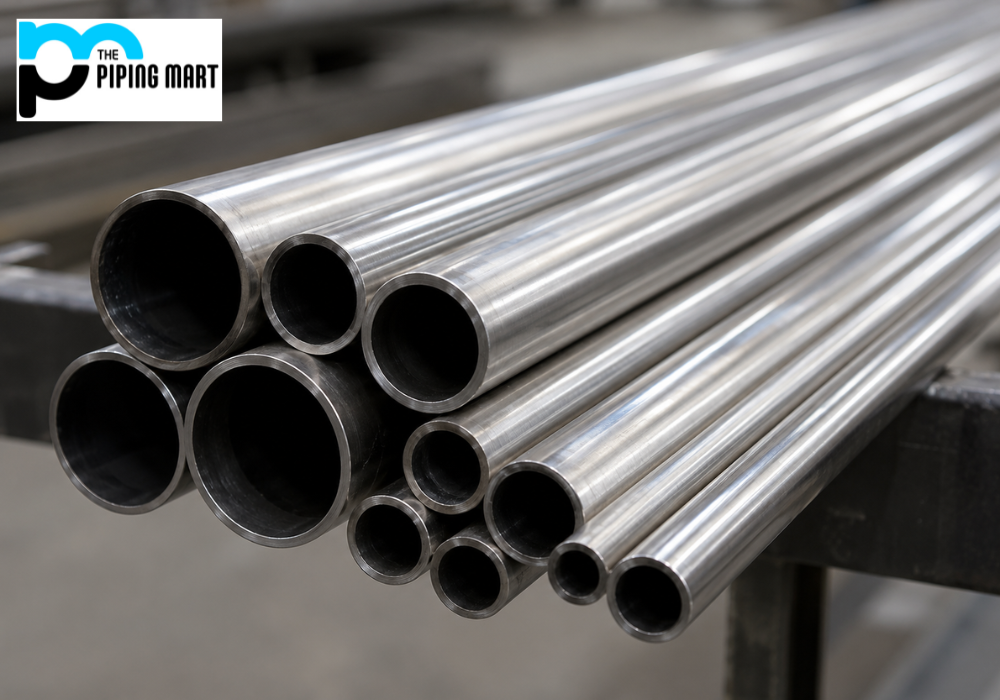
Testing is carried out at various stages during production and again on the finished pipe before dispatch. The tests are not only about compliance; they also confirm that the pipe will perform as intended in its end-use environment.
Hydrostatic Testing
The hydrostatic testing involves filling a pipe with water and pressurising it to a specified test pressure that is maintained for a defined duration. The test pressure is based on the pipe’s outside diameter, wall thickness, and the allowable stress for the material grade. If the pressure drops, there is a leak, crack, or weak point. This test must be conducted on all pipes used for pressure applications and is one of the last tests to be performed prior to dispatching a pipe.
PMI and Chemical Testing.
Positive Material Identification is a technique to confirm the elemental composition of the pipe by X-ray fluorescence. It verifies that the material is of the required grade, and there are no incorrect alloys in the production batch. Chemical analysis through spectroscopy or wet chemistry is also conducted to verify adherence to the compositional limits in the standard. In most critical applications, such as the oil and gas, defence, and nuclear industries, material traceability is required in the supply chain, and PMI is therefore required.
Non-Destructive Testing (NDT)
Ultrasonic testing checks for internal defects such as cracks, laminations, and wall thickness irregularities without cutting into the pipe. Eddy current testing is used on welded pipes to check the weld seam for discontinuity. Radiographic testing uses X-rays as a method of inspecting weld zones, primarily for porosity, inclusions, and lack of fusion. The required NDT technique depends on the standard and the importance of the application. All findings are recorded and reviewed before releasing the pipe batch.
ASTM and ASME Standards Followed
The standards define the technical requirements that pipes must meet, covering material chemistry, mechanical properties, dimensional tolerances, and testing procedures. In the stainless steel pipe manufacturing process, ASTM standards are the most commonly specified.
ASTM A312
ASTM A312 is the primary standard for austenitic stainless steel pipes intended for high-temperature and general corrosive service. It covers seamless, welded, and heavily cold-worked pipes in grades including 304, 304L, 316, 316L, 321, and 347. The standard specification limits on chemical composition, specifies minimum tensile and yield strength values, and defines hydrostatic and non-destructive test requirements. Most industrial piping projects specify A312-compliant pipes for critical service lines.
ASTM A269 and ASTM A358
ASTM A269 applies to seamless and welded austenitic stainless steel tubing for general service, including instrumentation lines and heat exchanger tubing. It is used where pressure ratings are lower and dimensional precision is the primary requirement. ASTM A358 covers electric-fusion-welded pipes in austenitic grades for high-temperature service, typically in large diameters not covered by A312. It is referenced in power generation and process plant projects where large-bore welded pipes are used in high-temperature systems.
Common Manufacturing Defects and Quality Checks
Defects can appear at any stage of the stainless steel pipe manufacturing process. In the case of seamless pipes, incorrect heating or piercing conditions can result in eccentricity of wall thickness, resulting in one side of the pipe being thicker than the other. Laps and seams on the billet surface can also be carried through to the finished pipe if not detected early enough. In welded pipes, defects such as porosity, incomplete fusion, and undercut at the weld seam are common due to incorrect welding parameters or poor edge preparation. Other problems encountered in production include surface contamination, dimensional drift, and incorrect heat treatment. The standard approach for detecting and resolving these defects before pipes are shipped to the customer is in-process inspection at each stage, along with final testing.
Conclusion
The production of stainless steel pipe comprises a series of interconnected steps, with the quality of the product associated with quality control at each stage of the manufacturing process. Seamless and welded pipes are made by different processes, but they share the same requirements for heat treatment, surface treatment, dimensional accuracy, and testing. Understanding how stainless steel pipes are made helps buyers choose the right pipe, ask better questions during purchasing, and check whether a supplier is capable. For critical uses, buyers should review material test certificates, ASTM or ASME compliance, and test reports for every order.
FAQs
How are seamless stainless steel pipes produced?
A seamless pipe is produced using a solid steel billet. The billet is heated, and then a rotating mandrel is used to pierce the billet, forming a hollow shell. This shell is then rolled and dimensioned to the desired outer diameter and wall thickness. The pipe produced after the process is not welded; thus, it is preferred for high-pressure applications.
What is the difference between seamless and welded stainless steel pipe manufacturing?
Seamless pipelines are made from solid billets without any weld joints, and the structure of the pipeline is uniform throughout the wall. The welded pipes are manufactured from strip material, which is rolled into a pipe and welded along the seams. Welded pipes are more affordable and can be used for applications where the pressures are within the rated limits of the weld seam.
Which ASTM standards apply to stainless steel pipes?
The most common international standard is ASTM A312, which specifies austenitic stainless steel pipes for hot and corrosive applications. ASTM A269 is used for general service tubing, and ASTM A358 is used for large diameter electric-fusion-welded pipes for high-temperature applications. The standard to be used will depend on the type of pipe, the grade of pipe, and the use to which it is to be put.
Why is annealing important in stainless steel pipe manufacturing?
Annealing removes residual stresses from forming and welding and reverses sensitisation caused by heat during welding. Without annealing, grades such as 304 and 316 can develop reduced corrosion resistance at grain boundaries. The process restores the material to its intended microstructure and ensures the pipe meets the mechanical and corrosion resistance requirements of the applicable standard.
What is pickling and passivation in stainless steel pipes?
Pickling and passivation are treatments that help stainless steel pipes resist corrosion. Pickling cleans the surface by removing scale, heat marks, and contaminants, while passivation helps build a stronger protective oxide layer. Together, these processes improve the pipe’s durability and performance in corrosive environments.