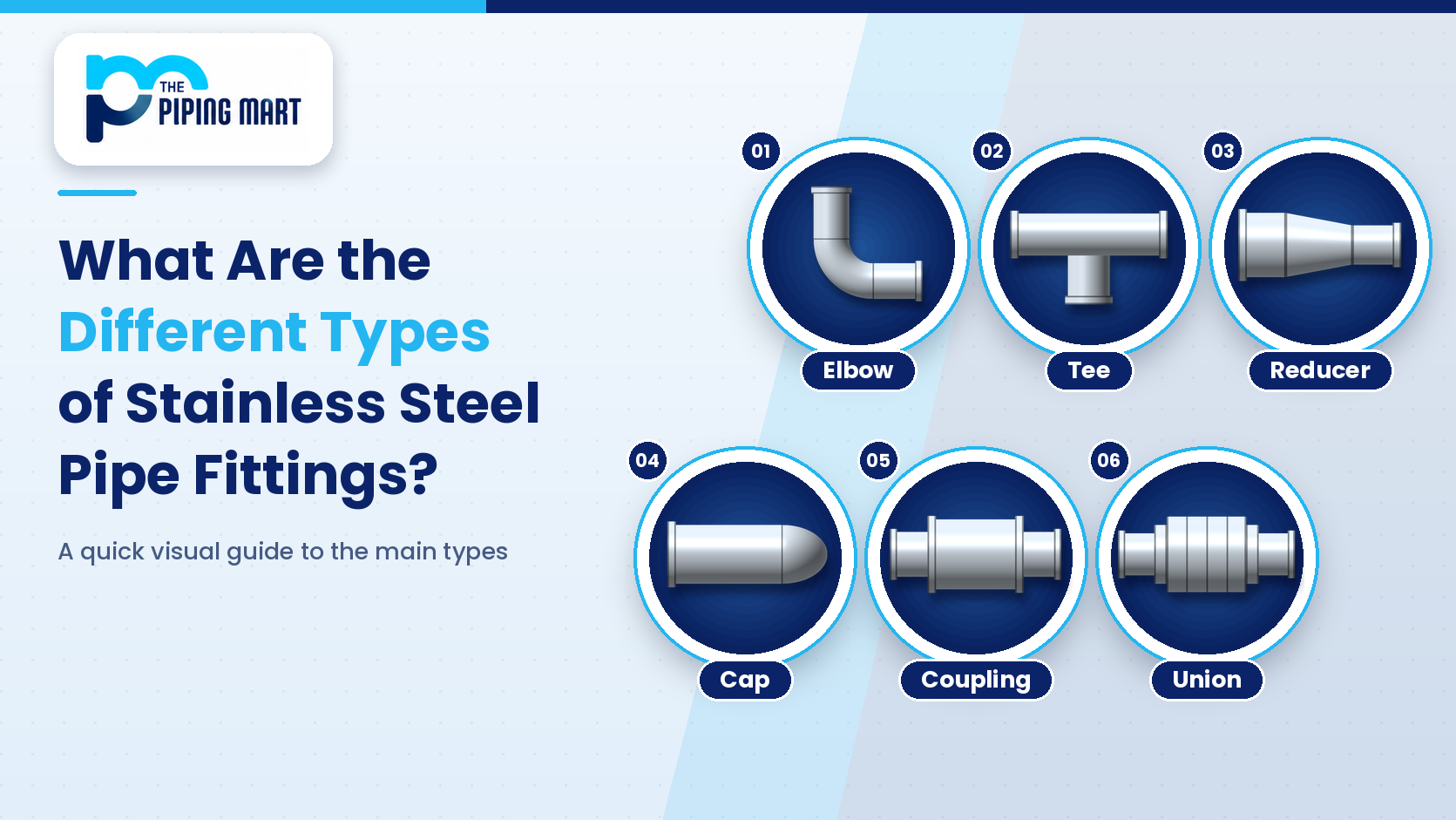
Stainless steel pipe fittings are the components that connect, redirect, branch, reduce, extend, or terminate a piping system. A straight run of pipe can only go so far on its own; the moment a line needs to turn a corner, split into a branch, step down in size, or simply stop, a fitting takes over. Different fitting configurations exist because piping layouts differ so widely, and the right choice depends on the layout, flow direction, pipe diameter, connection method, pressure, temperature, and service requirements. Common types of stainless steel pipe fittings include elbows, tees, reducers, caps, couplings, unions, crosses, and specialty configurations, covered below by shape and function rather than grade.
Stainless Steel Pipe Fittings At a Glance
Stainless steel pipe fittings connect, branch, redirect, reduce, or terminate piping systems, with elbows, tees, reducers, caps, and couplings all available across different stainless steel grades. The correct grade depends on corrosion exposure, temperature, pressure, fluid compatibility, fabrication requirements, and the specific application.
Different Types of Stainless Steel Pipe Fittings
Stainless Steel Elbows
Elbows change the direction of a piping system, most commonly through a 45° or 90° bend, with 180° return bends used in specific layouts. They also come in long-radius and short-radius configurations, with long-radius versions offering a gentler turn and short-radius versions fitting tighter spaces. Elbow selection affects both layout and how smoothly flow moves through the direction change, and they appear throughout process, utility, and industrial piping. Grade-specific options such as Stainless Steel 304 Pipe Fittings or Stainless Steel 316 Pipe Fittings cover elbows alongside the other configurations below.
Stainless Steel Tees
Tees create a branch connection off a main piping line, letting flow split in two directions or combine from two lines into one. Equal tees keep the branch outlet the same size as the main run; reducing tees step the branch down to a smaller diameter. The difference comes down to whether the branch needs the same flow capacity as the main line or a reduced one, and both forms are common across process and utility piping.
Stainless Steel Reducers
Reducers connect pipes with different nominal diameters, managing the transition between a larger and smaller line. Concentric reducers keep both centerlines aligned, suiting straight-line transitions; eccentric reducers offset the centerlines, which matters where a flat top or bottom edge needs to stay level, such as on a pump suction line. Reducer selection relates to piping orientation and process requirements, not one type simply replacing the other.
| Reducer Type | Basic Configuration | Typical Consideration |
| Concentric | Centerlines remain aligned | Common straight-line transitions |
| Eccentric | Centerlines are offset | Selected for specific piping orientations |
Stainless Steel Caps
Caps close the end of a pipe, whether permanently or as a temporary termination for a section reserved for future extension. They’re a simple fitting, commonly found wherever a process or industrial system needs a clean, sealed stop point.
Stainless Steel Couplings
Couplings join two pipe sections together in a straight run, connecting one length of pipe to another within a line. Their construction is simple, typically supplied in threaded or socket-weld configurations depending on how the rest of the system connects.
Stainless Steel Unions
Unions allow a pipe connection to be disconnected more conveniently than a permanent welded joint, which matters wherever maintenance access is a real consideration. Built from three parts that assemble and disassemble without disturbing the rest of the line, unions suit smaller piping and systems needing regular access. The difference from a coupling: a coupling makes a largely permanent joint, while a union is built to come apart and go back together.
Stainless Steel Crosses
Crosses provide multiple branch connections from a single fitting, typically in a four-way arrangement where more than one flow path needs to split off at the same point. They’re a more specialized fitting than a tee, used where a layout calls for that additional branch.
Other Stainless Steel Pipe Fittings
A handful of additional configurations round out the category: stub ends and related lap-joint fittings, pipe nipples, adapters, and specialty or custom-configured fittings built to a specific project’s requirements. Which of these a system needs depends on the piping design and the exact connection requirement.
Stainless Steel Pipe Fittings by Connection Method
Beyond shape and function, fittings are also classified by how they actually connect to the pipe.
Butt Weld Fittings
Butt-weld fittings, including elbows, tees, reducers, and caps, connect by welding directly to the pipe end, creating a permanent, continuous joint. This method is common across process and industrial piping where a durable, leak-resistant joint matters more than ease of disassembly.
Socket Weld Fittings
Socket-weld fittings work differently: the pipe end inserts into a socket in the fitting before the joint is welded around the outside. This suits smaller-diameter piping particularly well, and elbows, tees, and couplings are commonly supplied in socket-weld form.
Threaded Fittings
Threaded fittings connect through male and female threaded ends, allowing installation without welding. That makes them useful wherever a removable connection is appropriate, though pressure, temperature, and service suitability still need verifying before specifying a threaded joint.
Sanitary / Hygienic Fittings
Sanitary fittings are designed for hygienic piping systems, common across food, beverage, pharmaceutical, and biotechnology applications. Cleanability, surface finish, and hygienic design factor into this category more heavily than in standard industrial fittings.
Stainless Steel Pipe Fittings by Function
| Fitting Type | Main Function | Common Configuration |
| Elbow | Changes flow direction | 45°, 90°, 180° |
| Tee | Creates a branch | Equal, reducing |
| Reducer | Connects different pipe sizes | Concentric, eccentric |
| Cap | Closes pipe end | Various end configurations |
| Coupling | Joins pipe sections | Threaded, socket weld, etc. |
| Union | Facilitates disconnection | Threaded/assembled connection |
| Cross | Creates multiple branches | Four-way configuration |
How to Choose the Right Type of Stainless Steel Pipe Fitting?
Consider the Piping Layout
Determine whether the system needs a direction change, a branch, a size transition, a straight joint, or a termination point.
Match the Pipe Size
Confirm the nominal pipe size and dimensions of the connected pipes before selecting a fitting.
Select the Required Configuration
Narrow down the specifics: 45° or 90° elbow, equal or reducing tee, concentric or eccentric reducer, coupling or union, cap or cross.
Select the Connection Method
Match the fitting to the required butt-weld, socket-weld, threaded, sanitary, or other connection arrangement.
Check Operating Conditions
Factor in pressure, temperature, fluid characteristics, and installation conditions.
Verify Standards and Specifications
Confirm the applicable dimensional, material, testing, and project specifications before finalizing selection.
Conclusion
Stainless steel pipe fittings come in different configurations: elbows, tees, reducers, caps, couplings, unions, crosses, and specialty types, each built to perform a specific piping function. Fittings can also be differentiated by connection method, whether butt-weld, socket-weld, threaded, or sanitary. Selecting the right type means weighing piping layout, pipe size, connection method, pressure, temperature, and service conditions together, since the different types of stainless steel pipe fittings available each solve a different problem. At The Piping Mart, we help you navigate these grade-specific options, ensuring your chosen configuration perfectly aligns with the corrosion resistance and temperature limits your project demands.
FAQs
What are the different types of stainless steel pipe fittings?
The main types include elbows, tees, reducers, caps, couplings, unions, crosses, and specialty fittings such as stub ends and adapters, each serving a different function in a piping layout.
What type of stainless steel fitting changes the direction of a pipe?
Elbows change the direction of a piping system, commonly through 45°, 90°, or 180° bends in long-radius or short-radius configurations.
What is the difference between a tee and a cross fitting?
A tee provides a single branch connection off a main line. A cross creates numerous branch connections, usually in a four-way configuration.
What is the difference between a concentric and eccentric reducer?
Concentric reducers bring the center lines of the two pipes in line with each other. An eccentric reducer offsets the center lines. Often this is done to keep one side of the pipe flush for a certain orientation.
What is the difference between a coupling and a union?
A coupling is a mainly permanent connection between two pieces of pipe, while a union is designed to be detached and reconnected for access to service.
Which connection methods are available for stainless steel pipe fittings?
The most common types of connections are butt-weld, socket-weld, threaded, and sanitary or hygienic connections. They are used in different sizes of piping and for varied service requirements.