SS 304 is one of the most widely used grades of stainless steel in fastener manufacturing, and for straightforward reasons. The grade has a specific balance of chromium and nickel that enables it to perform reliably across a broad range of conditions. Stainless steel 304 fasteners are used in food processing plants, construction sites, marine equipment, chemical handling systems, and general industrial conditions. Before selecting these fasteners for a project, it helps to understand what the material actually offers in terms of strength, corrosion resistance, and physical behaviour. This article covers the key properties and characteristics of SS 304 fasteners in a practical, technical manner that will help engineers, procurement teams, and fabricators make more informed decisions.
Introduction to SS 304 Fasteners
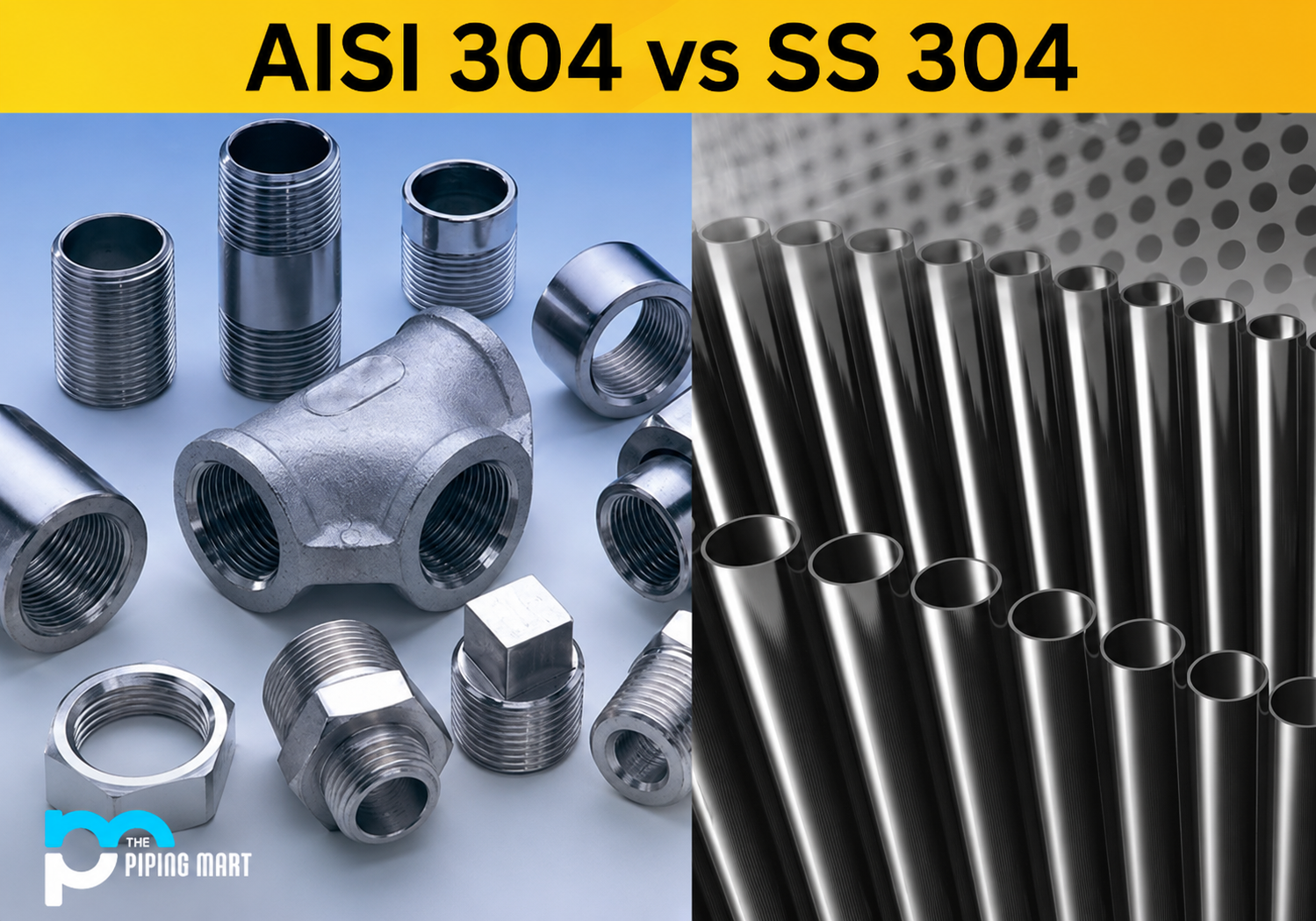
The SS 304 fasteners are bolts, nuts, screws, washers, studs, and threaded rods that are manufactured from AISI 304 stainless steel. The grade belongs to the austenitic family, meaning that it exhibits a face-centred cubic (fcc) crystal structure, which is known to offer the material good formability and durability. Grade 304 consists of 18% chromium and 8% nickel, due to which it is commonly referred to as “18/8” stainless steel. These fasteners are manufactured in accordance with international standards, like ASTM A193, ISO 3506, and DIN, and are available in different sizes and thread types with both metric and imperial fastening applications.
Key Properties of SS 304 Fasteners
The properties of the fasteners made of stainless steel 304 are wide-ranging, for example, in the fields of mechanical behaviour under load, thermal stability, and chemical resistance. Here is an organised list of the properties that are of significance, including mechanical, chemical composition, physical, and general properties.
Mechanical Properties of SS 304 Fasteners
The following table provides the mechanical properties for SS 304 fasteners that are based on standard grades and conditions. The values differ depending on the fastener property class and whether the material has been work-hardened during production.
| Property | Condition / Grade | Typical Value |
| Tensile Strength | A2-70 (ISO 3506) | 700 MPa min |
| Proof Load Stress | A2-70 | 630 MPa min |
| Yield Strength (0.2% offset) | Annealed bar | ~205–310 MPa |
| Elongation at Break | Annealed condition | ~40–50% |
| Hardness | A2-70 bolts | ~250 HV max (HRC ~22) |
| Fatigue Strength | Rolled threads | Higher than cut threads due to compressive residual stress |
| Impact Toughness | Room temperature to low-temperature conditions | Good: no brittle transition common in austenitic grades |
| Shear Strength | Approx. | ~60% of tensile strength |
| Modulus of Elasticity | General | ~193 GPa |
| Cold Work Effect | Thread rolling / head forging | Increases tensile strength; may induce slight magnetism |
Chemical Properties of SS 304 Fasteners
The chemical composition directly controls how stainless steel 304 fasteners behave in service. Chromium provides the passive oxide layer, nickel maintains the austenitic structure, and low carbon content reduces the risk of sensitisation during welding or high-temperature exposure.
| Aspect / Element | Typical Range / Limit (wt. %) | Role in Fastener Performance |
| Iron (Fe) | Balance | Base metal forms the matrix that carries the load and holds alloying elements. |
| Chromium (Cr) | 18.0 – 20.0 | Forms a stable chromium-oxide film for corrosion resistance; key to stainless behaviour. |
| Nickel (Ni) | 8.0 – 10.5 (up to 11.0 in some B8 specs) | Stabilises austenitic structure, improves ductility, toughness, and resistance to cracking. |
| Carbon (C) | ≤ 0.08 | Increases strength and hardness, but too much harms weld corrosion resistance; kept low for fasteners. |
| Manganese (Mn) | ≤ 2.00 | Helps deoxidation in steelmaking and supports austenitic structure; improves hot workability. |
| Silicon (Si) | ≤ 1.00 | Deoxidizer: improves high-temperature oxidation resistance and strength slightly. |
| Phosphorus (P) | ≤ 0.045 | Kept low; excess P can cause embrittlement and reduced toughness in fasteners. |
| Sulfur (S) | ≤ 0.030 | Kept very low to avoid hot shortness and cracking; slightly higher S may improve machinability but hurt toughness. |
| Nitrogen (N) | ≤ 0.10 | Strengthens the austenitic matrix; can slightly increase yield strength. |
| Molybdenum (Mo) | Not intentionally added (~0%) | 304 fasteners normally do not contain Mo; Mo is used in 316 to improve pitting resistance. |
| Typical ’18/8′ description | ~18% Cr, 8% Ni | Traditional shorthand for 304; it explains its balance of corrosion resistance and formability. |
| Corrosion behaviour | Good resistance to atmospheric, fresh water, and many chemicals; sensitive to chloride pitting vs. 316. | Cr-Ni-Fe balance plus low C gives good general corrosion and intergranular resistance. |
| Sensitisation tendency | Lower than plain 304 when low-C variants (304L) are used | Sensitisation is chromium-carbide precipitation at grain boundaries, controlled by C max and heat treatment. |
| Passivation behaviour | Easily passivated in nitric or citric acid solutions | Improves resistance to rust staining and improves surface durability of fasteners. |
Physical Characteristics of SS 304 Fasteners
Physical characteristics cover density, thermal behaviour, electrical properties, and surface behaviour. These values are considered for applications involving temperature cycling, precision assembly, or environments where weight and conductivity are relevant.
| Property / Characteristic | Typical Value / Description |
| Material grade | Stainless Steel 304 (AISI 304, EN 1.4301, UNS S30400): austenitic 18% Cr / 8–10.5% Ni stainless steel. |
| Density | About 7.9–8.0 g/cm³ (~7900–8000 kg/m³). |
| Crystal structure | Austenitic (face-centered cubic), giving high ductility and good formability. |
| Modulus of elasticity (Young’s) | ~193 GPa in tension; used for elastic deflection of bolts and studs. |
| Shear modulus | ~74–77 GPa, derived from E and Poisson’s ratio. |
| Poisson’s ratio | ~0.28–0.30 in the elastic range. |
| Thermal conductivity | About 16 W/m·K at 100°C, relatively low compared with carbon steel. |
| Coefficient of thermal expansion | Mean ~17–18 × 10⁻⁶ /°C between 20 and 300 °C; fasteners expand more than carbon steel when heated. |
| Specific heat | ~500 J/kg·K around room temperature to 100 °C. |
| Electrical resistivity | On the order of 0.7–0.8 μΩ·m at 20 °C, higher than carbon steel. |
| Magnetic behaviour | Essentially nonmagnetic in the solution-annealed condition, it becomes slightly magnetic after cold working. |
| Corrosion resistance (general) | Very good resistance to atmospheric corrosion, many neutral/oxidising media, and fresh water; susceptible to chlorides vs. 316. |
| Oxidation/temperature capability | Good scaling resistance up to roughly 870 °C in intermittent service. |
| Surface condition | Typically supplied pickled/passivated or lightly polished; can also be bright, machined, or coated. |
| Appearance | Silver-grey metallic with smooth or machined head and thread surfaces. |
| Ductility/formability | High ductility; threads can be rolled rather than cut, improving fatigue resistance and surface finish. |
| Toughness | Good toughness down to fairly low temperatures; it does not become brittle like some carbon steels. |
| Weldability | Good weldability (similar to 304 plate/bar), though fully threaded fasteners are seldom welded in service. |
| Typical fastener property classes | Commonly used in A2 (A2-50, A2-70, A2-80) or ASTM A193 Grade B8 classes. |
| Key performance characteristics | High corrosion resistance, non-rusting appearance, adequate strength for general structural and equipment bolting, and good fatigue resistance when properly preloaded. |
Characteristics of SS 304 Fasteners
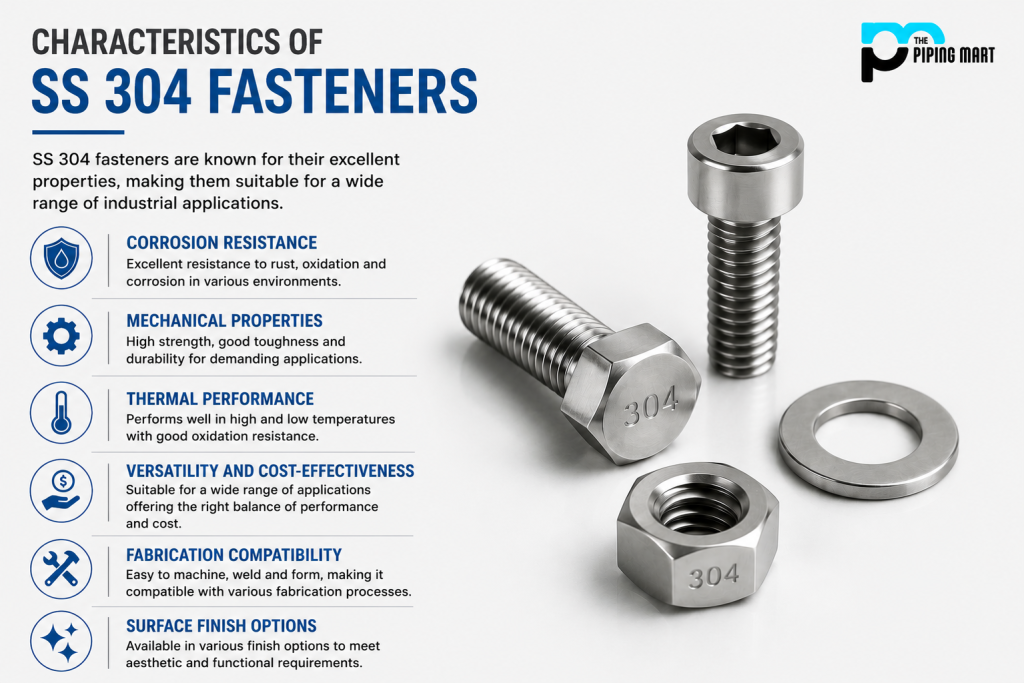
Beyond the raw data, the practical characteristics of SS 304 fasteners’ features are what determine how well they perform in actual service. Here is a closer look at each key characteristic.
Corrosion Resistance
This is typically the first thing engineers look at. The passive chromium-oxide layer that forms on the surface of 304 gives it good resistance to atmospheric corrosion, oxidising acids, and most freshwater environments. The layer is self-repairing to a degree, meaning if it gets scratched, it tends to reform when exposed to oxygen. That said, 304 is not the right choice in chloride-heavy environments such as seawater or highly acidic conditions, where 316 would be more appropriate. In most general industrial and food-grade applications, the corrosion resistance is more than adequate.
Mechanical Properties
SS 304 fasteners offer reliable mechanical performance in structural and equipment applications. SS 304 bolts in the A2-70 grade have a minimum tensile strength of 700 MPa, and the minimum proof load is 630 MPa, which applies to most of the general engineering applications. Thread rolling improves its resistance to fatigue, and the austenitic structure gives the bolts excellent ductility, meaning that the bolts can absorb shock loads without breaking suddenly. For applications involving very high pressures or extreme loads, higher-strength alloy steel fasteners may be preferred.
Thermal Performance
SS 304 fasteners work reliably in both hot and cold conditions. They resist oxidation (surface scaling) up to about 870°C in intermittent use. Because they expand more with heat than carbon steel, this difference must be taken into account when they are used together with other materials in bolted joints. SS 304 also conducts heat more slowly than carbon steel (around 16 W/m·K), so it transfers heat at a lower rate in service. In addition, their austenitic structure remains stable at low temperatures, providing excellent resistance to brittleness in cryogenic applications.
Versatility and Cost-Effectiveness
Stainless steel 304 fasteners sit in a practical middle ground. They are not the cheapest option, but they reduce maintenance and replacement costs in applications where corrosion would otherwise degrade plain steel fasteners within a short period. The grade is available in a very large number of fastener types and sizes, and lead times are generally shorter than for more specialised grades. For most general construction, pharmaceutical, dairy, food processing, and water treatment applications, 304 is specified simply because it covers the requirements without over-engineering the solution.
Fabrication Compatibility
These fasteners work well in fabricated assemblies that also use 304 plate, pipe, or structural sections. Galvanic compatibility is good when both the fastener and the connected material are the same grade. SS 304 is easy to machine, thread, and finish when the right tools are used. For large-scale production, thread rolling is often preferred because it improves the strength and fatigue resistance of the fastener. SS 304 can also be used for welded studs and inserts, although this is less common in standard fastening applications.
Surface Finish Options
The SS 304 fasteners’ features include multiple surface finish options depending on the application. Standard supply is typically pickled and passivated, which removes surface contaminants and strengthens the passive oxide layer. For more demanding visual or hygiene requirements, polished finishes are available. Some fasteners are supplied in a bright turned condition or with a machined head finish. Electropolishing is another option used in pharmaceutical and food processing applications where surface cleanliness is critical. Coatings such as PTFE or nylon patches are sometimes applied to thread surfaces for locking or sealing purposes.
Conclusion
Stainless steel 304 fasteners are a practical, well-understood choice for a very large number of industrial and commercial applications. The combination of chromium and nickel in the 18/8 composition gives the material a reliable corrosion resistance profile, decent mechanical strength, and good fabrication behaviour. These properties make SS 304 fasteners suitable for applications such as food processing, construction, water treatment, chemical handling, and the assembly of various equipment. They are not recommended for severely corrosive chloride applications, but will provide a long service life in most normal applications. To choose the right grade of stainless steel 304 fasteners from the outset, the properties of the fasteners should be understood, including mechanical data and chemical composition.
Frequently Asked Questions
What are SS 304 fasteners used for?
The SS 304 fasteners are used in various applications, such as water treatment systems, dairy and beverage plants, food processing machinery, construction, and general structural bolting. They will be selected when corrosion resistance is required in addition to the standard mechanical properties.
Are SS 304 fasteners corrosion-resistant?
Yes. The SS 304 fastener has good corrosion resistance to atmospheric conditions, most freshwater, and many mild chemical-resistant properties. The resistance is due to the passive chromium-oxide film growing on the surface. They are not recommended in environments where high chloride levels are present (seawater); however, the 316 grade is preferred.
Do SS 304 fasteners require regular maintenance?
In most environments, SS 304 fasteners require minimal maintenance. In food and pharmaceutical industries, they are often cleaned as part of normal hygiene routines, not because they rust or corrode easily.
Why do engineers prefer SS 304 fasteners?
The SS 304 fasteners have a good balance of corrosion resistance, mechanical strength, and availability in a variety of sizes and grades, which makes them the preferred choice of engineers. When used for most general applications, they are cost-effective, they are compatible with 304 stainless steel assemblies, and they are well supported by standards like ASTM A193 and ISO 3506.
What industries commonly use SS 304 fasteners?
The SS 304 fasteners are often used in the food and beverage industry, water treatment, construction, chemical processing, pharmaceutical manufacturing, and general engineering, where, in moderate corrosion resistance conditions, they are used in architectural applications and marine fittings.