Monel alloys are used in harsh service conditions such as marine systems and chemical plants where metals face saltwater, acids, and high stress. The monel metal composition, which is primarily a mixture of nickel and copper with trace amounts of controlled additions of other elements. This balance provides good mechanical strength and consistent resistance to corrosion over a wide range of temperatures. Nickel forms the base, while copper supports workability and thermal behaviour. Even minor changes in the composition can shift performance, so understanding the exact percentages matters during material selection. In the following sections, the composition is broken down into its main elements, followed by grade-wise differences and how these variations affect properties in real use.
The Core Monel Metal Composition
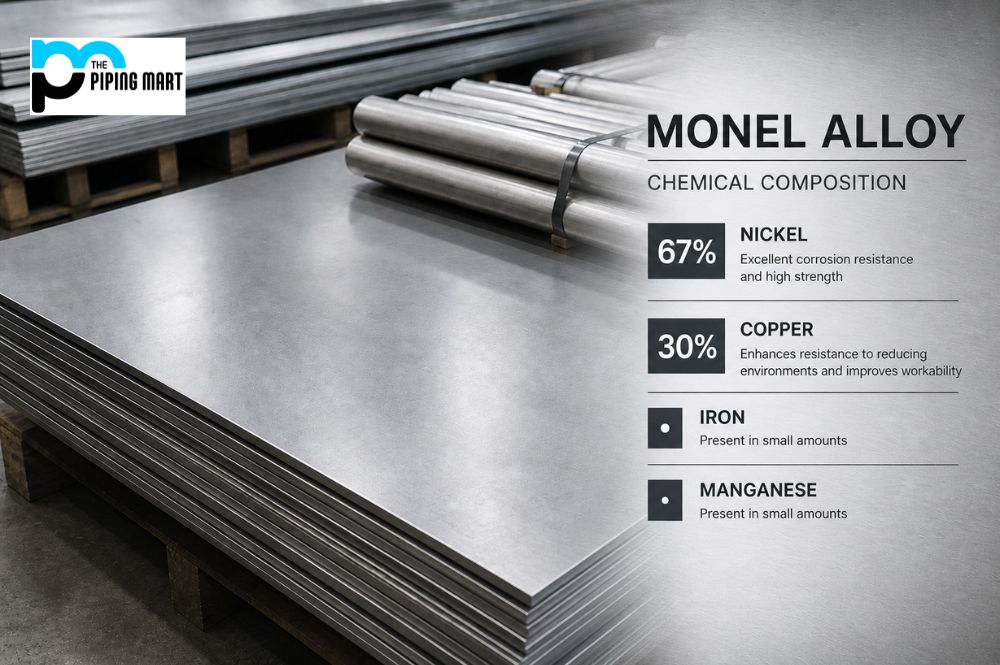
Monel is a nickel-copper alloy with a simple but controlled chemical structure. The typical monel metal composition is around 67% nickel, 30% copper, and small amounts of other elements.
Nickel forms the majority of the alloy, usually between 63% and 70%. Copper follows at roughly 28% to 34%. The remaining portion includes iron, manganese, and trace elements, all kept within tight limits. This ratio provides a stable structure that resists corrosion and maintains strength.
Nickel: The Primary Component
- Monel alloy consists of 63% to 70% nickel. This high percentage reflects its resistance to corrosion, particularly in saltwater and chemical environments. It also increases strength and resilience under stress.
- Nickel stays stable across a wide temperature range. It does not react easily with many chemicals, which helps the alloy maintain its surface condition. Because of this, nickel remains the dominant element in the composition.
Copper’s Role in the Alloy
- Copper is present between 28% and 34%. It improves machinability and helps with heat transfer. It also supports resistance to certain types of corrosion, especially in flowing seawater.
- Pure copper is softer and less strong. In Monel, copper works with nickel to improve workability without reducing overall strength too much. The combination gives a balanced material.
Minor Elements That Matter
Small additions are controlled carefully. Even in low amounts, they affect final behaviour.
- Iron (2–3%): It adds strength and helps control grain structure
- Manganese (up to 2%): Improves hot working and removes impurities
- Carbon (≤ 0.3%): affects hardness and strength in small ways.
- Silicon (≤0.5%): It supports deoxidation during melting.
- Sulfur (trace): It improves machinability in certain grades like R-405
Different Monel Grades and Their Composition
Monel is not a single formula. The composition changes slightly depending on the grade and the required properties. Some grades focus on strength, others on machinability.
Monel 400 Standard Composition
- Monel 400 is the most commonly used grade. It has a minimum of 63% nickel and 28–34% copper, with the balance made up of iron and manganese.
- It is used widely because the composition stays simple and consistent. There are no major alloying additions, which keep it stable in many environments.
Monel K-500 Alloy Formula
- Monel K-500 builds on the 400 composition but includes aluminium (2.3–3.15%) and titanium (0.35–0.85%). These additions allow age hardening.
- The base nickel-copper ratio remains similar, but the added elements increase strength and hardness significantly. This grade is used where higher mechanical strength is needed.
Other Specified Monel Grades
- Monel R-405 includes higher sulfur content. This improves machinability but slightly reduces corrosion resistance.
- Monel 401 is designed for electrical and electronic uses. Its composition supports controlled electrical properties.
- Monel 404 is designed for specialised applications such as electronic components, where precise composition control is required.
Composition Comparison Table
| Grade | Nickel (%) | Copper (%) | Key Additions | Notes |
| Monel 400 | ≥63 | 28–34 | Fe, Mn | General-purpose grade |
| Monel K-500 | ≥63 | 27–33 | Al, Ti | Age-hardened, high-strength |
| Monel R-405 | ≥63 | 28–34 | Higher sulfur | Better machinability |
| Monel 401 | ~63 | Balance | Controlled composition | Electrical applications |
| Monel 404 | ~63 | Balance | Special trace control | Electronic uses |
How Composition Affects Monel Properties
The chemical makeup directly controls how Monel behaves in service. Small changes in percentage can shift corrosion resistance, strength, and workability.
Corrosion Resistance From Nickel-Copper Balance
- The nickel-copper ratio in Monel creates strong resistance to seawater, neutral salts, and many acids. Nickel handles resistance to reducing acids and general corrosion. Copper supports resistance in flowing seawater and helps reduce attack in marine conditions.
- This is why Monel is used in saltwater valves, pump shafts, and marine fasteners. It also performs well in chemical tanks handling sulfuric or hydrofluoric acids in controlled conditions.
- According to ASTM B127 (for Monel 400 plate, sheet, and strip), the composition limits ensure that corrosion resistance stays consistent across supply batches. If nickel drops too low or impurities increase, corrosion resistance can be reduced.
- The balanced composition also prevents stress corrosion cracking in many environments where stainless steels may fail. This is one reason Monel is selected for critical systems where failure risk must be low.
Mechanical Strength and Temperature Performance
- Monel keeps its strength from sub-zero temperatures up to around 900°F (about 480°C). The nickel base holds the structure stable across this range.
- Typical Monel 400 has moderate yield strength, but when alloyed as K-500, the strength increases due to aluminium and titanium. Age hardening improves yield strength significantly, often more than double compared to annealed Monel 400.
- The composition also prevents brittleness at low temperatures. This allows use in cryogenic systems. At higher temperatures, oxidation resistance remains acceptable, though not as high as chromium-based alloys.
Comparing Monel to Similar Alloys
Monel sits between copper alloys and high-nickel alloys. The monel metal composition is different from stainless steel and Inconel, which changes performance.
| Property / Alloy | Monel (Ni-Cu) | Stainless Steel (Fe-Cr) | Inconel (Ni-Cr) | Cu-Ni Alloys |
| Base Elements | Nickel + Copper | Iron + Chromium | Nickel + Chromium | Copper + Nickel |
| Nickel Content | High (63–70%) | Low–Moderate | Very High | Low–Moderate |
| Chromium Content | None | Present (10–20%) | High | None |
| Corrosion Resistance | Excellent (marine) | Good (oxidising env.) | Excellent (high temp) | Good (marine) |
| Strength | Moderate–High | Moderate | High | Lower |
Monel does not contain chromium, so it behaves differently from stainless steel. It performs better in reducing environments and seawater. Inconel, on the other hand, handles high temperatures better due to chromium.
Monel vs Stainless Steel Composition
- Monel and stainless steel differ mainly in base elements. Monel uses nickel and copper, while stainless steel depends on iron and chromium.
- Monel has no chromium. Stainless steel usually contains 10–20% chromium, which forms a passive oxide layer. This operates effectively in oxidising environments but may not perform as well in reducing acids.
- Monel’s nickel-copper composition exhibits superior resistance to marine exposure. Stainless steel is prone to pitting in chloride environments, whereas Monel exhibits superior resistance in numerous instances.
| Property | Monel 400 | 316 Stainless Steel |
| Primary Element | Nickel (63%+) | Iron (~65%) |
| Corrosion Agent | Copper + Nickel | Chromium (16–18%) |
| Seawater Resistance | Excellent | Moderate |
| Cost | Higher | Lower |
| Magnetic | No (annealed) | Slightly (cold worked) |
Monel vs Inconel Chemical Composition:
- Both Monel and Inconel are nickel-based, but their alloying elements differ. Monel contains copper as the second major element. Inconel uses chromium, often along with iron and other elements.
- Inconel offers better resistance to oxidation and high temperatures than Monel due to its chromium content. Monel offers better performance in seawater and specific chemical environments due to its copper composition.
Testing and Verifying Monel Composition
Manufacturers confirm Monel composition through spectrometry and chemical analysis techniques. Optical emission spectroscopy (OES) is often used to quickly and accurately measure chemical percentages. Wet chemical analysis may also be used for confirmation. Standards like ASTM B127 for Monel 400 define appropriate composition ranges and testing criteria. Each batch undergoes testing to confirm compliance with these limits. Mill test certificates accompany the material, detailing the precise chemical composition. This enables customers to verify that the provided alloy corresponds to the specified grade and performance standards. This verification ensures that minor compositional changes may impact corrosion resistance and operational strength.
Conclusion
Monel alloys are produced from a simple nickel-copper base, usually in the 67/30 ratio. The monel metal composition varies slightly between grades, but the core structure remains constant. These minor modifications facilitate regulation of strength, machinability, and performance under various conditions. Understanding the chemical composition helps in selecting the right grade for marine, chemical, or structural applications. It also helps in preventing material incompatibilities in essential systems. For precise specifications, it is essential to check standards and consult with a supplier or metallurgist prior to final selection.
FAQ
What percentage of nickel is in Monel?
Most Monel grades contain around 63% to 70% nickel. Monel 400 is usually taken as the standard reference for this range.
Does Monel contain any iron?
Yes, small amounts of iron are present, typically up to about 2–2.5%. It is kept low to maintain corrosion resistance.
Why is copper mixed with nickel in Monel?
Copper improves workability and heat transfer, while nickel provides corrosion resistance. The combination gives balanced performance.
Is Monel magnetic due to its composition?
Monel is generally non-magnetic in the annealed condition. Slight magnetism may appear due to small iron content or cold working.
What makes Monel K-500 different chemically?
As the Mokel K-500 consists of aluminium and titanium additions. These allow age hardening and increase strength compared to Monel 400.
Can Monel composition be customised for specific uses?
Standard grades cover most uses, but special compositions are usually handled by manufacturers based on specific needs.