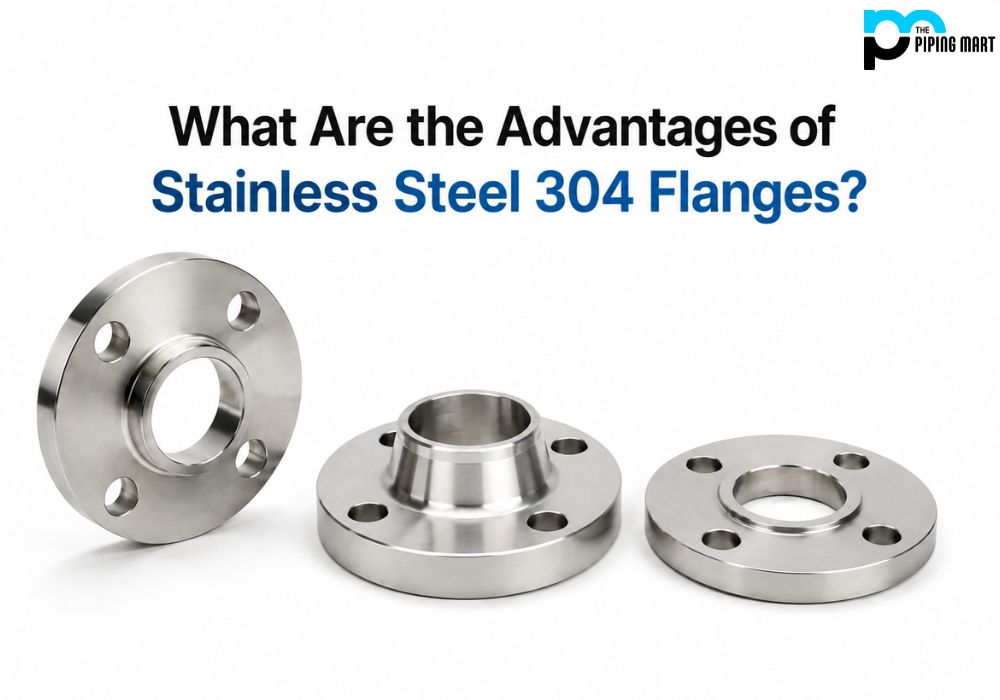
Stainless steel 304 flanges are among the most commonly used pipe fittings in industrial piping systems, as they connect pipes, valves, and equipment in a way that allows for easy assembly, inspection, and maintenance. This material is an austenitic grade with a composition of approximately 18% chromium and 8% nickel. This combination offers excellent mechanical characteristics, decent corrosion resistance in most standard environments, and satisfactory fabrication characteristics. When considering flange materials, engineers and procurement staff may well be choosing what is best for them when it comes to SS 304 because it fulfills several requirements at a reasonable price.
Introduction to Stainless Steel 304 Flanges
The Stainless steel 304 flanges are pipe fittings manufactured according to the dimensional standards like ANSI B16.5 or ASME B16.47. They are available in different types, like slip-on, weld-neck, blind, socket weld, threaded, and lap joints for various connection needs. The most widely used stainless steel available is the austenitic grade 304. Its chromium-nickel content provides a passive oxide layer on the surface, which protects the base metal in many chemical and atmospheric environments. For general piping, water service, food processing, or moderate chemical handling, these flanges get the job done at a reasonable cost.
Key Advantages of Stainless Steel 304 Flanges
The SS 304 flanges have several key advantages that make them a standard choice across various industries. Below are the key advantages mentioned of Stainless Steel 304 Flanges.
Corrosion Resistance in Different Environments
The corrosion resistance of SS 304 flanges is one of the primary factors that specify them. The chromium content forms a stable oxide layer that resists rust, oxidation, and attack from many chemicals. Stainless steel 304 can withstand a wide variety of exposure conditions in water service, food-grade fluids, and the atmosphere (without surface coatings or additional treatments), but is not immune to all conditions. Pitting or crevice corrosion is usually caused by chloride-rich conditions, salt water, and certain strong acids. These are typically the times when SS 316 might be a much better choice. For most of the common industrial and commercial uses, however, SS 304 flanges are capable of functioning for a longer period of time.
Strength Under Pressure and Load
The strength of stainless steel flanges made from SS 304 is adequate for a large number of standard piping applications. The yield strength of SS 304 is about 205 MP, and its tensile strength is about 515 MP. The values enable moderate pressures and mechanical loads in most standard pressures to be tolerated by the flanges. Many process piping systems use SS 304 flanges with ratings of class 150 to 600 under ASME pressure ratings. If the material is to be used for very high pressure or very high temperature, the material may need to be upgraded or specified as per the requirements, but for most applications, this grade meets the requirements.
Heat Resistance of SS 304 Flanges
The heat-resistant property of SS 304 flanges is acceptable in specific temperature ranges. The continuous service temperature of the material is up to approximately 870°C in non-scaling conditions. Below this, it maintains the mechanical strength and surface stability. It is capable of withstanding high temperatures of around 925°C when used in an intermittent service. Carbide precipitation may occur if SS 304 is kept in the temperature range between 425°C and 860°C for a prolonged period, resulting in a decrease in corrosion resistance. For such situations, SS 304L or SS 321 might be more suitable. Standard SS 304 flanges are commonly used in high-temperature service, except where they are to be used for long periods at temperatures in that specific range.
Weldability and Fabrication
The weldability of SS 304 flanges is generally good. The material can be welded using TIG, MIG, and stick welding processes without major complications. No preheating is normally required, which simplifies site fabrication. Post-weld heat treatment is also not mandatory in most cases. Fabrication shops find SS 304 straightforward to work with. It machines and forms reasonably well, and the finished weld quality is consistent when proper filler materials are used. For weld neck and socket weld flanges, the material operates reliably during the joining process, and passivation after welding is advisable to restore the surface oxide layer.
Durability
The SS 304 flanges have a long service life in most environments. The combination of corrosion resistance, mechanical strength, and surface hardness means these flanges resist wear, surface degradation, and material loss over time. In water treatment plants, food processing lines, and pharmaceutical systems, it is common to see SS 304 flanges lasting decades without replacement. The material does not require painting or external protective coatings. The passive layer is self-renewing in oxidizing conditions. For bolted flange connections that undergo periodic disassembly, the material holds thread integrity and seating face condition far better than carbon steel.
Versatility Across Industries
The Stainless steel 304 flanges are used in various industries, like food and beverage processing, dairy equipment, brewing, pharmaceutical manufacturing, water treatment, chemical handling, oil and gas surface facilities, paper mills, and general industrial plants. The material meets most of the common requirements, such as the ASTM A182 F304 standard for forged flanges. The industry codes and standards are widely accepted, and the sourcing/replacement is easy. There are many suppliers of flanges in the supply of all common sizes and pressure ratings; in most cases, they have stocks of SS 304 in their warehouses.
How to Maximize the Performance of Stainless Steel 304 Flanges
For optimal performance, choose the appropriate flange type that meets the application requirements, such as weld-neck flanges, which are often chosen for high-pressure, high-stress applications. Choose the correct gasket materials and apply the correct torque to the bolts to prevent leaking and damaging the flange. Avoid using metals that are incompatible with each other in a wet or chloride-rich environment unless they are separated by gaskets that will reduce the impact of galvanic corrosion. It is also crucial to inspect the flange surface during regular checks, as well as the type of gasket and the tightness of the bolts, particularly in high-pressure or temperature fluctuations. Properly installed and maintained, the SS 304 flanges can serve for many years of use.
Conclusion
The stainless steel 304 flanges are a practical, widely tested, and affordable material choice for several industrial piping applications. Due to their corrosion resistance, mechanical strength, ability to withstand heat, and weldability, they are applicable in all food, chemical, water, and general process industries. These flanges are not suitable for all applications, especially in chlorides and very high temperatures. But for standard conditions, SS 304 flanges are a good and smart solution. There are multiple choices for sourcing, simple choices for fabrication, and easily predictable choices for long-term performance. For most engineers specifying flanges in standard service conditions, SS 304 covers the requirement without overcomplicating the material selection.
FAQs
What makes stainless steel 304 flanges corrosion-resistant?
The corrosion resistance of the SS 304 flanges is due to the presence of Chromium, which is in their composition to the extent of around 18 percent. The oxide film on the surface of chromium is thin and stable and is formed by reacting with oxygen in the environment. This layer acts as a barrier between the base metal and corrosive media. The surface does not lose its corrosion resistance properties as long as there are no aggressive chlorides or mechanical damage to the surface, which will make it difficult for the oxide to reform.
Are SS 304 flanges suitable for high-temperature applications?
Yes, SS 304 flanges can handle temperatures up to about 870°C in non-scaling conditions, making them suitable for many high-temperature applications. However, prolonged exposure to temperatures between 425°C and 860°C can reduce their corrosion resistance. For applications involving continuous use within this temperature range, SS 304L or stabilized grades such as SS 321 are often a better choice.
How strong are stainless steel 304 flanges?
The tensile strength of SS 304 is around 515 MPa, while the yield strength is about 205 MPa. These values apply to normal pressure class ratings ranging from Class 150 to Class 600 for most process piping applications as per ASME standards. If pressure and/or temperature ratings are very high, or for critical service conditions, the actual pressure-temperature rating shall be verified to the applicable standards.
Is welding SS 304 flanges easy?
Standard conditions for the weldability of SS 304 flanges are good. It can be used with TIG, MIG, and SMAW welding processes and does not require preheating before welding. The selection of the proper filler material, usually ER308L for TIG welding, is crucial in order to ensure that the weld area remains corrosion-resistant. The surface oxide layer is suggested to be restored by using post-weld passivation.
Where are stainless steel 304 flanges commonly used?
The SS 304 flanges are used in food and beverage processing, pharmaceutical production, dairy processing, water treatment, chemical handling, paper and pulp production, and general industrial processes. These flanges must comply with ASTM A182 F304 and other international standards and are thus acceptable to most industry standards.