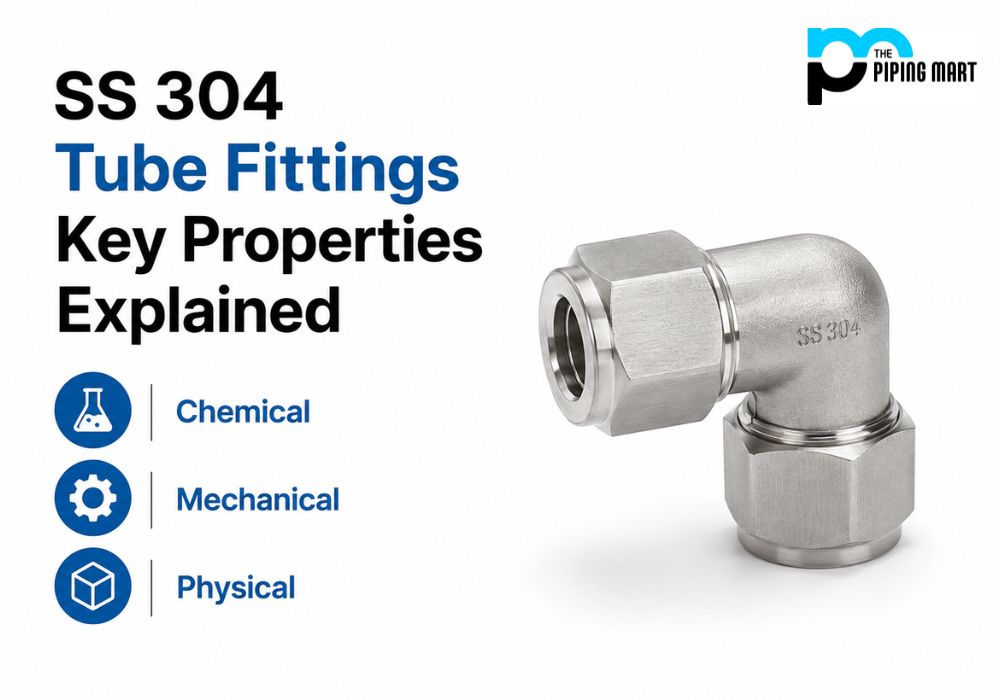
SS 304 tube fittings are one of the most commonly sourced items in industrial piping and instrumentation setups. The material itself, austenitic stainless steel grade 304, has been in use for decades across many industries and for practical reasons. It holds up well against corrosion, handles a fair range of temperatures, and does not need much in the way of maintenance. The SS 304 tube fittings’ properties that make this grade a go-to choice are not complicated. Good chromium and nickel content, reasonable strength, and predictable behaviour under pressure. This blog straightforwardly covers those properties, so you can understand what you are actually working with when you specify or source SS 304 fittings.
What Are SS 304 Tube Fittings?
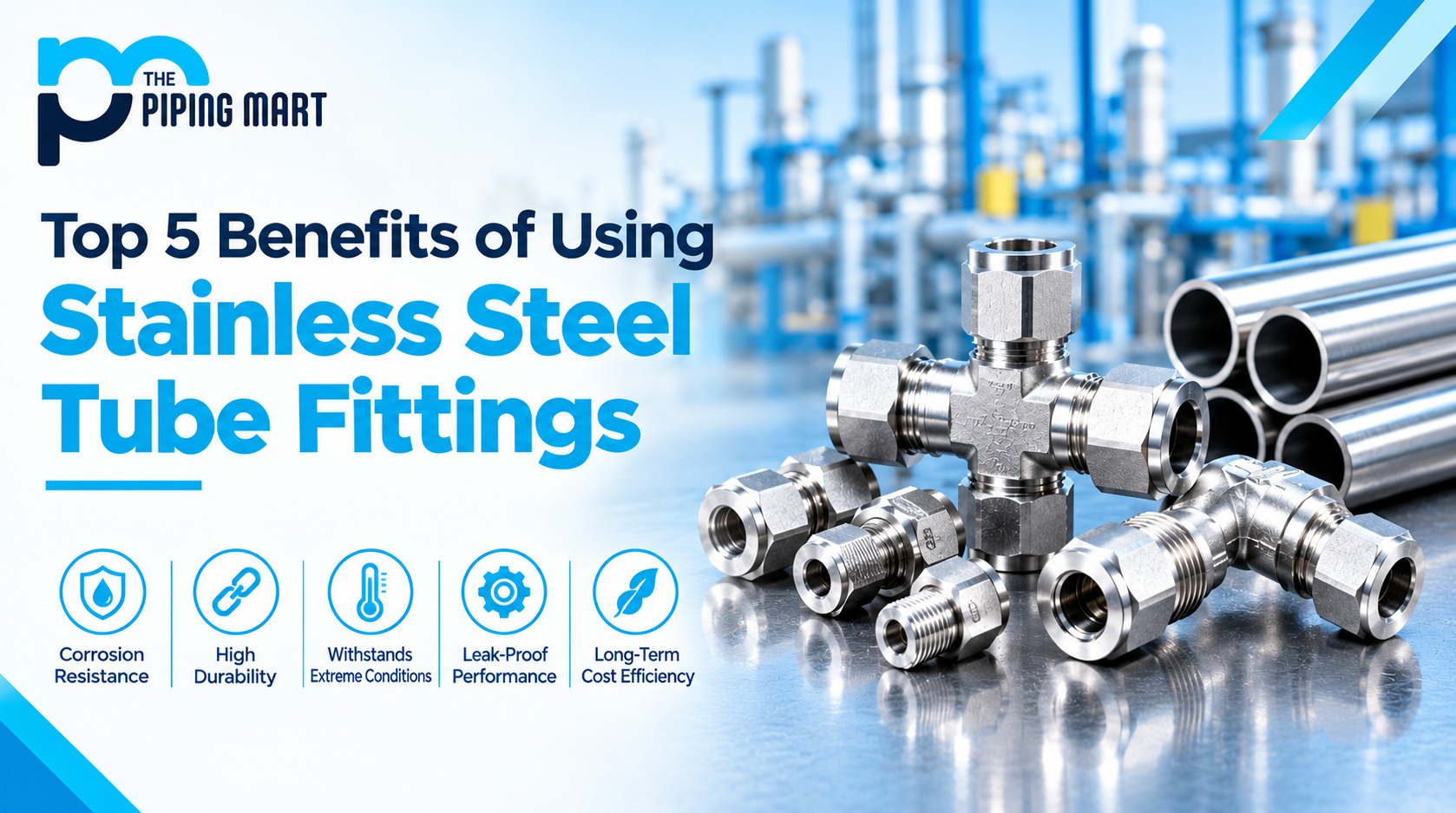
The SS 304 tube fittings are components made from grade 304 stainless steel that are used to connect, redirect, or close tubing in fluid and gas systems. Common types include elbows, tees, unions, reducers, compression fittings, and ferrule fittings. The fittings are used wherever a secure, leak-proof connection is needed in a tube line. Most SS 304 fittings are precision-machined to close tolerances. They are compatible with standard tube sizes and can be found in both metric and inch configurations. In most process plants, laboratories, and instrumentation setups, these fittings are a standard component.
Overview of SS 304 Tube Fittings Properties
The SS 304 tube fittings’ properties are largely determined by the alloy’s composition. The high chromium content gives the material its corrosion resistance. The nickel content contributes to toughness and formability. Beyond that, the grade has decent tensile and yield strength, handles temperatures from cryogenic levels up to around 870 degrees Celsius, and is reasonably easy to fabricate. None of these properties is extreme or exceptional in isolation, but together they make SS 304 a practical and cost-effective material for tube fittings across a wide variety of service conditions. It is not the right grade for every environment, but for general-purpose use, it tends to perform reliably.
Chemical Composition of SS 304 Tube Fittings
The SS 304 chemical composition tube fittings are manufactured to ASTM and EN standards. The table below gives the typical elemental breakdown for grade 304 stainless steel.
| Element | Symbol | Typical Range (% by weight) |
| Chromium | Cr | 18.0 – 20.0 |
| Nickel | Ni | 8.0 – 11.0 |
| Carbon | C | ≤ 0.08 |
| Manganese | Mn | ≤ 2.00 |
| Silicon | Si | ≤ 1.00 |
| Phosphorus | P | ≤ 0.045 |
| Sulfur | S | ≤ 0.030 |
| Nitrogen | N | ≤ 0.10 |
| Iron (balance) | Fe | Remainder (typically ~65–71) |
Note: The above values represent the typical composition range for SS 304 per ASTM A276 and similar standards. Actual mill test certificates may show values within this range. Iron makes up the remainder of the alloy balance.
Mechanical Properties of SS 304 Tube Fittings
The mechanical properties of SS 304 tube fittings determine how the material behaves under load, pressure, and stress. These figures are used in engineering calculations for pressure ratings and fitting design.
| Property | Symbol | Typical Value (304) | Notes |
| Density | ρ | 8.0 g/cm³ | Often used for weight calculations |
| Tensile strength (minimum) | Rm | 515 MPa (≈ 75 ksi) | Some specs give a 515–620 MPa range |
| Yield strength 0.2% (minimum) | Rp0.2 | 205 MPa (≈ 30 ksi) | “Proof stress” in some datasheets |
| Elongation (in 50 mm, minimum) | A5 | 40% | High ductility, good formability |
| Hardness (max, Brinell) | HB | ~ 201 HB max | Depends on product spec, usually ≤ 200–215 HB |
| Modulus of elasticity (Young’s) | E | 190–200 GPa | Often quoted ≈ 193 GPa |
| Shear modulus | G | 74–81 GPa | |
| Poisson’s ratio | ν | 0.27–0.30 |
Note: Values above are typical for annealed SS 304 material as per ASTM standards. Cold-worked or drawn material may show higher tensile and yield strength values. Always refer to the applicable standard and material test report for specific applications.
Physical Properties of SS 304 Tube Fittings
The physical properties of SS 304 tube fittings relate to how the material conducts heat, expands under temperature change, and behaves at extreme temperatures.
| Property | Typical Value | Conditions |
| Thermal conductivity | ~16 W/m·K | at 100 °C (slightly lower at room temp) |
| Specific heat capacity | ~500 J/kg·K | around 0–100 °C |
| Coefficient of thermal expansion | ~17.2 × 10⁻⁶ /K | 0–100 °C; increases slightly at higher temps |
| Maximum continuous service temp* | ~870 °C (intermittent) / ~925 °C (short-term) | For base 304 steel, fitting pressure ratings are usually limited lower values |
| Useful cryogenic range | Down to about −196 °C and below | Good toughness is retained at low temperatures |
Note: The above values are approximate and sourced from standard material property references for annealed SS 304. Service temperatures for tube fittings in pressure applications are typically rated lower than the base material limits. Check manufacturer pressure-temperature ratings before specifying high-temperature service.
Corrosion Resistance
SS 304 corrosion-resistant tube fittings rely on chromium content between 18 and 20 percent, which forms a passive oxide layer that resists rust and general corrosion. The grade performs well in water service, mild acids, and atmospheric conditions, but is not recommended for chloride-heavy environments.
Strength and Durability
The strength and durability properties of SS 304 are suitable for most common tube fitting uses. The material has a minimum tensile strength of 515 MPa and a yield strength of 205 MPa, and it is suitable for most instrumentation and process line applications. Also, the 40 percent elongation makes it easier to install and, when needed, in lines subjected to vibrations.
Temperature and Pressure Handling Capabilities
SS 304 temperature resistance covers a range from around minus 196 degrees Celsius up to 870 degrees Celsius in continuous service. For SS 304 pressure handling, the rated working pressure depends on wall thickness, fitting geometry, and connection type. Always refer to the manufacturer’s pressure-temperature charts for actual service limits.
Why Do Industries Prefer SS 304 Tube Fittings?
Industries prefer SS 304 mainly because it is easy to find, affordable, and performs well under normal operating conditions. The material is widely stocked, easy to source in most markets, and can be machined to the close tolerances needed for leak-tight fittings. It does not require coating or lining in most general-purpose applications. The SS 304 tube fittings are used in industries such as oil and gas, food processing, pharmaceuticals, chemical plants, and instrumentation. They often use SS 304 fittings because they meet most service needs without requiring more costly or special grades. For aggressive or high-chloride environments, SS 316 may be the better choice, but for most standard conditions, SS 304 is the more practical option.
Conclusion
The SS 304 continues to be the most common grade of tube fitting. This grade is also resistant to corrosion; has reasonably good mechanical properties, a temperature range suitable for most applications; and is readily available, making it the preferred choice for instrumentation and process piping. If you are sourcing fittings for standard service conditions, SS 304 usually fits the requirement without unnecessary cost. For more aggressive environments, a higher-alloyed grade may be more suitable, but for most general-purpose applications, SS 304 continues to be the preferred specification.
FAQs
Can SS 304 tube fittings be used outdoors?
Yes, the SS 304 tube fittings can be used for most of the outdoor applications. This grade contains sufficient chromium for the atmospheric corrosion and general weathering resistance to be adequate. If the grade is exposed to chloride in a coastal or marine environment, it can be exposed to chloride over time and may be susceptible to pitting. In these cases, SS 316 may be a better choice.
Do SS 304 tube fittings require regular maintenance?
In most service conditions, SS 304 tube fittings do not require regular maintenance. The passive oxide layer on the surface provides ongoing protection without the need for coatings or treatments. Periodic inspection for signs of corrosion or mechanical damage is still recommended, particularly in environments with chemical exposure or high humidity.
Can SS 304 tube fittings resist chemical exposure?
The SS 304 offers good resistance to many chemicals, including dilute acids, alkalis, and common process fluids. However, it has limited resistance to chloride-rich environments and may be affected by pitting and crevice corrosion. For applications involving high chloride levels or concentrated acids, chemical compatibility should be checked before use.
Are SS 304 tube fittings suitable for industrial applications?
The SS 304 tube fittings are generally applicable to the majority of industrial uses, such as instrumentation, process piping, fluid handling, and utilities. They are used in food processing, pharmaceuticals, oil and gas, the chemical industry, etc. The suitability for any particular application will depend on the service conditions, such as temperature, pressure, and the nature of the media to be carried.