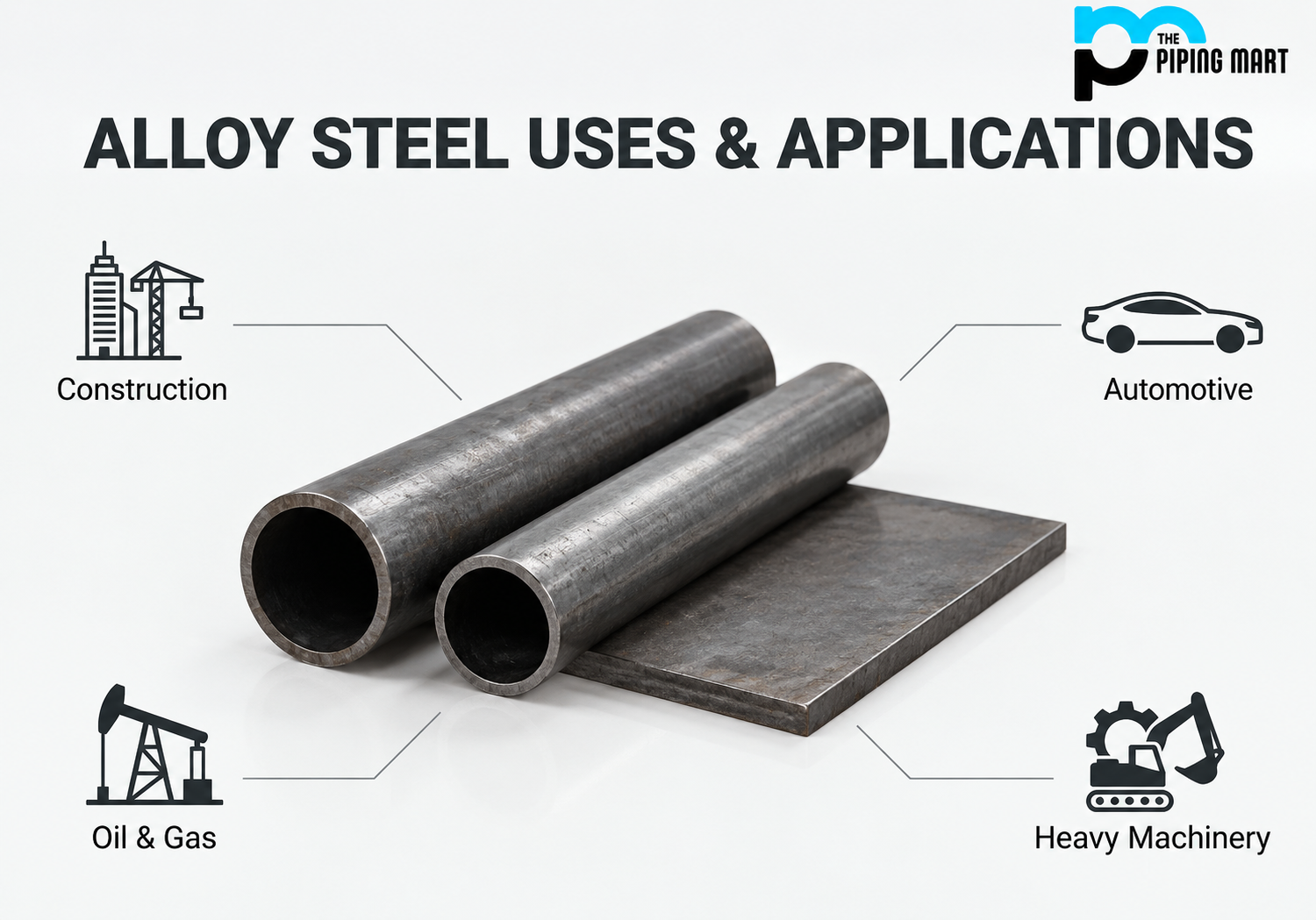
Alloy steel is often used in industries where standard carbon steel fails to meet performance standards. It contains other elements such as chromium, nickel, molybdenum, and vanadium, which increase its strength, hardness, and resistance to heat and corrosion. These changes are checked throughout the manufacturing and heat treatment procedures. As a result, alloy steel is used in components that can withstand loads or wear or operate at high temperatures.
Common Applications of Alloy Steel
Alloy steel is used across various industries where standard carbon steel would not perform well under load, heat, or environmental exposure. Below are the main application areas.
Automotive Components (Gears, Shafts, Axles)
The alloy steels such as 4140 and 4340 are used for gears, drive shafts, crankshafts and axles. These parts are subjected to cyclic loading and require strong fatigability. These grades contain molybdenum and chromium, which allow case hardening without loss of core toughness.
Aerospace Structural and Turbine Components
Materials for aircraft structural components, landing gear and turbine discs must be strong in both hot and cold conditions. Generally, steels such as 300M and 4340 are used. Nickel and cobalt are used to help preserve their strength and other mechanical properties at high temperatures and repeated pressures (as might occur during flight).
Construction Structures (Bridges, Buildings, Reinforcement)
Bridges, structural columns and reinforcement bars are all made from high-strength low-alloy (HSLA) steels. These grades have higher yield strengths than common structural steel, and are also weldable. High-strength grades result in lower tonnage of steel in the structure.
Oil and Gas Equipment (Pipelines, Drilling Tools, Pressure Vessels)
High-pressure, high-temperature pipelines or pressure vessels often use chrome-moly grades such as P11, P22 and P91. Grades with high abrasive resistance, high impact resistance and high hardness are used in drilling tools and downhole parts to withstand wear from the abrasive properties of the well and repeated shock loads.
Thermal and Nuclear Power Plant Components
Creep-resistant alloy steels are used for making boilers, steam lines and heat exchangers in power plants. For instance, the P91 and P92 grades can resist high temperatures up to 600°C without compromising the structure. The presence of chromium also helps to prevent oxidation and steam-side corrosion.
Industrial Machinery and Heavy Equipment Parts
Conveyor shafts, press frames, hydraulic cylinders, and tooling use alloy steels with good hardenability and toughness. Grades like 4140 are a common choice for general machinery applications where fatigue life and machinability both matter.
Chemical Processing Equipment and Pressure Vessels
Hydrogen embrittlement and sulphide stress corrosion are potential problems in chemical environments and alloys containing chromium and molybdenum resist these. There are specific NACE-approved alloy steel grades for vessels carrying hydrogen sulphide and high-pressure hydrogen.
Marine Structures and Shipbuilding Components
Alloy steels are tougher at low temperatures and resist corrosion in seawater, and are used to create offshore platforms, ship hulls and propeller shafts. In cold conditions, grades are preserved by the use of HSLA or nickel-bearing steels.
Mining Equipment (Crushers, Drill Bits, Excavators)
The requirements for crusher jaws, drill bits and excavator buckets are high hardness and impact resistance. Hadfield manganese steel, which is high in carbon and manganese, is used in equipment that is used in highly wear-prone mining. These materials impact work-harden during operation, resulting in a more wear resistant material.
Agricultural Machinery (Tractors, Harvesters, Implements)
Alloy steels are used for tillage implements, plough shares, tractor axles, and other components that are exposed to abrasion from soil and subjected to cyclic loading due to vibrations. These medium-carbon alloy grades exhibit a range of surface hardness and toughness which is appropriate for agricultural applications.
High-Strength Fasteners and Industrial Fittings:
The grade 8.8, 10.9, and 12.9 bolts and studs are produced from alloy steel. These fasteners are used in flanged joints, structural connections, and mechanical assemblies where carbon steel bolts may fail under high load or repeated stress.
Key Properties of Alloy Steel
The properties of alloy steel differ significantly by grade. For general reference, the table below includes typical values for medium alloy steel (such as 4140/42CrMo4). The conditions of the heat treatment determine the actual values.
| Property | Typical Value / Range | Function |
| Chemical Composition | ||
| Carbon (C) | 0.38 – 0.43% | Increases hardness and tensile strength; higher carbon improves hardenability but reduces weldability |
| Chromium (Cr) | 0.80 – 1.10% | Improves hardenability, wear resistance, and resistance to oxidation and corrosion |
| Molybdenum (Mo) | 0.15 – 0.25% | Enhances high-temperature strength, creep resistance, and hardenability through thick sections |
| Manganese (Mn) | 0.75 – 1.00% | Increases strength and hardenability; also acts as a deoxidiser during steelmaking |
| Silicon (Si) | 0.15 – 0.35% | Acts as a deoxidiser; improves strength and oxidation resistance at elevated temperatures |
| Phosphorus (P) | ≤ 0.035% | Controlled as an impurity, excess phosphorus reduces toughness and ductility |
| Sulphur (S) | ≤ 0.040% | Controlled as an impurity; improves machinability in small quantities but reduces toughness |
| Mechanical Properties (Quenched & Tempered) | ||
| Tensile Strength | 850 – 1000 MPa | Indicates the maximum stress the material can carry before fracture |
| Yield Strength | 680 – 900 MPa | The stress level at which permanent deformation begins; critical for structural design |
| Elongation | 12 – 20% | Measures ductility; higher values indicate the material can deform before fracturing |
| Hardness | 28 – 34 HRC | Reflects resistance to surface indentation and wear; determines suitability for abrasive service |
| Charpy Impact (at room temp) | 50 – 80 J | Measures energy absorbed before fracture; indicates toughness under sudden or shock loads |
| Physical Properties | ||
| Density | ~7.85 g/cm³ | Standard steel density; relevant for weight calculations in structural and mechanical design |
| Thermal Conductivity | ~42 W/m·K | Indicates heat transfer rate; relevant for components in thermal cycling or elevated temperature service |
| Modulus of Elasticity | ~200 GPa | Measures stiffness; defines how much the material deflects under a given load |
| Melting Point | ~1420 – 1460°C | Sets the upper limit for high-temperature service and guides welding and casting parameters |
Why Alloy Steel is the Preferred Choice for Industrial Applications:
Alloy steel is used in various industrial applications as it can withstand more demanding conditions than plain carbon steel. The difference is due to the addition of elements such as chromium, molybdenum, and nickel, which change the steel’s behaviour under stress, heat, and wear.
High strength and toughness under load: Alloy steels have the ability to be made very strong (over 1000 MPa) without being too brittle. This means that they are suitable for parts such as shafts or other parts in which a constant and alternating load can be applied and that they can also help prevent the growth of cracks.
Wear resistance: Hard carbides are formed in the structure during heat treatment. These are not damaged by the surface. This is beneficial in areas of friction or abrasive contact to prolong service life. In identical circumstances, carbon steel tends to wear out faster.
Better corrosion resistance: Even with a small amount of chromium. This significantly reduces the risk of rusting and scaling in outdoor or high-temperature environments. It does not totally protect the steel from corrosion, but it is more resistant than standard carbon steel.
High-temperature strength: Carbon steel begins to lose its strength at temperatures over 400°C, while alloy steel retains its strength at high temperatures. Useful in boilers, turbines and piping systems where the heat remains constant.
Heat treatment flexibility: The composition permits various heat treatment techniques. These are treated as needed by quenching and tempering, case hardening or normalising. The same grade can be modified for higher hardness or increased toughness.
Hardenability through the section: The addition of alloying elements retards the phase changes during cooling. This enables achieving hardness in the material at depth and not merely on the surface. It is useful for larger parts such as large shafts or dies where uniformity of properties is important.
Strength-to-weight ratio: Alloy steel is stronger; less material is often needed. This reduces overall weight without reducing load capacity. In many designs, that helps with handling and efficiency.
Weldability: Moderate- and low-alloy steels are generally weldable by conventional welding techniques. Preheat and post-weld heat treatment may be required.
Impact resistance: The nickel-containing alloy steels perform better at low temperatures. They maintain impact strength even below zero. This is beneficial in offshore work, cold storage, and similar environments.
Creep resistance: Metals will gradually change their shape when under a constant load at high temperatures. This is more likely to happen in non-alloy steels. The structure is stable in the long term with carbide-forming elements.
Lower maintenance over time: Alloy steel has a higher resistance to wear and damage and higher strength, so its parts have a longer life and can be replaced less frequently. While the up-front expense might be greater, the overall expenditure will typically work out in the end.
For most industrial applications, it comes down to reliability under stress, heat and long service life. Alloy steel is less compromised and complies with these specifications.
Conclusion
Alloy steel is used in various industries as it performs well under tough conditions. They can withatand high pressure, resist wear, and maintains their strength at high temperatures. Heat treatment can also enhance its properties in specific applications. The appropriate grade is determined by the working conditions, required strength, and production specifications. Buyers often consider the grade, certifications, and supplier quality before making a final purchase decision.
FAQs
What are the advantages of alloy steel?
The advantages of using alloy steel are it has higher strength, wear resistance, toughness, and corrosion resistance. It can also be heat treated to achieve the mechanical properties based on the application requirements.
What exactly is alloy steel used for?
The alloy steel is used in automotive parts, aerospace components, pressure vessels, pipelines, power plants, mining equipment, fasteners, and marine structures. It is commonly selected where standard carbon steel can not provide enough strength, heat resistance, or wear resistance.
How can one choose the right alloy steel grade?
The grade selection often depends on operating temperature, load conditions, required hardness, weldability needs, and the corrosive environment. It is essential to verify the international standards, such as ASTM, EN, or ASME and reviewing material datasheets for a specific grade is the appropriate initial step.
Are alloy steels weldable like carbon steel?
Yes. Alloy steels often require more care, like preheating the metal or using particular filler rods. If the cooling process is not followed correctly, the weld region can become brittle and crack, as compared to plain carbon steel, which is more forgiving.
Can alloy steel be recycled?
Yes. Alloy steel is completely recyclable. It can be melted down and recycled with minimal loss of material quality. Recycled alloy steel is often used as scrap in electric arc furnace steelmaking.