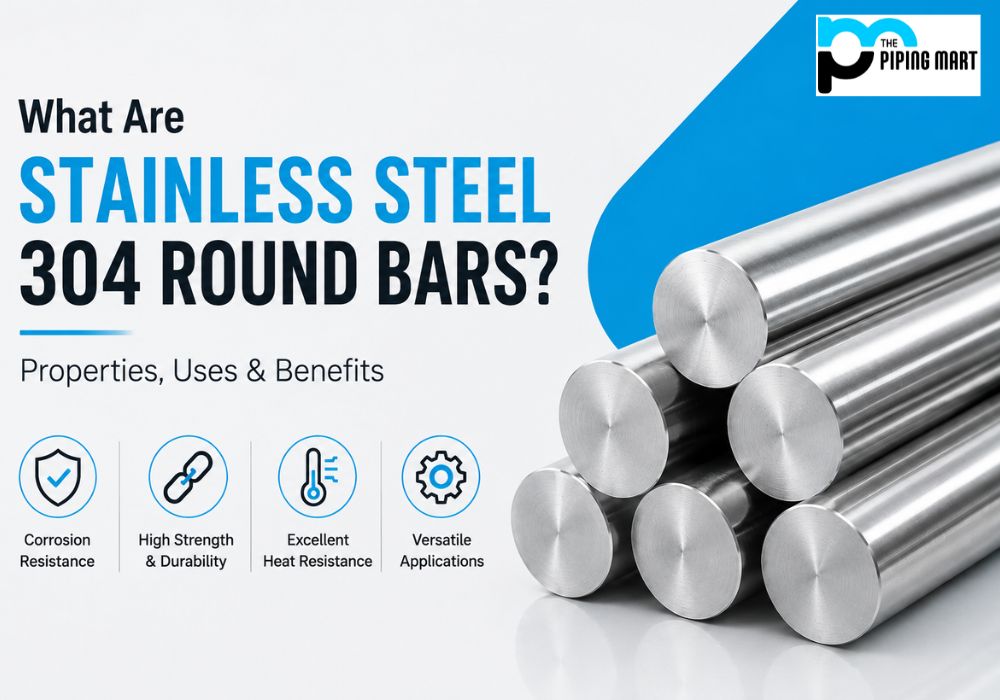
Stainless steel 304 round bars are solid, cylindrical metal rods made from 304-grade stainless steel, also called 18/8 stainless steel, as it consists of 18% chromium and 8% nickel. They are available in different diameters, lengths, and surface finishes to meet different applications. These round bars are strong, can resist rust and corrosion, and are easy to shape and work with. SS 304 round bars are widely used in manufacturing, construction, and engineering projects around the world.
What Are SS 304 Round Bars?
The SS 304 round bars are solid, cylindrical steel bars made of grade 304 stainless steel. The material is austenitic, which means it has a face-centered cubic crystal structure and is often non-magnetic when annealed. Hot rolling or cold drawing procedures are used to make these bars, depending on the dimensional tolerances and surface polish required. They are available in mill finish or polished conditions and comply with standards such as ASTM A276 and AISI 304. The presence of chromium and nickel in their composition creates a natural passive layer on the surface that resists oxidation and corrosion in most conditions.
Stainless Steel 304 Round Bars Specifications
SS 304 round bars are manufactured and supplied as per the material specification and given dimensions.
Standard Sizes and Diameter Range
The SS 304 round bars are available in diameters ranging from as small as 3 mm and going up to as large as 500 mm or more, depending on the manufacturer and production method. The most commonly stocked range is 6 mm to 300 mm. Smaller diameters are generally produced by cold drawing, while larger diameters are hot-rolled. Bar diameters are specified in millimeters in the metric system, or in inches in the imperial system.
Length, Tolerances & Standards
Standard mill lengths for SS 304 round bars are typically 3 meters, 6 metres, or random lengths between 3 and 7 meters. Custom-cut lengths are also available. Standards such as ASTM A276, EN 10278, and IS 6911 specify dimensional tolerances for diameter and straightness. Hot-rolled bars have better tolerances, but cold-drawn bars usually have tighter dimensional control.
Surface Finishes Available
The most common surface finishes for SS 304 round bars are mill finish (No. 1 or hot-rolled), bright annealed (BA), turned and polished (T&P), ground, and centreless ground. Mill-finished bars are used where appearance is not critical. Polished or centerless ground bars are preferred in applications requiring tight tolerances or where the bar needs to move inside a housing or guide. The surface finish also affects corrosion resistance to some degree.
Stainless Steel 304 Round Bar Specifications Chart
| Parameter | Details |
| Grade | SS 304 / AISI 304 |
| Standard | ASTM A276, EN 10278, IS 6911 |
| Diameter Range | 3 mm to 500 mm |
| Standard Lengths | 3 m, 6 m, or custom cut |
| Surface Finish | Mill Finish, Bright, Polished, Ground |
| Form | Round Bar (solid) |
| Manufacturing Method | Hot Rolled / Cold Drawn |
SS 304 Round Bar Properties
The properties of SS 304 round bars cover mechanical, chemical, and physical characteristics. These together determine how the material performs in real applications.
Mechanical Properties of SS 304 Round Bars
The table below lists the standard mechanical property values for SS 304 round bars in the annealed condition.
| Property | SS 304 Round Bar |
| Tensile Strength | 515 MPa minimum |
| Yield Strength (0.2% proof) | 205 MPa minimum |
| Elongation | 35% minimum |
| Density | 8.0 g/cm³ |
| Melting Point | About 1400°C |
| Magnetic Behaviour | Non-magnetic in the annealed condition |
| Corrosion Resistance | Excellent in many environments |
Chemical Properties of SS 304 Round Bars
The chemical composition of SS 304 is tightly controlled during production. The table below shows the typical elemental ranges.
| Element | Typical Composition (%) |
| Carbon (C) | 0.07 max |
| Chromium (Cr) | 17.5–19.5 |
| Nickel (Ni) | 8.0–10.5 |
| Manganese (Mn) | 2.0 max |
| Silicon (Si) | 0.75 max |
| Phosphorus (P) | 0.045 max |
| Sulphur (S) | 0.03 max |
| Nitrogen (N) | 0.10 max |
| Iron (Fe) | Balance |
Physical Properties of SS 304 Round Bars
The physical properties below are useful for engineering calculations and material selection.
| Property | Value |
| Density | 8.00 g/cm³ |
| Modulus of Elasticity | 193 GPa |
| Melting Point | 1400–1450°C |
| Electrical Resistivity | 0.72 x 10⁻⁶ Ω·m |
| Thermal Expansion | 17.2 x 10⁻⁶/K |
| Thermal Conductivity | 16.2 W/m·K |
| Magnetic Behaviour | Essentially non-magnetic, slightly magnetic when cold worked |
Manufacturing Process of Stainless Steel 304 Round Bars
The SS 304 round bars undergo several manufacturing steps to achieve the required dimensions, surface quality, and mechanical properties.
Raw Material Selection (Billets)
The process begins with the selection of steel billets or blooms with a chemical composition suitable for grade 304. They are made in electric arc furnaces and then treated to modify the carbon and sulfur content, for example, by AOD (Argon Oxygen Decarburization). The quality of the billet will directly impact the properties of the final bar.
Hot Rolling vs. Cold Drawing
Hot rolling is the process of heating the billet above the recrystallization temperature and then rolling it through rolling mills to get the desired diameter for larger-diameter bars. The cold drawing process is performed by pulling the bar at room temperature after hot rolling. The cold-drawn bars have slightly higher tensile strength and superior surface finish and dimensional tolerance.
Heat Treatment & Annealing
The SS 304 bars are rolled or drawn and then annealed by heating to approximately 1010–1120 degrees centigrade and then rapidly quenching. This process releases internal stresses, removes the ductility lost due to cold work, and guarantees the material is in the proper austenitic microstructure. The non-magnetic property of the bar is also recovered during annealing.
Surface Finishing Processes
The bars may undergo further surface finishing treatments, depending on the application. The centerless grinding cleans the mill scale and sets the bar’s diameter to a defined value. A smooth or bright surface is desired when polishing is used, and progressively finer abrasives are used for the polishing process. In addition, bars may be provided in the “as rolled” state, where surface appearance is not important.
SS 304 Round Bar Applications Across Industries
SS 304 round bars are used across many sectors because they combine corrosion resistance, strength, and ease of fabrication.
Construction & Structural Components
In construction, SS 304 round bars are used for making handrails, balustrades, support rods, anchor bolts, and structural fasteners. They are also applied to reinforcement applications where corrosion protection is needed, such as in coastal applications or chemical plant applications. They can be used in structural connections, weighing a little.
Food Processing Industry
Round bars of SS 304 are popularly used in the food industry for frames of equipment, conveyors, mixing shafts, and fittings. The material neither reacts with food products nor is difficult to clean and conforms to hygiene requirements. One of its benefits is that it is resistant to acidic and alkaline cleaners used in food plants.
Chemical & Petrochemical Industry
In chemical plants, these bars are used in pump shafts, valve stems, agitator shafts, and fasteners exposed to corrosive environments. SS 304 holds up well against many organic acids and alkaline solutions, though it is not suitable for strongly reducing acid environments or high chloride conditions without additional protection.
Automotive & Engineering Applications
In automotive and general engineering, SS 304 round bars are machined into shafts, pins, bushings, and fittings. The material machines reasonably well and can be welded without major difficulty. In precision engineering, cold-drawn bars with tight tolerances are used directly as machining stock to reduce material removal.
Decorative & Architectural Uses
SS 304 round bars with polished or bright finishes are used in interior design and architecture for furniture legs, decorative railing inserts, display stands, and shopfitting. The bright finish lasts well indoors and needs very little care. For outdoor decoration, the bars perform well in non-coastal, low-chloride environments.
Key Benefits of Stainless Steel 304 Round Bars
SS 304 round bars work across a wide range of applications because of a few core material properties.
- Chromium content forms a self-healing passive oxide layer, which protects against corrosion without any added coating.
- Nickel content adds ductility and toughness, making the bars easier to form and weld.
- Operating range runs from cryogenic service up to roughly +870°C for intermittent use.
- It is non-reactive to most common substances, making the bars suitable for hygienic and food-grade applications.
- SS round bars are available in various sizes, finishes, and standards; selecting the right bar for a particular application is easy.
- Delivers a practical balance of strength, durability, and corrosion resistance at a lower cost than higher-alloy grades.
Limitations of SS 304 Round Bars
The SS 304 round bars aren’t perfect for all applications, and it is good to know a few limitations before specifying them.
- Prone to pitting and crevice corrosion in high chloride environments such as seawater or de-icing salt exposure. SS 316 with molybdenum can better withstand these conditions.
- Machining is harder compared with free-machining grades like 303, since the material work-hardens quickly and shortens tool life.
- Cannot be hardened through heat treatment, so it’s not suitable where high surface hardness is required.
- Corrodes faster in acidic, low-pH environments compared with more corrosion-resistant grades.
How to Choose the Right Stainless Steel 304 Round Bar
The first step to making the right choice is to select the right size and length of the SS 304 round bar. Determine if the bar is for direct use or is machineable. A cold-drawn bar is more suitable than a hot-rolled bar to give accurate dimensions and a smooth surface finish. Bars ground or polished centreless are suitable for applications requiring a clean surface or smooth movement. Also, inspect the work area. However, if the material is to be exposed to chlorides or salt water, then SS 316 may be more suitable. Finally, ask your supplier to ensure that the bar meets standards such as ASTM, EN, or IS.
Conclusion
Stainless steel 304 round bars are the most common and reliable material used in construction, food processing, the chemical industry, automobiles, and architecture. They are highly resistant to corrosion, have good mechanical properties, and are easy to manufacture; therefore, they are used in many industries. They are readily available, conform to standard specifications, and are available in a variety of sizes and surface finishes. They are among the most widely used grades of stainless steel in the world and are not suitable in highly corrosive or chloride-laden environments. Choosing the correct form and finish will give you the maximum service life from these bars.
FAQs
Can SS 304 round bars be welded easily?
Yes. SS 304 round bars can be welded by normal processes such as TIG, MIG, and stick welding. The alloy has a low carbon content, which makes it less susceptible to sensitization and intergranular corrosion in the heat-affected zone. Most applications do not require post-weld annealing, but it is done for heavy sections.
What is the density of SS 304 round bars?
The density of SS 304 round bars is 8.0 g/cm³. The same as with austenitic stainless steel, and it is used in weight and load calculations during design and engineering.
Are SS 304 round bars suitable for outdoor use?
Round bars of SS 304 are suitable for outdoor applications in various environments, especially in low-chloride exposure areas such as urban and rural ones. In marine environments where the bars are exposed to salt, the bars may become stained or pitted over time. In such conditions, SS 316 is used.
Do SS 304 round bars rust over time?
SS 304 round bars may produce surface rust or stains when subjected to chlorides, seawater, or severe industrial conditions for extended durations. This often affects mainly the outside and can be avoided by regular cleaning and maintenance.
Are stainless steel 304 round bars magnetic?
The SS 304 round bars are essentially non-magnetic when they are in the fully annealed condition. Processes like drawing or machining can include a small amount of magnetism due to changes in the metal structure during cold working. This process does not affect the material’s corrosion resistance or mechanical properties.
What is the price of SS 304 round bars?
The SS 304 round bar price depends on various factors, such as the diameter of the bar, the length of the bar, surface finish, quantity, and the market for nickel and chromium. Smaller diameters of polished or ground finish will be more expensive than long-rolled bars per kilogram. It is advisable to ask for a quote from a supplier depending on the specific needs, as costs are dependent on the raw material market.
How long do Stainless Steel 304 round bars last?
When it is properly installed, SS 304 round bars can endure for decades without any significant deterioration. The life span of the depends on the application, exposure to corrosive agents, and maintenance. In food processing or indoor architecture, the bars can last the life of the installation.