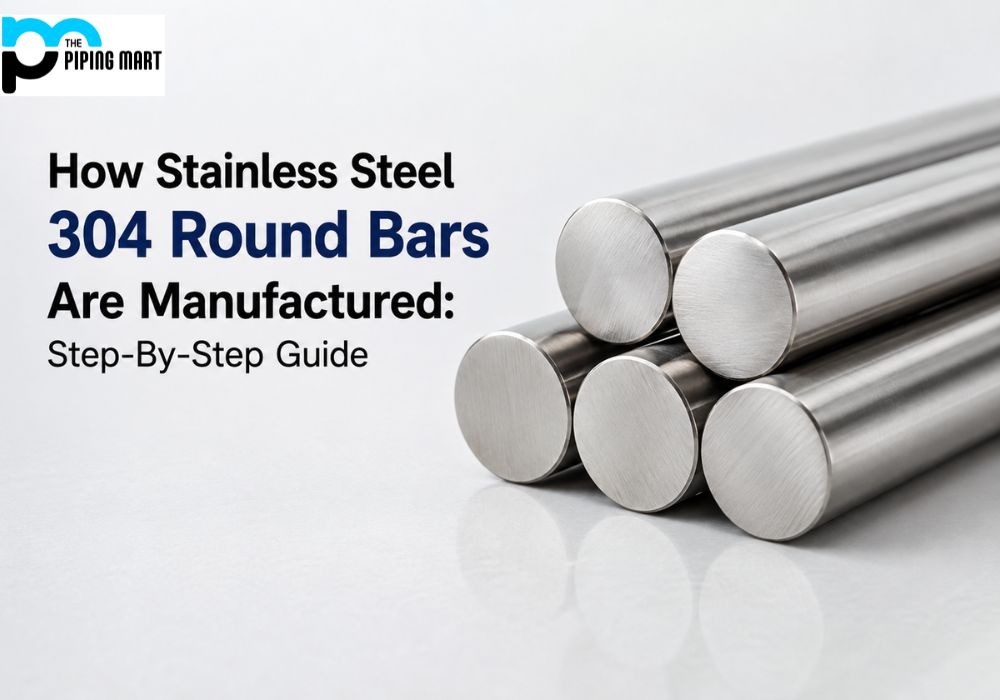
Stainless steel 304 round bars are among the widely used metal products in industries such as construction, chemical processing, food machinery, and engineering. Understanding how the manufacturing process helps buyers and engineers to make the appropriate decision based on material selection, tolerances, and surface specifications. The manufacturing process of stainless steel 304 round bars consists of multiple steps, with each step having an impact on the strength, corrosion resistance, and quality of the final product. This guide explains the complete process in a simple step-by-step manner.
Introduction to the Stainless Steel 304 Round Bars
The stainless steel 304 round bars are solid cylindrical bars produced from an austenitic stainless steel grade with approximately 18% chromium and 8% nickel. This composition offers the bars excellent corrosion resistance, higher strength, and formability. The bars are available in different sizes and lengths. Depending on the dimensional tolerance and surface roughness of the product that is required, these bars are produced by the hot or cold rolling process.
Step-by-Step Stainless Steel 304 Round Bars Manufacturing Process
The manufacturing of stainless steel 304 round bars follows several specific steps. Each step is carefully monitored to make sure the material meets all required specifications, which are explained in detail below.
Step 1: Raw Material Selection and Composition Control
The first step is to choose the right raw materials. The iron ore, chromium, nickel, manganese, and other alloying elements are obtained according to the chemical composition of SS 304 required. The scrap stainless steel is another common base input. These proportions of the elements are determined before the melting, and even minor variations can alter the properties of corrosion resistance or mechanical characteristics.
Step 2: Melting and Refining of Stainless Steel
The steel is then treated in the Argon Oxygen Decarburization (AOD) and Vacuum Oxygen Decarburization (VOD) processes after it has been melted. The carbon content is reduced as the right balance of chromium and carbon is maintained to give high corrosion resistance, and the material is tested during the refining process to ensure compliance with SS 304 specifications.
Step 3: Casting into Billets or Ingots
The molten steel is cast into semi-finished steel, like billets or ingots of semi-finished steel, after the refining process. Continuous casting is more commonly used in newer plants because it produces a higher yield and consistency. The billets are cooled in a controlled way to minimise the internal stresses and prevent cracking. May be rolled or forged to the desired shape as needed. The material is visually checked for the presence of surface cracks, porosity, or other defects at this stage.
Step 4: Hot Rolling Stainless Steel Bars
The first forming step is hot rolling the stainless steel bars. The billets are reheated to around 1100–1250°C and then passed through a series of rolling mills. The cross section of the billet is progressively reduced during the rolling operation to a final cross section (round bar diameter). The grain refinement process in hot rolling stainless steel bars results in bars with good mechanical properties and reasonable dimensional tolerances. The final bars are cut and cooled on cooling beds. Hot-rolled bars usually have a slightly rough, scaled surface caused by the oxidation of the bars during the heating process.
Step 5: Heat Treatment and Annealing Process
After the hot rolling process, the bars are heated to about 1010–1120°C and then quickly cooled in water. This heat treatment eliminates carbide precipitates, dissolves them back into the steel, and restores the austenitic structure. If performed properly, it will provide an even corrosion-resistant surface on the bar. Failure to carry out this step or to perform the step properly can result in chromium carbides precipitating at the grain boundaries (sensitisation) and sacrificing the corrosion resistance of the material.
Step 6: Descaling and Surface Cleaning
After annealing, the bar’s surface has a protective layer of oxide scale. This scale should be taken off before doing any other processing or dispatching. Descaling is done by shot blasting, acid pickling (a mixture of nitric and hydrofluoric acid), or both. The pickling also removes the scale and restores the passive chromium oxide surface layer on stainless steel that is responsible for corrosion resistance.
Step 7: Cold Drawing Stainless Steel Bars (Optional Precision Step)
The cold-drawing process of stainless steel bars is an additional process that is applied when higher tolerances or a better finish are required. The annealed and pickled bar is drawn at room temperature through a tungsten carbide die. This process is able to decrease the diameter by a small amount and make the surface smoother. Work hardening also results in an increase in tensile strength and hardness of cold-drawn stainless steel bars. Cold-drawn bars are normally used when precision is required (h9 and h11) and for smooth surfaces, as in precision-machined parts or hydraulic parts.
Step 8: Cutting, Straightening, and Sizing
After rolling or cold drawing, the bars are straightened using suitable machines to remove bends and warps, then cut to the required length with saws or shear cutters. Their ends and overall length are checked to ensure they are straight and within the specified size limits. Any bars that do not meet these standards are either fixed or discarded.
Step 9: Surface Finishing and Treatment
The bars can be surface-treated as required by the application. Common finishes include:
Surface Finish: The hot-rolled, annealed, and pickled rough surface for industrial use.
Bright Annealed (BA): Annealed in a controlled atmosphere to obtain a reflective surface in the absence of pickling.
Polished Finish: Mechanically polished to a specified grit or Ra value for food-grade or decorative finishes.
Ground Finish: Centerless ground to achieve very tight diameter tolerances. The right finish is selected as per the buyer’s requirements.
Step 10: Quality Inspection and Testing
The SS 304 round bars undergo quality inspections before delivery to ensure they meet the required mechanical, chemical, and dimensional specifications.
Mechanical Testing:
The sample from each batch is tested for tensile strength, hardness, bending and so on. The tests verify the strength, hardness, elongation, etc. according to ASTM A276 or EN 10278.
Chemical Analysis:
The elements in the metal bars are determined by a special type of machine or chemical tests. Chromium, nickel, manganese, silicon, phosphorus, and sulfur are checked to ensure that the metal bars conform to the grade specifications of SS 304.
Non-Destructive Testing (NDT)
These tests are used to detect hidden flaws such as cracks, empty space, etc. Without breaking or cutting bars, the ultrasonic or eddy current tests are conducted. These tests are conducted particularly on bars that are used in high-pressure or heavy-load applications.
Dimensional inspection
The bar diameter, length, straightness, and roundness are checked with the help of measuring instruments. These bars are tested more carefully for the cold-drawn bars, which are within very tight tolerances, ±0.01 mm.
Step 11: Packaging, Storage, and Dispatch
After the required testing and inspection, the bars are packed for delivery. Each batch is labeled with required information such as grade, size, heat number, and applicable standard. Sometimes outer wrappings are added for export consignments to prevent moisture entry. Storage is in covered areas to prevent contamination or surface damage before delivery.
Common Manufacturing Defects and How They Are Prevented
If the process parameters are not controlled, several defects can be incurred during the production process of the metal bar. Common defects are surface cracking, which may occur at improper rolling temperatures; internal voids, which can be caused by solidification problems during the casting process; and scaling or pitting, which are caused by poor descaling. If the annealing is not carried out properly, the chromium carbides may form at the grain boundaries, causing a condition known as sensitisation. Worn dies or improper straightening may cause dimensional non-conformance. In-process controls include regular maintenance of the dies, sample testing at each stage, temperature monitoring, and final non-destructive testing; most of these defects are prevented. The documentation and traceability also help to identify the source of any defect quickly.
Conclusion
The production process of stainless steel 304 round bars is a series of meticulous operations, including raw material selection, forging, rolling, cleaning, inspection, and even packaging. Each step in making the bar affects its final quality, such as strength, precise size, resistance to rust, and surface finish. The bars can be made by hot rolling alone or by hot rolling followed by cold drawing. In all cases, they must meet set standards so that the final products are consistent and reliable. When understanding the stainless steel fabrication process, the buyer can determine the correct product, and engineers can choose the correct bar for their needs.
FAQs on Stainless Steel 304 Round Bars Manufacturing
How Does the Manufacturing Process Affect Final Properties?
The manufacturing procedure directly impacts the mechanical and dimensional properties of the bar. Hot-rolled bars are less strong, but more ductile, than cold-drawn bars, which are stronger and tighter due to work hardening and have improved surface finish and tolerances. The heat treatment operations, such as annealing, restore corrosion resistance and normalize the microstructure after deformation.
What is the difference between hot-rolled and cold-drawn stainless steel bars?
The hot-rolled bars are produced at high temperatures. They usually have a rough or scaled surface and wider size tolerances and are used in structural work and general manufacturing, as they are produced at room temperature by pulling the material through dies. This process improves the surface finish, dimensional accuracy, and strength. They are mainly used for precision machining applications.
Why is heat treatment important in SS 304 manufacturing?
Solution annealing is used to re-dissolve the carbides, which may have been precipitated during hot working or welding and which could cause a loss of corrosion resistance in the steel. If SS 304 is not heat-treated correctly, it can be susceptible to intergranular corrosion, especially in highly corrosive welding and environments. In addition, annealing also eliminates residual stresses and equalizes mechanical properties throughout the cross-section of a bar.
What Industry Standards are followed in stainless steel bar production?
The Stainless steel 304 round bars are produced in accordance with standards such as ASTM A276, EN 10278, EN 10088, IS 6603, and JIS G4303. These standards define the required chemical composition, mechanical strength, dimensional tolerances, and testing procedures for SS 304 bars, ensuring consistent quality and performance.