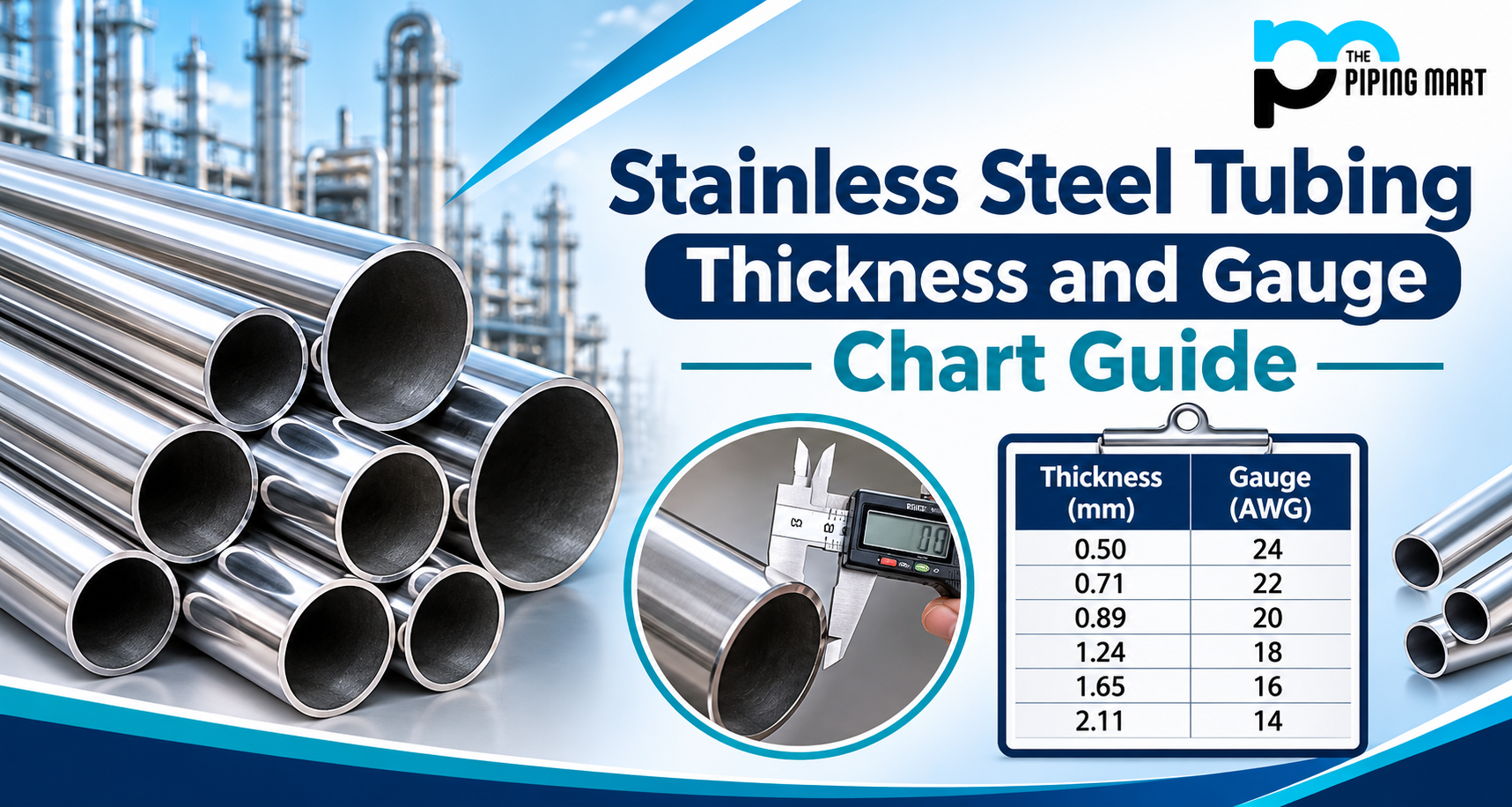
Stainless Steel Tubing Thickness is the wall measurement between a tube’s outer and inner surface, stated in millimetres, inches, or as a gauge number. Heat exchangers, hydraulic lines, dairy plants and architectural frames rely on correct wall selection. Thickness governs mechanical strength, weight per metre, and service life. A 0.4 mm difference determines whether a tube passes a pressure test. Reading gauge numbers correctly before purchase prevents costly rejections at inspection.
What Is Stainless Steel Tubing Thickness?
Wall thickness is the distance from the outer surface of the tube to the bore, measured perpendicular to the axis. Mills state it in millimetres for metric orders and in decimal inches for ASTM work. Thin-wall tubing runs below roughly 1.5 mm and suits light structural and fluid-transfer duty. Heavy-wall tubing starts near 2.8 mm and carries higher internal pressure. The same outside diameter can be supplied in six or more wall options, so OD alone never defines a tube.
Stainless Steel Tubing Thickness and Gauge Chart
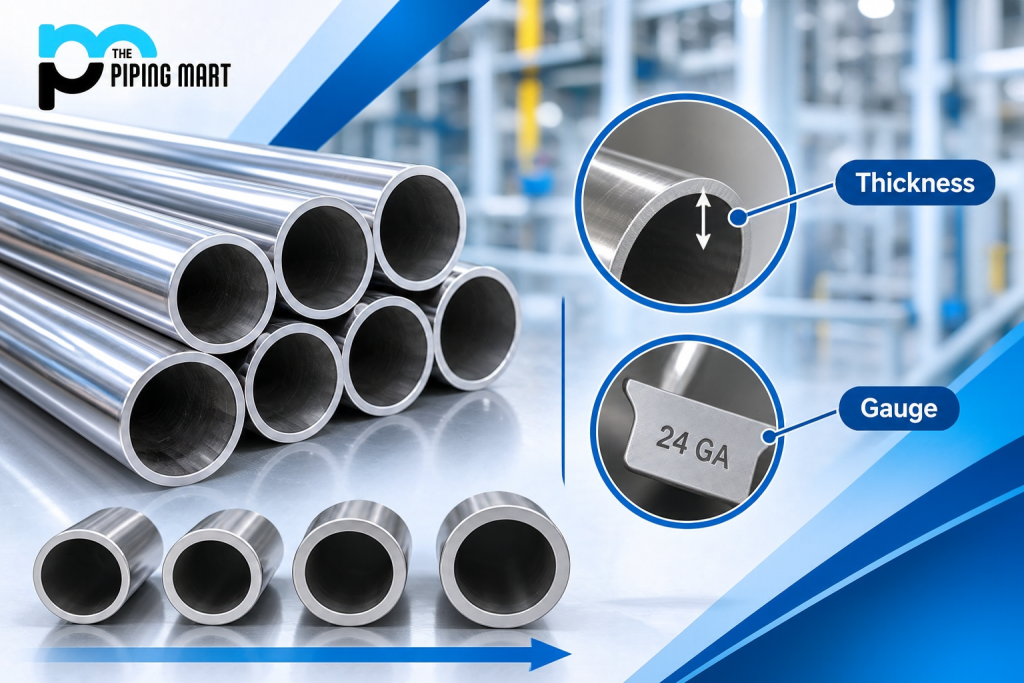
Gauge numbers encode wall thickness on an inverse scale: as the number rises, the wall gets thinner. A Stainless Steel Tubing Gauge Chart converts those numbers into usable dimensions. The table below lists Birmingham Wire Gauge (BWG) sizes from 10 to 24 with the matching SS Tube Thickness in MM and in inches. Sheet and strip buyers often quote Manufacturers Standard Gauge instead, and the two scales differ across several thicknesses. A 16 gauge wall under one system can differ from the other by 0.1 mm or more. Purchase orders should always carry the numeric wall, not only the gauge.
| Gauge (BWG) | Thickness (mm) | Thickness (inches) |
| 10 | 3.40 | 0.1345 |
| 12 | 2.77 | 0.1094 |
| 14 | 2.03 | 0.0800 |
| 16 | 1.65 | 0.0650 |
| 18 | 1.24 | 0.0490 |
| 20 | 0.89 | 0.0350 |
| 22 | 0.71 | 0.0280 |
| 24 | 0.56 | 0.0220 |
Understanding Stainless Steel Tubing Gauge Measurements
The gauge system is a legacy numbering scale that assigns a fixed wall value to each number rather than measuring in direct units. Lower numbers mean thicker metal. BWG applies to tubes and condenser stock; MSG applies to sheet and plate, with its stainless values following a separate progression. Mills, inspectors and fabricators therefore work from Stainless Steel Tubing Wall Thickness in millimetres or inches, and consider the gauge number as shorthand only.
Common Stainless Steel Tubing Wall Thicknesses and Their Uses
Three thickness bands cover most commercial demand.
Thin-Wall Stainless Steel Tubing
Thin-wall tube from 0.56 mm to 1.24 mm keeps weight low. Furniture frames and handrails use it. 18 Gauge Stainless Steel Tubing at 1.24 mm suits stainless steel decorative tubes.
Medium-Wall Stainless Steel Tubing
This band, roughly 1.65 mm to 2.03 mm, handles general fabrication and support structures. 16 Gauge Stainless Steel Tubing falls within this range, and stainless steel seamless tubes in this band take welding and bending without wall collapse.
Heavy-Wall Stainless Steel Tubing
Heavy-wall tube from 2.77 mm upward serves heavy engineering and process equipment. Boiler and stainless steel heat exchanger tubes often specify 10 or 12 gauge.
How to Measure Stainless Steel Tubing Thickness
Three instruments cover Stainless Steel Tubing Thickness checks on the shop floor and at inspection.
Digital Vernier Caliper
A digital vernier caliper reads outside and inside diameter to 0.01 mm. Both figures feed the wall calculation.
Micrometer
The micrometer checks wall thickness directly on a cut end, and holds tighter repeatability than a caliper.
Ultrasonic Thickness Gauge
This instrument measures the wall through the tube surface, so installed pipework stays intact.
Wall Thickness = (OD – ID) / 2
For a tube measuring 25.4 mm OD and 22.1 mm ID: (25.4 – 22.1) / 2 = 1.65 mm, which matches 16 BWG.
Factors to Consider When Choosing Stainless Steel Tubing Thickness
Five conditions determine the correct Stainless Steel Tubing Thickness for an application.
- Operating pressure: Higher design pressure needs a thicker wall. Barlow’s formula links wall, diameter, and allowable stress.
- Grade: SS 316 tubing holds chloride resistance better than 304, which can allow a thinner wall in marine service.
- Temperature: Allowable stress drops as metal temperature rises, so elevated-temperature lines need added wall.
- Mechanical load: External loads, vibration, and bending stiffness favour heavier walls on structural runs.
- Weight and cost: Wall thickness drives weight per metre, and weight drives price. Over-specifying adds cost without benefit.
Conclusion
Correct Stainless Steel Tubing Thickness starts with the application’s pressure, temperature, and load, not with a gauge number alone. Gauge charts speed up conversion, and a caliper, micrometer, or ultrasonic reading confirms the actual dimensions. Before releasing a purchase order, verify grade, outside diameter, wall tolerance, and the governing ASTM specification.
Frequently Asked Questions
What is the standard thickness of stainless steel tubing?
There’s no single standard. Commercial tubing runs from 0.56 mm to 3.40 mm wall, with 1.24 mm and 1.65 mm moving in the highest volumes across structural, sanitary, and general fabrication work.
What does gauge mean in stainless steel tubing?
Gauge is a numbered scale for wall thickness. Each number maps to a fixed dimension, and the value falls as the number rises. BWG 10 equals 3.40 mm; BWG 24 equals 0.56 mm.
Which is thicker, 16 gauge or 18 gauge stainless steel tubing?
16 gauge is thicker at 1.65 mm against 1.24 mm for 18 gauge. The 0.41 mm difference raises pressure capacity and weight per metre on every size.
How do you measure wall thickness without cutting the tube?
An ultrasonic thickness gauge reads the wall from the outside surface in seconds. Plant inspectors use it on live pipework to track corrosion loss without taking a line out of service.
Does stainless steel tubing wall thickness affect pressure rating?
Yes. Allowable internal pressure rises almost in proportion to wall thickness at a fixed diameter. A 2.77 mm wall carries far more pressure than a 1.24 mm wall of the same OD.