Stainless steel fittings price depends on six variables: material grade, size, fitting type, manufacturing route, finishing requirements, and raw material market movement. These components join, branch, and redirect flow in industrial piping systems, so specification accuracy matters more than cost. Quoted rates for Stainless Steel Pipe Fittings shift as nickel and molybdenum prices move. Buyers acquainted with the cost drivers compare quotations on equal terms, plan procurement budgets, and select suitable fittings without reducing quality.
Stainless Steel Fittings Price Chart
The table below lists indicative price bands for common stainless steel fittings grades in the Indian market, quoted per kilogram.
| Grade | Indicative Price Range (INR per kg) |
| SS 201 | 140 to 200 |
| SS 304 / 304L | 200 to 320 |
| SS 303 | 260 to 400 |
| SS 316 / 316L | 280 to 420 |
| SS 321H | 450 to 750 |
| SMO 254 | 1,200 to 2,200 |
What Determines the Price of Stainless Steel Fittings?
No fixed rate exists for stainless steel pipe fittings. Suppliers assemble each quotation from technical inputs and commercial ones, so a change in any single input moves the final figure up or down. Six variables carry most of the weight:
- Stainless steel grade and chemical composition
- Fitting size, thickness and pressure rating
- Fitting type and design complexity
- Manufacturing process and finishing requirements
- Order quantity and availability
- Raw material prices and market fluctuations
Specifications come first, pricing second. Buyers who settle grade, schedule, and application requirements before collecting offers can compare supplier quotations against a single technical baseline instead of guessing which rate covers what.
Major Factors Affecting Stainless Steel Fittings Prices
The seven factors below explain where the money goes in a fittings order.
Stainless Steel Grade and Material Composition
Chemical composition sets the floor under any stainless steel fittings price. Nickel, chromium, and molybdenum are the costly alloying elements, so grades carrying more of them start from a higher base.
- Stainless Steel 201 Pipe Fittings: an economical grade for general-purpose applications.
- Stainless Steel 303 Pipe Fittings: a free-machining grade where machining characteristics matter.
- Stainless Steel 321H Pipe Fittings: a stabilised grade for elevated-temperature applications.
- Stainless Steel SMO 254 Pipe Fittings: a high-alloy grade resisting pitting and crevice corrosion.
Operating conditions should drive grade selection, not the rate.
Size, Thickness and Dimensions
Material consumption rises with size, and so does the price of each stainless steel fitting. Wall thickness compounds it, since a heavier wall needs a heavier starting billet.
- Nominal Pipe Size (NPS)
- Outside diameter and wall thickness
- Schedule 10, Schedule 40, Schedule 80 and higher schedules
- Custom dimensions and non-standard requirements
Larger, heavier fittings consume more raw material per piece.
Type and Design of Fittings
The design configuration decides how much forming and machining each fitting needs. A 90° elbow and a lateral cross don’t cost the same to make.
- Elbows (45° and 90°)
- Tees and crosses
- Concentric and eccentric reducers
- Couplings and unions
- Caps and end fittings
Complex geometries and custom configurations need extra fabrication and machining time, which suppliers price in.
Manufacturing Process
The production route changes the cost structure before a fitting reaches the finishing line.
- Seamless fittings
- Welded fittings
- Forged fittings
- Fabricated fittings
Each route carries its own material yield and quality-control burden. Seamless and forged products start from solid or pierced stock, so they require more processing time. Welded and fabricated items require less input material, but the cost of weld inspection is an additional factor.
Surface Finish and Quality Requirements
Finishing and inspection scope adds a measurable layer to the final cost.
- Pickled and passivated finish
- Polished finish
- Precision machining
- PMI testing and hydrostatic testing, where applicable
- Mill Test Certificates (MTCs) and material traceability
Every extra test consumes shop time and documentation effort. Third-party inspection, full traceability, or a mirror polish all show up in the per-piece rate.
Order Quantity and Customization
Per-piece cost falls as order volume rises.
- Bulk purchasing and volume discounts
- Small or individual orders
- Custom dimensions and specifications
- Special manufacturing requirements
Large orders spread setup, tooling and documentation costs across more pieces, reducing the per-unit rate where stock is available. One-off custom sizes work the other way.
Raw Material Market Conditions
Nickel, chromium and molybdenum prices set the base metal cost, and all three are traded on volatile global markets. A rally in nickel lifts austenitic grade rates within weeks. Four more commercial pressures are also present:
- Currency exchange rates
- Energy and manufacturing costs
- Transportation and logistics
- Import duties and supply availability
How to Choose Cost-Effective Stainless Steel Pipe Fittings
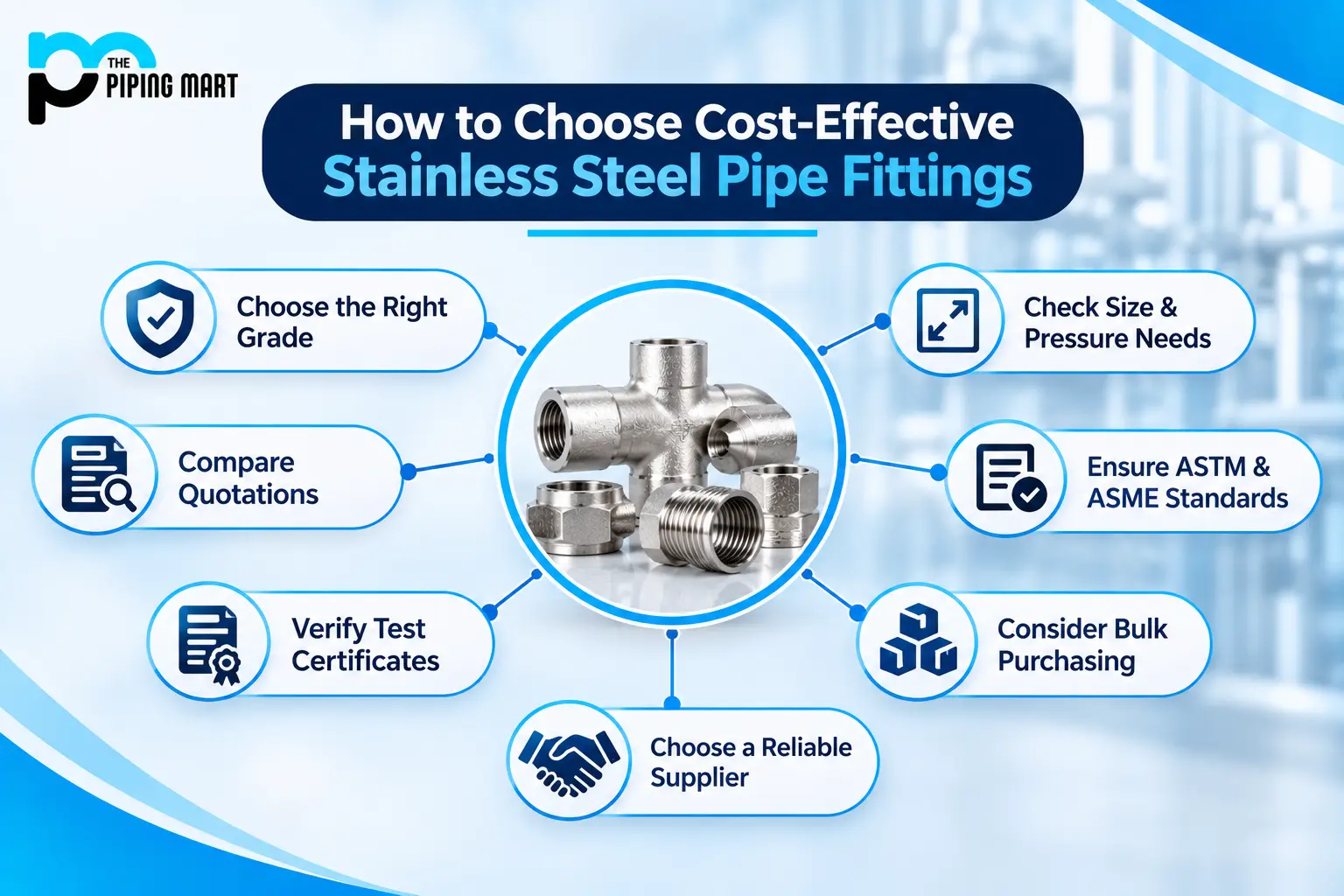
Procurement costs come under control when buyers settle the specification before the negotiation starts. Seven checks keep quality intact while trimming avoidable spend:
- Select the appropriate stainless steel grade for the application, not the cheapest available.
- Verify size, schedule and pressure requirements against the line design.
- Compare quotations for identical material specifications only.
- Verify the applicable ASTM and ASME standards for the fitting type.
- Verify material test certificates and inspection requirements before release.
- Consider bulk purchasing for large projects and repeat requirements.
- Evaluate supplier experience, product availability, and delivery timelines.
The cheapest fitting rarely proves the most economical across a service life measured in decades.
Why Compare Specifications Before Buying Stainless Steel Fittings?
Price alone tells a buyer nothing about the material, the route, or the paperwork behind it. Five parameters deserve a line-by-line check:
- Material grade and applicable standards
- Dimensions and wall thickness
- Manufacturing process
- Testing and certification
- Delivery timelines and commercial terms
Comparing identical specifications gives buyers a defensible basis for the purchase decision and removes the cost surprises that surface after dispatch.
Conclusion
Grade chemistry, dimensions, manufacturing route, finishing scope and raw material markets together shape every stainless steel fittings price a buyer receives. The Piping Mart supplies stainless steel fittings across a wide grade range and specification set. Review the pressure, temperature and standard requirements for the line first, then request a quotation against that finalised scope.
Frequently Asked Questions
1. What factors affect stainless steel fittings prices?
Six inputs drive the rate: grade chemistry, size and wall thickness, fitting type, manufacturing route, finishing and inspection scope, and order quantity. Nickel and molybdenum market movements precede all of them.
2. Which stainless steel grade is more economical for pipe fittings?
SS 201 carries the lowest material cost of the common grades because manganese replaces part of the nickel content. It suits general-purpose, non-aggressive service. Chloride or acid exposure calls for 316 or higher.
3. Why are SMO 254 pipe fittings pricier than standard SS fittings?
SMO 254 holds roughly 6% molybdenum, about 18% nickel, and a copper addition, so its alloy bill lands far above that of 304. The grade also machines and welds more slowly, which adds to fabrication costs.
4. Does buying stainless steel fittings in bulk reduce the price?
Yes, in most cases. Volume orders spread setup, tooling, and certification costs across more pieces, and suppliers price ex-stock quantities more keenly than one-off pulls. Non-standard sizes receive smaller discounts.
5. How can I get an accurate quotation for stainless steel fittings?
Share the grade, fitting type, nominal size, schedule, applicable ASTM or ASME standard, required quantity and any testing or certification needs. A supplier can price the order firmly once you fix that scope.