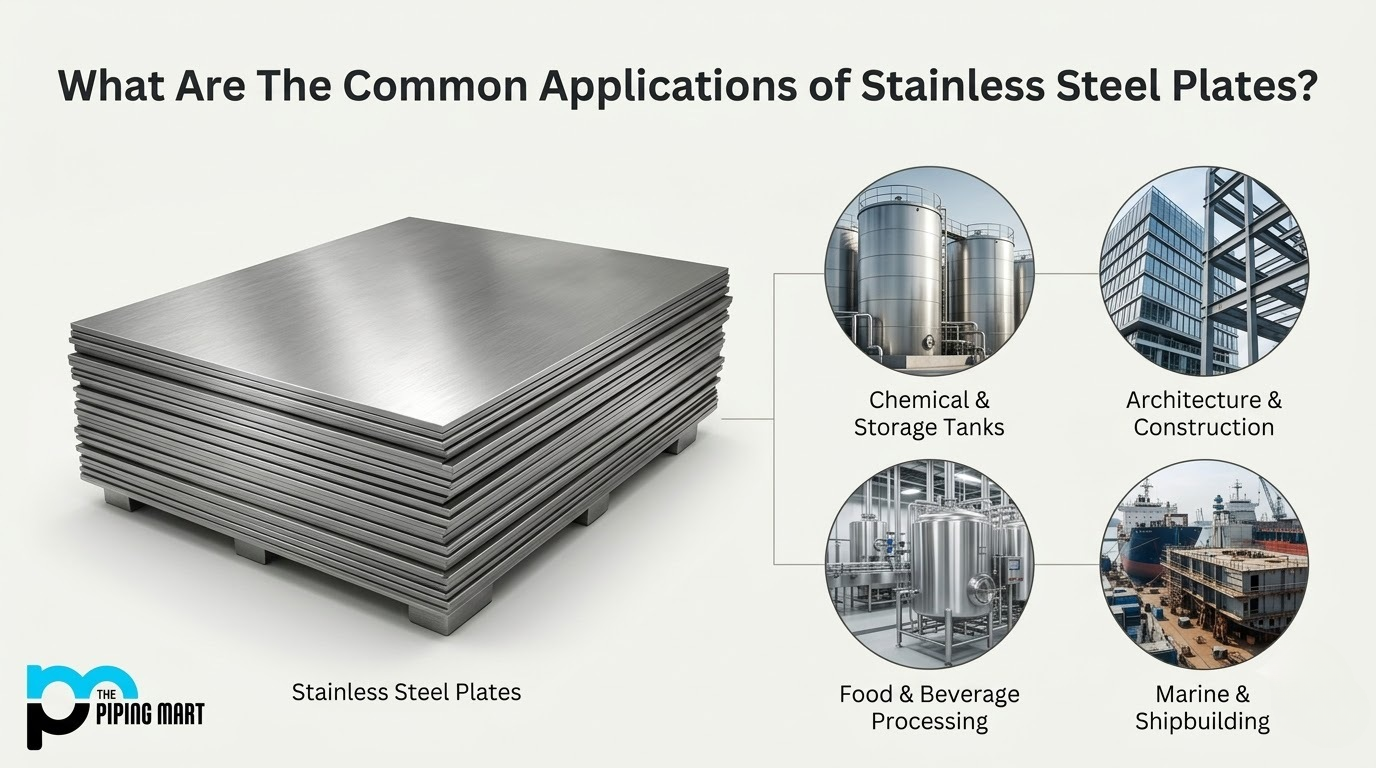
Chemical plants, food processors, offshore platforms, desalination units, and power stations all weld their equipment from stainless steel plate. Each service places different demands on the material: chloride exposure in seawater, washdown chemicals in food plants, steam and flue gas in boilers. Those demands steer the grade, thickness, and finish a buyer orders. This page covers seven common applications, explains why fabricators pick plate for each one, and lists the factors that turn an end use into a purchase specification.
What Are Stainless Steel Plates?
Stainless steel plates are flat rolled products that fabricators cut, form, and weld into vessels, tanks, structural members, and industrial components. The supplier provides industrial stainless steel plates in different grades, dimensions, thicknesses, surface conditions, and supply conditions. Each end-user sets its own demands, since corrosion exposure, strength, temperature, hygiene, fabrication method, and surface requirements differ from one plant to the next. This article covers where plates are used and why buyers select them for each use.
Common Applications of Stainless Steel Plates
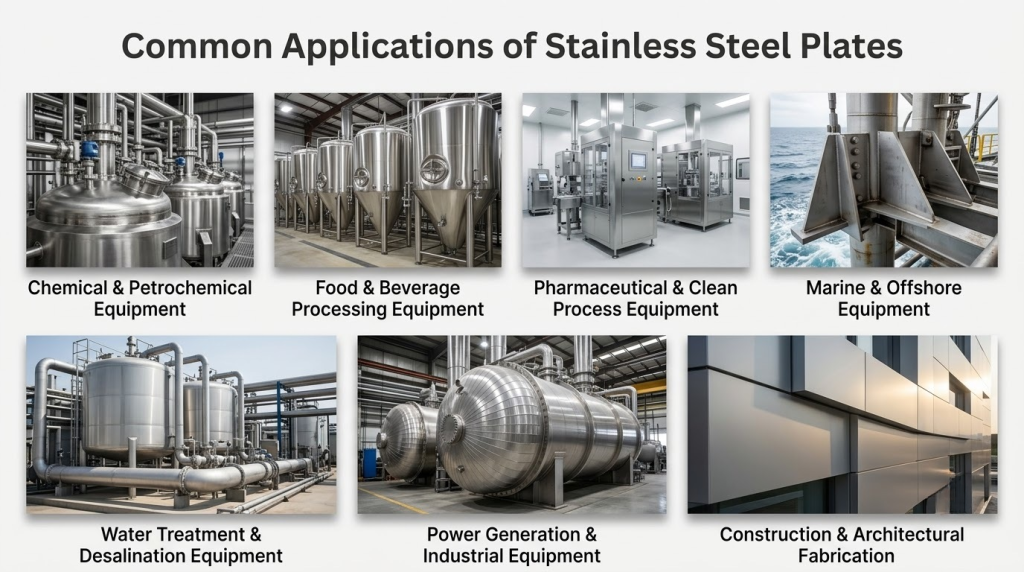
Plates serve process industries, and each use below links the equipment, material requirement, and the reason fabricators choose plate over pipe, bar, or sheet.
Chemical and Petrochemical Equipment
Fabricators roll and weld stainless steel plate into storage vessels, process tanks, and equipment components for chemical and petrochemical plants. Plate suits these jobs because large-diameter vessels need wide flat stock that welds into thick, continuous walls. The chemicals, their concentration, temperature, and exposure conditions determine the grade, so no single stainless steel grade covers all chemical services. Process engineers confirm the grade against the actual medium before fabrication starts.
Food and Beverage Processing Equipment
Food plants specify plates for processing equipment, storage tanks, hoppers, and equipment enclosures, along with fabricated parts that touch the product. Smooth surfaces clean quickly, and corrosion-resistant material withstands washdown chemicals and acidic ingredients. Fabricators also weld plate into tank walls and hopper cones with smooth joints that leave no crevices to trap residue. Surface finish, therefore, carries as much weight as the grade, since a polished face resists buildup during cleaning cycles.
Pharmaceutical and Clean Process Equipment
Pharmaceutical and clean process facilities use plates for process vessels, storage systems, equipment panels, and other fabricated components. These installations demand surfaces that clean thoroughly, resist corrosion from cleaning agents, and weld without defects that hold contamination. Buyers therefore specify the surface condition alongside the grade, and low-carbon grades such as 316L suit welded construction. Any compliance requirement applies to the finished system and its documentation, so buyers confirm those separately.
Marine and Offshore Equipment
Shipbuilders and offshore contractors use plate for deck components, equipment housings, platforms, and structural fabrication. Seawater and salt-laden air expose the metal to chlorides, which attack some stainless steel grades faster than others. That makes grade choice critical, and standard austenitic grades do not suit every seawater or splash zone exposure. Chloride level, temperature, and the exact service location decide whether a higher alloyed grade is necessary.
Water Treatment and Desalination Equipment
Water treatment facilities and desalination plants use plates for treatment equipment, storage and process tanks, brine handling units, and fabricated components. Water chemistry changes from site to site, and chloride concentration has the most influence on material choice. Mild conditions may allow common austenitic grades. Brine and seawater feed streams push the requirement toward higher alloyed grades, because stronger chloride exposure attacks lower alloyed material. Engineers therefore request a water analysis before they select the plate.
Power Generation and Industrial Equipment
Power stations and industrial plants use plates for heat exchanger components, equipment housings, process equipment, and fabricated plant parts. Heat, steam, and flue gases subject these parts to oxidation and thermal cycling. Strength must hold at operating temperature, and the plate must resist scaling and corrosion over long service intervals. Grade 321, which carries titanium stabilization, appears in some elevated-temperature duties, though operating temperature and the required mechanical properties determine the final choice.
Construction and Architectural Fabrication
Architects and contractors specify plates for cladding, facade components, structural fabricated elements, railings, and other architectural parts. Exposed installations face rain, pollution, and coastal air, so corrosion resistance protects both strength and appearance. Surface finish controls how the plate looks and how easily dirt washes off. Maintenance needs shape the decision as well, because a building element that needs frequent repair or cleaning raises the lifetime cost.
Why Are Stainless Steel Plates Used in Industrial Applications?
Six requirements shape the uses of stainless steel plates across industry. Corrosion resistance comes first because acids, chlorides, and moisture attack ordinary carbon steel. Strength and durability follow, since vessels and structural parts carry load and pressure for years. Fabrication matters just as much, so a plate must be cut, formed, and welded without losing its properties. Cleanability determines suitability in food and pharmaceutical plants, where residue on rough surfaces creates a contamination risk. Specific service environments, such as hot gases or brine, demand resistance to one particular form of attack. Surface condition and maintenance need a complete list, because a stain-resistant finish reduces cleaning effort.
How Does the Application Affect Stainless Steel Plate Selection?
The end use defines the material requirements before a buyer contacts any supplier, and eight factors turn that use into a clear written purchase specification.
- The application decides the required stainless steel grade, since each grade resists a different range of corrosive media and service conditions.
- Corrosion exposure determines how much alloying the plate needs to survive contact with acids, chlorides, or cleaning chemicals.
- Mechanical strength requirements depend on whether the plate carries pressure, structural load, or only forms an enclosure.
- Operating temperature affects strength retention and oxidation resistance, which matters in heat exchangers, furnaces, and exhaust-related equipment.
- Plate thickness and dimensions follow the design loads, the vessel or panel size, and the cutting and forming sequence the fabricator plans.
- Welding and forming requirements influence the grade and supplied condition because heat from welding can alter corrosion performance in some grades.
- Surface finish matters most where cleanability or appearance counts, as in food equipment, pharmaceutical vessels, and architectural cladding.
- The applicable specification fixes the tests, tolerances, and documentation the supplier must meet, so the buyer names it in the request.
- In general industrial service, grade and dimensions depend on the actual environment and the mechanical requirements.
- In chloride exposure, concentration, temperature, and the duration of contact all shape the grade decision.
- In high-temperature service, the operating temperature and the required mechanical and oxidation performance guide material choice.
Common Mistakes When Choosing Stainless Steel Plates for an Application
Six recurring mistakes appear when buyers match a plate to an application, and each one is easy to avoid with a short check before ordering.
- Buyers select the most common grade without assessing the environment, which exposes the plate to conditions beyond its resistance.
- Teams assume all stainless steel grades give the same corrosion resistance, although resistance differs from grade to grade.
- Ignoring chloride or chemical exposure can lead to pitting and crevice corrosion, even in equipment that looks correctly specified.
- Selecting only by plate price ignores replacement, downtime, and maintenance costs that follow when a cheaper grade fails early.
- Overlooking fabrication and welding requirements can lead to cracking, distortion, or loss of corrosion resistance at the weld.
- Failing to verify the applicable material specification leaves the buyer without confirmed properties, tests, and documentation for the finished equipment
Frequently Asked Questions About Stainless Steel Plate Applications
What are stainless steel plates commonly used for?
Fabricators build them into chemical process equipment, food and pharmaceutical vessels, marine and offshore structures, water treatment and desalination units, power plant components, architectural cladding, and general industrial equipment.
Why are stainless steel plates used in industrial equipment?
Corrosion resistance protects the equipment, strength supports loads and pressure, and weldability allows custom fabrication. Cleanable surfaces and durable finishes support hygiene and appearance, though resistance levels differ between grades.
Are stainless steel plates suitable for marine applications?
Yes, in the right grade. Chloride exposure, seawater contact, temperature and the specific service environment determine which grade survives, because standard grades do not tolerate every marine condition.
What stainless steel plates are used for food processing equipment?
Buyers choose austenitic grades such as 304 and 316 on corrosion resistance, cleanability, fabrication needs, surface condition and the specific ingredients and cleaning chemicals involved. The exact application settles the final grade.
How do buyers choose stainless steel plates for an application?
Define the service environment first, then list required properties, choose the grade, set dimensions and thickness, check fabrication needs, select the surface condition, and confirm the applicable specification.
Conclusion
Stainless steel plates serve process, food, pharmaceutical, marine, water, power, industrial, and construction applications, yet no single plate fits all of them. Chemical exposure, chloride levels, temperature, hygiene demands, and fabrication methods differ across these settings, and each difference changes the grade, thickness, finish, and specification a buyer needs. Service conditions should therefore set the material requirements..