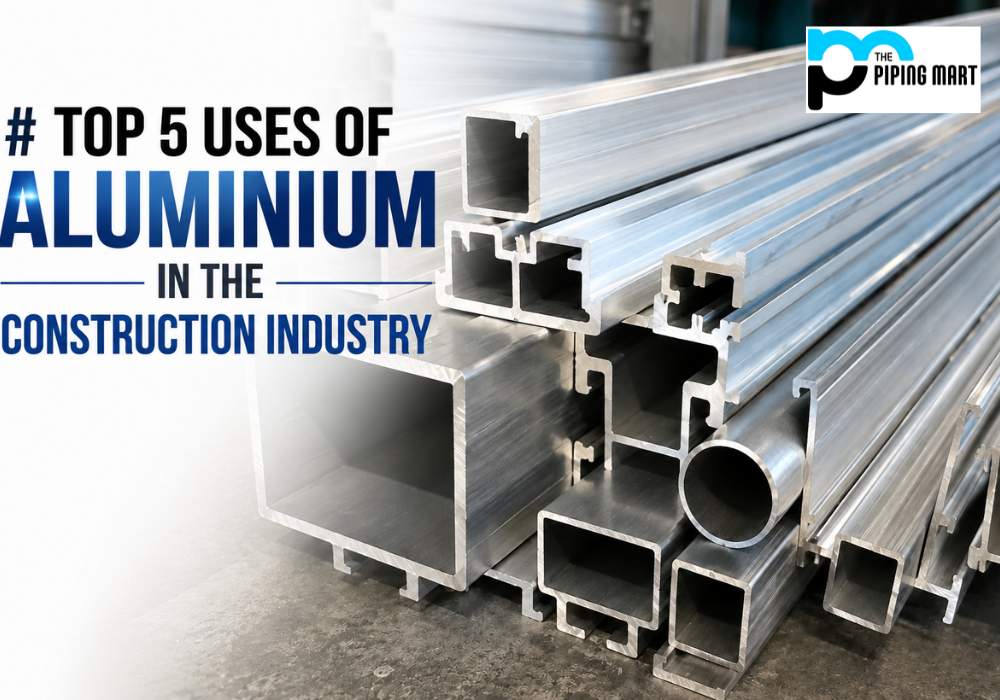
Modern construction is changing fast, and material choice plays a key role in performance and cost. Aluminium has become a preferred option in many projects because it offers a balance of strength, low weight, and resistance to corrosion. In specific cases, builders choose aluminium over steel or wood because it does not rust, does not warp, and needs far less maintenance over time. This makes it suitable for long-term use in demanding environments. At the same time, the growing demand for modern infrastructure, including high-rise buildings and smart commercial spaces, has increased the use of aluminium across structural and architectural applications. It fits well with current design needs, and it meets the exact demands.
Top 5 Uses of Aluminium in Building Construction
Aluminium in the construction industry appears at nearly every stage of a building construction, from the frame to the facade. Here are the five applications where it’s most widely specified.
1. Aluminium window and door frames
Window and door frames take a constant battering from weather, temperature changes, and daily mechanical use. Aluminium survives all of it with minimal maintenance. It’s lightweight, which makes it easier to handle on site, and it doesn’t rust or warp the way steel and timber do over time. These qualities make aluminium frames an attractive first choice for both residential and commercial buildings, where low long-term maintenance costs are as important as initial performance.
2. Aluminium cladding and facades
Cladding does two jobs at once: it protects the building envelope and defines how the building looks. Aluminium handles both well. It resists moisture, UV exposure, and temperature swings without degrading, making it reliable for exterior use across decades. It’s a material that works. For high-rise and commercial projects where aesthetics are just as important as performance, aluminium facades deliver a clean, modern finish that holds up in the field.
3. Roofing systems and structural sheets
Aluminium roofing sheets and panels are widely used where strong performance in harsh weather is required. Unlike traditional materials that can corrode, crack, or need frequent repairs, aluminium performs well in good condition for a longer time. It resists rain, humidity, and temperature changes without damage. This makes it a reliable long-term option, especially for industrial and agricultural buildings where roofs face tough conditions.
4. Structural components and frameworks
Aluminium sections, beams, and support profiles are widely used in lightweight structures and modular construction, where speed and weight reduction are priorities. The material’s strength-to-weight ratio means structural loads are managed effectively without the bulk of heavier alternatives. It also lends itself well to prefabrication; components can be manufactured off-site to precise tolerances and assembled quickly on location, reducing labour costs and programme time. Efficient by design.
5. HVAC systems and thermal applications
Ducting, heat exchangers, and ventilation systems rely on aluminium for good reason. Its high thermal conductivity means heat transfers efficiently through the material, making HVAC systems perform better without using larger equipment. Aluminium ducting is also lightweight and corrosion-resistant, which matters in plant rooms and technical spaces where conditions can be demanding. For building services engineers, it’s a practical material that reduces both system weight and ongoing maintenance requirements.
Aluminium Construction Materials: Common Forms Used
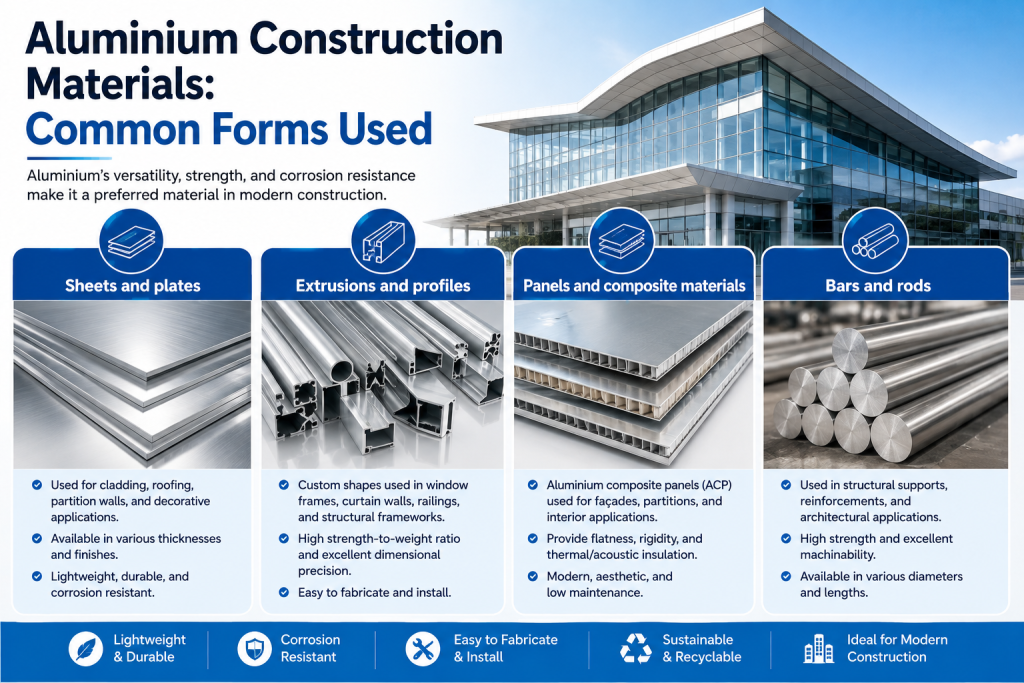
Aluminium construction materials are available in several standard forms; each grade is designed for different construction applications depending on structural requirements, fabrication method, and finish.
- Sheets and plates
Flat-rolled aluminium sheets and plates are used extensively for roofing, cladding, and internal linings. Aluminium sheets are typically thinner and used in lighter-duty applications, while plates carry more load and are suited to structural or heavy fabrication work. Both are readily cut, bent, and formed to project-specific dimensions.
- Extrusions and profiles
Extruded aluminium profiles are produced by pushing the material through a shaped die, which allows for highly consistent cross-sections, I-beams, channels, angles, and custom sections. They’re widely used in window frames, curtain walling, structural supports, and HVAC components. Dimensional consistency is a key advantage here.
- Panels and composite materials
Aluminium composite panels (ACPs) are made up of two aluminium skins bonded to a core material and are commonly used for facade cladding. They are used in commercial and high-rise construction due to their stiffness, low weight, and better surface quality.
- Bars and rods
Aluminium bars and rods are used in brackets, fixings, handrails, and support components where a compact, high-strength format is required. They are easily machined and welded, and they hold up well in exposed or semi-exposed applications without corrosion treatment.
Why Aluminium is Widely Used in the Construction Industry
Aluminium has become an essential material as it handles several real-world challenges in construction. It operates effectively in various conditions and applications.
- Lightweight reduces structural load
Aluminium is roughly one-third the weight of steel. For large structures, that reduction in dead load can directly affect foundation design, structural framing, and transport logistics. Less weight in the envelope means more flexibility in the overall structural system.
- Corrosion resistance increases lifespan
When exposed to air, aluminium forms a natural oxide layer that protects it from further degradation. It doesn’t require paint, galvanising, or regular treatment to maintain that protection. In coastal and industrial environments where salt and pollutants accelerate corrosion in other metals, aluminium simply lasts longer.
- Design flexibility for modern architecture
Aluminium can be extruded, rolled, welded, and finished in a wide range of ways. Architects and facade engineers use that flexibility to achieve complex geometries and surface treatments that other materials can’t match without high cost and fabrication complexity. It’s a material that keeps up with design ambition.
- Sustainability and recyclability
Aluminium is one of the most recyclable materials in construction. It can be recycled repeatedly without loss of properties, and recycled aluminium requires a fraction of the energy needed to produce primary metal. For projects targeting green building ratings or meeting sustainability commitments, aluminium is a material that supports those goals directly.
How to Choose the Right Aluminium Material for Construction?
Selecting the right aluminium product depends on the structural demands, environmental conditions, and fabrication requirements of your specific application. Consider the following points while choosing the right material:
Aluminium grades
Different aluminium grades offer different levels of strength, corrosion resistance, and workability. Choosing the correct grade ensures reliable performance in specific conditions.
- 6000 series (6061, 6063): The most widely used grades in construction. They offer a good balance of strength, corrosion resistance, and ease of extrusion, making them the default choice for structural profiles, window frames, and curtain walling.
- 3000 series (3003): A softer, highly formable grade with good corrosion resistance. Well-suited to roofing sheets, ducting, and cladding applications where forming and bending are required rather than high structural strength.
- 5000 series (5005, 5052): Strong resistance to marine and industrial environments makes this series the right choice for coastal projects or buildings with exposure to moisture and chemical agents. Commonly used in panelling and sheet applications.
- 7000 series (7075): The highest-strength aluminium alloys, used where mechanical performance is the primary requirement. It is less commonly specified in general construction but is appropriate for highly loaded structural components where weight saving is critical.
Corrosion resistance
Consider the environment the material will be exposed to throughout its service life. Coastal, humid, or chemically aggressive environments require alloy grades and surface treatments specifically rated for those conditions. Specifying the wrong grade can compromise longevity, regardless of other design decisions.
Finish and appearance
Aluminium accepts a wide range of surface finishes, including anodising, powder coating, and mill finish, all of which are standard options. The choice affects both appearance and long-term surface performance. For high-visibility facade applications, finish consistency across large panel areas is particularly important.
Ease of shaping and welding
If the component needs to be fabricated, bent, machined, or welded on site or in a workshop, the alloy’s workability matters. Grades in the 3000 and 6000 series are generally the most fabrication-friendly. Higher-strength 7000 series alloys require more controlled welding procedures and may not be suitable for all fabrication environments.
Conclusion
Aluminium has become one of the most dependable materials in the construction industry, not because it’s new, but because it consistently delivers where it matters. It reduces structural load, resists corrosion, suits a wide range of fabrication methods, and supports sustainability objectives without compromise. From window frames to facades, roofing to HVAC systems, it’s a material that works across the full scope of a construction project. We supply aluminium sheets, profiles, panels, and bar stock to meet the demands of contractors, architects, and procurement teams who need reliable material, correctly specified, and delivered on time.
FAQs
Why is aluminium widely used in the construction industry?
Aluminium is widely used because it is lightweight, corrosion-resistant, and easy to shape. It reduces structural load and requires less maintenance over time, making it practical for long-term use.
What are the most common aluminium construction materials?
Extruded profiles and sections, flat sheets and plates, aluminium composite panels, and bars and rods are some of the most commonly specified forms. Each form is suitable for various applications ranging from structural framing and facades to roofing systems and mechanical services.
Is aluminium strong enough for structural use?
Yes. Structural aluminium alloys, particularly the 6000 and 7000 series, provide adequate strength for beams, columns, supports, and prefabricated structural components. Steel can support higher absolute loads, and aluminium’s strength-to-weight ratio makes it an effective structural material, particularly in lightweight and modular construction.
Where is aluminium used in building construction?
Aluminium appears across the full construction scope: window and door frames, exterior cladding and facades, roofing sheets, structural sections and supports, and HVAC ducting and ventilation systems. It’s used in both residential and large-scale commercial and industrial buildings.
What are the advantages of aluminium over steel in construction?
Aluminium is significantly lighter than steel, which reduces structural load and simplifies transport and installation. It also resists corrosion naturally without surface treatment, whereas steel typically requires galvanising or paint to prevent rust. For applications where weight, aesthetics, and low maintenance are priorities, aluminium is the stronger choice.