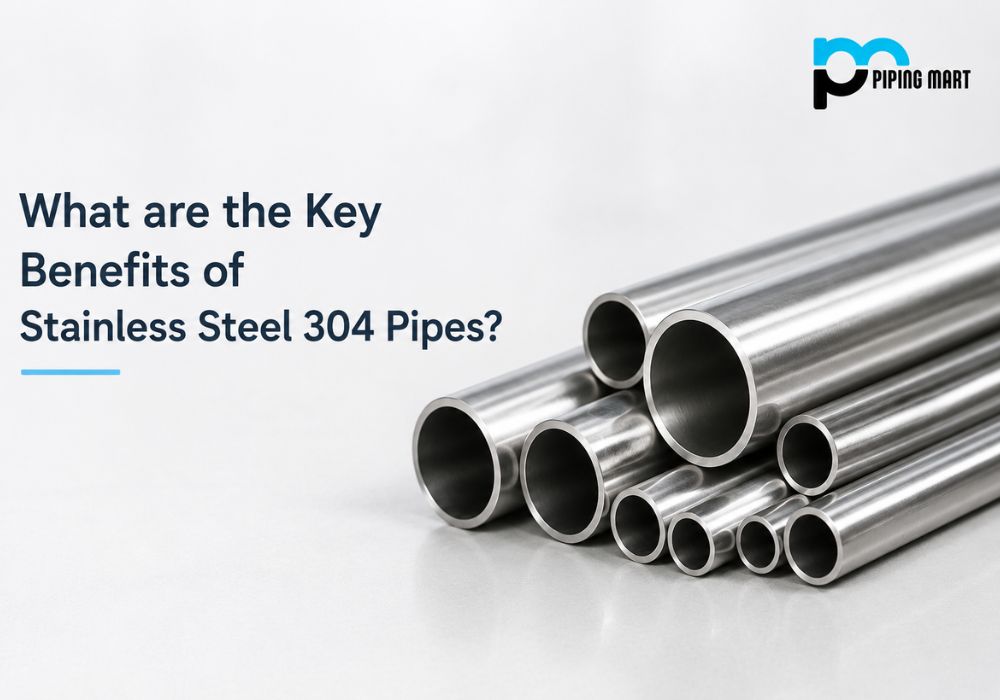
Stainless steel 304 pipes are commonly used in industrial and residential piping systems. In industries like chemical processing, construction, and food production, they provide a balanced combination of cost and performance. The material’s austenitic structure, which includes chromium and nickel, allows it to remain stable under different environmental conditions. Understanding these essential properties enables better purchasing decisions and reduces the risk of failure. This guide covers the main technical features and physical properties that make this grade a common choice across many industries.
What are Stainless Steel 304 Pipes?
Stainless Steel 304 pipes are made from AISI 304 grade stainless steel. This is an austenitic alloy that contains about 18% chromium and 8% nickel. These pipes follow international standards like ASTM A312, ASTM A213, and ASTM A269, based on their use. The grade is also called 18/8 stainless steel because of its chromium and nickel content. SS 304 pipes are available in both seamless and welded forms. They are available in various sizes and wall thicknesses to withstand pressure and flow requirements. These pipes are commonly used in food and dairy plants, chemical factories, construction, water supply systems, and building design. When softened by heat treatment (annealed), SS 304 is non-magnetic, but it can become slightly magnetic after it is cold-worked (bent or formed without heating).
Key Benefits of Stainless Steel 304 Pipes
SS 304 pipes offer several benefits that make them a preferred choice in many industries. Each benefit is directly related to the grade’s material qualities.
Excellent Corrosion Resistance
The high chromium content forms a passive layer of chromium oxide on the pipe’s surface. This layer is extremely thin, yet it works as a barrier, preventing oxygen and water from reaching the iron beneath. It prevents rust formation in most air conditions and when exposed to various organic substances.
High Strength and Durability
304 stainless steel pipes provide a high tensile strength, which means they can withstand significant internal and external pressure without deforming. They stay durable even when the installation environment is rough. This strength doesn’t come at the cost of being brittle, so the pipes can handle physical impacts well.
Superior Temperature Resistance
SS 304 pipes can be used continuously at temperatures up to 870°C and intermittently up to around 925°C. At cryogenic temperatures as well, the grade retains its toughness and does not become brittle, unlike some other materials. This makes it suitable for both heat exchangers handling hot fluids and cold storage or liquefied gas systems. It is worth noting that prolonged exposure to the 425–860°C range can cause sensitisation, so SS 316L or stabilised grades are preferred for those specific conditions.
Hygienic and Easy to Clean
The smooth, non-porous surface of SS 304 pipes does not harbour bacteria or allow contamination to settle in. This is a key reason the grade is standard in food processing, dairy, brewing, and pharmaceutical piping systems. The surface can be cleaned with standard industrial detergents and sanitising agents without degrading the material. Regular cleaning does not damage the finish or reduce the pipe’s life, which matters in applications with strict hygiene protocols.
Low Maintenance and Cost-Effective
As the material resists corrosion well, there is no need to paint or coat these pipes to prevent them from rusting. This saves a lot of money on long-term upkeep. While the initial cost is higher than that of carbon steel, the fact that they last for decades makes them cheaper over time.
Excellent Weldability and Fabrication
Fabricators like working with 304 because it can be welded using all standard commercial techniques. It is also quite ductile, which means it can be bent or shaped into precise shapes without breaking. This flexibility makes it easier to install pipes in compact areas.
Eco-Friendly and Recyclable Material
304 stainless steel pipes are highly sustainable and eco-friendly due to their 100% recyclability. It is easy to weld using most standard techniques, including TIG, MIG, and arc welding. No pre-heating is required, and post-weld heat treatment is generally not necessary for most applications. The grade also machines and bends reasonably well, which simplifies custom fabrication. These characteristics reduce labour time and costs during installation and when making modifications to existing piping systems.
Properties That Contribute to These Benefits
The performance of these pipes isn’t accidental; it comes down to the specific physical and chemical makeup of the alloy.
Chemical composition (Chromium, Nickel content)
SS 304 contains 18–20% chromium and 8–10.5% nickel. Chromium is responsible for forming the passive oxide layer that gives the grade its corrosion resistance. Nickel helps keep the austenitic structure stable and improves ductility and toughness. The carbon content is kept below 0.08%, which lowers the risk of carbide formation during welding and heating. Small amounts of manganese (up to 2%) and silicon (up to 0.75%) improve the steel’s workability.
Mechanical properties (strength, flexibility)
304 stainless steel has a yield strength of about 205 MPa and a high elongation percentage. This means the pipe can stretch or bend to a certain degree before it actually breaks. This mechanical balance is why the pipes are reliable under the vibration and pressure shifts found in industrial pumps.
Resistance factors
The alloy is specifically resistant to most oxidising acids and can handle moderate salt exposure, though it isn’t the best for heavy marine use. Its resistance to scaling at high temperatures is another factor. These resistance levels are documented in standard laboratory tests, ensuring predictable performance for the user.
Conclusion
Stainless steel 304 pipes are a reliable and effective option for most industrial applications. They are rust-resistant, easy to clean, and strong, which makes them ideal for various applications. While higher grades, such as 316, are preferable for marine conditions, 304 is often the most cost-effective option for construction, food processing, and chemical transport. It has a long lifespan and requires little maintenance, which helps to cut operating expenses. If you require a pipe that welds readily, can withstand high pressure, and remains clean, then 304 is one of the most preferred solutions.
FAQS
What makes SS 304 pipes corrosion-resistant?
The chromium in the steel reacts with oxygen in the air, forming a thin, invisible film of chrome oxide. This layer prevents moisture and chemicals from damaging the steel. If the surface gets scratched, the layer actually reforms itself quickly in the presence of oxygen.
Can SS 304 pipes handle high pressure?
Yes. SS 304 pipes can withstand high pressure, depending on the pipe’s wall thickness (schedule). Its high strength and solid welds help it handle fluid pressure. Just pick a pipe thickness (schedule) that matches the pressure you need.
What makes 304 stainless steel pipes different from other grades?
The main difference is the specific ratio of chromium and nickel and the absence of molybdenum. Grade 316 has molybdenum for better salt resistance, while 304 is the general-purpose version. It is more affordable than 316 but offers much better protection than the 200-series steels.
Are SS 304 pipes easy to weld and fabricate?
The SS 304 pipes are easy to weld with standard procedures such as TIG or MIG. As the metal is flexible, it can be bent or shaped without requiring special heat treatments. This makes it easy for the installation team to make changes on-site.
Do SS 304 pipes rust or corrode over time?
In most normal conditions, SS 304 pipes do not rust or corrode for many years. They can develop stains or small pits if they are always exposed to salty environments or strong industrial chemicals. For regular indoor use or mild outdoor conditions, they usually stay clean and rust-free.