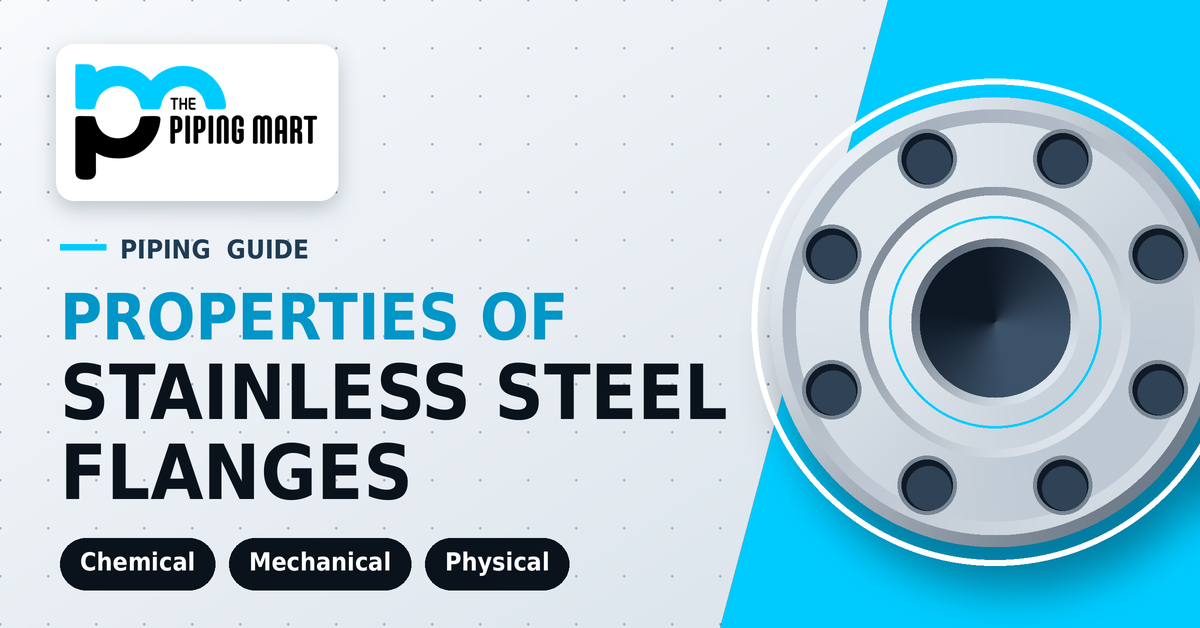
Stainless steel flanges deliver reliable industrial performance based entirely on their specific chemical, mechanical, and physical properties. Chemical, mechanical, and physical properties affect corrosion resistance, load capacity, temperature performance, durability, and ease of fabrication. They also test flanges for certain service uses. Flanges are properly alloyed with chromium, nickel, molybdenum, and carbon to prevent pitting, crevice corrosion, and oxidation in hostile process streams. The ability to retain pressure during extreme temperature cycling and mechanical stress is defined by yield, tensile, and impact toughness.
Introduction to Stainless Steel Flanges
Stainless steel flange properties include chemical composition, corrosion resistance, tensile and yield strength, hardness, ductility, toughness, density, thermal conductivity, thermal expansion, oxidation resistance, and weldability. Together, they decide whether a flange survives a given pressure, temperature, and process medium.
Exact values depend on the grade, the manufacturing condition, and the applicable material specification. Always check the standard, never a general figure. For types and grades, read our stainless steel flanges guide.
Chemical Properties of Stainless Steel Flanges
Chemistry drives how a flange resists its environment. Each alloying element does a specific job.
Chromium Content
Chromium builds the protective layer. Stainless steel needs at least 10.5% chromium to form a thin passive oxide film that repairs itself when scratched in oxygen-bearing conditions.
Nickel Content
Nickel stabilizes the austenitic structure. Austenitic flanges gain toughness, ductility, and broader corrosion resistance from it.
Molybdenum Content
Molybdenum fights pitting and crevice corrosion, especially where chlorides are present. Grade 316 carries roughly 2–3% of it, which is why it outperforms 304 in saltwater service.
Carbon Content
Carbon raises hardness but invites trouble. During welding, high carbon lets chromium carbides form at grain boundaries, a defect called sensitization that weakens corrosion resistance. Low-carbon grades such as 304L and 316L cap carbon at 0.03%.
Nitrogen and Other Alloying Elements
Nitrogen adds strength and helps pitting resistance. Titanium and niobium stabilize selected grades against carbide precipitation. Manganese, silicon, and copper adjust processing behavior and specific properties.
Chemical Property Summary Table
| Chemical Property | What It Means | Effect on Flange Performance |
| Chromium | Forms a passive oxide layer | Improves corrosion resistance |
| Nickel | Stabilizes austenitic structure | Supports toughness and corrosion resistance |
| Molybdenum | Improves localized corrosion resistance | Helps resist pitting and crevice corrosion |
| Carbon | Influences hardness and carbide formation | Important for welding and corrosion behavior |
| Nitrogen | Strengthens certain stainless steels | Can improve strength and corrosion resistance |
| Titanium/Niobium | Stabilizing elements in selected grades | Helps control carbide precipitation |
| Silicon/Manganese | Alloying elements used in stainless steel production | Influence processing and material properties |
Mechanical Properties of Stainless Steel Flanges
Mechanical properties decide whether a flange withstands pressure, bolt loads, mechanical forces, temperature-related stresses, and deformation. Tensile and yield strength set load capacity. Hardness, ductility, and elongation describe how the metal deforms. Toughness, fatigue resistance, and creep resistance cover impact, cyclic loading, and long-term heat under load.
Mechanical Property Table
| Mechanical Property | Definition | Importance for Stainless Steel Flanges |
| Tensile Strength | Maximum stress a material can withstand before failure | Indicates resistance to tensile loading |
| Yield Strength | Stress at which permanent deformation begins | Important for pressure and bolt loading |
| Hardness | Resistance to indentation or localized deformation | Supports durability and wear resistance |
| Ductility | Ability to deform plastically without fracture | Important during forming and service |
| Elongation | Amount of deformation before fracture | Indicates ductility |
| Toughness | Ability to absorb energy before fracture | Helps resist cracking and impact |
| Fatigue Resistance | Ability to withstand repeated or cyclic loading | Important in pressure and vibration conditions |
| Creep Resistance | Resistance to gradual deformation under sustained load and temperature | Important for elevated-temperature service |
Physical Properties of Stainless Steel Flanges
Physical properties shape weight, thermal behavior, and dimensional stability. Austenitic stainless steel has a density near 8.0 g/cm³, so flange weight matters in large-bore or high-pressure sizes. Thermal conductivity runs well below carbon steel, while thermal expansion runs higher. Melting range, electrical resistivity, and magnetic behavior vary by grade, and austenitic types are generally non-magnetic when annealed. Surface condition influences cleanliness and corrosion behavior.
Physical Property Table
| Physical Property | What It Indicates | Relevance to Flanges |
| Density | Mass per unit volume | Influences component weight |
| Thermal Conductivity | Ability to transfer heat | Relevant to heat-transfer conditions |
| Thermal Expansion | Dimensional change with temperature | Important for thermal cycling and alignment |
| Melting Range | Temperature range where material changes from solid to liquid | Relevant to fabrication and extreme-temperature conditions |
| Electrical Resistivity | Resistance to electrical current | Relevant in selected industrial environments |
| Magnetic Properties | Response to magnetic fields | Varies according to stainless steel structure and grade |
| Surface Condition | Characteristics of the flange surface | Influences cleanliness, corrosion behavior, and service suitability |
Temperature and Thermal Properties
Heat changes everything. Thermal expansion moves bolt circles and mating faces, so it matters wherever temperatures swing. Thermal conductivity affects heat transfer through the joint. Oxidation resistance protects the surface at high temperature, while high-temperature strength and creep resistance keep the flange from slowly deforming under load. Where service runs cold, low-temperature toughness decides whether the material resists brittle fracture. Grade and actual service conditions set the limits.
How to Select Stainless Steel Flanges Based on Properties
Work through these steps in order:
- Identify the operating temperature.
- Determine pressure and mechanical loads.
- Evaluate corrosion and chemical exposure.
- Consider chloride or moisture exposure.
- Review thermal expansion requirements.
- Select a suitable stainless steel grade.
- Verify required mechanical and chemical properties.
- Check applicable standards and material documentation.
Skipping step 8 causes the most expensive mistakes, because certificates prove what the flange actually contains.
Conclusion
Understanding flange properties is essential for ensuring a material can handle the specific pressure, temperature, corrosion, and mechanical demands of any application. Material chemistry provides critical corrosion defense, mechanical traits carry heavy structural loads, and physical attributes govern thermal expansion within the joint. Selecting the right grade prevents premature system failure, reduces maintenance downtime, and guarantees long-term operational safety. As a reliable B2B procurement portal, we at ThePipingMart connect buyers directly with certified suppliers offering fully compliant stainless steel flanges with verified material test reports. Submit your project’s service conditions, pressure ratings, and dimensional specifications today to receive accurate, competitive vendor quotes.
FAQs
What are the main properties of stainless steel flanges?
Chemical composition, corrosion resistance, tensile and yield strength, hardness, ductility, toughness, density, thermal conductivity, thermal expansion, and weldability form the core set.
What chemical properties make stainless steel flanges corrosion resistant?
Chromium, at 10.5% minimum, forms the passive oxide layer. Molybdenum and nitrogen add pitting resistance, and nickel supports overall corrosion behavior in austenitic grades.
What are the important mechanical properties of stainless steel flanges?
Tensile strength, yield strength, hardness, ductility, elongation, toughness, fatigue resistance, and creep resistance determine how a flange handles pressure, bolt loads and cyclic stress.
What are the physical properties of stainless steel flanges?
Density, thermal conductivity, thermal expansion, melting range, electrical resistivity, magnetic behavior, and surface condition describe weight, heat response, and dimensional stability.
How does temperature affect stainless steel flange properties?
Heat expands the metal, lowers strength, and speeds oxidation and creep. Cold reduces toughness in some grades. Grade selection must match the service temperature range.
Do stainless steel flange properties vary by grade?
Yes. Austenitic, ferritic, martensitic, and duplex grades differ in chemistry, strength, corrosion resistance, and magnetic behavior, so verify values against the material standard.