Stainless steel bars fall into two broad groupings: shape-based types such as round, square, hex, flat, bright, and hollow bars, and grade-based types such as 304, 316, 321, 410, 430, and duplex. Construction, engineering, manufacturing, fabrication, and general industrial work all utilize SS bars for reliable performance. Each shape carries a different production route and tolerance class. Selection depends on the application, corrosion resistance, strength, machinability, and operating conditions.
What Are Stainless Steel Bars?
Stainless steel bars are solid or hollow long products rolled, forged, or drawn from stainless steel billets and supplied in fixed cross sections. Iron forms the base, with chromium content of at least 10.5% defining the material, and most bar grades carry 16 to 26% chromium along with nickel, molybdenum, manganese, silicon, and carbon in controlled amounts. Chromium matters because it reacts with oxygen to form a thin passive oxide film across the bar surface. That film reforms after machining or mechanical damage. This prevents SS bars from rusting without coating or plating.
Different Types of Stainless Steel Bars
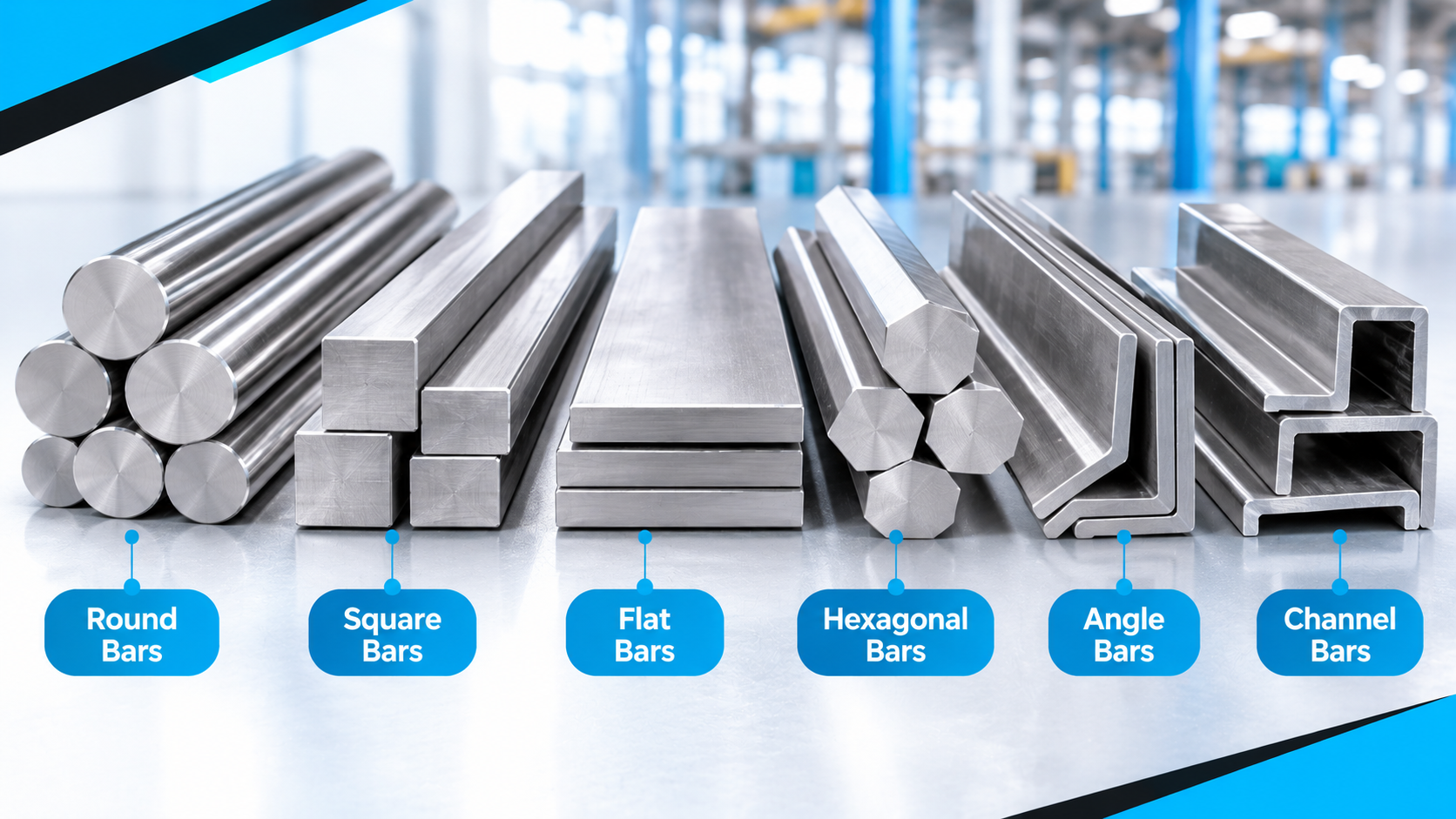
Stainless steel bars come in a range of profiles, each designed to meet specific requirements for strength, precision, and ease of fabrication.
Stainless Steel Round Bars
Stainless steel round bars carry a circular cross section and turn easily on lathes. Shafts, pins, fasteners, valve stems, and pump components all start as round bar stock.
Stainless Steel Square Bars
Square bars give four flat faces that clamp securely in jigs and weld without edge preparation. Frames, base plates, grilles, machine guards and structural brackets use stainless steel square bars.
Stainless Steel Hex Bars
Hex bars present six flat sides, which let a spanner or collet grip the stock without slipping. Nuts, bolts, couplings and threaded inserts come from stainless steel hex bars.
Stainless Steel Flat Bars
Flat bars are rectangular in section, with width always exceeding thickness. Base frames, lintels, support plates, ladder rungs and architectural trims rely on stainless steel flat bars in rolled condition.
Stainless Steel Bright Bars
Bright bars leave the mill after cold drawing, peeling, or grinding, so they hold tighter tolerances and a reflective surface. Precision shafts and dairy equipment use stainless steel bright bars.
Stainless Steel Hollow Bars
Hollow bars arrive with a centre bore already formed, which removes most of the drilling work. Bushings, sleeves, cylinders and flange rings are machined faster from stainless steel hollow bars.
Types of Stainless Steel Bars by Grade
Grade selection decides corrosion behaviour and strength, and six grades account for most stainless steel bar usage worldwide.
SS 304 Bars
SS 304 bars contain 18% chromium and 8% nickel, which suits general-purpose fabrication, food equipment, and architectural work.
SS 316 Bars
Molybdenum of 2 to 3% gives SS 316 bars pitting resistance in seawater, chemical plants, and chloride-bearing service.
SS 321 Bars
SS 321 bars carry a titanium addition that blocks chromium carbide formation, so they serve elevated temperature conditions up to 870°C.
SS 410 Bars
This martensitic grade hardens through heat treatment, which makes SS 410 bars suitable for valve trim, shafts, and wear parts.
SS 430 Bars
SS 430 bars use a ferritic chromium structure without nickel, keeping costs down for architectural trim and general industrial fittings.
Duplex Stainless Steel Bars
Duplex stainless steel bars combine austenitic and ferritic phases, roughly doubling yield strength while resisting chloride stress corrosion cracking offshore.
Stainless Steel Bars for Different Industries
These sectors account for most stainless steel bar demand, each one driven by a different combination of corrosion and load conditions.
- Construction contractors use flat and round bars for balustrades, cladding supports, anchor bolts and reinforcement in coastal structures.
- Oil and gas operators specify duplex and 316 bars for valve stems, pump shafts and downhole components exposed to sour service.
- Chemical processing plants machine agitator shafts, pump parts and fasteners from 316 and duplex stock, since acids attack carbon steel fast.
- Food processing lines depend on 304 bright bars for conveyor shafts, mixer blades, and frames that face daily washdown.
- Pharmaceutical manufacturers need polished 316L bars for reactor internals and cleanroom fittings, since surface finish controls contamination risk.
- Automotive suppliers machine exhaust fittings, fasteners and suspension components from 304, 430 and 410 bars.
- Marine builders rely on 316 and duplex round bars for propeller shafts, deck hardware and fasteners that withstand salt spray.
- Power plants use 321 and 410 bars in turbine fasteners, boiler supports and steam valve components that run hot continuously.
- General engineering workshops keep round, square and hex bars for jigs, tooling and repair parts.
How to Choose the Right Stainless Steel Bar
Bar selection follows the service environment rather than the price list. Corrosion exposure, load, temperature, and machining method each narrow the field. Dimensional tolerance and surface finish then decide whether the stock arrives ready to machine or needs further processing.
- Required grade: 304 general, 316 chlorides, 321 heat, 410 wear, 430 cost, duplex strength.
- Bar shape: Round for turning, flat for frames, hex for fasteners, hollow for bored parts.
- Diameter or dimensions: Confirm finished size plus machining allowance.
- Corrosion resistance: Match grade to chloride, acid or humidity exposure.
- Mechanical strength: Check tensile and yield against the design load.
- Temperature conditions: Verify scaling and creep limits in hot service.
- Machinability: Free-machining grades cut faster; duplex needs rigid setups.
- Surface finish: Bright, polished, peeled, or hot-rolled.
- Applicable standards: ASTM A276, A479 and A484 with mill test certificate.
The Piping Mart lists verified stainless steel bar suppliers, stockists and manufacturers by grade, shape and size.
Conclusion
Shape and grade together define what a stainless steel bar can do in service. Round, square, hex, flat, bright and hollow sections answer different machining needs, while 304, 316, 321, 410, 430 and duplex grades answer different corrosion and strength demands. Matching shape, grade, size, finish and specification to the operating condition keeps performance predictable.
FAQs
What are the different types of stainless steel bars?
Stainless steel bars are divided by shape into round, square, hex, flat, bright, and hollow sections. By grade, they are divided into 304, 316, 321, 410, 430, and duplex.
What are stainless steel bars commonly used for?
Shafts, fasteners, valve stems, pump parts, frames, railings, and machined components use stainless steel bars across construction, oil and gas, food processing, marine, and power generation work.
What are the most commonly used stainless steel bar grades?
SS 304 and SS 316 dominate stock lists, followed by 321, 410, 430 and duplex. The Piping Mart lists suppliers holding all six grades in bar form.
How do I choose the right stainless steel bar for an application?
Match the grade to corrosion exposure, the shape to the machining route, and the size to the finished part. A mill test certificate against ASTM A276 or A479 confirms compliance.