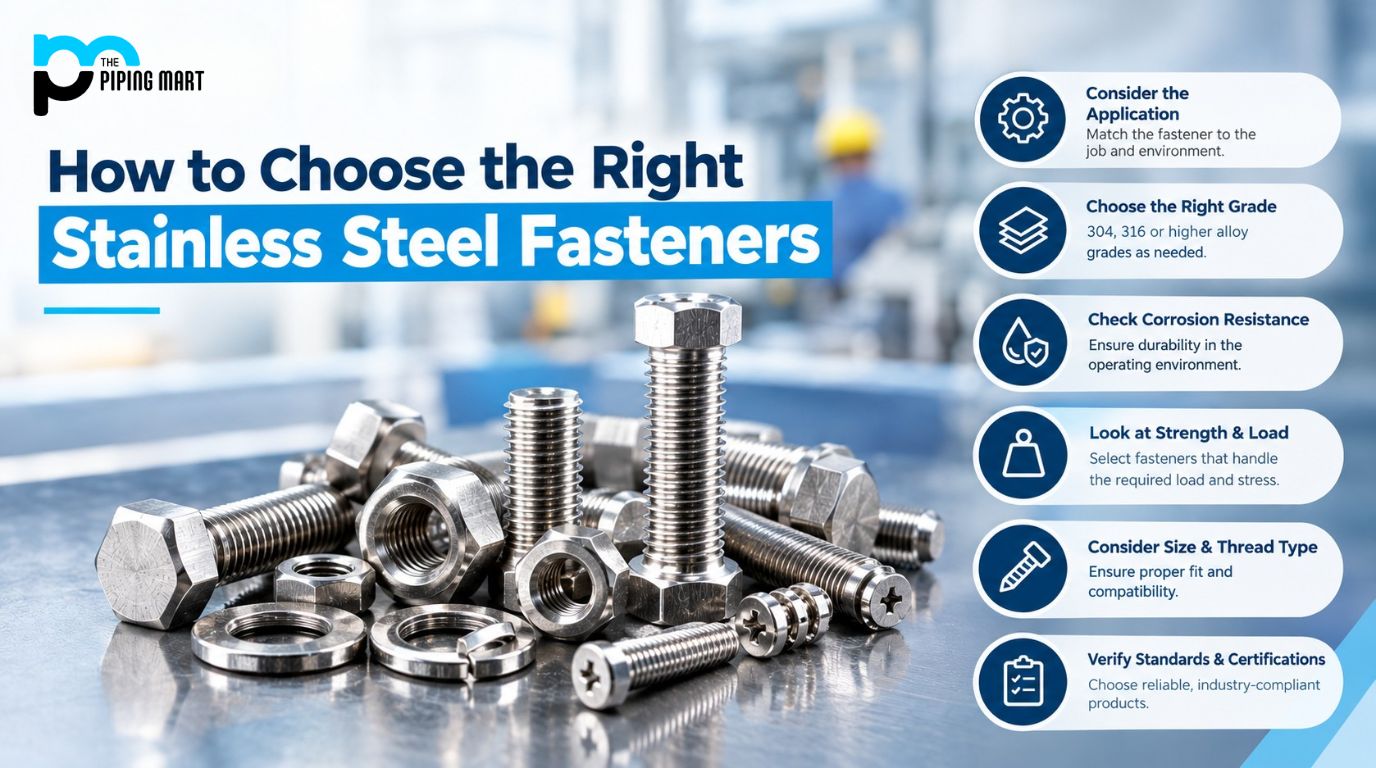
Stainless Steel Fasteners are used in construction, machinery, piping, and industrial assemblies to join parts together. A poor selection reduces grip, shortens service life, and can fail under rain, moisture, chemicals, or heat.
Industrial fasteners require a systematic selection process. Consider material grade, dimensions, loading, environment, and standards before ordering.
Understand the Different Stainless Steel Fastener Grades
SS Fasteners Products perform different roles. Hex bolts and nuts are used for structure, socket head screws for tight-fitting areas, and machine screws for light assemblies. Grade 304 contains about 18 percent chromium and 8 percent nickel and is suitable for general indoor use. Grade 316 adds 2 to 3 percent molybdenum, which improves pitting resistance where chlorides are present.
Consider 316 for coastal or road salt exposure. Even so, actual service conditions decide the grade, and no single grade fits every application.
Consider the Application and Environment
Start with the installation location. Industrial stainless steel fasteners in a dry indoor frame face far milder conditions than those outdoors, where rain, humidity, and temperature swings act on every thread.
Exposure alone can change the required grade. Marine and chloride-containing areas demand resistance to pitting and crevice corrosion. Fasteners are subjected to acids, alkalis, or solvents during chemical processing, so select the appropriate grade for the specific medium. Food and general industrial applications require a cleanable surface, and high-temperature service requires a confirmed operating range.
Select the Right Fastener Type and Size
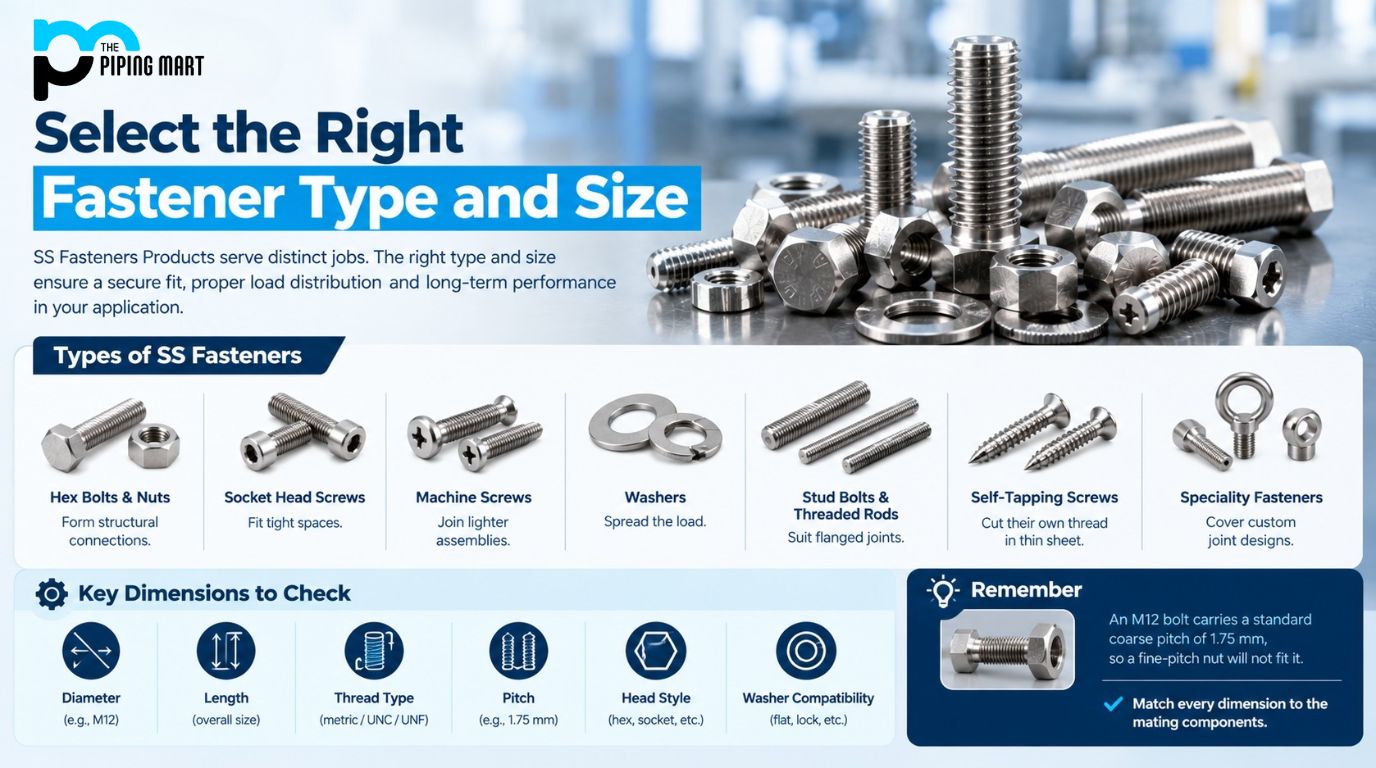
SS Fasteners Products serve distinct jobs. Hex bolts and nuts form structural connections, socket head screws fit tight spaces, and machine screws join lighter assemblies. Washers spread the load. Stud bolts and threaded rods suit flanged joints, self-tapping screws cut their own thread in thin sheet, and speciality fasteners cover custom joint designs.
Dimensions matter as much as type. Check diameter, length, thread type and pitch, head style, and washer compatibility against the connection design. An M12 bolt carries a standard coarse pitch of 1.75 mm, so a fine-pitch nut will not fit it. Match every dimension to the mating components.
Check Strength and Load Requirements
Fasteners must carry the loads the assembly specifies. Define whether the joint sees tension, shear, vibration, or a combination and confirm the tightening requirement.
Match fastener properties to the connected materials. Higher strength does not suit every environment, since stronger materials can have lower corrosion resistance. SS fasteners also gall during tightening, so apply anti-seize compound and follow the specified torque. Take load figures from the standard and project calculations, never assumptions.
Consider Compatibility and Corrosion Risks
Galvanic corrosion occurs when stainless steel fasteners come in contact with other conductive or wet metals like carbon steel or aluminium; the lower-grade metal is attacked. This is seen outdoors where moisture bridges the two metals on an aluminium plate clamped by stainless bolts. Isolation washers and sleeves, coatings, sealants, and compatible material choices lower the risk. Industrial Stainless Steel Fasteners must then be selected against the complete system, not the fastener alone.
Verify Standards, Quality, and Certification
When purchasing industrial fasteners, make sure to check the applicable standard. ASTM F593 and F594 cover stainless bolts, screws, and nuts; bolt dimensions are specified by ASME B18.2.1 and mechanical properties are covered by ISO 3506.
Verify the material grade and condition, tolerances, mechanical testing, and surface finish. Ask for Material Test Certificates and heat and lot traceability so each batch links to its source melt.
Supplier documentation is most important for critical applications. SS Fasteners Products delivered with full certificates and inspection reports allow engineers to verify compliance prior to installation.
Conclusion
Selecting Stainless Steel Fasteners is determined by seven checks: grade, environment, dimensions, strength, compatibility, standards, and supplier documentation. Base the final choice on actual operating conditions and engineering requirements.
FAQs
How do I choose the right type of stainless steel fasteners?
Match the type to the joint. Hex bolts suit structural connections, socket head screws suit compact spaces, and stud bolts suit flanged joints. Confirm the choice against the load and environment.
Which stainless steel grade is best for fasteners?
No grade is suitable for every service condition. Grade 304 is for general indoor use, while grade 316 is for chloride exposure, such as coastal sites.
What factors should be considered when selecting SS fasteners?
Seven factors apply: grade, environment, dimensions, load, compatibility, standards, and supplier certification. Corrosion exposure and load narrow the options first.
How do I determine the right size of stainless steel fasteners?
Measure the mating hole or thread, then match the diameter, length, pitch, and head style. A metric M16 bolt uses a standard coarse pitch of 2 mm. Check grip length against joined thickness.
What standards should I check when buying Industrial Fasteners?
Check the dimensional standard, like ASME B18.2.1 or ISO 4014, the mechanical standard, such as ISO 3506, and any project specification. Add Material Test Certificates to the order.