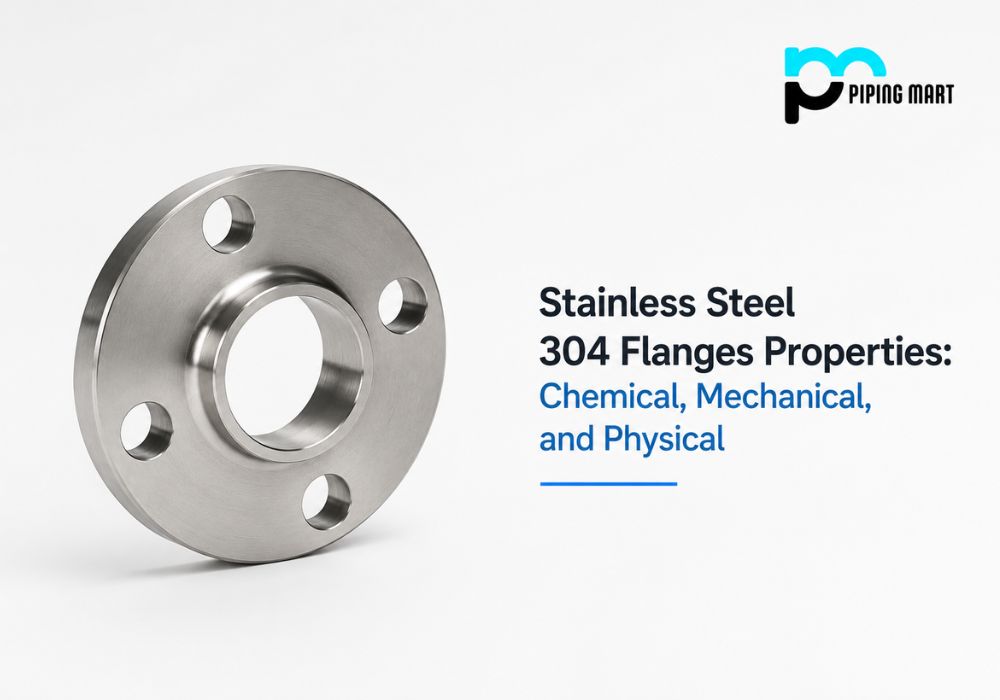
Stainless steel 304 flanges are used across a broad number of industries, and selecting the right material starts with understanding what the material actually does. The stainless steel 304 flange properties, including chemical composition, mechanical strength, and physical behaviour, determine whether a flange will hold up in a given environment. Grade 304 is one of the most frequently specified austenitic grades, mainly because of its chromium-nickel content, which gives it solid corrosion resistance in most standard conditions. Before procurement or installation, engineers and buyers need to check the actual values, not just rely on general grades. This post covers the core data sets: the SS 304 flange chemical composition, mechanical limits, physical constants, and SS 304 flange dimensions across common standards.
Understanding Stainless Steel 304 Flanges
Stainless steel 304 flanges are pipe fittings fabricated from grade 304 stainless steel, which is generally used to join pipes, valves, and equipment in process systems. A grade 304 stainless steel designation is used because of the particular alloy composition; this type of stainless steel is classified as austenitic. They are available in several configurations, such as weld neck, slip-on, blind, socket weld, threaded, and lap joint flanges. They are produced according to different standards, including ASME B16.5, ASME B16.47, ISO 7005, and national equivalents. The material has a moderate-to-high temperature resistance property and is fairly resistant to corrosion in atmospheric, water service, and most chemical conditions. This pressure class flange is offered in various pressure classes and sizes to meet system needs.
Stainless Steel 304 Flange Properties
The properties of SS 304 flanges fall into three categories: chemical composition, mechanical performance, and physical constants. Each category tells you something different about how the material behaves in service.
Chemical Composition of SS 304 Flanges
The SS 304 flange chemical composition defines the alloy limits set by ASTM A182 and related specifications. The chromium and nickel content is what makes this grade corrosion-resistant. Below are the elemental limits for grade 304.
| Element | Minimum (%) | Maximum (%) |
| Carbon (C) | – | 0.08 |
| Manganese (Mn) | – | 2.0 |
| Silicon (Si) | – | 0.75 |
| Phosphorus (P) | – | 0.045 |
| Sulfur (S) | – | 0.030 |
| Chromium (Cr) | 18.0 | 20.0 |
| Nickel (Ni) | 8.0 | 10.5 |
| Molybdenum (Mo) | – | – |
| Nitrogen (N) | – | 0.10 |
Note: Values are per ASTM A182 / ASME SA182 F304 specification. Mo is not a specified element in 304; if molybdenum content matters for your application, consider grade 316.
Mechanical Properties of Stainless Steel 304 Flanges
The mechanical properties of stainless steel 304 flanges determine load capacity, resistance to deformation, and suitability for pressure service. These values are the minimum or maximum requirements under ASTM A182 F304 at room temperature.
| Property | Value | Units |
| Tensile Strength (min) | 515 | MPa |
| Yield Strength 0.2% Proof (min) | 205 | MPa |
| Elongation (min, in 50 mm) | 40 | % |
| Hardness (max, Rockwell B) | 92 | HRB |
| Hardness (max, Vickers) | 223 | HV |
| Hardness (max, Brinell) | 217 | HB |
| Density | 8.0 | g/cm³ |
| Elastic Modulus | 193 | GPa |
| Melting Point | 1400 | °C |
| Thermal Conductivity (@100°C) | 16.2 | W/m·K |
| Thermal Conductivity (@500°C) | 21.5 | W/m·K |
| Specific Heat (@0–100°C) | 500 | J/kg·K |
| Coefficient of Thermal Expansion (@0–100°C) | 17.2 | µm/m·°C |
| Electrical Resistivity | 720 | n·m |
Note: Mechanical values are at room temperature (approximately 20°C). Tensile and yield strength decrease at elevated temperatures. For high-temperature service, always refer to ASME Section II Part D allowable stress tables.
Physical Properties of Stainless Steel 304 Flanges
The physical properties of 304 stainless steel flanges are relevant to thermal calculations, stress analysis, and system design. These values are standard reference data for grade 304 austenitic stainless steel.
| Property | Value | Units |
| Density | 8000 | kg/m³ (8.0 g/cm³) |
| Elastic Modulus | 193 | GPa (29 × 10⁶ psi) |
| Mean Coeff. Thermal Expansion (0–100°C) | 17.2 | µm/m·°C |
| Mean Coeff. Thermal Expansion (0–315°C) | 17.8 | µm/m·°C |
| Mean Coeff. Thermal Expansion (0–538°C) | 18.4 | µm/m·°C |
| Thermal Conductivity (at 100°C) | 16.2 | W/m·K |
| Thermal Conductivity (at 500°C) | 21.5 | W/m·K |
| Specific Heat (0–100°C) | 500 | J/kg·K |
| Electrical Resistivity | 720 | n·m (0.73 µΩ·m) |
| Melting Point | 1400 | °C (2550 °F) |
Note: Thermal expansion coefficients increase slightly with temperature. Use the appropriate range value for your service temperature when calculating pipe expansion or flange movement.
SS 304 Flange Dimensions and Standards
SS 304 flange dimensions vary depending on the standard, pressure class, and nominal pipe size. The table below covers dimensions for common standards, including ASME B16.5, ISO 7005 (DIN), AS 2129, and AS 4087. These are reference values; always confirm against the current revision of the applicable standard.
| Standard | Class/Rating | NPS | OD | Bolt Circle Dia. | No. of Bolts | Bolt Size | Bolt Hole Dia. | Flange Thickness (T) | Hub Dia. | Hub Height |
| ASME B16.5 | 150 | 1/2″ | 89 mm | 60 mm | 4 | 13 mm | 16 mm | 15.7 mm | 44.5 mm | 12.7 mm |
| ASME B16.5 | 150 | 3/4″ | 99 mm | 70 mm | 4 | 13 mm | 16 mm | 16.5 mm | 54.0 mm | 12.7 mm |
| ASME B16.5 | 150 | 1″ | 108 mm | 79 mm | 4 | 13 mm | 16 mm | 17.5 mm | 63.5 mm | 12.7 mm |
| ASME B16.5 | 150 | 1½” | 135 mm | 106 mm | 4 | 13 mm | 16 mm | 19.0 mm | 88.9 mm | 12.7 mm |
| ASME B16.5 | 150 | 2″ | 152 mm | 121 mm | 4 | 13 mm | 16 mm | 21.0 mm | 101.6 mm | 12.7 mm |
| ASME B16.5 | 300 | 1/2″ | 95 mm | 67 mm | 4 | 13 mm | 16 mm | 18.3 mm | 44.5 mm | 15.9 mm |
| ASME B16.5 | 300 | 3/4″ | 105 mm | 77 mm | 4 | 13 mm | 16 mm | 19.0 mm | 54.0 mm | 15.9 mm |
| ASME B16.5 | 300 | 1″ | 117 mm | 89 mm | 4 | 13 mm | 16 mm | 21.0 mm | 63.5 mm | 15.9 mm |
| ASME B16.5 | 300 | 2″ | 168 mm | 149 mm | 8 | 13 mm | 16 mm | 25.0 mm | 101.6 mm | 19.0 mm |
| ASME B16.5 | 600 | 2″ | 191 mm | 168 mm | 8 | 19 mm | 22 mm | 31.0 mm | 101.6 mm | 25.4 mm |
| ISO 7005 (DIN) | PN10 | 1/2″–2″ | 95 mm | 65 mm | 4 | M12 | 14 mm | 14 mm | 55 mm | 10 mm |
| ISO 7005 (DIN) | PN16 | 1/2″–2″ | 95 mm | 65 mm | 4 | M12 | 14 mm | 16 mm | 55 mm | 12 mm |
| AS 2129 | Table C | 1/2″ | 95 mm | 67 mm | 4 | 13 mm | 14 mm | 16 mm | 55 mm | 12 mm |
| AS 4087 | PN14 | 1/2″ | 95 mm | 67 mm | 4 | M12 | 14 mm | 16 mm | 55 mm | 12 mm |
Industrial Applications Based on Properties
The combination of corrosion resistance, moderate strength, and reasonable thermal stability makes grade 304 suitable for several industrial sectors. Chemical processing plants use these flanges in pipelines handling dilute acids, alkalis, and process water. Food and beverage facilities prefer 304 because it meets hygiene standards and handles cleaning agents. In pharmaceutical manufacturing, the material is acceptable for many utility lines and some process lines. Oil and gas facilities use it in low-pressure, non-chloride service. Architectural and structural pipework also uses grade 304 in outdoor environments where aesthetic finish and basic corrosion resistance are the main requirements. The grade is not suited for seawater or high-chloride environments; in those cases, grade 316 or duplex grades are a better fit.
Conclusion
Grade 304 remains one of the most common choices for stainless steel flanges, and for straightforward reasons. The SS 304 flange chemical composition gives it adequate corrosion protection in most standard environments. The mechanical properties of stainless steel 304 flanges are sufficient for moderate pressure and temperature service. The physical properties stay predictable across a wide temperature range, which helps in system design. For procurement, always cross-reference stainless steel 304 flange properties against your service conditions, pressure class, and applicable standard. The data in this article covers the main reference values, but project-specific requirements should always be confirmed against the relevant ASTM, ASME, or ISO documents.
FAQs
How Do SS 304 Flange Properties Affect Performance?
The corrosion resistance of the SS 304 flange chemical composition in service is directly determined by the chromium and nickel content. The yield and tensile strength determine the amount of force that the flange is able to withstand before it starts to deform or fails. If the mechanical properties of stainless steel 304 flanges are not up to the minimum standards for a specific pressure class, the flange will not satisfy the design pressure and should not be used for that application.
What Factors Affect SS 304 Flange Performance?
The primary factors are service temperature, fluid chemistry, and pressure class. The tensile and yield strength decrease with increasing temperature, thus limiting the amount of stress and pressure that the material can withstand. Stress corrosion cracking is a potential problem in 304, even if the 304 grade complies with its standard chemical limits, when subject to chloride-containing fluids. However, improper torqueing also impacts performance; if the material properties are within specification, but the bolts are not properly torqued, then a leak will occur at the flange.
How Durable Are SS 304 Flanges?
SS 304 flanges are highly durable in clean water, atmospheric, and mild chemical services. They will not rust in normal outdoor or indoor environments. Under some more aggressive conditions, e.g., solutions with high chloride concentration or solutions with pH > 5, degradation may take place over time. Hardness limits of up to 92 HRB (217 HB) suggest that the material has a high level of toughness but is not as hard as the Ferritic or Martensitic grades.
What Is the Service Life of SS 304 Flanges?
Service life depends heavily on the environment rather than the material alone. In neutral or mildly corrosive conditions, properly installed 304 flanges can last several decades. In harsher conditions, the material may show surface pitting or crevice corrosion within a few years. Regular inspection intervals and fluid monitoring help in estimating remaining service life accurately.
Are SS 304 Flanges Easy to Fabricate?
Yes, grade 304 is generally straightforward to machine, weld, and finish. It does not require preheating before welding in most cases. However, work hardening during machining needs to be managed by using sharp tooling and appropriate cutting speeds. Post-weld heat treatment is rarely required for standard service conditions, though sensitisation in the heat-affected zone can be a concern if the flange will be in corrosive service.