Stainless steel pipe fittings are manufactured from different stainless steel grades to suit different service environments, not one universal alloy. The grades vary in their corrosion resistance, strength, temperature capability, weldability, and resistance to certain chemicals. Common grades include 201, 202, 303, 304/304L, 316/316L, 321/321H, 347/347H, 309/310 series, 317/317L, 316Ti, 348/348H, 431, 17-7 PH, 904L, 253MA and SMO 254, and duplex and super duplex grades used where better strength and corrosion resistance are important. This guide covers the key characteristics and suitable applications of each, grouped by where it actually fits.
What Are Stainless Steel Pipe Fittings?
Stainless steel pipe fittings connect, branch, redirect, reduce, or terminate piping systems, with elbows, tees, reducers, caps, and couplings all available across different stainless steel grades. These fittings connect systems using components from manufacturers and suppliers stocking specific grades, since grade determines material characteristics while fitting design determines function. The correct grade depends on corrosion exposure, temperature, pressure, fluid compatibility, fabrication requirements, and the specific application.
Common Stainless Steel Pipe Fitting Grades
Stainless Steel 201 Pipe Fittings
201 SS Pipe is a 200-series austenitic stainless steel used for applications where its available corrosion resistance and mechanical properties meet the service requirements.
Stainless Steel 202 Pipe Fittings
SS 202 pipe is a 200-series austenitic stainless steel used where its corrosion resistance, strength and fabrication characteristics are suitable for the application.
Stainless Steel 303 Pipe Fittings
303 pipe is a free-machining stainless steel, selected specifically where machining performance matters. Its corrosion resistance differs from 304, so it shouldn’t be treated as a general replacement for it.
Stainless Steel 304 and 304L Pipe Fittings
Stainless Steel 304 Pipe is one of the most widely used austenitic grades, valued for general corrosion resistance and broad industrial suitability. Low-carbon 304L reduces sensitization risk in welded applications. Both cover food processing, water systems, and general industrial piping, which is why 304/304L remains the default for general service.
Stainless Steel 316 and 316L Pipe Fittings
316 adds molybdenum, improving resistance in many chloride-containing environments beyond 304. 316L carries the same low-carbon advantage for welded fabrication. Marine, chemical, pharmaceutical, and food-processing environments commonly specify 316/316L for that improved chloride resistance.
Stainless Steel 316Ti Pipe Fittings
Stainless Steel 316Ti Pipe Fittings add titanium stabilization to the 316 base, improving resistance to sensitization at elevated temperatures. It’s specified that 316-series corrosion resistance and that added stabilization are both required.
Stainless Steel 309, 309S and 309H Pipe Fittings
309, 309S, and 309H suit high-temperature, oxidation-resistant service, differing mainly in carbon content and heat-treatment condition. Furnace, heat-treatment, and thermal-processing equipment specify these instead of general-purpose austenitic grades, which don’t hold up as well at sustained elevated temperatures.
Stainless Steel 310, 310S and 310H Pipe Fittings
310, 310S, and 310H carry higher chromium and nickel content, delivering strong high-temperature and oxidation resistance for demanding thermal environments. Furnace, petrochemical, and thermal-processing applications draw on this series where 309-series performance isn’t quite enough.
Stainless Steel 321 and 321H Pipe Fittings
321 uses titanium stabilization to resist sensitization at elevated temperature, with 321H suited to higher-temperature service. Thermal processing, heat exchangers, and high-temperature piping commonly specify this pair.
Stainless Steel 347 and 347H Pipe Fittings
347 uses niobium stabilization instead of titanium, delivering similar elevated-temperature suitability, with 347H addressing higher-temperature applications. Thermal, power-generation, and process-piping environments specify this pair.
Stainless Steel 348 and 348H Pipe Fittings
348 and 348H are stabilized grades related to the 347 series but kept distinct by additional compositional controls relevant to certain nuclear and demanding thermal applications, suiting similar elevated-temperature and process environments.
Stainless Steel 317 and 317L Pipe Fittings
317 and 317L carry higher alloy content than common 300-series grades, improving corrosion resistance in aggressive chemical environments. 317L’s low carbon suits welded applications specifically, and chemical processing commonly specifies this pair.
Stainless Steel 904L Pipe Fittings
904L is a highly alloyed austenitic grade built for demanding corrosive environments, offering resistance beyond what conventional stainless grades manage. Chemical processing and other severe-corrosion applications specify it when standard austenitic grades fall short.
Stainless Steel SMO 254 Pipe Fittings
SMO 254 is a highly alloyed grade with strong resistance to pitting and crevice corrosion, particularly relevant in chloride-rich environments. Marine, desalination, offshore, and demanding chemical applications specify it based on how severe the corrosion environment is.
Stainless Steel 253MA Pipe Fittings
253MA is a high-temperature grade focused on oxidation resistance and elevated-temperature performance, specified for furnaces, combustion equipment, heat treatment, and thermal processing.
Stainless Steel 431 Pipe Fittings
431 is a martensitic stainless steel offering higher strength and hardness than common austenitic grades, with corrosion resistance suited to applications where strength is the priority. It shouldn’t be treated as equivalent to 304 or 316, since its metallurgy differs fundamentally.
Stainless Steel 17-7 PH Pipe Fittings
17-7 PH is a precipitation-hardening grade combining high strength with useful corrosion resistance, distinct from conventional austenitic stainless steels, specified where both strength and dimensional stability matter.
Duplex and Super Duplex Stainless Steel Pipe Fitting Grades
Duplex stainless steels combine austenitic and ferritic microstructures, delivering strength and corrosion resistance suited to demanding process, marine, oil and gas, and chemical environments. Super duplex grades carry enhanced alloying for greater corrosion resistance in more demanding conditions. Neither is universally superior; the choice depends on how severe the actual environment is.
Stainless Steel Pipe Fitting Grades Comparison
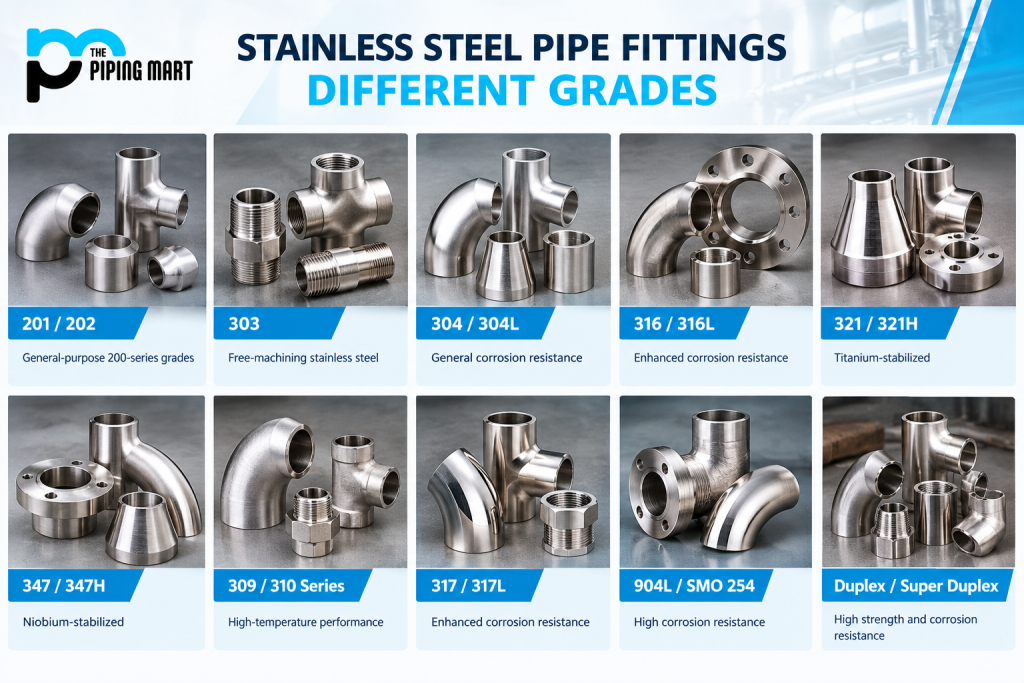
| Grade / Grade Family | Key Characteristic | Typical Service Focus |
| 201 / 202 | General-purpose 200-series grades | Moderate-duty applications |
| 303 | Free-machining stainless steel | Machining-focused applications |
| 304 / 304L | General corrosion resistance | General industrial and food applications |
| 316 / 316L | Enhanced corrosion resistance | Marine, chemical and process service |
| 321 / 321H | Titanium-stabilized | Elevated-temperature service |
| 347 / 347H | Niobium-stabilized | High-temperature service |
| 309 / 310 Series | High-temperature performance | Thermal and furnace applications |
| 317 / 317L | Enhanced corrosion resistance | Aggressive chemical environments |
| 904L / SMO 254 | High corrosion resistance | Severe corrosive environments |
| Duplex / Super Duplex | High strength and corrosion resistance | Demanding process and offshore service |
Why Are Different Stainless Steel Grades Used for Pipe Fittings?
No single stainless steel grade meets every piping requirement, because applications differ in corrosion resistance needed, chloride exposure, high-temperature performance, strength, weldability, and chemical resistance. Standard grades suit general service, while stabilized, high-temperature, precipitation-hardening, or high-alloy grades get selected for more demanding environments. Grade selection should follow actual service conditions rather than a default preference for a familiar grade.
How to Choose the Right Stainless Steel Pipe Fitting Grade
Start by identifying corrosion exposure: chemicals, chlorides, moisture, and other corrosive agents the fitting will face. Check operating temperature, since ambient-service and elevated-temperature grades aren’t interchangeable, and confirm pressure requirements against the fitting’s rating. Material compatibility matters too, between fittings, pipes, valves, and other components, alongside welding requirements tied to the grade and fabrication method. Application context- food, chemical, marine, power, or general industrial- often points toward a different grade, and applicable standards need confirming alongside testing and documentation such as MTCs.
Conclusion
Stainless steel pipe fittings come in several grades due to the wide range of corrosion exposure, temperature, pressure, and strength requirements in the pipeline environment. Selection depends on corrosion resistance, operating temperature and pressure, strength, production needs, and applicable standards. Stainless steel pipe fittings are best when they are best suited to the work, not when they are simply the most expensive or high-alloy material. The correct grade should be selected to suit actual service conditions.
FAQs
What is the most commonly used stainless steel grade for pipe fittings?
304 and 304L are the most widely used grades, valued for general corrosion resistance across food, water, and general industrial applications.
What is the difference between 304 and 316 stainless steel pipe fittings?
316 has molybdenum in it, which 304 does not. This makes it more resistant to chlorides and other corrosive situations.
Why are 304L and 316L used for welded stainless steel fittings?
The lower carbon content minimizes the likelihood of carbide sensitization and precipitation at grain boundaries during welding, and it also helps to improve corrosion resistance in the heat-affected zone surrounding the weld.
Which stainless steel pipe fitting grades are suitable for high-temperature applications?
Grades such as 309, 310, 321, 347, and 253MA are very commonly used in applications that require high temperature and oxidation resistance.
When should 904L or SMO 254 pipe fittings be considered?
These highly alloyed grades are ideal for harsh corrosive situations such as aggressive chemical processing or chloride-rich maritime service where ordinary grades will not perform.
How do I choose the right stainless steel grade for pipe fittings?
Selection should include all of the factors of corrosion exposure, operating temperature, pressure requirements, material compatibility, welding requirements, and the application and applicable standards.