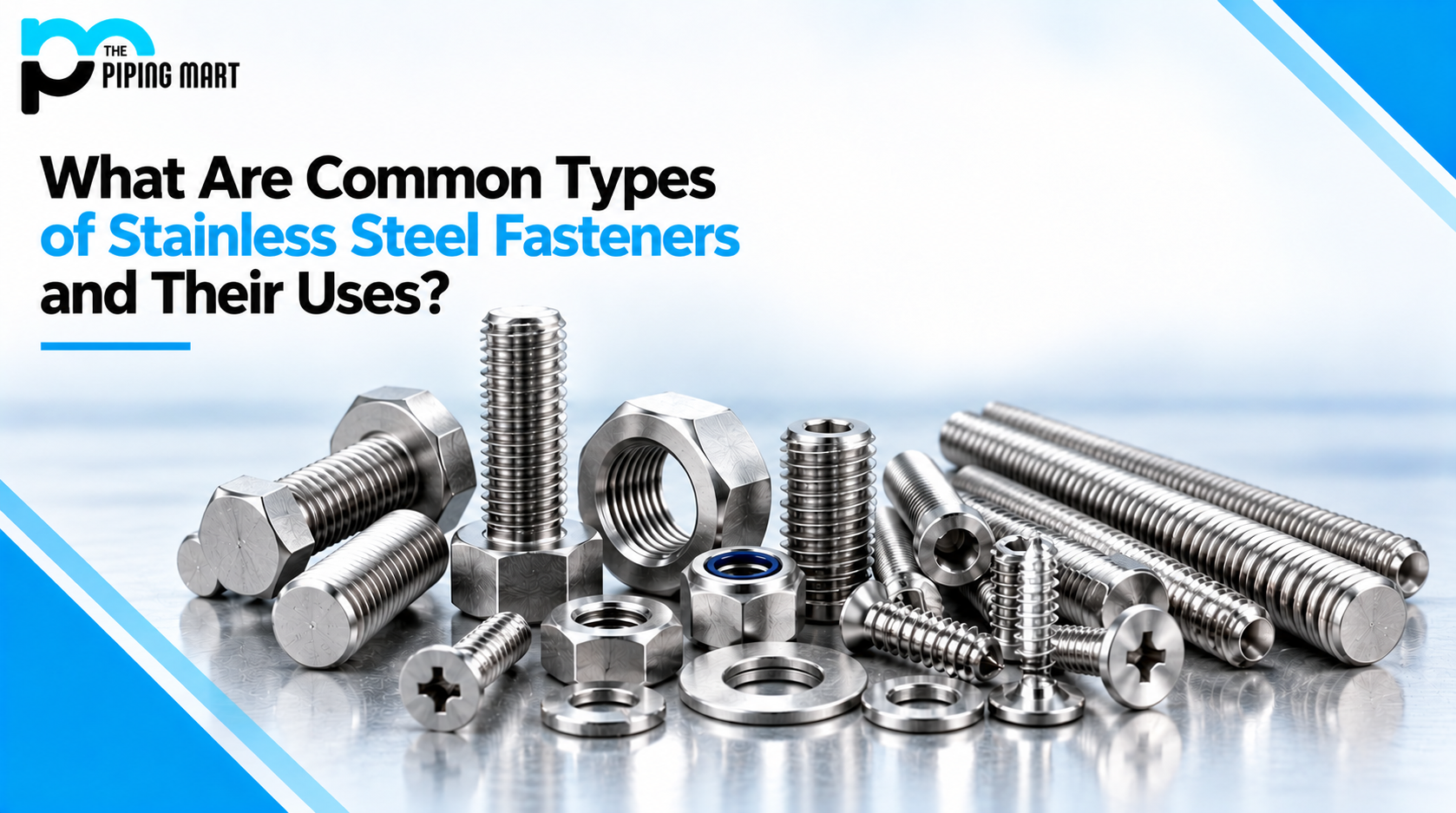
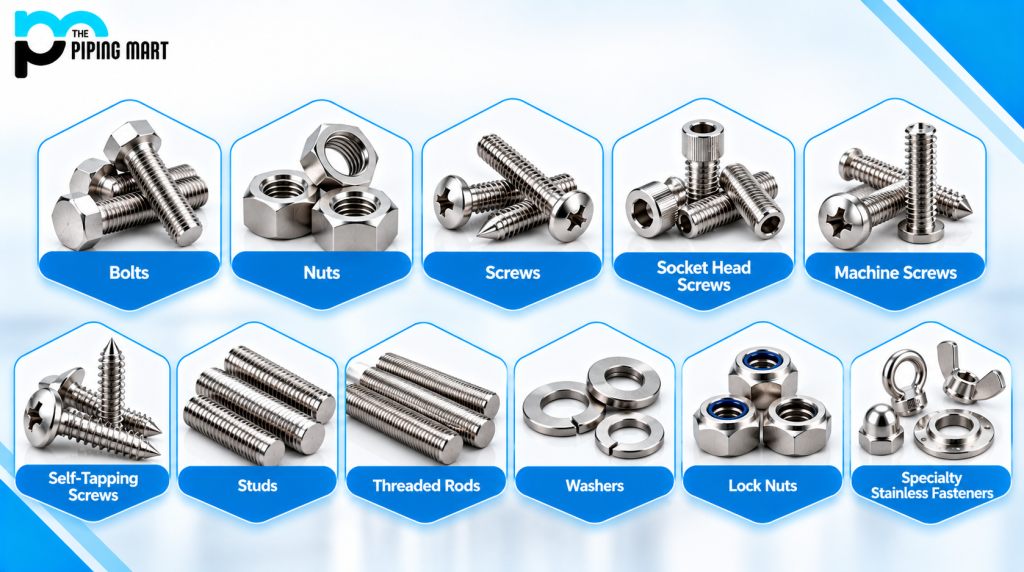
Stainless fasteners are mechanical components that join and secure the parts of an assembly, from a single equipment cover to a flanged pipeline with dozens of joints. Each design serves a specific joining method or installation requirement, and no single type fits every joint. This article covers eleven common types and the uses each one serves: bolts, nuts, screws, socket head screws, studs, threaded rods, washers, self-tapping screws, machine screws, lock nuts, and specialty fasteners. Five factors determine the appropriate type: joint design, load, installation method, access, and component configuration.
Understanding Stainless Fasteners
Stainless fasteners include threaded and unthreaded mechanical components that create removable or permanent connections between parts. Each design performs a distinct joining function, from supplying clamping force to spreading load across a surface, so the connection itself determines which design belongs in it.
Fasteners fall into three working groups. Bolts, screws, and studs supply the primary clamping force. Nuts and washers receive that load and distribute it across the joint. Self-tapping screws, lock nuts, and specialty designs meet specialized installation needs, such as forming a thread in sheet or resisting vibration.
Common Types of Stainless Fasteners
The table below gives a quick reference, and the sections after it explain each type.
| Fastener Type | Basic Function | Common Use |
| Bolts | Join components using a nut or threaded hole | Structural and mechanical assemblies |
| Nuts | Mate with threaded bolts or studs | Bolted connections |
| Screws | Fasten directly into a threaded or prepared material | Equipment and component assembly |
| Socket Head Screws | Provide compact internal drive fastening | Machinery and confined spaces |
| Machine Screws | Secure components into tapped holes | Machinery and equipment |
| Self-Tapping Screws | Form mating threads during installation | Sheet and light assembly work |
| Studs | Provide a fixed threaded connection | Flanges and process equipment |
| Threaded Rods | Provide continuous threaded fastening | Supports and structural installations |
| Washers | Distribute load and protect surfaces. | Bolted joints |
| Lock Nuts | Help prevent loosening. | Vibration-prone assemblies |
| Specialty Fasteners | Address specific joining requirements. | Specialized industrial assemblies |
Bolts
Bolts carry external threads and pair with a nut or a tapped hole. Hex bolts handle general work, while flange and eye bolts fill narrower roles. Structural assemblies, machinery, process piping, and maintenance repairs use them, with dimensions, loading, and thread configuration steering selection.
Nuts
A nut supplies the internal thread that completes a bolted joint and also mates with studs and threaded rods. Hex nuts handle standard clamping, while lock nuts, cap nuts, and flange nuts meet particular needs. Machinery, structural assemblies, and industrial joints rely on them.
Screws
Screws engage with a tapped or prepared hole, so the joint needs no nut. Machinery, equipment enclosures, fabricated components, and general assembly work require them. Head shape and drive type must match the available access.
Socket Head Screws
A compact cylindrical head and an internal hex drive define the socket head screw. A hex key turns it, so the head needs less clearance than a wrench demands. Machinery, precision equipment, tooling, and compact assemblies use it where space runs short.
Machine Screws
Machine screws thread into tapped holes or accept a matching nut. Equipment panels, machinery, electrical and mechanical assemblies, and fabricated components rely on them for secure, repeatable fastening.
Self-Tapping Screws
Self-tapping screws cut or form their own mating threads during installation. Sheet material and light equipment assemblies suit them best. Material thickness and screw design must match, because a mismatch strips the new thread or stalls the drive.
Studs
Studs are threaded rods with a configuration built for fixed threaded engagement. One end sits in a component while a nut tightens on the other, which suits joints needing repeated assembly and disassembly. Flanged connections, machinery, process equipment, and piping assemblies use them.
Threaded Rods
Continuous external threading runs the full length of a threaded rod. Supports, suspended installations, mechanical assemblies, and structural fastening arrangements use rods. Unlike a bolt, a rod has no head, so nuts at both ends create the clamp.
Washers
Washers spread the clamping force of a bolt and nut over a wider area and shield the mating surface during tightening. Flat washers cover standard joints, while spring and fender washers serve particular needs.
Lock Nuts
Lock nuts resist loosening where vibration works against a standard nut, so vibration-prone machinery and mechanical assemblies rely on them. Locking performance depends on the design and the installation conditions, since nylon insert and all-metal designs lock by different mechanisms.
Specialty Stainless Fasteners
Specialty fasteners cover designs for a particular application outside the standard bolt, screw, nut, and washer groups. Joint dimensions, installation needs, access, and service requirements decide whether a specialty design belongs.
Uses of Common Stainless Fastener Types
Fastener type follows function. The same joint calls for a different design depending on what it must hold, how often crews open it, and how much room they have to work.
Construction and Structural Assemblies
Bolts, nuts, and washers form the clamped connection in structural members, with washers protecting the surface under the nut. Studs and threaded rods suit equipment supports and anchored installations. Handrail posts, for example, bolt to base plates, and equipment frames bolt to supporting steel. Outdoor assemblies, façades, and fabricated structures draw on these five types, which together cover clamping, load spreading, and anchoring.
Machinery and Equipment
Screws, socket head screws, and machine screws hold covers, housings, and maintenance access components, and they allow repeated removal without damaging the tapped hole. Bolts and nuts join heavier machinery parts. Frequent access points favor screws, since a tapped hole survives repeated removal cycles. Specialty fasteners fill the gaps where a standard design cannot reach or fit.
Piping and Process Equipment
Flanged joints rely on bolts, nuts, studs, and washers working as a set. Studs suit joints that crews open for inspection, and washers protect flange faces during tightening. Fastener dimensions, material grade, pressure requirements, and applicable standards must match the joint specification, since a mismatch weakens the seal.
Outdoor, Marine and Corrosion Exposed Assemblies
Exposed assemblies reward careful fastener configuration. Hex bolts with flat washers spread load evenly on railings and fittings, lock nuts hold position despite wind and wave motion, and socket head screws keep the head profile low. Each of these designs still requires suitable material selection for the exposure.
Food, Pharmaceutical and Hygienic Equipment
Processing machinery, conveyors, tanks, and accessible mechanical joints in hygienic plants use machine screws, bolts, and lock nuts. Plain heads and smooth surfaces leave fewer places for residue to collect, which helps crews wash down tank covers and conveyor frames. Material selection for the application remains part of every specification.
Choosing the Right Stainless Fastener Type
Fastener type and fastener grade are separate selection decisions, and type comes first.
| Selection Factor | What to Consider |
| Joint Design | How the components connect |
| Load | Tensile, shear, vibration, and clamping requirements |
| Installation Access | Available tool and working space |
| Thread Requirement | Thread size, pitch, and configuration |
| Fastener Size | Diameter, length, and dimensional requirements |
| Material Being Joined | Compatibility with the fastener |
| Environment | Moisture, chemicals, outdoor or marine exposure |
| Removal Requirement | Whether the joint needs regular disassembly |
| Standard | Applicable dimensional or material specification |
Bolts and nuts suit joints with a through hole, while screws suit blind or tapped holes. Socket head screws work in restricted spaces. Studs help flanged or repeatedly serviced connections because the threaded end stays put while nuts come off. Washers spread load and lock nuts keep joints from backing off, so both serve as supporting components.
Conclusion
Stainless fasteners split into eleven designs with distinct jobs. Bolts, studs, and threaded rods clamp the joint. Nuts and lock nuts engage them, and washers spread the load. Screws in four forms, general, socket head, machine, and self-tapping, fasten into tapped holes or sheet, while specialty fasteners cover unusual requirements. Each type brings its own joining function and installation requirement. Final selection weighs load, dimensions, thread form, joint design, tool access, environment, and the governing standard.
FAQs
What are the common types of stainless fasteners?
Eleven types cover common joining work: bolts, nuts, screws, socket head screws, machine screws, self-tapping screws, studs, threaded rods, washers, lock nuts, and specialty fasteners.
How do I choose the right type of stainless fastener?
Start with how the parts connect, then check load, thread, size, working space, exposure, removal needs, and the applicable standard. A through-hole points to bolting with a nut, and a blind tapped hole points to a screw.
Are different stainless fastener types available in different grades?
Yes. Each type comes in more than one stainless grade, so grade selection runs as a separate step after the type decision.
What is the strongest type of fastener?
No single type holds that title, because strength comes from grade, property class, diameter, and load direction rather than design alone. A higher property class carries more load at the same size.