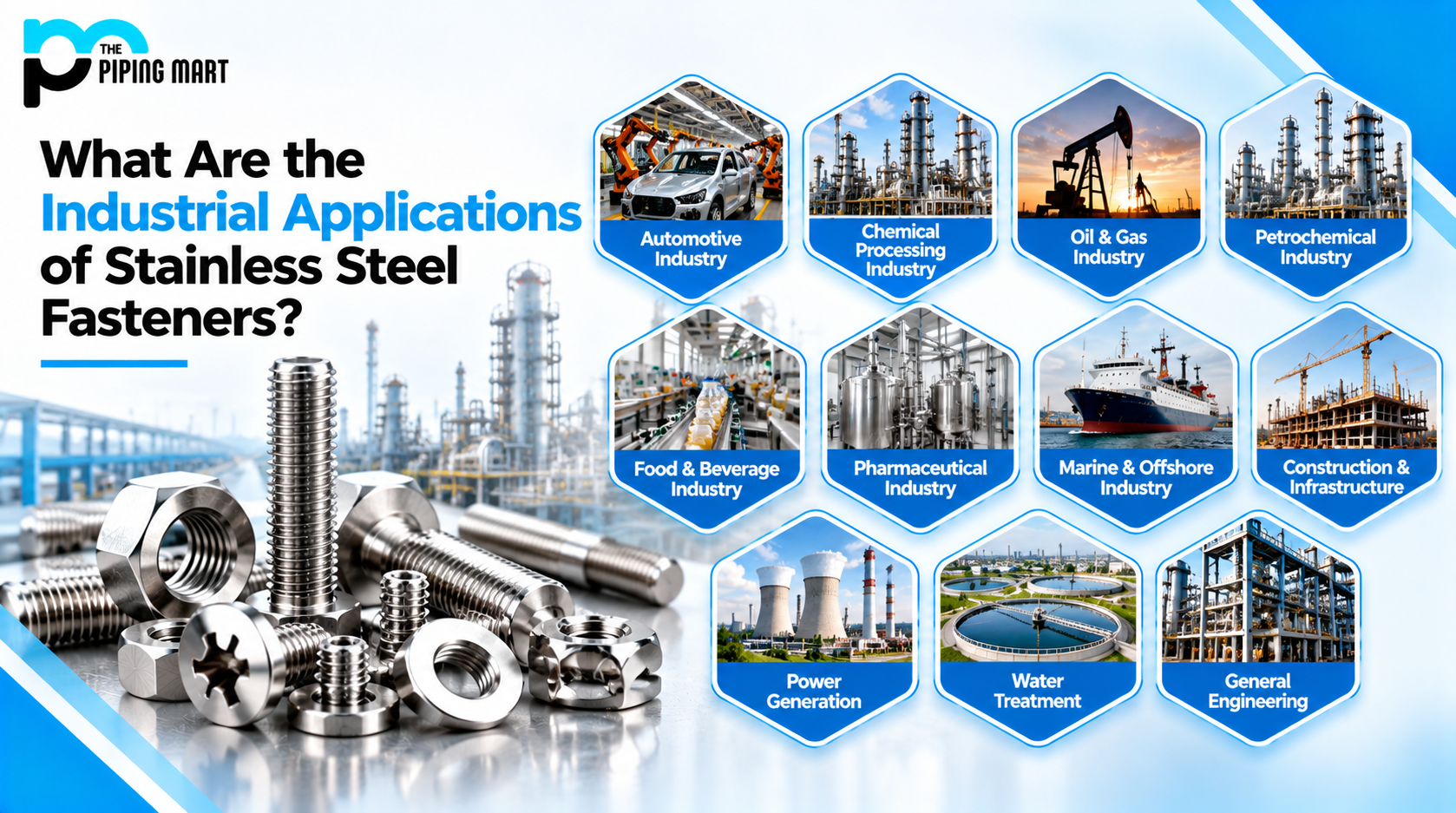
Every bolted joint in an industrial plant depends on a fastener that holds under load, vibration, and daily exposure. Stainless steel fasteners join the equipment, machinery, structures, piping systems, and fabricated components that keep those plants running. Their applications span automotive, chemical processing, oil & gas, petrochemical, food & beverage, pharmaceutical, marine & offshore, construction & infrastructure, power generation, water treatment, and general engineering. Each sector relies on mechanical connections that technicians can tighten, inspect, and replace without cutting or welding the surrounding equipment.
What Are Stainless Steel Fasteners?
Stainless steel fasteners are mechanical joining components that hold two or more parts together in an assembly. They include bolts, screws, nuts, washers, studs, and similar hardware that create bolted, threaded, clamped, and supporting connections in industrial equipment, piping, and structures.
Inside an industrial assembly, a fastener performs one of six jobs. It joins equipment components, secures machinery parts, connects piping and flanges, attaches supports and brackets, fixes panels and covers in place, or assembles structural components. Each task places a different demand on the joint, from steady clamping force on a pipe flange to repeated removal of a maintenance access cover.
Industrial Applications of Stainless Steel Fasteners
Across an industrial site an industrial site from the production floor to the perimeter, the same hardware appears wherever technicians assemble, service, or replace equipment. The sections below name each industry, the equipment on its floor, and the joints that hold it together.
Automotive Industry
A vehicle contains stainless steel fasteners in brackets, mounting components, and body and interior fittings. Engine and exhaust assemblies use them where the operating conditions suit the material. Behind the vehicle stands the plant that builds it. Production line machinery, fixtures, jigs, and fabricated assemblies depend on bolted joints that workers adjust at every changeover.
Chemical Processing Industry
Process piping, flanges, valves, and pumps dominate a chemical plant, and bolted joints connect every one of them. Fasteners also hold storage and process tanks, equipment covers, pipe supports, maintenance access components, and structural frames together. Selection here depends on the process environment, temperature, loading, chemical exposure, and the applicable specification for each joint.
Oil & Gas Industry
Trace a process line through an oil and gas installation and bolted joints mark every stage. Piping connections, valve bodies, flanges, and pumps depend on them, as do process equipment, equipment supports, skid-mounted units, and structural assemblies. Fasteners create removable joints, which let crews inspect, service, and replace equipment during maintenance and replacement work.
Petrochemical Industry
Process units form the core of a petrochemical site. Heat transfer equipment, pumps, valves, storage equipment, and piping systems all join through flanged connections, while equipment supports and maintenance assemblies add more bolted joints. Fastening requirements change with the equipment type and the operating environment around each process unit, so one site may need different joint designs side by side.
Food & Beverage Industry
Along a food processing line, stainless steel fasteners assemble processing machinery, conveyors, mixing equipment, tanks, hoppers, filling equipment, and the frames that carry them. Removable covers and panels need fasteners that crews can open for cleaning and close again after inspection. Equipment that needs regular cleaning, inspection, maintenance, and hygienic operation makes fastener selection a design decision.
Pharmaceutical Industry
Pharmaceutical manufacturing runs on cleanable equipment inside controlled production environments. Fasteners connect processing machinery, mixing and blending equipment, tanks, conveyors, and other production equipment, and they secure the equipment panels. Cleanable mechanical assemblies need fastening components that suit cleaning routines, maintenance access, and the controlled conditions of the production area. Inadequate fastener choice here affects cleanliness, not only mechanical strength.
Marine & Offshore Industry
Salt spray, humidity, and constant water contact define marine and offshore service. Deck equipment, marine machinery, piping systems, pumps, and valves rely on bolted connections, as do structural assemblies, brackets, supports, and offshore equipment. Maintenance access components add more joints that crews open and close in exposed conditions. Material and fastener selection must match these marine service conditions.
Construction & Infrastructure
Large structures shift the focus from process equipment to fabricated frameworks. Fasteners connect structural assemblies, equipment supports, handrails, facades, outdoor structures, and infrastructure components, and they anchor brackets and mounting systems for mechanical installations. Across all of these, fasteners join fabricated structural and architectural components into assemblies that hold under load and outdoor exposure.
Power Generation Industry
Pumps, valves, flanges, piping systems, and plant machinery inside a power generation facility connect through bolted joints. Equipment supports and mechanical assemblies add more joints, and maintenance access components let technicians reach machinery for servicing. Fastener selection must correspond to operating temperature, loading, environment, equipment design, and applicable specifications.
Water & Wastewater Treatment
Treatment installations move water through tanks, filtration equipment, pumps, valves, and piping, and fasteners join each stage of that path. Conveyors, equipment supports, walkways, and fabricated assemblies add further bolted connections along the same route. Moisture reaches equipment and assemblies throughout the installation, so fasteners must suit wet operating conditions.
General Engineering & Industrial Machinery
Beyond process industries, general engineering uses fasteners on manufacturing machinery, fabricated equipment, machine frames, equipment enclosures, and mechanical assemblies. Brackets, guards, covers, and maintenance components also rely on them. Joint design and equipment requirements decide the fastener configuration, so a bolted machine frame requires a different arrangement than a removable guard.
Why Are Stainless Steel Fasteners Used in Industrial Applications?
Resistance to moisture and environmental exposure suits washdown areas, marine decks, treatment basins, and outdoor structures. Durable mechanical connections keep joints tight under load. Equipment that needs frequent assembly and disassembly, such as hoppers, access covers, and guards, benefits from threaded joints that technicians can open and close again without damaging the surrounding parts. Hygienic equipment in food and pharmaceutical plants can use stainless steel fasteners when engineers choose the appropriate specification. Fastener forms exist for flanged, structural, and machinery joints, and correct selection keeps them compatible with the equipment and component materials they join. Long-term maintenance also shapes the decision, because durable joints reduce replacement work across the equipment service life.
Stainless steel does not suit every industrial environment automatically. Material grade and fastener specification must match service conditions, including temperature, chemical exposure, loading, and the materials they join.
How Are Stainless Steel Fasteners Selected for Industrial Applications?
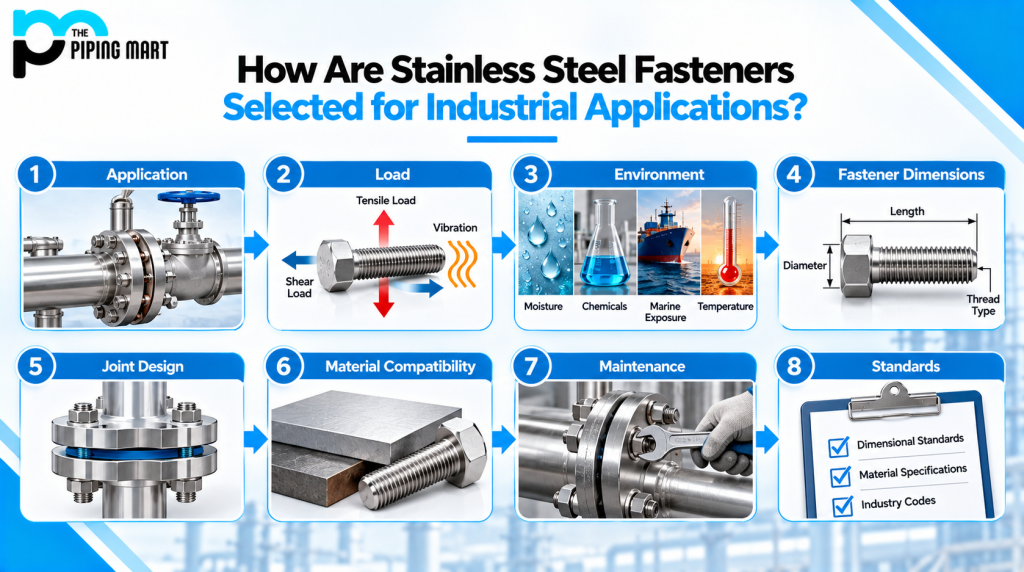
Selection starts with the industrial application, meaning the equipment and the components that must join in each assembly. Engineers then define the fastener design and, last, the material specification that fits the load, environment, and maintenance demands of that joint. The table below lists the seven factors that guide each decision.
| Selection Factor | Industrial Consideration |
| Application | What components need to be joined |
| Load | Tensile, shear, vibration, and clamping requirements |
| Environment | Moisture, chemicals, marine exposure and temperature |
| Fastener Dimensions | Diameter, length and thread requirements |
| Joint Design | Flanged, structural, equipment or component connection |
| Material Compatibility | Compatibility with joined materials |
| Maintenance | Frequency of inspection and disassembly |
| Standards | Applicable dimensional and material specifications |
Standards close the process by fixing dimensional and material requirements that suppliers and inspectors can verify, which keeps replacement fasteners consistent over the life of the equipment.
Industrial Applications at a Glance
Use this table as a quick check of where stainless steel fasteners work in each sector, then return to the sections above for equipment-level detail on each joint, from piping flanges to machine frames.
| Industry | Stainless Steel Fastener Primary Applications |
| Automotive | Components, machinery and production equipment |
| Chemical | Piping, tanks, valves and process equipment |
| Oil & Gas | Flanges, piping, valves and equipment |
| Food & Beverage | Processing machinery and conveyors |
| Pharmaceutical | Processing and cleanable equipment |
| Marine | Machinery, piping and exposed assemblies |
| Construction | Structural and outdoor assemblies |
| Power Generation | Plant equipment, piping and supports |
| Water Treatment | Tanks, piping, pumps and treatment equipment |
| General Engineering | Machinery and fabricated equipment |
Conclusion
Stainless steel fasteners run through industrial equipment, machinery, piping, structural assemblies, and process installations. In every sector, the chain stays the same: the industry sets the equipment, the equipment sets the joint, and the joint sets the fastener application. Chemical processing, oil & gas, petrochemical, automotive, food & beverage, pharmaceutical, marine, construction, power, water treatment, and general engineering form the major application areas. Correct selection depends on the specific operating environment, joint design, loading, dimensions, material compatibility, and applicable standards for each installation.
FAQs
What are the common applications of stainless steel fasteners?
Stainless steel fasteners join process piping, flanges, valves, pumps, tanks, machine frames, and structural assemblies. They serve 11 sectors, from automotive production lines to offshore platforms.
What are 5 characteristics of stainless steel fasteners?
Five characteristics stand out: moisture resistance, mechanical durability, outdoor suitability, cleanable surfaces, and compatibility with removable joints. Each depends on matching the specification to service conditions.
What are the different types of stainless steel fasteners?
The main types are bolts, nuts, washers, screws, studs, and threaded rods. Bolts with nuts clamp flanges, screws secure covers, and washers spread load.
Which stainless steel fastener is commonly used across industries?
Hex head bolts with nuts and washers appear in flanged connections, equipment frames, and structural joints across all 11 sectors. Technicians tighten and remove them with common tools.