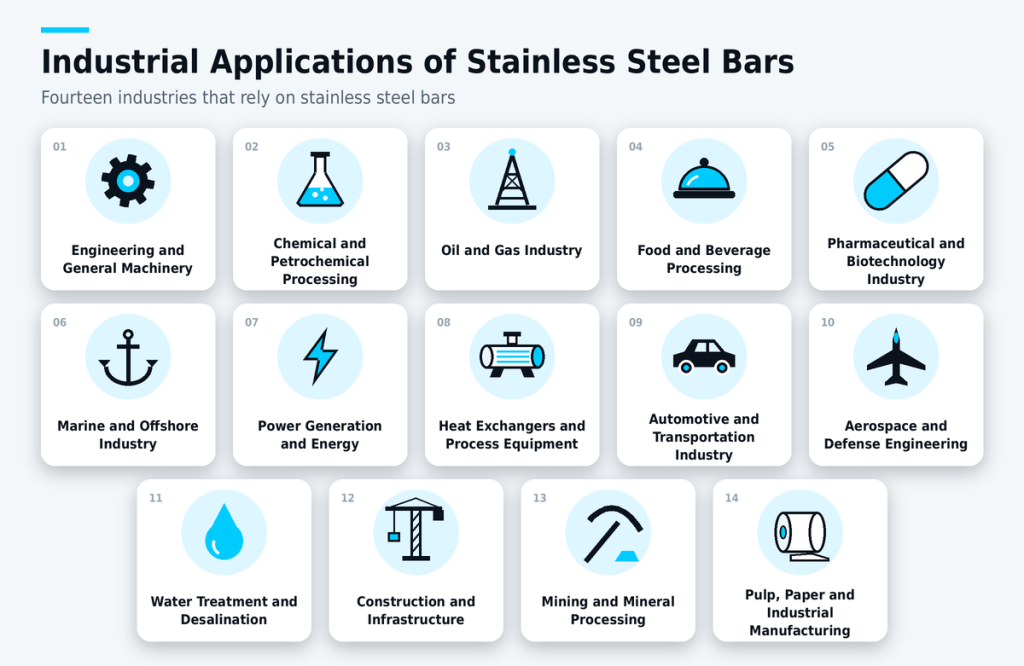
Stainless steel bars supply the solid raw material for shafts, fasteners, valve components, brackets, and structural hardware in fourteen industrial sectors. Manufacturers machine, weld, and fabricate them into parts that support, connect, and reinforce equipment. Dozens of grades, shapes, sizes, finishes, and mechanical properties drive that reach. Each sector weighs corrosion exposure, temperature, strength, wear, hygiene, machinability, and fabrication needs differently. This article covers engineering, chemical processing, oil and gas, food and beverage, pharmaceuticals, marine, power generation, automotive, aerospace, construction, water treatment, and energy. No single grade suits every job, so both the grade and the bar form must match the actual service conditions.
Introduction to Stainless Steel Bars
Stainless steel bars are solid sections of corrosion-resistant steel that manufacturers supply as raw material or finished components. Equipment, machinery, shafts, fasteners, valves, structures, and fabricated parts all begin as bar stock, which gives engineers a dimensionally controlled starting point.
Round bar suits turned shafts, hexagonal bar suits nuts and fittings, and forged bar suits heavily loaded parts. Flat, square, and bright bars cover brackets, keys, and tight tolerance machined work. These characteristics shape the industry uses covered below.
Industrial Applications of Stainless Steel Bars
Engineering and General Machinery
Shafts, pins, axles, bushes, spacers, rollers, and fasteners start as bar stock and finish on CNC lathes and machining centers. Moisture, friction, loading, and repeated operation test each one. Machinability, strength, hardness, dimensional accuracy, and corrosion resistance drive grade choice. Grade 303 cuts freely from added sulfur, but that sulfur lowers corrosion resistance and weldability, so it suits selected parts only.
Chemical and Petrochemical Processing
Pumps, valves, shafts, fasteners, and fabricated machinery parts in fluid handling systems face chemical attack, localized corrosion, and process heat. Engineers choose among 316/316L, 317/317L, 904L, and higher alloy grades according to the chemical environment. Chemical compatibility needs checking against the actual process medium, concentration, temperature, and exposure conditions.
Oil and Gas Industry
Upstream, midstream, and downstream facilities specify bars for valves, shafts, fasteners, machined components, equipment parts, and selected structural or fabricated items. Moisture, process fluids, pressure, and temperature act together on these parts. Corrosion resistance, mechanical strength, temperature capability, and material compatibility guide each grade decision, because stainless steel does not fit every oil and gas service.
Food and Beverage Processing
In dairy, beverage, brewing, food processing, and packaging plants, bar stock becomes machinery shafts, fasteners, mixing equipment parts, and supports. Corrosion resistance, cleanability, hygiene, and surface condition decide suitability. Grades 304/304L suit general food contact, while 316/316L handles chloride-bearing cleaning agents and brines. Designers check hygienic requirements and applicable food processing standards.
Pharmaceutical and Biotechnology Industry
Manufacturing equipment, shafts, mechanical components, fasteners, supports, and clean utility equipment demand corrosion resistance, cleanability, controlled surface condition, and contamination control. Grade 316L serves process equipment, purified water systems, and clean utilities where its characteristics meet the service conditions. Other grades qualify too, so no grade becomes mandatory.
Marine and Offshore Industry
Salt-laden air, moisture, and seawater contact challenge shafts, fasteners, pumps, valves, brackets, and marine machinery. Chloride-induced corrosion, pitting, and crevice corrosion shorten service life. Grade 316/316L handles general marine atmospheres and splash exposure. Severe or continuous seawater immersion calls for higher alloy grades such as 904L or SMO 254.
Power Generation and Energy
Turbine components, shafts, fasteners, valve components, and auxiliary machinery in thermal, renewable, and nuclear support equipment rely on bar stock. Temperature, pressure, water chemistry, oxidation, and mechanical loading shape each choice. Heat-resistant options include 309, 310, 321, 347, and 253MA, yet none substitutes for another because each resists oxidation, creep, or carbide precipitation differently.
Heat Exchangers and Process Equipment
Shafts, support components, fasteners, machined parts, and equipment interfaces sit around heat exchangers, vessels, pumps, valves, and processing equipment. Temperature resistance, corrosion resistance, mechanical strength, and dimensional stability matter here. Specialized grades serve elevated temperature duty where required. Tubes and sheets fall outside this scope, so the focus stays on bar-based components.
Automotive and Transportation Industry
Where heat, vibration, moisture, and loading coincide, shafts, pins, fasteners, exhaust-related parts, and selected engine or transmission components call for stainless bars. Machinability protects tolerances on precision parts. Ferritic grades such as 430 and 444 suit exhaust areas, martensitic grade 410 suits hardened parts, and austenitic or specialty grades fill other roles. Use stays limited to selected components.
Aerospace and Defense Engineering
Landing system components, high-strength shafts, fasteners, structural hardware, and precision machined parts need specialized stainless steel. Strength-to-weight ratio, corrosion resistance, fatigue performance, dimensional stability, and reliability matter most. Precipitation hardening grades including 13-8 PH, 15-5 PH, 17-4 PH, 17-7 PH, and 455 serve suitable applications, and 17-4 PH in the H900 condition exceeds 1,100 MPa yield strength. Aerospace buyers require exact material specifications and certification.
Water Treatment and Desalination
Pump shafts, valve components, fasteners, structural supports, and filtration system parts operate in treatment plants, wastewater facilities, and desalination systems. Moisture resistance matters everywhere, and chloride resistance matters in certain services. Freshwater duty accepts 304, wastewater and brackish water push toward 316, and seawater calls for 904L, SMO 254, or similar alloys.
Construction and Infrastructure
Structural supports, brackets, frames, anchors, fasteners, handrails, and exposed mechanical components appear in industrial buildings, infrastructure projects, commercial facilities, and specialized construction. Durability, corrosion resistance, appearance, and low maintenance matter most in exposed positions. Environmental exposure and required structural performance determine both the grade and the bar form.
Mining and Mineral Processing
Shafts, pins, fasteners, brackets, and wear-related machinery parts in mineral processing plants encounter moisture, abrasive material, chemicals, and heavy loads. Grade selection balances corrosion resistance, hardness, wear resistance, and strength. Severely abrasive duty does not automatically justify stainless steel, because a dedicated wear material may outperform it. Service conditions decide suitability.
Pulp, Paper and Industrial Manufacturing
In continuous operation, machine shafts, rollers, fasteners, brackets, and fabricated parts withstand moisture, chemicals, and heat inside processing machinery. Corrosion resistance and mechanical durability protect continuous operation. Austenitic grades such as 304 and 316, or specialty grades, suit these lines according to process chemistry and temperature.
How Stainless Steel Bar Selection Changes by Industrial Application
| Industry | Important Service Considerations | Stainless Steel Bar Selection Focus |
| Engineering & Machinery | Machining, mechanical loading, wear | Strength, hardness, machinability |
| Chemical Processing | Chemicals, corrosion, temperature | Corrosion resistance and chemical compatibility |
| Oil & Gas | Pressure, temperature, fluids, corrosion | Strength, corrosion resistance and service compatibility |
| Food & Beverage | Hygiene, moisture, cleaning | Corrosion resistance, cleanability and surface condition |
| Pharmaceutical | Cleanliness, corrosion, contamination control | Corrosion resistance and suitable surface condition |
| Marine & Offshore | Chlorides, seawater, moisture | Pitting and crevice corrosion resistance |
| Power Generation | Heat, pressure, water chemistry | Temperature capability, strength and corrosion resistance |
| Automotive | Heat, vibration, machining | Strength, fatigue performance and machinability |
| Aerospace | Strength, fatigue, certification | High strength and controlled material specifications |
| Water Treatment | Moisture, chemicals, chlorides | Corrosion resistance and grade compatibility |
| Mining | Abrasion, chemicals, mechanical loads | Strength, hardness, wear and corrosion resistance |
| Construction | Outdoor exposure, structural loads | Durability, corrosion resistance and dimensions |
Application sets the required characteristics, while engineers confirm the grade against the operating environment and applicable specification.
Stainless Steel Bar Grades Used in Industrial Applications
| Grade / Grade Family | Industrial Application Considerations |
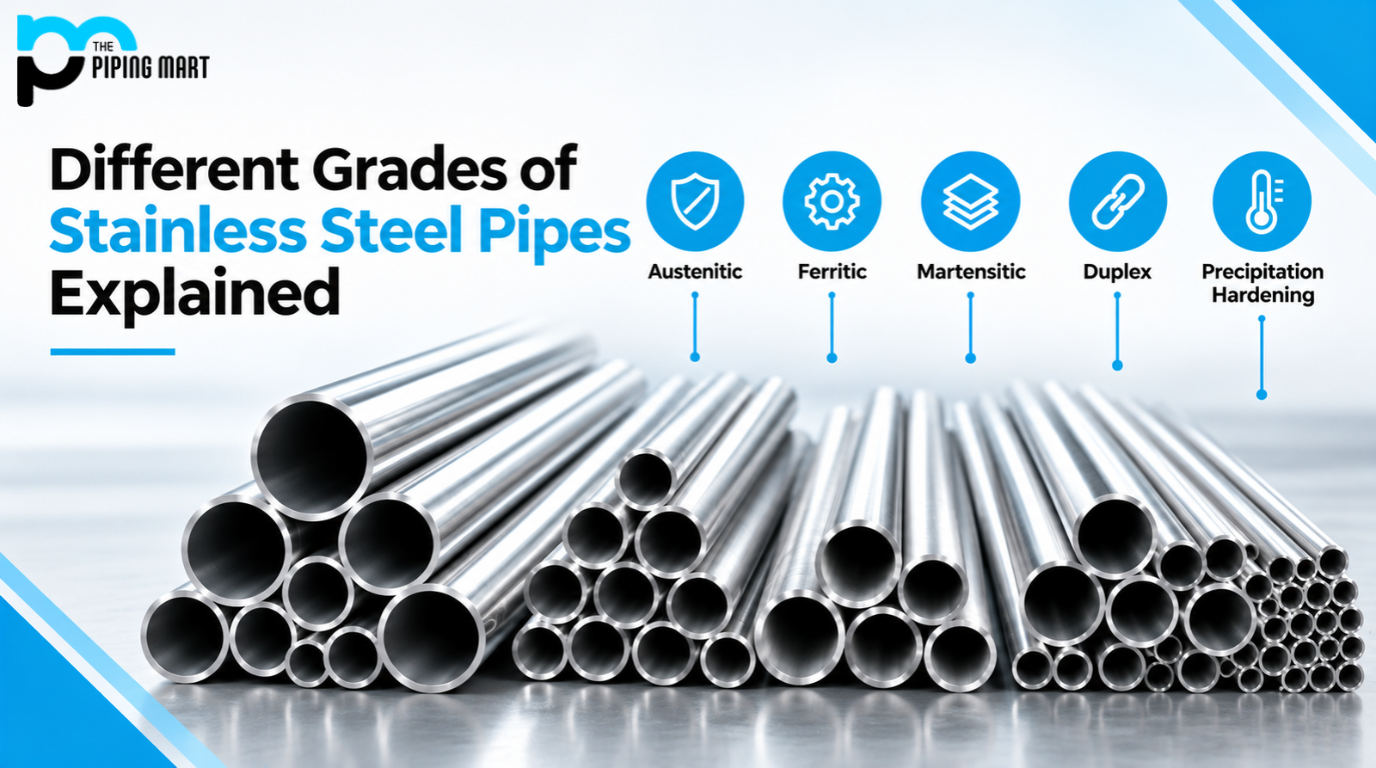
| 304 / 304L | General industrial equipment, food processing, machinery and fabrication |
| 316 / 316L | Marine, chemical, pharmaceutical and chloride-exposed environments |
| 303 | Machined components needing enhanced machinability |
| 321 / 321H | Elevated temperature components |
| 347 / 347H / 348 / 348H | High temperature thermal service |
| 309 / 310 Series | High-temperature oxidation-resistant service |
| 317 / 317L | More demanding chemical environments |
| 904L / SMO 254 | Severe corrosion where their resistance matters |
| 410 / 431 / 440 Series | High strength, hardened or wear-related mechanical components |
| 17-4 PH / 15-5 PH / 13-8 PH / 17-7 PH / 455 | High strength and specialized engineering applications |
| 430 / 439 / 444 | Selected industrial, automotive, architectural and equipment applications |
| 253MA / 422 / other heat resistant grades | Specialized elevated temperature applications |
Why Stainless Steel Bars Are Used Across Industries
Engineers weigh eight practical factors before they specify a stainless steel bar.
- Corrosion exposure: chemicals, chlorides, moisture, seawater, acids, alkalis, and other corrosive media.
- Temperature: ambient, elevated, or cycling service conditions.
- Mechanical loading: tensile load, impact, fatigue, hardness, wear, and deformation.
- Machining requirements: machinability that suits precision components.
- Fabrication method: welding, forging, forming, heat treatment, or machining.
- Bar form and dimensions: round, flat, square, or hexagonal, matched to component design.
- Hygiene requirements: food, pharmaceutical, and biotechnology applications.
- Applicable standards: material, dimensional, testing, certification, and traceability requirements.
Industrial application alone does not fix the grade, because actual service conditions decide it.
Conclusion
Stainless steel bars serve engineering, chemical processing, oil and gas, food, pharmaceuticals, marine, power, automotive, aerospace, water treatment, mining, construction, and manufacturing. Each sector asks for a different mix of corrosion resistance, strength, hardness, machinability, temperature performance, and hygiene. Components last in service when grade and bar form match actual service conditions. Bar form matters as much as grade in component design. Confirming that choice against the applicable specification completes the selection.
FAQs About Industrial Applications of Stainless Steel Bars
Are stainless steel bars used in the oil and gas industry?
Yes. Oil and gas facilities machine them into valves, shafts, fasteners, and equipment parts.
Why are stainless steel bars suitable for food and beverage equipment?
Corrosion resistance, easy cleaning, and a hygienic surface make 304/304L and 316/316L workable choices.
Which grade of stainless steel bars are used in marine applications?
316/316L suits coastal air and splash zones, while 904L or SMO 254 handles severe seawater.
Are stainless steel bars suitable for high-temperature industrial applications?
High-temperature duty calls for 321, 347, 309, 310, or 253MA, each within its own limits.
Are stainless steel bars used in pharmaceutical manufacturing?
Process equipment, clean utilities, and purified water systems use them, with 316L fitting those service conditions.
Are stainless steel bars used in aerospace and automotive applications?
Aerospace specifies precipitation-hardening grades such as 17-4 PH, while automotive uses ferritic, martensitic, or austenitic bars.