What Are Stainless Steel Tube Fittings?
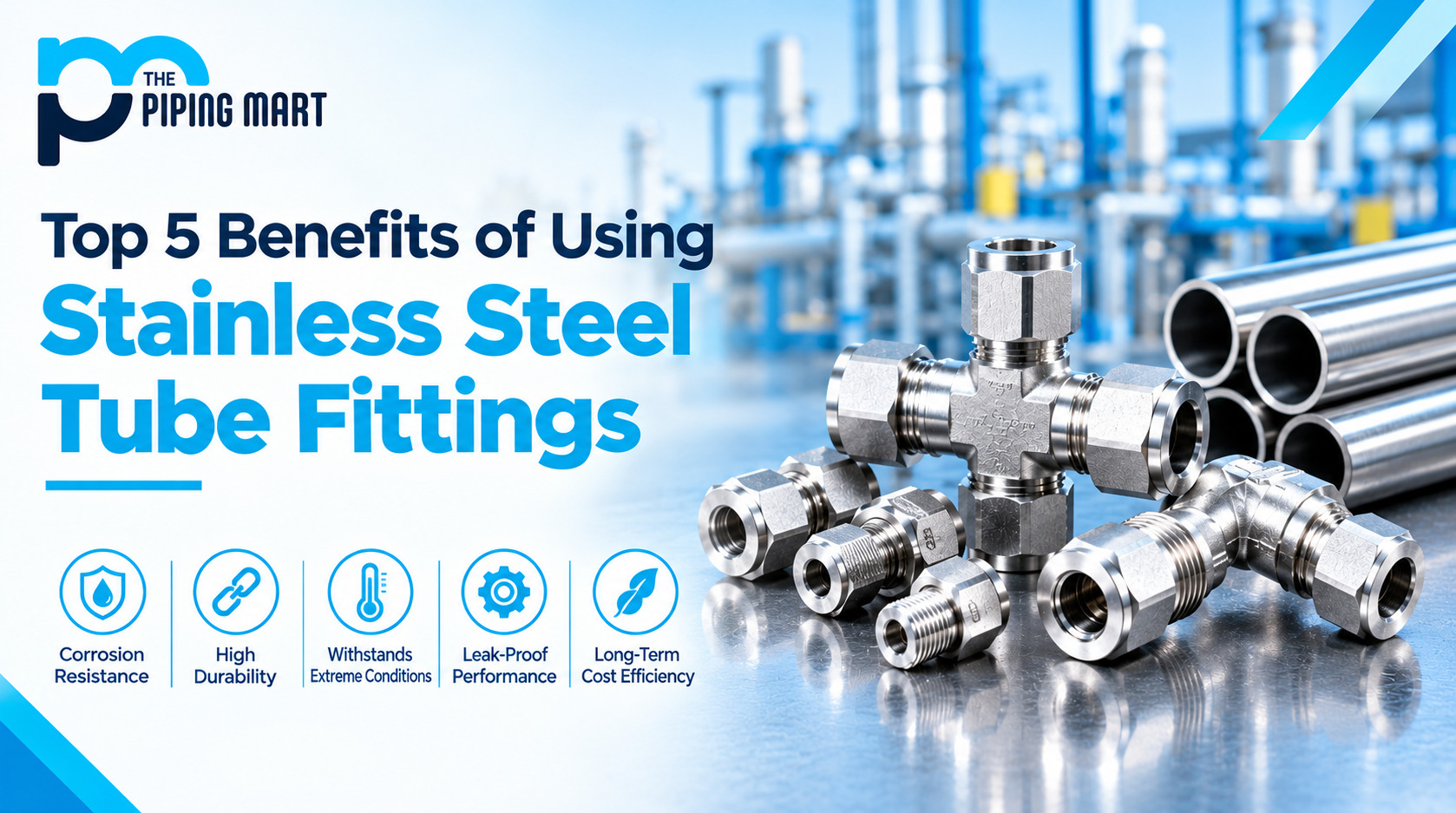
Stainless steel tube fittings are used to join, redirect, and control stainless steel tubing in fluid, gas, and instrumentation systems. They secure the tube in position and seal the connection under operating pressure. Buyers choose the right grade based on corrosion resistance, operating temperature, pressure, and service conditions. A mismatch between grade and environment reduces service life. So both the fitting and the tubing need the right grade before purchase or installation.
What Are the Common Grades of Stainless Steel Tube Fittings?
Nine austenitic grades cover the common tube fitting requirements, from general-purpose types to high-alloy and heat-resistant steels. Each one suits a particular mix of environment and temperature.
Stainless Steel 304 Tube Fittings
SS 304 is a widely used austenitic grade with about 18% chromium and 8% nickel. It has good general corrosion resistance, decent strength, and is easy to fabricate. In most cases, 304 tube fittings are used in standard industrial applications such as water, air, and mild process lines, where specialised corrosion resistance is not required.
Stainless Steel 304L Tube Fittings
SS 304L has a maximum carbon content of 0.03%, against 0.08% in standard 304. The lower carbon limits chromium carbide formation in the heat-affected zone when the material is welded. Because of this, 304L tube fittings are a good fit for welded tube and fitting systems, especially where post-weld heat treatment is not practical.
Stainless Steel 316 Tube Fittings
SS 316 has 2% to 3% molybdenum added to the 304 base. This improves resistance to pitting and crevice corrosion, mainly in chloride environments. That is why it is the usual step up from 304. 316 tube fittings are used for chemical processing, marine systems, and process equipment, where more demanding corrosive conditions rule out 304.
Stainless Steel 316L Tube Fittings
SS 316L has the same molybdenum content as 316, but it limits carbon to 0.03% maximum. This reduces carbide precipitation at weld joints, so welded assemblies keep their corrosion resistance. 316L tube fittings are used in pharmaceutical, chemical, marine and process systems. Weld quality and clean, corrosion-resistant surfaces matter in these applications.
Stainless Steel 321 Tube Fittings
SS 321 is stabilised with titanium. The titanium bonds with carbon before chromium carbides form at the grain boundaries, so the steel resists sensitisation when it runs at elevated temperatures. 321 tube fittings are used where there is regular heat exposure, for example, process lines that go through repeated temperature cycles.
Stainless Steel 347 Tube Fittings
SS 347 is stabilised with niobium instead of titanium. Niobium forms stable carbides with the carbon in the steel, which stops chromium depletion at the grain boundaries. This makes 347 suitable for elevated temperature service. 347 tube fittings are used in chemical processing, power generation, and other high-temperature systems.
Stainless Steel 310 / 310H Tube Fittings
The 310 family has high chromium and nickel, roughly 25% and 20%. This helps it maintain strength and oxidation resistance at high temperatures, so it is used in heat-resistant applications such as furnaces and thermal process systems. 310 is the general grade, while 310H has a higher carbon range and is meant for sustained high-temperature loading.
Stainless Steel 904L Tube Fittings
SS 904L is a high-alloy austenitic grade, with about 25% nickel, 4% to 5% molybdenum, and some added copper. Because of this composition, it resists acidic and chloride-bearing media better than 316L. 904L tube fittings are used with aggressive chemicals and in demanding process conditions, including sulphuric acid service.
Stainless Steel 317L Tube Fittings
SS 317L has 3% to 4% molybdenum, compared with 2% to 3% in 316L. That gives better resistance to pitting and to certain chemical media. The carbon limit is 0.03%, which helps with welding. 317L tube fittings are used in chemical processing and other demanding applications where 316L reaches its limit.
Stainless Steel Tube Fittings Grades Comparison
The table below lists the key characteristics and common applications of each grade. It gives buyers a quick reference when shortlisting stainless steel tube fittings for a system or process.
| Grade | Key Characteristic | Common Applications |
| SS 304 | General corrosion resistance | General industrial and process systems |
| SS 304L | Low carbon, suitable for welding | Welded tube systems |
| SS 316 | Higher corrosion resistance | Chemical, marine, and process systems |
| SS 316L | Low carbon with strong corrosion resistance | Pharmaceutical, chemical, marine |
| SS 321 | Titanium stabilised | Elevated temperature applications |
| SS 347 | Niobium stabilised | High-temperature and process systems |
| SS 310/310H | High-temperature performance | Heat-intensive applications |
| SS 904L | High corrosion resistance | Aggressive chemical environments |
| SS 317L | Enhanced corrosion resistance | Chemical processing |
How Do You Choose the Right Grade of Stainless Steel Tube Fitting?
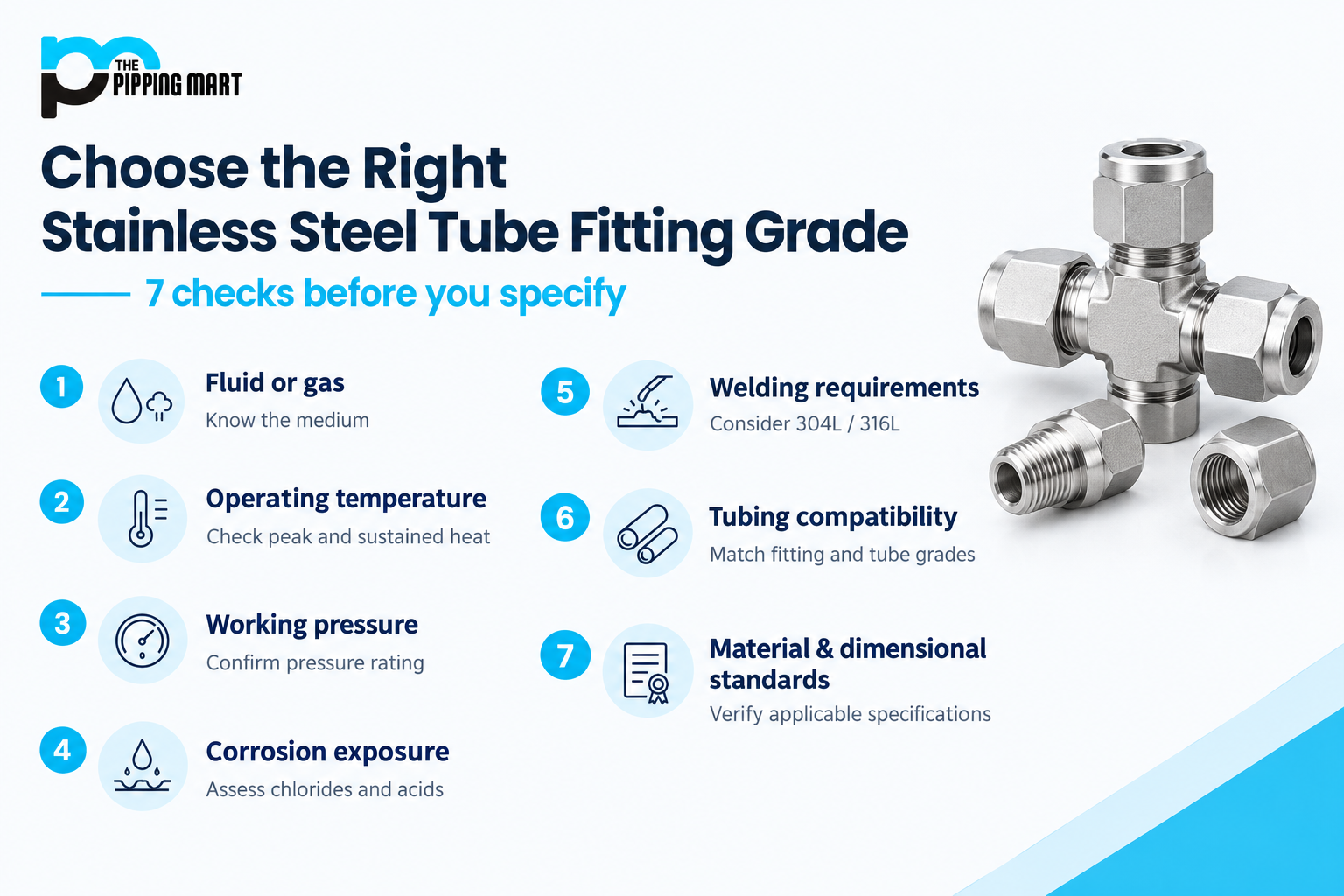
Seven checks help narrow down the grade and avoid replacements later. Engineers and procurement teams can use them to specify fittings against the operating conditions.
- Consider the type and concentration of the fluid or gas, since each medium affects stainless steel differently.
- Check the operating temperature, including peak and sustained levels, because heat affects both strength and sensitisation.
- Determine the working pressure and confirm that the fitting and tubing meet the required rating.
- Evaluate the level of corrosion exposure, especially to chlorides, acids, and marine atmospheres.
- Consider whether the fittings will be welded, as low-carbon grades such as 304L and 316L suit this better.
- Check compatibility between the fitting grade and the stainless steel tubing to avoid mixed-material problems.
- Verify the applicable material and dimensional specifications before placing an order.
Why Is Grade Selection Important for Stainless Steel Tube Fittings?
Grade selection decides how a fitting performs over its service life. A wrong grade can weaken corrosion resistance, cause pitting or cracking at the joint, and shorten the life of the whole tubing system. The material has to match the operating environment; otherwise, joints can fail early, and shutdowns become unplanned. Standard 304 or 316 does not cover every case. High-temperature service needs stabilised grades such as 321 and 347, and severely corrosive media need 317L or 904L, which have more molybdenum and alloying content.
Conclusion
Nine grades make up the common range of stainless steel tube fittings. Grades 304 and 304L are used for general and welded applications, 316 and 316L for higher corrosion resistance, and 321, 347, 310/310H, 317L and 904L for more specialised service conditions. The final choice depends on the actual temperature, pressure, corrosion exposure, fluid media and installation requirements.
Frequently Asked Questions
What Is the Most Common Grade of Stainless Steel Tube Fittings?
SS 304 is the most common grade. It is used for its general corrosion resistance, strength, and ease of fabrication. The Piping Mart lists suppliers and manufacturers offering 304 fittings for standard industrial systems.
What Is the Difference Between 304 and 316 Stainless Steel Tube Fittings?
316 contains 2% to 3% molybdenum, which gives it better resistance to chlorides and chemicals. 304 has no molybdenum, so it suits general service, while 316 is used in marine and chemical environments.
Which Stainless Steel Tube Fitting Grade Is Suitable for High-Temperature Applications?
Grades 321, 347, 310, and 310H are used for high-temperature applications. 321 and 347 resist sensitisation through titanium and niobium stabilisation, respectively, while 310 and 310H suit the most heat-intensive service conditions.